
The best stereo microscopes make detailed work easier by providing depth perception, comfortable viewing, and a larger working area than compound microscopes. This roundup includes binocular and trinocular models for electronics repair, jewelry, dissection, crafts, inspection, and documentation.
We selected options across fixed and zoom magnification ranges, stand styles, illumination setups, and camera-ready configurations so you can match the microscope to your workspace, budget, and typical projects.
Best 10 Stereo Microscopes Picks for 2026
Versatile Inspection Choice
AmScope SE306R-PZ Binocular Stereo Microscope

- 20X, 40X, and 80X magnification settings
- Dual incident and transmitted illumination
- Metal pillar stand with five-year warranty
Best For: General inspection, electronics, and hobby bench work
Digital Workstation Pick
AmScope SM-3T-54S-5M Trinocular Zoom

- 5MP camera with USB 2.0 output
- Continuous 7X–45X zoom range
- 54-bulb adjustable LED ring light
Best For: Circuit boards, documentation, and shared digital viewing
Flexible LED Viewing
Swift S306S-20-2L Binocular Stereo Microscope

- 20X, 40X, and 80X magnification
- Dimmable upper and lower LED lights
- Rotating head and reversible stage plate
Best For: Repair, crafts, collecting, and detailed solid-object viewing
Long-Reach Zoom Stand
AmScope SM-3T Trinocular Stereo Microscope

- Continuous 7X–45X zoom range
- Long-working-distance boom stand
- 360-degree rotatable trinocular head
Best For: Large-item inspection and hands-on bench work
Reliable Bench Work
AmScope SE306R-P20 Stereo Microscope

- 40X and 80X stereo magnification
- Widefield optical glass lenses
- Top and bottom illumination
Best For: Routine inspection and hobby bench work
Versatile Professional Zoom
SWIFT Trinocular Stereo Microscope
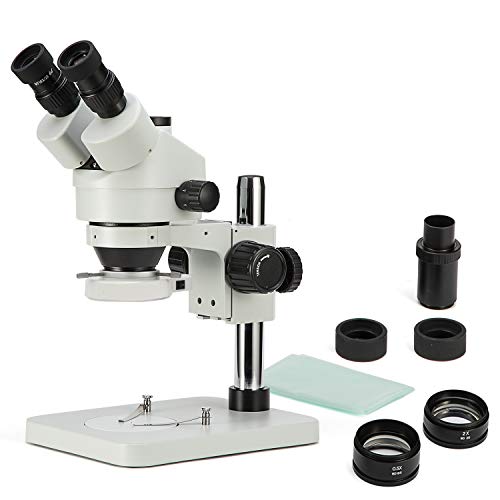
- 3.5X-to-90X magnification range
- 56-bulb LED ring light included
- Vertical trinocular camera port
Best For: Professional inspection and specimen documentation
Compact Student Pick
AmScope SE304R-PZ Stereo Microscope

- 20X, 40X, and 80X settings
- Compact design for small workspaces
- Height-adjustable pillar stand
Best For: Students and hobbyists with limited bench space
Best High-Magnification Pick
Professional Trinocular Stereo Zoom Microscope

- 3.5X–90X range with two auxiliary lenses
- Camera-ready trinocular viewing head
- Heavy-duty boom stand and adjustable ring light
Best For: Advanced inspection and high-magnification work
Best Lighting Flexibility
Swift S7 Trinocular Stereo Microscope

- 7X–45X zoom with a 4-inch working distance
- Gooseneck and transmitted LED illumination
- Metal pillar stand with ergonomic rotating head
Best For: Workshop inspection and flexible specimen lighting
Best Compact Ring-Light Option
ZTEEERS 6X–45X Trinocular Microscope

- 6X–45X continuous zoom magnification
- 56-bulb LED ring light for uniform illumination
- Trinocular head with included 0.5X CTV adapter
Best For: General bench inspection and documentation
Versatile Inspection Choice – AmScope SE306R-PZ Binocular Stereo Microscope
For buyers comparing stereo microscopes for routine inspection, repair, or hobby work, the AmScope SE306R-PZ offers straightforward binocular viewing with selectable 20X, 40X, and 80X magnification. Its metal pillar stand and dual illumination make it adaptable for both solid objects and specimens viewed through a stage.
Best For: Electronics work, hobby inspection, dissection, and general bench-top viewing.
Pros:
- Three practical magnification settings from 20X to 80X.
- Widefield optical glass lenses with 10X and 20X eyepieces.
- Built-in incident and transmitted lighting supports different specimen types.
- Sturdy all-metal pillar stand and a five-year manufacturer warranty.
Cons:
- Uses a fixed-magnification setup rather than continuous zoom.
- Halogen lighting may be less convenient than LED illumination.
This is a practical option if you want dependable binocular stereo magnification and both top and bottom lighting without adding a camera or more advanced stand system.
Digital Workstation Pick – AmScope SM-3T-54S-5M Trinocular Zoom
Among stereo microscopes designed for detailed bench work, the AmScope SM-3T-54S-5M stands out with continuous zoom, a long-working-distance boom stand, and an integrated 5MP camera. It is built for inspecting or manipulating larger items while displaying or capturing images through USB 2.0.
Best For: Circuit-board work, dental-appliance inspection, documentation, demonstrations, and shared viewing.
Pros:
- Continuous 0.7X–4.5X zoom provides a 7X–45X magnification range.
- Included 5MP CMOS camera, reduction lens, and USB 2.0 output.
- Trinocular head rotates 360 degrees and includes super-widefield eyepieces.
- Rheostat-controlled 54-bulb LED ring light offers adjustable illumination.
Cons:
- The boom stand and camera add size and complexity compared with basic binocular models.
- Its maximum listed magnification is lower than some fixed 80X stereo microscopes.
The combination of camera connectivity, adjustable LED lighting, and a long working distance makes this the most complete choice here for inspection workflows that involve documentation or computer display.
Flexible LED Viewing – Swift S306S-20-2L Binocular Stereo Microscope
The Swift S306S-20-2L is a flexible choice among stereo microscopes for close inspection, offering 20X, 40X, and 80X magnification with interchangeable wide-field eyepieces. Dimmable upper and lower LED lights, plus reversible stage plates, help tailor contrast and illumination to the object being viewed.
Best For: Electronics repair, engraving, gemology, dissection, and coin or stamp collecting.
Pros:
- 20X–80X magnification with 2X and 4X objective lenses.
- 360-degree rotatable head supports shared or multi-person observation.
- Dimmable incident and transmitted LED illumination.
- Reversible black/white stage plate and frosted glass plate support contrast control.
Cons:
- Provides stepped magnification rather than continuous zoom.
- The supplied notes do not indicate camera connectivity or a trinocular port.
This model is especially appealing when illumination flexibility and viewing contrast matter as much as magnification, making it well suited to varied solid-object inspection tasks.
Long-Reach Zoom Stand – AmScope SM-3T Trinocular Stereo Microscope
For buyers who need room to work around larger objects, the AmScope SM-3T combines a continuous zoom stereo microscope with a single-arm boom stand. Its trinocular head supports shared observation, while the adjustable boom provides extended positioning across the work area.
Best For: Circuit boards, dental appliances, large specimens, and hands-on work requiring extra clearance.
Pros:
- Continuous 0.7X–4.5X zoom gives a 7X–45X magnification range.
- Long working distance supports manipulation of larger items.
- Trinocular head offers 360-degree rotation and adjustable interpupillary distance.
- Adjustable 16-inch boom arm supports X- and Y-axis positioning.
Cons:
- It does not include a camera, unlike the SM-3T-54S-5M variant.
- The boom-stand design is larger and heavier than compact pillar-stand models.
- The supplied notes describe ambient lighting rather than built-in specimen illumination.
This is a strong fit when workspace access and continuous zoom are priorities. Choose it over a compact stereo microscope when the stand’s reach is more valuable than integrated lighting or imaging.
Reliable Bench Work – AmScope SE306R-P20 Stereo Microscope
The AmScope SE306R-P20 is a straightforward choice for buyers seeking stereo microscopes with fixed, practical magnification settings. Its binocular design, widefield optical glass lenses, and built-in top and bottom illumination suit routine inspection of opaque and translucent specimens.
Best For: Hobbyists, students, and bench users who need 40X or 80X viewing with both incident and transmitted lighting.
Pros:
- Provides 40X and 80X stereo magnification settings.
- Uses high-quality widefield optical glass lenses.
- Includes built-in incident and transmitted lights.
- Sturdy pillar stand uses a metal framework.
Cons:
- Offers only two magnification settings.
- Uses a corded 120-volt halogen light source.
- Binocular design does not provide a dedicated trinocular camera port.
Choose this model when dependable fixed magnification and flexible illumination matter more than zoom control or camera connectivity. The five-year manufacturer warranty is an added benefit for longer-term ownership.
Versatile Professional Zoom – SWIFT Trinocular Stereo Microscope
The SWIFT trinocular model is a flexible option among stereo microscopes, combining zoom viewing, a long working distance, and a camera-ready vertical port. Its included ring light and additional objectives make it suitable for detailed work across a broad range of magnifications.
Best For: Researchers, gemologists, engravers, collectors, and electronics or semiconductor work requiring zoom flexibility and documentation options.
Pros:
- Supports a broad 3.5X-to-90X range with included objectives.
- Offers a 6.4:1 zoom range and 100 mm working distance.
- Includes a 56-bulb LED ring light for cool, shadow-free illumination.
- Trinocular port supports camera attachment and image capture.
Cons:
- Its 4.2 kg metal construction is less portable than compact models.
- Requires corded power and is listed at 230 volts.
- The wider feature set may be more than casual users need.
This is the strongest fit for users who need adjustable magnification and the option to document specimens. The sturdy stand, ergonomic head, and cool LED ring light also support longer precision-work sessions.
Compact Student Pick – AmScope SE304R-PZ Stereo Microscope
The AmScope SE304R-PZ is a compact option for shoppers comparing stereo microscopes for basic observation in limited spaces. It provides three selectable magnification levels and a height-adjustable pillar stand, with a halogen top light for opaque objects.
Best For: Students and hobbyists who want simple stereo viewing without a large footprint.
Pros:
- Provides 20X, 40X, and 80X magnification levels.
- Compact design suits space-constrained work areas.
- Pillar stand allows head-height adjustment and positioning flexibility.
- Halogen top light illuminates opaque objects.
Cons:
- Provides top illumination only, rather than transmitted lighting.
- Does not offer continuous zoom magnification.
- Its halogen/tungsten light source may produce more heat than LED lighting.
For straightforward student or hobby use, this model keeps the controls and footprint manageable while retaining useful 20X-to-80X coverage. It is best suited to opaque specimens and tasks that do not require camera connectivity or advanced illumination.
Best High-Magnification Pick – Professional Trinocular Stereo Zoom Microscope
For buyers seeking versatile stereo microscopes, this professional trinocular model combines a broad 3.5X–90X range with camera-ready viewing and a flexible boom stand. Its included auxiliary lenses and ring light make it suitable for detailed inspection across a range of specimen sizes.
Best For: Advanced inspection, electronics work, and users who need both wide magnification coverage and trinocular camera connectivity.
Pros:
- Expansive 3.5X–90X magnification range using the 0.7X–4.5X zoom objective and included 0.5X and 2X auxiliary lenses.
- Trinocular head supports binocular observation and camera or electronic-eyepiece connections.
- Heavy-duty steel base, flexible single-arm boom stand, and adjustable 56S LED ring light.
- 45-degree viewing angle and 360-degree rotation help improve viewing comfort and sharing.
Cons:
- Its large 19.5-inch dimensions and 18-pound base may require substantial bench space.
- The extensive magnification and stand system may be more capability than casual users need.
This is the most adaptable option of the three, particularly for users who value very high magnification and a robust boom-stand setup. The included lenses and adapters add flexibility, though the larger footprint is worth planning for.
Best Lighting Flexibility – Swift S7 Trinocular Stereo Microscope
This Swift model is a practical choice among stereo microscopes for users who want straightforward 7X–45X viewing, a long working distance, and adaptable illumination. Its dual gooseneck and transmitted LED lights support work with objects that benefit from directional or underside lighting.
Best For: Workshop inspection, temperature-sensitive specimens, and users who want flexible top and transmitted lighting.
Pros:
- 7X–45X magnification with a 6.4:1 zoom range and 4-inch working distance.
- Trinocular head offers adjustable interpupillary distance, 45-degree viewing, and 360-degree rotation.
- Dual gooseneck and transmitted LED lights provide directional, shadowless illumination.
- Metal construction and a sturdy pillar stand support stable bench use.
Cons:
- Its 45X maximum magnification is lower than the first model’s expanded range.
- The corded 120-volt design requires access to a suitable power outlet.
The S7-TGL-CA05 stands out when lighting control matters as much as magnification. It offers a balanced range and ergonomic viewing, while the transmitted light adds versatility for specimens that are difficult to illuminate from above.
Best Compact Ring-Light Option – ZTEEERS 6X–45X Trinocular Microscope
For a more compact stereo microscopes setup, this ZTEEERS model pairs 6X–45X zoom magnification with a 56-bulb LED ring light and a trinocular port. The included 0.5X CTV adapter is designed to provide a wider, clearer field of view for camera-connected observation.
Best For: General bench inspection, documentation, and buyers seeking a compact trinocular microscope with integrated illumination.
Pros:
- 6X–45X continuous zoom range supports general-purpose detailed viewing.
- Trinocular head allows simultaneous binocular observation and camera attachment.
- 56S LED ring light provides bright, uniform illumination around the specimen.
- Aluminum-alloy frame and pillar stand provide a stable, relatively compact setup.
Cons:
- The listed magnification range is less expansive than the professional model’s 3.5X–90X range.
- The supplied notes specify a 0.5X CTV adapter but do not list a broader auxiliary-lens set.
This model offers a focused feature set for routine inspection and imaging. Its ring light, CTV adapter, and smaller listed dimensions make it a sensible option when you want trinocular capability without the more elaborate boom-stand configuration.
How We Picked the Best Stereo Microscopes
We evaluated these Stereo Microscopes by looking at the features that most affect real-world usability: optical configuration, magnification range, working distance, illumination, stand stability, viewing comfort, and upgrade potential. Binocular models are often simpler and more affordable, while trinocular designs add a dedicated camera port for photography, video, or live display.
We also considered whether each microscope is better suited to fixed-power inspection or changing magnification during a project. Zoom systems are particularly useful when you need to move from locating a feature to examining it closely without changing eyepieces.
Quick Comparison
| Best For | Configuration | What to Look For |
|---|---|---|
| Routine repairs and inspection | Binocular | Clear optics, stable stand, comfortable eyepieces |
| Camera documentation | Trinocular | Dedicated photo port and compatible adapter |
| Variable-detail work | Zoom stereo | Wide zoom range and smooth controls |
| Small components | Higher magnification | Long working distance and strong illumination |
| Teaching or shared workspaces | Flexible stand | Easy focus, durable construction, adjustable lighting |
Key Buying Factors for Stereo Microscopes
Magnification and Zoom
Choose magnification based on the smallest details you regularly inspect. Lower ranges provide a wider field of view and make it easier to position larger objects; higher ranges reveal fine solder joints, fibers, stones, and surface defects. A broad zoom range is more versatile, but fixed 20X, 40X, or 80X options can be cost-effective for specialized tasks.
Working Distance and Stand Design
Working distance is the space between the objective and your specimen. More space is valuable for tweezers, tools, and taller objects. A sturdy pillar or boom stand reduces vibration, while a rotating or forward-mounted head can improve access and viewing posture.
Lighting
Look for adjustable incident lighting for opaque objects and transmitted lighting for slides or translucent samples. Ring lights provide even illumination around the objective, while gooseneck lights offer more control over shadows and reflective surfaces.
Camera Connectivity
If you plan to record demonstrations or document repairs, select a trinocular microscope and confirm that the camera adapter, sensor format, and image output are compatible. A trinocular port is useful, but it does not automatically include a camera.
Who Should Buy Which Stereo Microscopes?
Choose a binocular model for general inspection, electronics repair, hobbies, and classroom use when you mainly need comfortable depth perception. A trinocular model is the better choice for professionals who need photos, video, or a monitor view without giving up eyepiece access. For varied projects, prioritize a zoom system with a generous working distance and adjustable lighting. If your work is limited to a repeatable magnification, a fixed-power model may deliver the best value and simpler operation.