
Capturing sharp stars with a DSLR depends on more than a capable camera and fast lens. The right mount can compensate for Earth’s rotation, improve exposure times, and make wide-field astrophotography much easier.
This roundup covers dedicated star trackers, GoTo equatorial mounts, telescope adapters, dovetail hardware, and camera-positioning accessories. Use the buying guide below to match the setup to your lenses, portability needs, and experience level.
Best 10 Astrophotography Mounts for Dslr Cameras Picks for 2026
Best Portable Tracker
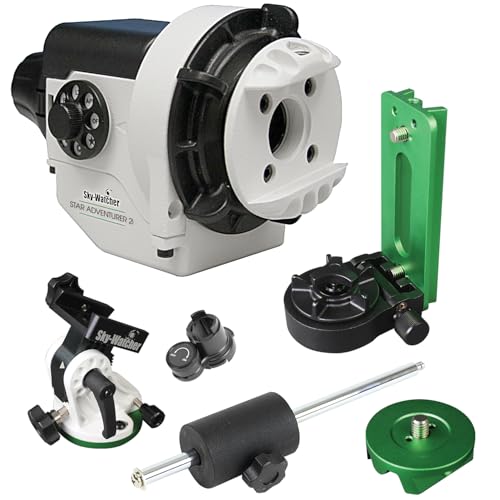
- Motorized platform for wide-field astrophotography
- Wi-Fi control via the SAM Console app
- Equatorial base supports polar alignment
Best For: Portable DSLR nightscapes and Milky Way photography
Best Telescope Adapter
Celestron Universal 1.25-inch T-Adapter

- Connects DSLR or SLR cameras to telescopes
- Fits standard 1.25-inch focusers
- Supports prime-focus astrophotography
Best For: Telescope-based DSLR imaging with a 1.25-inch focuser
Best GoTo Mount
Star Adventurer GTi Mount Head Kit

- Full GoTo equatorial tracking in a compact package
- Built-in Wi-Fi and illuminated polar scope
- Includes counterweight bar and 5-pound counterweight
Best For: Portable DSLR imaging with automated GoTo control
Best Canon Connection Kit
Astromania T2 T Ring and Adapter

- Fits compatible Canon EOS and Rebel cameras
- Includes a 1.25-inch telescope adapter
- Metal construction with angle-adjustment wrench
Best For: Manual Canon DSLR telescope astrophotography
Flexible Open-Source Tracker

- Custom stellar, moon, and rotation speeds
- Supports both hemispheres
- USB-C powered and app-free
Best For: Customizable portable DSLR tracking setups
Versatile Vixen Adapter

- Fits Vixen-style dovetail saddles
- Long slots aid balance adjustment
- Multiple M6, 1/4-inch, and 3/8-inch holes
Best For: Adapting cameras and accessories to Vixen mounts
Portable Full-Featured Tracker

- Handles balanced setups up to 11 pounds
- Illuminated polar scope aids alignment
- Internal battery runs up to 20 hours
Best For: Traveling DSLR astrophotographers with heavier setups
Versatile Framing Support
DSLR L Bracket Quick Release Plate
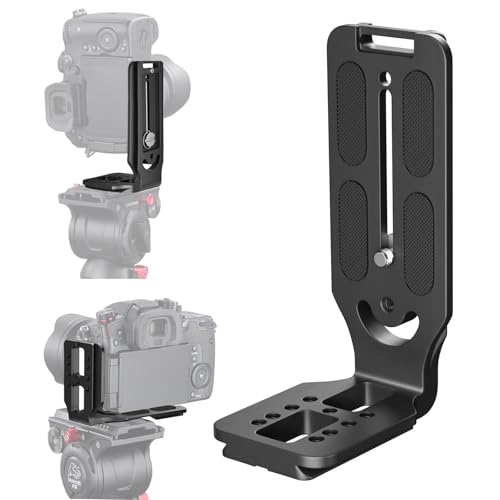
- Switches quickly between landscape and portrait orientation
- Lightweight CNC-machined aviation aluminum
- Multiple 1/4-inch accessory mounting holes
Best For: Tripod-mounted DSLR framing and orientation changes
Finder-Scope Camera Interface

- Fits 33–36 mm finder dovetail bases
- Uses a 1/4-inch camera mounting screw
- Includes anti-slip pads and Allen wrench
Best For: Attaching a threaded camera to a compatible finder base
Hot-Shoe Telescope Link
Finder Dovetail to Camera Adapter

- Connects finder dovetails to camera hot or cold shoes
- Hand-tightened locking ring for setup
- Adds a 1/4-inch threaded mounting hole
Best For: Mounting finder or guide-scope accessories on DSLR and mirrorless cameras
Best Portable Tracker – Star Adventurer 2i Pro Pack
The Sky-Watcher Star Adventurer 2i Pro Pack is a strong choice among astrophotography mounts for DSLR cameras when portability and wide-field tracking matter most. Its motorized platform works with existing photographic tripods and adds Wi-Fi smartphone control through the SAM Console app.
Best For: Portable Milky Way, eclipse, nightscape, and time-lapse photography with a DSLR setup.
Pros:
- Motorized tracking platform for detailed wide-field astronomical images.
- Modular design integrates with existing photographic tripods.
- Built-in Wi-Fi enables smartphone control with the free SAM Console app.
- Deluxe equatorial base supports positioning for polar alignment.
Cons:
- Its emphasis is wide-field photography rather than a full GoTo mount.
- Tripod integration is possible, but a photographic tripod is part of the broader setup.
Choose this model if you want a portable tracking platform with useful automation features and flexible tripod compatibility. Its included lithium metal batteries and 7-pound product weight also suit mobile observing and imaging kits.
Best Telescope Adapter – Celestron Universal 1.25-inch T-Adapter
The Celestron Universal 1.25-inch T-Adapter is an accessory rather than a tracking mount, but it can be an important part of a DSLR astrophotography system. It connects a compatible DSLR or SLR camera to a telescope for prime-focus photography through a 1.25-inch focuser.
Best For: DSLR users who need a straightforward telescope-to-camera connection for prime-focus imaging.
Pros:
- Supports prime-focus photography with DSLR and SLR cameras.
- Chrome barrel fits focusers accepting 1.25-inch accessories.
- Uses standard T-threads with a camera-specific T-ring.
- Backed by Celestron support and a stated two-year US warranty.
Cons:
- A camera-specific T-ring is required and sold separately.
- It does not provide motorized tracking or equatorial mounting.
- Manual focus is required.
This is best viewed as a telescope connection accessory to pair with a suitable tracking mount. Confirm that your telescope accepts 1.25-inch accessories and purchase the correct T-ring for your camera brand.
Best GoTo Mount – Star Adventurer GTi Mount Head Kit
The Sky-Watcher Star Adventurer GTi is a compact full GoTo equatorial mount for photographers seeking more automated control than a basic tracker. It includes a counterweight bar and 5-pound counterweight, built-in Wi-Fi, and a polar scope with illuminator; the dovetail accepts a DSLR or mirrorless camera.
Best For: Portable DSLR or mirrorless astrophotography requiring GoTo functionality and equatorial tracking.
Pros:
- Provides full GoTo performance in a compact package.
- Built-in Wi-Fi adds wireless control capability.
- Includes a polar scope with illuminator for alignment.
- Counterweight bar and 5-pound counterweight are included.
Cons:
- The tripod is not included.
- At 6.9 kg, it is heavier than the smallest portable tracking platforms.
- Camera mounting is supported, but the DSLR or mirrorless camera is not included.
The GTi is a practical upgrade for users who want a portable equatorial platform with integrated GoTo features. Budget for a compatible tripod and camera, then use the included counterweight hardware to balance the imaging setup.
Best Canon Connection Kit – Astromania T2 T Ring and Adapter
The Astromania T2 T Ring and T Adapter is a camera-to-telescope connection kit for Canon EOS SLR and DSLR cameras. It combines a Canon-compatible T-ring with a 1.25-inch adapter, making it useful alongside astrophotography mounts for DSLR cameras when you need to connect a Canon body to a telescope.
Best For: Canon EOS users connecting a compatible camera to a telescope with a 1.25-inch focuser.
Pros:
- Designed for Canon EOS and Rebel SLR/DSLR cameras with EF mounts.
- Includes a 1.25-inch adapter for standard telescope focusers and accessories.
- All-metal aluminum construction is intended for long-term use.
- Includes a hex wrench for camera angle adjustment.
Cons:
- It has no electrical contacts, so focus and aperture adjustments are manual.
- It is a connection accessory, not a motorized tracking mount.
- Compatibility is specifically centered on Canon EOS cameras and 1.25-inch telescope systems.
This kit makes sense when your Canon camera and telescope both match its stated interfaces. Since it provides no electronic camera control or tracking, pair it with a suitable equatorial mount and plan on manual focusing and aperture adjustment.
Flexible Open-Source Tracker – TeSeek Equatorial Mount
For photographers comparing astrophotography mounts for DSLR cameras, this TeSeek equatorial mount offers customizable tracking in a compact, power-bank-friendly design. It supports stellar, moon, and custom rotation speeds, with settings for both northern and southern hemispheres.
Best For: DSLR users who want customizable tracking and a lightweight setup for astrophotography or time-lapse photography.
Pros:
- Supports stellar, moon, and custom rotation speeds.
- Switches between northern and southern hemisphere operation.
- USB Type-C power and no app required for operation.
- Can also function as a gimbal head for time-lapse photography.
Cons:
- Requires a separate ball head for camera connection.
- A 1/4-to-3/8-inch screw sleeve may be needed for many ball heads.
- Requires a USB-A-to-USB-C cable; USB-C-to-USB-C is prohibited.
This is an interesting choice for buyers who value flexible tracking modes and portable power. Check the mounting hardware and cable requirements before building your DSLR setup.
Versatile Vixen Adapter – Yueoct 230mm Dovetail Plate
This Yueoct plate is an accessory rather than a complete tracking mount, but it can help adapt DSLR cameras and other equipment to astrophotography mounts for DSLR cameras. Its Vixen-style profile, long slots, and multiple thread patterns make positioning and balancing equipment more flexible.
Best For: Astrophotographers who need a versatile mounting plate for adapting cameras, brackets, or other accessories to a Vixen-style saddle.
Pros:
- Compatible with Vixen-style dovetail saddles.
- Long slots support flexible positioning and balancing.
- Includes M6, 1/4-inch, and 3/8-inch mounting options.
- Anti-slip pads and safety stop screws help secure mounted equipment.
Cons:
- It is a mounting plate, not a complete equatorial tracking system.
- Some saddles may require removing the safety stop screws.
- Compatibility depends on the saddle and equipment thread pattern.
Consider this plate when your existing mount needs a more adaptable connection between a Vixen saddle and camera equipment. Confirm dimensions, screw spacing, and saddle loading requirements before purchasing.
Portable Full-Featured Tracker – iOptron SkyGuider Pro
The iOptron SkyGuider Pro is a dedicated camera mount for photographers seeking astrophotography mounts for DSLR cameras with portability and higher payload capacity. Its all-metal construction, illuminated polar scope, adjustable base, and internal rechargeable battery support more deliberate long-exposure setups.
Best For: DSLR photographers who need a portable tracker for balanced camera-and-lens combinations up to 11 pounds.
Pros:
- Supports up to 11 pounds when properly balanced.
- Compact 2.2-pound mount is suited to travel.
- Illuminated AccuAlign polar scope assists with polar alignment.
- Internal rechargeable battery provides up to 20 hours at 20°C.
Cons:
- Requires careful balancing to reach its stated payload capacity.
- The listed product weight and mount specifications may differ, so verify the package contents.
- It is not water resistant.
With its adjustable alignment base, polar scope, and internal battery, the SkyGuider Pro is the most complete tracking option in this group. It is a strong fit for mobile DSLR astrophotography when the setup is balanced correctly.
Versatile Framing Support – DSLR L Bracket Quick Release Plate
For photographers comparing astrophotography mounts for dslr cameras, this L bracket is a practical framing accessory rather than a telescope tracking mount. Its vertical and horizontal shooting positions, tripod compatibility, and quick-release design can simplify camera placement during night-sky panoramas or other long-session photography.
Best For: DSLR users who need quick landscape-to-portrait switching and a sturdy tripod-mounted camera bracket.
Pros:
- Supports rapid vertical and horizontal camera switching.
- CNC-machined aviation aluminum construction is lightweight and durable.
- Includes multiple 1/4-inch screw holes for accessories such as lights, monitors, or microphones.
- Rated for a maximum weight recommendation of 10 kg.
Cons:
- It is a camera bracket, not a motorized or equatorial astrophotography mount.
- Compatibility should be checked against the specific camera and tripod quick-release system.
- It is not water resistant.
This is best viewed as a sturdy camera-positioning accessory for an astrophotography setup. It can improve handling and orientation changes, but buyers seeking star tracking will need a separate tracking mount.
Finder-Scope Camera Interface – Dovetail Camera Adapter Mount
Among accessories considered with astrophotography mounts for dslr cameras, this adapter provides a direct way to attach a camera with a 1/4-inch thread to a compatible finder dovetail base. Its aluminum construction and anti-slip pads are aimed at keeping the camera secure while recording through a telescope or related setup.
Best For: Telescope users who need to mount a compatible 1/4-inch-threaded camera or accessory on a 33–36 mm finder dovetail base.
Pros:
- Uses a standard 1/4-inch mounting screw for compatible cameras and accessories.
- Fits finder dovetail bases measuring approximately 33–36 mm.
- Anti-slip rubber pads help improve grip and protect the camera.
- Includes a 4 mm Allen wrench.
Cons:
- It does not function as a tracking or motorized mount.
- Compatibility depends on both the finder-base dimensions and the camera’s 1/4-inch thread.
- The compact adapter may require additional equipment for complete telescope imaging.
This is a focused mechanical adapter for integrating a camera with a finder dovetail system. Confirm the base size and camera connection before buying, especially if your setup uses a nonstandard finder shoe.
Hot-Shoe Telescope Link – Finder Dovetail to Camera Adapter
This compact adapter can complement astrophotography mounts for dslr cameras by connecting a telescope finder or guide-scope dovetail to a camera hotshoe or cold shoe. It is designed for straightforward accessory mounting, with a hand-tightened locking ring, protective rubber pad, and an extra 1/4-inch threaded hole.
Best For: DSLR and mirrorless users who want to attach a compatible finder or guide-scope accessory through the camera’s hotshoe or cold shoe.
Pros:
- Connects a standard finder dovetail to most camera hotshoes or cold shoes.
- Knurled locking ring can be tightened by hand.
- Rubber padding helps protect the camera shoe and improve grip.
- Provides an additional 1/4-inch threaded mounting hole.
Cons:
- It is an adapter, not a complete telescope or tracking mount.
- Fit depends on the camera shoe and compatible finder-dovetail dimensions.
- Manual tightening and alignment may require careful setup.
This adapter is useful when the goal is to bridge a camera shoe and a finder or guide-scope accessory. It offers mounting flexibility, but it should be paired with a suitable telescope and tracking system for serious deep-sky work.
How We Picked the Best Astrophotography Mounts for Dslr Cameras
We selected products that address the main components of a DSLR astrophotography setup: tracking, camera mounting, telescope connection, balancing, and compatibility. Dedicated trackers such as the Sky-Watcher Star Adventurer 2i, Star Adventurer GTi, and iOptron SkyGuider Pro are evaluated as primary tracking platforms. The remaining products serve as adapters, plates, rails, or mounting accessories that can expand how a DSLR connects to a telescope or tripod.
Because specifications and included hardware vary, verify payload limits, thread sizes, camera compatibility, and whether a counterweight, wedge, ball head, or dovetail plate is included before ordering.
Quick Comparison
| Setup type | Best suited to | Main advantage |
|---|---|---|
| Portable star tracker | Wide-field DSLR imaging | Compact tracking for cameras and lenses |
| GoTo equatorial mount | Longer sessions and heavier setups | Computerized pointing and tracking |
| Camera-to-telescope adapter | Prime-focus imaging | Connects a DSLR directly to a telescope |
| Dovetail or hot-shoe accessory | Custom mounting arrangements | More flexible hardware placement |
Key Buying Factors for Astrophotography Mounts for Dslr Cameras
Tracking Accuracy and Alignment
Look for an equatorial tracker that follows the sky’s apparent motion smoothly. A polar scope, illuminated alignment aid, or electronic alignment system can make setup easier. For wide-angle lenses, modest tracking performance may be sufficient; longer focal lengths demand better alignment and lower periodic error.
Payload and Balance
Calculate the combined weight of the DSLR, lens, ball head, adapters, cables, and counterweights. Stay comfortably below the stated payload rather than operating at the limit. Proper balance improves tracking and reduces strain on the drive system.
Portability and Power
Travel-oriented trackers are easier to carry but may require more manual setup. GoTo mounts offer convenience and positioning features but typically add weight, power demands, and complexity. Check battery options and operating time if you plan to image away from mains power.
Connection Standards
Confirm whether the product uses a standard tripod thread, Vixen-style dovetail, T2 connection, camera hot shoe, or telescope-specific interface. T-rings are camera-brand specific, while many T-adapters and rails are telescope or mount dependent.
Who Should Buy Which Astrophotography Mounts for Dslr Cameras?
Choose the Star Adventurer 2i or iOptron SkyGuider Pro if you want a compact tracker for Milky Way scenes, nebulae, and wide-field DSLR lenses. Choose the Star Adventurer GTi if GoTo control, automated pointing, or a more expandable equatorial setup matters more than minimum weight.
Choose a T-ring and T-adapter when you already own a telescope and need to attach a compatible DSLR for prime-focus photography. Choose a rail, finder-base adapter, hot-shoe adapter, or L-bracket when you are building a custom rig and need better balance, accessory placement, or quick camera orientation changes.
For beginners, start with a tracker, sturdy tripod, and wide or medium telephoto lens before adding telescope accessories. More advanced users should prioritize payload headroom, precise alignment, reliable power, and a mounting system that can grow with their camera and lens collection.