
Excessive noise can affect sleep, concentration, comfort, and relationships with neighbors. A sound level meter gives you objective readings instead of relying on guesswork or smartphone microphone estimates.
These 10 picks cover practical home needs, including quick spot checks, classroom and street monitoring, wall-mounted displays, alarms, and long-term data logging. Use the guide below to choose the right features for your space and budget.
Best 10 Sound Level Meters for Home Use Picks for 2026
Best All-Around Value

- Large backlit 2.25-inch display
- A/C weighting, 30–130 dB range
- MAX/MIN, data hold, and case included
Best For: Routine home and noisy-neighbor checks
Best for Ongoing Monitoring

- Rechargeable 1500mAh battery
- 30-second curve and fast/slow response
- Thresholds with 30-alarm history
Best For: Home theater tuning and recurring noise checks
Best for Classic Meter Readings
Extech 407730 Digital Sound Level Meter

- 40–130 dB range with 0.1 dB resolution
- Analog bar graph for changing levels
- MAX/MIN, Max Hold, and windscreen
Best For: Traditional spot measurements and peak checks
Best for Loudness Interpretation
Goldeep SL750A Sound Level Meter

- 30–130 dB range with ±1.5 dB accuracy
- dB and SONE loudness units
- Fast/slow response with MAX/MIN tracking
Best For: Home noise, audio, and perceived-loudness checks
Best Portable Pick
RISEPRO HT-80A Digital Sound Level Meter

- 30–130 dB range with ±1.5 dB accuracy
- Max, min, hold, backlight, and auto-off functions
- Compact design with carrying pouch
Best For: Portable household and workplace noise checks
Best Wall Display
DANOPLUS 11-Inch LED Decibel Meter

- Large adjustable-brightness LED screen
- Displays noise, temperature, and humidity
- Visual icons indicate changing sound levels
Best For: Continuous room monitoring from a wall or desktop
Best A/C Weighting
Tadeto SL720 Portable SPL Meter
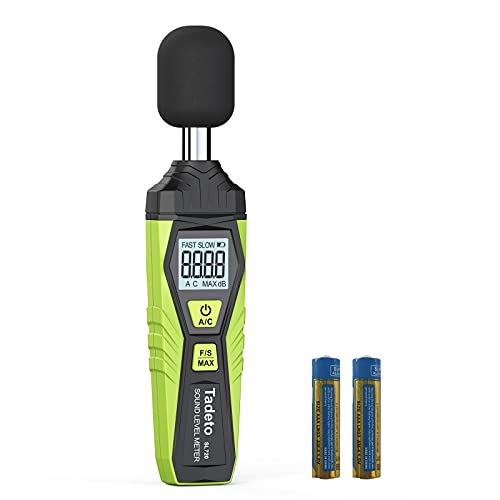
- A- and C-weighted measurement modes
- Fast and slow response settings
- Backlit LCD with 0.1 dB resolution
Best For: Flexible portable checks of ambient and equipment noise
Best Basic Pick
S8607 Digital Sound Level Meter

- 30–130 dB range with 0.1 dB resolution
- FAST/SLOW and MAX/MIN modes
- Backlit display with result hold
Best For: Simple household and classroom spot checks
Best for Data Logging

- Stores up to 3,100 readings
- Supports dB(A) and dB(C) measurements
- USB rechargeable with PC export
Best For: Tracking and reviewing recurring household noise
Best Advanced Monitoring Pick

- Stores up to 43,000 readings for export
- A/C weighting with FAST/SLOW response
- Trend display and adjustable three-color alarms
Best For: Long-term household noise monitoring and analysis
Best All-Around Value – TopTes TS-501B
For shoppers comparing sound level meters for home use, the TopTes TS-501B offers a straightforward mix of readability, flexible weighting, and useful peak tracking. Its large backlit display and portable design make it practical for checking household, neighborhood, and workshop noise.
Best For: Home noise checks, noisy-neighbor monitoring, home theaters, and general everyday measurements.
Pros:
- Large 2.25-inch backlit LCD is easy to read, including in dim conditions.
- A- and C-weighting support measurements from 30 to 130 dB with stated ±1.5 dB accuracy.
- MAX/MIN readings and data hold help capture changing or peak noise levels.
- Includes three AAA batteries and a carrying case.
Cons:
- Uses replaceable AAA batteries rather than a rechargeable battery.
- Does not list threshold alarms or sound-history recording.
The TS-501B is a balanced pick for routine household testing, especially if you value a clear screen and simple controls over advanced logging features.
Best for Ongoing Monitoring – FNIRSI FDM-02
The FNIRSI FDM-02 stands out among sound level meters for home use when you want more than a momentary reading. Its rechargeable battery, response-speed options, curve display, and alarm history support ongoing checks around the house or workplace.
Best For: Home theater tuning, speaker setup, family noise checks, and monitoring recurring disturbances.
Pros:
- 2-inch IPS screen offers light and dark themes for clear viewing.
- Rechargeable 1500mAh battery with automatic off and sleep functions.
- Fast and slow response modes, plus a 30-second sound-change curve.
- High/low thresholds and storage for the 30 most recent alarms add monitoring capability.
Cons:
- Its listed 30–130 dB range may be more capability than needed for simple spot checks.
- At 12.6 ounces, it is heavier than some compact battery-powered meters.
Choose the FDM-02 if reviewing sound changes and alarm events matters to you; it is a particularly versatile option for audio setup and recurring household noise.
Best for Classic Meter Readings – Extech 407730 Digital Sound Level Meter
For buyers seeking sound level meters for home use with a traditional measurement layout, the Extech 407730 combines A/C weighting with a digital readout and analog bar graph. Its MAX/MIN functions and windscreen make it suitable for basic indoor and outdoor sound checks.
Best For: Users who prefer a conventional digital meter with visual level movement and simple peak recording.
Pros:
- Measures from 40 to 130 dB with 0.1 dB resolution.
- Includes A/C weighting, MAX/MIN recording, and Max Hold.
- Fast-response analog bar graph provides an at-a-glance view of changing levels.
- Includes a microphone windscreen, four AAA batteries, and a one-year parts-and-labor warranty.
Cons:
- Its 40 dB minimum is higher than the 30 dB minimum offered by several compact alternatives.
- Stated accuracy is 2 dB, less precise than products listed at ±1.5 dB.
- The supplied notes do not mention a backlit display.
The 407730 is a sensible choice for straightforward measurements when a moving bar graph and established Extech features are more important than the widest range or highest stated accuracy.
Best for Loudness Interpretation – Goldeep SL750A Sound Level Meter
The Goldeep SL750A is a flexible option among sound level meters for home use, combining standard decibel measurements with a SONE mode for perceived loudness. Its A/C weighting, response settings, and MAX/MIN tracking cover everything from household noise to audio and instrument checks.
Best For: Home noise, music and audio checks, traffic monitoring, and users who want a loudness-oriented readout.
Pros:
- Measures 30–130 dB with stated ±1.5 dB accuracy.
- A- and C-weighting modes suit environmental and higher-intensity sound testing.
- Switchable dB and SONE units help compare sound intensity with perceived loudness.
- Fast/slow response, MAX/MIN tracking, data hold, and a windbreak ball are included.
Cons:
- The supplied details do not mention backlighting or rechargeable power.
- Only two AAA batteries are included.
The SL750A makes a strong everyday choice if you want conventional noise readings plus a SONE option for understanding how loud sound may seem, rather than only its measured intensity.
Best Portable Pick – RISEPRO HT-80A Digital Sound Level Meter
If you want sound level meters for home use that are easy to carry between rooms, the RISEPRO HT-80A offers a practical combination of broad measurement range, useful recording functions, and a backlit display. It measures from 30 to 130 dB with claimed accuracy of ±1.5 dB.
Best For: Portable noise checks around the home, workplace, family spaces, and study areas.
Pros:
- Measures a wide 30–130 dB range with ±1.5 dB accuracy.
- Includes data hold, maximum and minimum readings, and auto power-off.
- Backlight supports reading the display in darker conditions.
- Comes with a black carrying pouch and gift box.
Cons:
- Its 31.5 Hz–4 kHz frequency range may be less suitable for specialized audio analysis.
- The plastic body is compact, but the small dimensions may make the display less convenient for wall-mounted monitoring.
The HT-80A is a well-rounded handheld option for everyday household noise checks, especially if you value portability and quick access to peak and minimum readings.
Best Wall Display – DANOPLUS 11-Inch LED Decibel Meter
For sound level meters for home use that need to be visible across a room, the DANOPLUS DP-336 stands out with its large 11-inch LED display. It shows real-time decibel levels along with temperature and humidity, making it useful for continuous room monitoring.
Best For: Wall or desktop monitoring in home offices, studios, classrooms, and other shared spaces.
Pros:
- Large 11-inch display is designed for easy viewing from a distance.
- Shows decibel level, temperature, and humidity.
- Face icons change by sound level, from green below 60 dB to red above 85 dB.
- Offers ±1.5 dB accuracy and a calibration function.
Cons:
- Its larger wall-display format is less portable than handheld meters.
- The face icon indicator has no audible alarm.
- Requires charging through the included USB cable.
This model makes the most sense when visibility matters more than portability. Its adjustable-brightness screen and visual warning icons can help households keep track of changing noise levels at a glance.
Best A/C Weighting – Tadeto SL720 Portable SPL Meter
The Tadeto SL720 is one of the more flexible sound level meters for home use because it supports both A- and C-weighted measurements. Its portable design, backlit LCD, and selectable fast or slow response make it suitable for everyday ambient checks as well as louder equipment-related measurements.
Best For: Home users who want portable readings with A/C weighting and adjustable response speed.
Pros:
- Measures from 30 to 130 dB with claimed ±2.0 dB accuracy.
- A weighting suits ambient-noise checks, while C weighting supports higher-intensity sound analysis.
- Fast 0.125-second and slow 1-second response settings accommodate different noise patterns.
- Backlit 4-digit LCD provides 0.1 dB resolution and a low-battery indicator.
Cons:
- Its claimed accuracy is lower than the ±1.5 dB rating of some competing models.
- The standard handheld format does not provide a large room-facing display.
The SL720 is a sensible choice if you want more control over how sound is measured. A/C weighting and fast/slow response options give it added versatility for household noise, offices, vehicles, and equipment checks.
Best Basic Pick – S8607 Digital Sound Level Meter
For straightforward sound level meters for home use, the S8607 focuses on essential readings without adding data-logging complexity. It measures 30–130 dB with 0.1 dB resolution and offers practical controls for checking household, classroom, office, and neighborhood noise.
Best For: Home users who want a simple handheld meter for occasional noise checks.
Pros:
- Measures a broad 30–130 dB range with ±1.5 dB stated accuracy.
- Includes FAST/SLOW response modes plus MAX/MIN measurement.
- Backlit LCD, result hold, low-battery indicator, and automatic shutoff support convenient use.
Cons:
- Uses A-weighted measurement only, according to the supplied notes.
- Does not list data logging, PC connectivity, or rechargeable operation.
The S8607 is a sensible low-complexity option when you mainly need an immediate decibel reading. Its hold and maximum/minimum functions make it more useful than a bare basic meter, while the lack of recording features keeps it best suited to spot checks.
Best for Data Logging – GAIN EXPRESS SLM-442
The GAIN EXPRESS SLM-442 is one of the more capable sound level meters for home use when you want to review noise over time. It combines rechargeable operation, PC connectivity, stored readings, and visual alerts in a compact meter for home, office, classroom, or neighbor-noise monitoring.
Best For: Users who need recorded measurements and computer-based review rather than one-off readings.
Pros:
- Stores up to 3,100 data records and supports PC export on compatible Windows versions.
- Provides both dB(A) and dB(C) measurement ranges from 30–130 or 35–130 dB.
- Three-color alarm lights and an on-screen warning icon make elevated readings easier to notice.
- USB rechargeable design provides about eight hours of operation per charge.
Cons:
- Its data-recording features may be unnecessary for quick, occasional checks.
- The supplied notes mention a calibration knob but do not describe a calibration procedure.
Choose the SLM-442 if documenting noise is a priority. The combination of A/C weighting, storage, export, and configurable shutdown gives it more flexibility than a basic meter, though it is a more feature-heavy choice for casual users.
Best Advanced Monitoring Pick – DANOPLUS DP-441 Data Logger
The DANOPLUS DP-441 is designed for users who want more detailed monitoring from sound level meters for home use. Along with a 30–130 dB range and ±1.5 dB accuracy, it adds extensive data storage, PC export, frequency weighting choices, a colored trend display, and adjustable alarm thresholds.
Best For: Home users who want long-term noise records, visual trends, and adjustable alerts.
Pros:
- Records up to 43,000 data points and supports Excel export through a PC connection.
- Switches between A and C frequency weighting and FAST/SLOW response settings.
- Colored screen includes a line chart, analog bars, and date/time information.
- Three-color alarm system offers manually adjustable low, medium, and high thresholds.
Cons:
- The larger feature set may be more than needed for occasional room checks.
- The supplied notes do not specify battery runtime or charging time beyond a stated approximately 1.5-hour charge.
The DP-441 stands out when your goal is to identify patterns rather than capture a single reading. Its large recording capacity and PC workflow suit extended monitoring, while A/C weighting and adjustable alarms provide useful control for more involved investigations.
How We Picked the Best Sound Level Meters for Home Use
We focused on meters suited to everyday residential monitoring rather than specialized laboratory work. Selection criteria included usable measurement ranges, readable displays, A- or C-weighting options, minimum and maximum readings, data hold, portability, power options, and ease of operation. Models with logging, alarms, large displays, or environmental indicators were also included for buyers with more specific monitoring needs.
Because advertised accuracy and calibration methods vary, these devices are best used for comparisons, troubleshooting, and documenting noise patterns—not as a substitute for certified acoustic testing when legal or occupational requirements apply.
Quick Comparison
| Type | Best for | Features to prioritize |
|---|---|---|
| Basic handheld meter | Quick room and appliance checks | 30–130 dB range, backlight, data hold |
| Large wall display | Continuous room awareness | Visible LED screen, alarm icons, temperature and humidity |
| Data logger | Tracking noise over hours or days | Memory capacity, USB export, rechargeable battery |
| Professional-style meter | More controlled measurements | A/C weighting, stable readings, reputable specifications |
Key Buying Factors for Sound Level Meters for Home Use
Measurement Range and Weighting
A 30–130 dB range covers most household situations, from quiet rooms to loud tools and appliances. A-weighting is the most useful default for approximating perceived environmental noise. C-weighting can help assess louder, lower-frequency sound.
Display and Controls
Backlit LCDs are useful in bedrooms, basements, and dim utility areas. Maximum and minimum functions reveal short peaks, while data hold freezes a reading for easier note-taking. Large wall displays are preferable when several people need to see the result from across a room.
Logging, Alarms, and Power
Choose a logger if the problem is intermittent or occurs when you are away. Check memory capacity, recording intervals, export method, and whether the meter is rechargeable. Alarm indicators are helpful for classrooms, workshops, nurseries, and shared living spaces where a quick visual warning matters.
Portability and Environment
A compact handheld meter is easiest to carry between rooms or take outdoors for neighborhood comparisons. For reliable readings, hold the microphone consistently, avoid blocking it, and measure from the same position each time. Wind, reflections, and nearby surfaces can affect results.
Who Should Buy Which Sound Level Meters for Home Use?
- For occasional home checks: Choose a straightforward handheld model with a backlight, data hold, and A/C weighting.
- For bedrooms, nurseries, or shared spaces: A wall-mounted large-display meter makes noise levels visible without repeatedly taking measurements.
- For neighbor, appliance, or construction investigations: Select a meter with maximum/minimum readings and consistent controls so you can compare events fairly.
- For recurring or overnight noise: Buy a data logger with substantial memory, USB export, and rechargeable power.
- For more demanding measurements: Favor a model with clearly documented specifications, selectable weighting, and a stable, readable display.