
Finding a reliable sound level meter does not require a large budget. The best sound level meters under $100 can help you check room noise, equipment output, workplace sound, and everyday environmental levels with useful features such as A/C weighting, response modes, backlit displays, alarms, and data logging.
This roundup compares 10 affordable meters across simple handheld designs and rechargeable models with memory and USB data export, so you can choose the right balance of convenience, visibility, and measurement control.
Best 10 Sound Level Meters Under 100 Picks for 2026
Best Overall Value

- 30–130 dB range with A/C weighting
- Large backlit 2.25-inch display
- MAX/MIN, data hold, batteries, and case included
Best For: Everyday home, office, workshop, and factory noise checks
Best for Response Control

- Fast and slow response settings
- A/C weighting with 30–130 dB range
- 0.1 dB resolution and backlit display
Best For: Changing environmental noise and machinery measurements
Best for Field Convenience

- 30–130 dB range with A/C weighting
- Fast/slow response and MAX/data hold
- Batteries, screwdriver, and velvet bag included
Best For: Portable noise checks at schools, factories, and traffic areas
Best Compact Basic Pick

- 30–130 dB range with ±1.5 dB accuracy
- Fast response, MAX/MIN, and data hold
- Backlight and carrying pouch included
Best For: Simple personal, household, and workplace spot checks
Best All-Around Pick

- 30–130 dB range with ±1.5 dB accuracy
- A/C weighting and FAST/SLOW response modes
- SONE, MAX/MIN, hold, LCD, windbreak, and batteries included
Best For: Everyday home, office, classroom, and equipment noise checks
Best Simple Budget Meter
VLIKE LCD Digital Decibel Meter
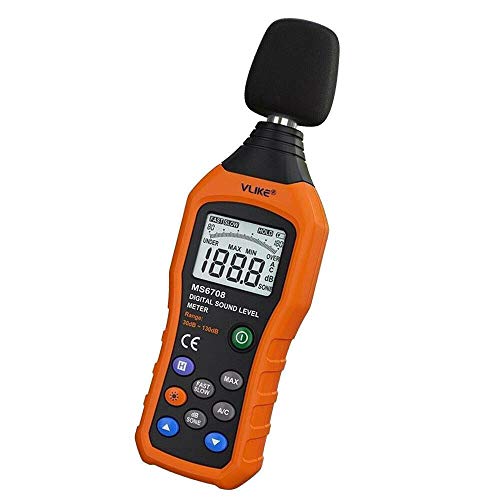
- 30–130 dB range with A/C modes
- Backlit display with auto power-off
- Compact anti-drop design and max locking
Best For: Straightforward real-time noise checks without onboard reporting
Best for Data Logging
GAIN EXPRESS Recording SPL Meter

- Stores up to 3,100 records with PC export
- Rechargeable USB operation with about eight hours of use
- Graphical display, three-color alarm system, and ±1.5 dB accuracy
Best For: Recorded noise monitoring, inspections, and quality-control checks
Large-Display Pick

- 30–130 dB measurement range
- Large red LCD display
- Automatic wall-hanging design
Best For: Fixed-location, at-a-glance noise monitoring
Data-Logging Pick

- Stores up to 43,000 readings
- PC export with Excel support
- A/C weighting and three-color alarms
Best For: Documented noise monitoring and data analysis
Portable Everyday Pick
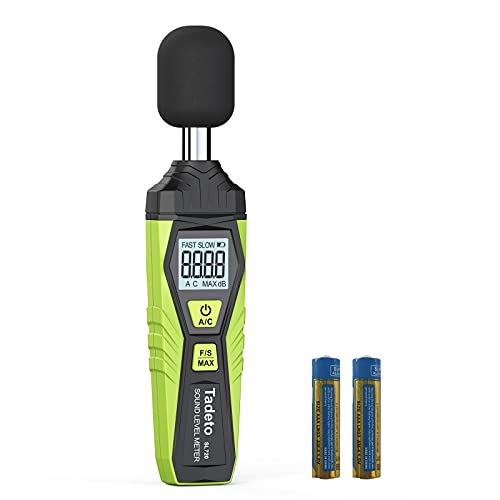
- 30–130 dB range with ±2.0 dB accuracy
- A/C weighting and fast/slow response
- Backlit LCD with data hold
Best For: Portable home, office, and equipment checks
Best Overall Value – TopTes TS-501B
If you want sound level meters under 100 for everyday noise checks, the TopTes TS-501B combines a broad 30–130 dB range with a large backlit display and straightforward controls. Its A/C weighting, MAX/MIN readings, and data hold make it practical for home, office, workshop, and factory use.
Best For: General-purpose noise monitoring where an easy-to-read display and portable design matter.
Pros:
- Large 2.25-inch backlit LCD screen
- A/C weighting and 30–130 dB measurement range
- MAX/MIN and data-hold functions
- Includes three AAA batteries and a carry case
Cons:
- Automatic power-off may interrupt longer unattended measurements
- Battery-powered rather than rechargeable
The TS-501B is a well-rounded option for buyers who want useful measurement features without a complicated interface. Factory calibration and the included case add convenience for routine checks.
Best for Response Control – Protmex PT6708
The Protmex PT6708 stands out among sound level meters under 100 for its selectable fast and slow response modes. With A/C weighting, 0.1 dB resolution, and a 30–130 dB range, it suits users who want more control over how changing environmental or machine noise is evaluated.
Best For: Noise checks involving changing sound levels, machinery, workshops, and environmental measurements.
Pros:
- Fast 0.125-second and slow 1-second response settings
- A/C weighting for ambient and machine-noise measurements
- 0.1 dB resolution with stated ±1.5 dB accuracy
- Backlight, MAX, data hold, and dB/SONE selection
Cons:
- Cannot generate or retain a report directly from the device
- Longer and heavier than some compact meters
Choose the PT6708 if response timing is more important than the smallest possible footprint. Its feature set is especially useful when readings change quickly or when comparing general environmental noise with machine sound.
Best for Field Convenience – POROMETISTO SL02
For shoppers comparing sound level meters under 100, the POROMETISTO SL02 offers a practical field-measurement package. It covers 30–130 dB, provides A/C weighting and fast/slow response modes, and includes a backlit display, batteries, screwdriver, and velvet storage bag.
Best For: Portable checks in factories, schools, traffic areas, workshops, and other noisy environments.
Pros:
- 30–130 dB range with stated ±1.5 dB accuracy at 94 dB/1 kHz
- A/C weighting and fast 125 ms or slow 1-second response
- MAX and data-hold functions for reviewing peak readings
- Includes batteries, screwdriver, and storage bag
Cons:
- Specified frequency range is 250 Hz–8 kHz
- Auto power-off activates after 10 minutes of inactivity
The SL02 is a sensible choice when portability and a complete starter kit are priorities. Its dual response modes and peak capture features give it flexibility for both general noise monitoring and louder work areas.
Best Compact Basic Pick – RISEPRO HT-80A
The RISEPRO HT-80A keeps the core features useful for sound level meters under 100 in a compact, simple format. It measures 30–130 dB with stated ±1.5 dB accuracy and adds fast response, data hold, MAX/MIN recording, backlighting, and automatic power-off.
Best For: Personal, household, business, study, and general-purpose sound checks.
Pros:
- 30–130 dB measurement range
- Fast 125 ms time weighting
- Data hold plus MAX and MIN readings
- Backlight and included black carrying pouch
Cons:
- Notes specify Type A frequency weighting only
- Frequency range is 31.5 Hz–4 kHz
- Short product dimensions are provided without a full dimension set
The HT-80A is a straightforward option for buyers who prefer essential controls over specialized analysis features. Its compact design, backlight, and carrying pouch make it convenient for routine spot measurements.
Best All-Around Pick – Goldeep Portable SPL Tester
For shoppers comparing sound level meters under 100, the Goldeep SL750A is a versatile handheld option with a 30–130 dB range, ±1.5 dB accuracy, and both A and C weighting. Its straightforward controls make it practical for checking household, office, classroom, traffic, and equipment noise.
Best For: Everyday noise checks and users who want flexible weighting, response, and loudness settings.
Pros:
- Measures 30–130 dB with stated ±1.5 dB accuracy.
- Offers A/C weighting, FAST/SLOW response, and MAX/MIN tracking.
- Includes dB and SONE modes, data hold, LCD display, windbreak, and two AAA batteries.
Cons:
- Its listed frequency response is 31.5 Hz–8 kHz, so it is not described as a full-spectrum audio analyzer.
- The notes do not mention onboard data logging or computer export.
The Goldeep stands out as a balanced choice for routine environmental and workplace measurements. SONE mode adds a useful perceived-loudness perspective, while MAX/MIN tracking helps capture changing sound levels.
Best Simple Budget Meter – VLIKE LCD Digital Decibel Meter
If you want one of the more straightforward sound level meters under 100, the VLIKE VL6708 provides real-time 30–130 dB readings in a compact handheld design. It adds A/C modes, max locking, an illuminated display, and an auto-ranging measurement system for general-purpose monitoring.
Best For: Basic home, office, school, road, workshop, and audio noise measurements.
Pros:
- Provides a broad 30–130 dB measurement range with A/C mode.
- Backlight supports nighttime data gathering and automatically powers off.
- Compact casing includes an anti-drop structure and power-saving circuit design.
Cons:
- Batteries are not included, and the meter requires four AAA batteries.
- The device cannot store or generate a report directly.
- The supplied notes do not specify measurement accuracy.
The VLIKE is best suited to buyers who value simple real-time readings over logging or advanced analysis. Its max-locking function and backlight make routine spot checks easier, but users needing reports should consider a data-logging model instead.
Best for Data Logging – GAIN EXPRESS Recording SPL Meter
Among sound level meters under 100, the GAIN EXPRESS SLM-442 is the feature-rich choice for users who need more than a live reading. It combines 30–130 dB measurement, rechargeable USB-C operation, alarm lights, and PC-connected recording for reviewing collected sound data.
Best For: Extended monitoring, classroom or office checks, quality control, and users who need recorded measurements.
Pros:
- Stores up to 3,100 data records and supports PC data export on specified Windows versions.
- Offers numerical and graphical readings plus yellow and red alarm indicators.
- Provides ±1.5 dB accuracy, rechargeable operation, a calibration knob, and an included USB cable.
Cons:
- PC connectivity is specified for Windows 7, Windows 10, and Windows 11.
- Battery life is listed at about eight hours per charge.
- The notes mention 3,100 stored records, rather than unlimited recording.
The SLM-442 is the strongest fit here for documenting noise over time instead of checking a single moment. Its alarms and graphical display improve at-a-glance monitoring, while the calibration control and export capability add usefulness for more structured inspections.
Large-Display Pick – SW-525A Sound Level Meter
For shoppers comparing sound level meters under 100, the SW-525A is a straightforward choice when a large, easy-to-see reading matters. It measures from 30 to 130 dB and uses automatic digital operation.
Best For: Wall-mounted or fixed-location noise monitoring where a prominent display is useful.
Pros:
- Large red LCD display for visibility.
- 30–130 dB measurement range.
- Automatic digital operation.
- Wall-hanging design with a compact plastic-acrylic build.
Cons:
- Its wall-hanging format may be less convenient for portable measurements.
- The supplied details do not list advanced logging, weighting, or data-export functions.
The SW-525A keeps the feature set simple and the reading prominent, making it a practical fit for users who want at-a-glance decibel monitoring rather than detailed data analysis.
Data-Logging Pick – DANOPLUS DP-441 Decibel Meter
Among sound level meters under 100, the DANOPLUS DP-441 stands out for users who need to record and review measurements. It stores up to 43,000 readings, supports PC export, and provides real-time visual alerts.
Best For: Noise tracking, documentation, and reviewing measurement data on a Windows PC.
Pros:
- Records up to 43,000 data points and exports them to Excel through a PC connection.
- Measures 30–130 dB with stated ±1.5 dB accuracy.
- Offers A/C frequency weighting and FAST/SLOW response settings.
- Includes three-color alarms, a line chart, analog bars, and rechargeable USB charging.
Cons:
- PC connectivity is specified for Windows 7, 10, and 11.
- The supplied notes indicate approximately 1.5 hours of charging time for its 1,000 mAh battery.
The DP-441 is the most feature-rich option in this group for measurements that need to be saved, exported, or analyzed, though its extra functions may be unnecessary for occasional spot checks.
Portable Everyday Pick – Tadeto SL720 Decibel Meter
If you want one of the more versatile sound level meters under 100 for routine checks, the Tadeto SL720 combines a portable design with A/C weighting, selectable response speed, and a backlit LCD. Its 30–130 dB range covers common home, office, factory, and equipment measurements.
Best For: Portable environmental and equipment noise checks in homes, offices, vehicles, and work areas.
Pros:
- Measures 30–130 dB with stated ±2.0 dB accuracy.
- A-weighting supports ambient-noise checks, while C-weighting suits louder machine sounds.
- Fast and slow response modes accommodate changing or steadier noise levels.
- Backlit 4-digit LCD offers 0.1 dB resolution and a maximum-data-hold function.
Cons:
- Its stated accuracy is lower than the DANOPLUS model in this roundup.
- The supplied details do not mention data logging or PC export.
- Manual operation may require more user input than an automatic meter.
The SL720 is a balanced choice for users who value portability and useful measurement controls without needing stored records or computer-based reporting.
How We Picked the Best Sound Level Meters Under 100
We focused on meters with a practical 30–130 dB measurement range, since that covers common home, workshop, office, vehicle, and general environmental checks. We also considered features that affect everyday usability: A and C frequency weighting, fast and slow response modes, maximum and minimum readings, data hold, backlighting, automatic power-off, alarms, and rechargeable batteries.
Models with onboard memory or USB export received extra consideration for repeated measurements and documentation. Because these are budget instruments, they should be treated as comparative testing tools rather than substitutes for calibrated professional or regulatory equipment.
Quick Comparison
| Feature | Best For | What to Look For |
|---|---|---|
| Basic handheld meter | Occasional checks | Clear LCD, backlight, data hold |
| A/C weighting | More flexible testing | Selectable weighting modes |
| Fast/slow response | Changing or steady noise | Both response settings |
| Data logger | Longer monitoring sessions | Memory capacity, USB export, rechargeable battery |
| Alarm or color indicator | Quick threshold checks | Visible warning system and adjustable limits |
Key Buying Factors for Sound Level Meters Under 100
Measurement Range and Resolution
A 30–130 dB range is versatile for most everyday applications. Check the display resolution and stated accuracy, but remember that low-cost meters can vary between units and may not be suitable for compliance-grade measurements.
Weighting and Response Modes
A-weighting is commonly used for general environmental and workplace-style noise readings, while C-weighting captures more low-frequency content. Fast response tracks changing sounds more quickly; slow response produces a steadier reading when levels fluctuate.
Display and Controls
A backlit screen is valuable in workshops, vehicles, basements, and outdoor areas. Large digits, data hold, MAX/MIN functions, and simple buttons make it easier to read and record measurements without repeatedly repositioning the meter.
Logging, Power, and Portability
Choose a compact battery-powered model for occasional spot checks. For surveys or recurring measurements, prioritize rechargeable power, generous data storage, color alarms, and USB export. Confirm how data is transferred and whether the logger records continuously or at set intervals.
Who Should Buy Which Sound Level Meters Under 100?
For occasional home and DIY checks: Choose a straightforward handheld meter with a backlit LCD, data hold, and A/C weighting.
For workshops, vehicles, and equipment: Look for fast and slow response modes, MAX/MIN tracking, and a broad 30–130 dB range.
For repeated monitoring: A data-logging model with rechargeable power, substantial memory, and USB export is the better choice.
For quick visual warnings: Select a meter with an alarm or multicolor indicator, especially when checking changing noise levels from a distance.