
Finding the right sound level meter is easier when you know which features matter most. The best beginner models make everyday noise checks simple with clear displays, straightforward controls, and useful measurement ranges.
This roundup compares 10 affordable portable meters for checking sound at home, in classrooms, on streets, or in small work areas. Use the buying guide below to narrow the options based on accuracy, weighting, response modes, and convenience.
Best 10 Sound Level Meters for Beginners Picks for 2026
Balanced Starter
Tadeto Digital Sound Level Meter
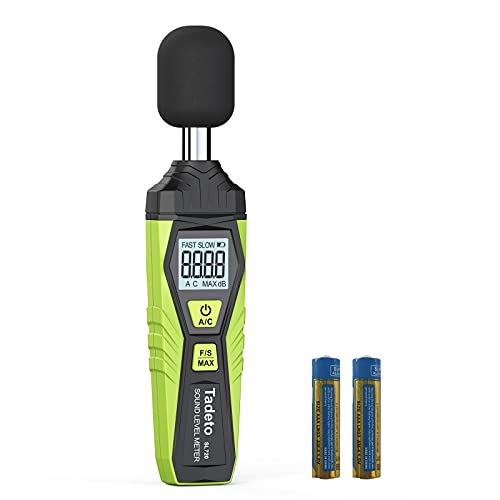
- 30–130 dB range with 0.1 dB resolution
- A/C weighting and fast/slow response modes
- Backlit display and lightweight handheld design
Best For: Everyday home, school, office, and factory noise checks
Feature-Rich Value

- 30–130 dB range with ±1.5 dB stated accuracy
- MAX, Data Hold, and fast/slow response modes
- Includes batteries, bag, screwdriver, and manual
Best For: Beginners wanting a ready-to-use monitoring kit
Simple All-Rounder

- 30–130 dB range with ±1.5 dB stated accuracy
- MAX/MIN, Data Hold, backlight, and auto-off
- Includes a carrying pouch and gift box
Best For: Routine personal, home, business, and study measurements
Color-Screen Pick

- 30–130 dB range with 0.1 dB resolution
- dB and SONE units plus A/C weighting
- Color screen, windbreak, case, and MAX/MIN hold
Best For: Visual, portable measurements at home or work
Best All-Around Pick

- 30–130 dB range with ±1.5 dB stated accuracy
- A/C weighting plus dB and SONE modes
- FAST/SLOW response and MAX/MIN tracking
Best For: Everyday home, office, classroom, and equipment noise checks
Best Budget Basic Meter
VLIKE VL6708 Sound Level Meter
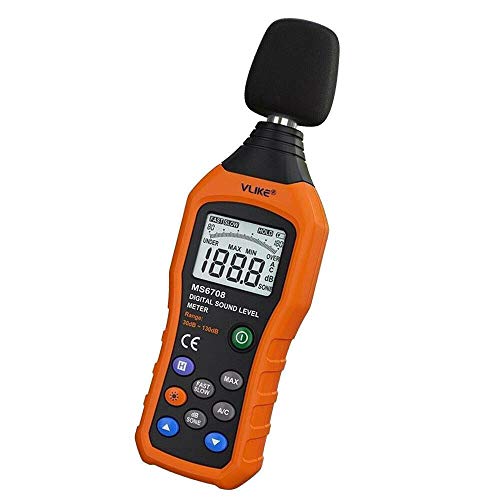
- 30–130 dB real-time measurement range
- A/C mode with maximum-reading lock
- Backlit portable design for dim conditions
Best For: Simple household, office, school, and workshop monitoring
Best for Easy Reading
TopTes TS-501B Sound Level Meter

- Large 2.25-inch backlit LCD
- 30–130 dB range with ±1.5 dB stated accuracy
- Includes MAX/MIN, data hold, and three AAA batteries
Best For: Readable home, neighbor-noise, school, and workshop measurements
Best Handheld Starter
Mengshen MS-M80A Sound Level Meter

- 30–130 dBA range with ±1.5 dB accuracy
- Backlit LCD with data hold and MAX/MIN
- Compact design with included 9V battery
Best For: Beginners wanting a portable meter for quick everyday noise checks
Best Large-Display Pick

- 2.25-inch backlit LCD is easy to read
- 30–130 dB A-weighted range
- Includes AAA batteries and carry case
Best For: Beginners who want clear viewing and a complete starter kit
Best Mode Flexibility
Digital S8607 Sound Level Meter

- FAST and SLOW response modes
- 30–130 dB range with 0.1 dB resolution
- A-weighted, MAX/MIN, hold, and backlight
Best For: Beginners who want more control over response and recorded readings
Balanced Starter – Tadeto Digital Sound Level Meter
If you are comparing sound level meters for beginners, the Tadeto offers a straightforward combination of a 30–130 dB range, readable backlit display, and practical measurement controls. Its A/C weighting and fast/slow response modes also make it useful beyond basic household checks.
Best For: Beginners who want one meter for home, school, office, factory, and general environmental noise checks.
Pros:
- Measures 30–130 dB with stated accuracy of ±2.0 dB and 0.1 dB resolution.
- A weighting supports ambient-noise checks, while C weighting suits louder machinery and motor noise.
- Fast and slow response modes, a backlit LCD, and a low-battery indicator simplify use.
- Lightweight handheld design is convenient for carrying between locations.
Cons:
- Its stated accuracy is lower than some alternatives in this roundup.
- The supplied notes do not mention automatic power-off or included batteries.
The Tadeto is a practical entry-level pick when ease of use and broad everyday applications matter more than advanced recording features.
Feature-Rich Value – POROMETISTO Sound Level Meter
For beginners seeking sound level meters for beginners that still offer useful monitoring features, the POROMETISTO combines a wide 30–130 dB range with A/C weighting, peak recording, and fast/slow response settings. Included batteries and accessories help you begin measuring immediately.
Best For: New users who want a complete starter kit for environmental, school, traffic, or workshop measurements.
Pros:
- Stated accuracy of ±1.5 dB at 94 dB/1 kHz, with a 30–130 dB measurement range.
- A/C weighting supports general environmental and higher-intensity machine-noise measurements.
- MAX recording, Data Hold, and fast/slow response modes help capture changing readings.
- Includes two AAA batteries, screwdriver, velvet bag, and manual; automatic shutoff activates after 10 minutes of inactivity.
Cons:
- Its stated frequency range is 250 Hz–8 kHz, narrower at the low end than some models.
- The supplied notes do not specify a color screen or water-resistance rating.
With its included accessories and useful hold and peak functions, the POROMETISTO is a well-equipped option for beginners who want more than basic instantaneous readings.
Simple All-Rounder – RISEPRO HT-80A Decibel Meter
The RISEPRO HT-80A is a simple choice among sound level meters for beginners, with a 30–130 dB range, ±1.5 dB stated accuracy, and controls for holding readings and tracking maximum or minimum levels. Its backlight and carrying pouch add convenience for routine checks.
Best For: Beginners who need a compact meter for personal, household, business, study, or industrial sound monitoring.
Pros:
- Measures 30–130 dB with a stated accuracy of ±1.5 dB.
- Includes Data Hold, MAX/MIN recording, backlight, and automatic power-off features.
- Fast 125 ms time weighting is suited to general changing-noise measurements.
- Comes with a black carrying pouch and gift box.
Cons:
- The supplied specifications list only Type A frequency weighting.
- Its stated frequency range ends at 4 kHz, narrower than some competing models.
The HT-80A keeps operation approachable while covering the core features most beginners need for comparing noise levels in everyday settings.
Color-Screen Pick – DURFICST Sound Level Meter
Beginners comparing sound level meters for beginners may appreciate the DURFICST for its color LCD, broad 31.5 Hz–8 kHz frequency range, and extra SONE loudness unit. It also provides A/C weighting and response controls for more varied home and work measurements.
Best For: Beginners who want a more visual, portable meter for home, office, classroom, factory, and outdoor use.
Pros:
- Measures 30–130 dB with ±1.5 dB stated accuracy and 0.1 dB resolution.
- A/C weighting supports environmental and higher-intensity mechanical-noise checks.
- Displays dB and SONE units, with fast/slow response, MAX/MIN recording, and Data Hold.
- Color LCD, windbreak ball, carrying case, rubber wrapping, and handheld design support portable use.
Cons:
- It requires three AAA batteries, compared with two for some alternatives.
- The supplied notes do not mention automatic power-off.
The DURFICST stands out for beginners who value a more informative display and flexible readouts without moving beyond a handheld meter format.
Best All-Around Pick – Goldeep SL750A Decibel Meter
For beginners comparing sound level meters for beginners, the Goldeep SL750A offers a useful balance of accuracy, straightforward controls, and flexible measurement modes. Its 30–130 dB range covers common household, workplace, classroom, traffic, and equipment checks.
Best For: Beginners who want one meter for everyday noise checks and basic acoustic testing.
Pros:
- Measures 30–130 dB with stated ±1.5 dB accuracy.
- Offers A-weighting and C-weighting for environmental and higher-intensity industrial sounds.
- Includes FAST/SLOW response, MAX/MIN tracking, data hold, and dB/SONE units.
- Comes with two AAA batteries and a windbreak ball for immediate use.
Cons:
- Its 31.5 Hz–8 kHz frequency response may not suit specialized low- or high-frequency testing.
- SONE readings are useful for perceived loudness comparisons but do not replace professional acoustic analysis.
The Goldeep is a practical starting point when you want more than a basic live reading. FAST/SLOW response and MAX/MIN tracking make it easier to interpret changing or steady noise, while the included batteries reduce setup friction.
Best Budget Basic Meter – VLIKE VL6708 Sound Level Meter
The VLIKE VL6708 is a simple option for beginners exploring sound level meters for beginners. It provides real-time readings across a 30–130 dB range, with a portable handheld design and backlight for viewing measurements in dim conditions.
Best For: Budget-conscious users who need basic noise monitoring around homes, offices, schools, roads, or workshops.
Pros:
- Covers a broad 30–130 dB measurement range.
- Includes A/C mode, auto-ranging, and a maximum-reading lock.
- Backlit display supports nighttime or low-light measurements.
- Compact casing has an anti-drop structure and power-saving design.
Cons:
- Batteries are not included, and the meter requires four AAA batteries.
- The device cannot store or generate a report directly.
- The notes do not specify an accuracy rating or response-time options.
This VLIKE model keeps the feature set focused on live monitoring. It is a reasonable entry-level choice if you mainly need to compare noise levels rather than document or analyze measurements in detail.
Best for Easy Reading – TopTes TS-501B Sound Level Meter
For beginners who prioritize visibility and simple operation, the TopTes TS-501B is a strong choice among sound level meters for beginners. Its large 2.25-inch backlit display makes readings easier to see, while the 30–130 dB range handles many common home and workplace situations.
Best For: New users who want a readable handheld meter for home, neighbor-noise, workshop, school, or factory checks.
Pros:
- Large 2.25-inch LCD with a backlight for dim environments.
- Measures 30–130 dB with stated ±1.5 dB accuracy and 30 Hz–8 kHz frequency coverage.
- Provides A/C weighting, MAX/MIN readings, and data hold.
- Includes three AAA batteries, a user manual, and a carrying case.
Cons:
- The backlight requires a long press of its button, which may be less immediate for some users.
- Its frequency range is intended for general-purpose measurement rather than specialized acoustic work.
The TS-501B is especially approachable when screen readability matters. Factory calibration, a non-slip grip, automatic power-off, and included batteries make it a convenient first meter for routine noise checks.
Best Handheld Starter – Mengshen MS-M80A Sound Level Meter
For beginners comparing sound level meters, the Mengshen MS-M80A offers a straightforward handheld design, a 30–130 dBA range, and a clear backlit display. Its 0.5-second response, data hold, and MAX/MIN functions make it practical for quick checks around homes, offices, theaters, factories, and audio systems.
Best For: Beginners who want a compact meter with broad everyday measuring range and simple peak-reading features.
Pros:
- Measures 30–130 dBA with ±1.5 dB accuracy and 0.1 dB resolution.
- Large backlit LCD is easier to read in low light.
- Includes data hold, MAX/MIN readings, alarm, and a 9V battery.
- Compact design and a professional-grade 1/2-inch condenser microphone.
Cons:
- Uses a 9V battery rather than the three AAA batteries supplied with some competing meters.
- Its 15-minute automatic shutoff may interrupt longer unattended measurements.
The MS-M80A is a well-rounded entry-level choice when you want readable results and useful controls without a complicated setup. Its included battery and portable form make it especially convenient for first-time users.
Best Large-Display Pick – TopTes TS-501A Decibel Meter
Among sound level meters for beginners, the TopTes TS-501A stands out for its large 2.25-inch backlit LCD and simple A-weighted measurement. It covers 30–130 dB with ±1.5 dB accuracy and adds MAX/MIN, data hold, low-battery indication, and a carry case for convenient home or field use.
Best For: Beginners who prioritize easy-to-read results and a ready-to-use portable kit.
Pros:
- Large 2.25-inch display with backlight for viewing in dim conditions.
- A-weighted readings cover 30–130 dB with ±1.5 dB accuracy.
- MAX/MIN and data hold functions help capture peaks or freeze readings.
- Includes three AAA batteries, a user manual, and a carry bag.
Cons:
- Its listed measurement range begins at 30 dB, so it is not intended for quieter readings.
- The notes specify an A-weighted mode rather than multiple weighting options.
The TS-501A is an approachable choice for monitoring household, community, workshop, school, or automobile noise. Its oversized screen and included accessories reduce the friction of getting started.
Best Mode Flexibility – Digital S8607 Sound Level Meter
The S8607 is a practical option for beginners seeking sound level meters with more control over how readings are captured. It measures 30–130 dB with ±1.5 dB accuracy, supports A-weighted measurement, and lets you switch between FAST and SLOW response modes for different monitoring situations.
Best For: Beginners who want adjustable response speed, held readings, and MAX/MIN tracking for varied noise checks.
Pros:
- 30–130 dB range with ±1.5 dB accuracy and 0.1 dB resolution.
- FAST and SLOW response modes provide measurement flexibility.
- Includes A-weighted measurement, result hold, and MAX/MIN functions.
- Backlight, low-power indicator, and automatic shutdown support easier use.
Cons:
- The supplied notes do not list included batteries or a carrying case.
- Automatic shutdown occurs after three minutes of inactivity, which may be brief for some tasks.
With its selectable response modes and clear status indicators, the S8607 gives new users a useful introduction to more deliberate sound testing. It suits classrooms, homes, offices, traffic areas, and other general measurement settings.
How We Picked These Sound Level Meters for Beginners
We focused on portable digital meters with a practical measurement range around 30–130 dB, since that covers quiet rooms, conversation, traffic, appliances, and many common noise situations. We also considered display readability, portability, controls, data-hold functions, response settings, and A/C weighting where listed.
These are consumer-friendly tools rather than laboratory-grade instruments. Product specifications and included features can vary, so check the current listing before buying, especially if you need calibration documentation or professional compliance.
Quick Comparison
| Feature | Why It Matters | Best For |
|---|---|---|
| 30–130 dB range | Covers most everyday noise checks | Home, classroom, and hobby use |
| A weighting | Better reflects how people perceive ordinary environmental sound | General noise monitoring |
| C weighting | Captures more low-frequency sound | Music, machinery, and bass-heavy noise |
| Fast/slow response | Helps track changing or steadier sound | Comparing fluctuating noise levels |
| Data hold or MAX/MIN | Makes readings easier to record | Spot checks and troubleshooting |
Key Buying Factors for Sound Level Meters for Beginners
Measurement Range and Resolution
A 30–130 dB range is suitable for most beginner tasks. Look for a clear LCD and easy-to-read digits; a bright backlight is especially useful in dim rooms or during evening inspections.
Weighting and Response Modes
A-weighting is the most useful starting point for general environmental measurements. C-weighting can help when low-frequency sound matters. Fast response is useful for changing sounds, while slow response creates a steadier reading when levels fluctuate.
Useful Controls
Data hold, MAX/MIN readings, automatic shutoff, and simple one-button controls can make a meter more practical. A protective case, windscreen, or tripod compatibility may also be valuable, depending on where you plan to use it.
Accuracy Expectations
For casual comparisons, an affordable handheld meter may be sufficient. If you need legally defensible readings, workplace certification, or formal acoustic testing, choose a calibrated professional instrument instead of relying solely on a budget model.
Who Should Buy Which Sound Level Meters for Beginners?
Choose a basic single-mode meter if you only need to compare noise from appliances, rooms, or neighbors. Pick a model with A/C weighting when you want more flexibility for music, machinery, or low-frequency noise. Fast/slow response options are worthwhile for users monitoring changing sound, while MAX/MIN and data hold suit troubleshooting and repeated spot checks.
For classrooms and home projects, prioritize readable displays and uncomplicated controls. For outdoor or workplace use, look for a backlit screen, sturdy construction, and a windscreen. Whichever model you choose, take several readings from the same position and avoid blocking the microphone for more consistent results.