
The best solar system models for children turn abstract space lessons into hands-on learning. From simple wooden puzzles for preschoolers to gear-driven STEM kits for older kids, the right model can make planets, orbits, and scale easier to understand.
We’ve gathered 10 engaging options across age ranges, skill levels, materials, and play styles so you can choose a model that fits your child’s interests and your available space.
Best 10 Solar System Models for Children Picks for 2026
Best Glow-and-Build Pick
National Geographic Solar System Model

- Paint-and-build kit with all eight planets and the Sun
- Movable arms create an adjustable display
- Glow-in-the-dark finish and learning poster
Best For: Hands-on astronomy projects and space-themed bedroom décor
Best Interactive Build
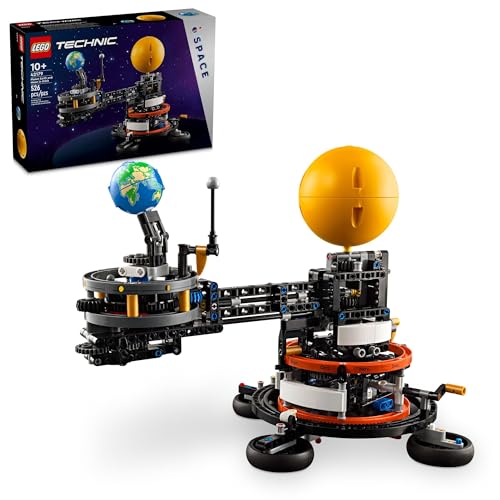
- 526-piece Technic construction set
- Hand crank shows Earth and Moon orbiting the Sun
- Includes months and moon-phase details
Best For: Older children who enjoy detailed LEGO builds and interactive science displays
Best Mechanical STEM Kit
Thames & Kosmos Orbiting Solar System

- Wind-up motor rotates the planets without batteries
- Introduces gear ratios and planetary gears
- Suitable for STEM and science fair projects
Best For: STEM learners, science fair projects, and mechanism enthusiasts
Best Preschool Puzzle
Wooden Solar System Planet Puzzle

- Designed for toddlers and preschoolers
- Wooden planet pieces feature realistic photographs
- Portable format supports fine motor practice
Best For: Preschoolers developing fine motor skills and beginning astronomy vocabulary
Best Creative Starter Kit
Wookidel 64-Piece Solar System Model

- 64-piece kit with foam planets, paints, brushes, and project accessories
- Includes instructions for a guided astronomy activity
- Good fit for school projects and creative family learning
Best For: Creative solar system projects for ages 6–12
Best Glow-in-the-Dark Planetarium
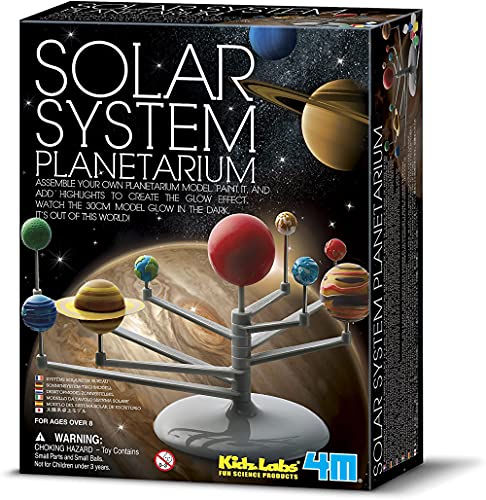
- Assemble-and-paint kit with glow paint, rods, and string
- Includes a fact-filled wall chart and quiz questions
- Designed for children ages 8 and up
Best For: Older kids and teens who enjoy astronomy crafts and displays
Best Interactive Felt-Board Model

- Movable planets attach to a felt board with hook-and-loop pieces
- Includes paints, labels, adhesives, brushes, and instructions
- Completed project can be hung as wall décor
Best For: Visual, interactive learning for children ages 6 and up
Hands-On Preschool Pick
Wooden Solar System Puzzle Board

- Smooth wooden board with eight planet pieces
- Includes astronaut figures and double-sided cards
- Designed for matching, exploration, and early space learning
Best For: Preschoolers learning colors, planets, and basic space concepts
Best Build-and-Explore Option
Smartivity Gear-Driven Solar System Kit

- DIY rotating model for hands-on learning
- Explores planets, orbits, day, and night
- Made for STEM-minded kids ages 8–14
Best For: Older children who enjoy construction and interactive science projects
Best Flash-Card Learning Set
Wooden Solar System Board with Astronauts

- Eight wooden planets for matching practice
- Adds three astronauts and eight double-sided cards
- Supports observation, imagination, and early STEM learning
Best For: Preschoolers and guided parent-child space activities
Best Glow-and-Build Pick – National Geographic Solar System Model
For children ages 8 and up, this National Geographic kit is one of the more creative solar system models for children. Kids paint all eight planets and the Sun, add decals, and assemble a movable display that glows in the dark.
Best For: Hands-on astronomy projects and space-themed bedroom décor.
Pros:
- Includes planets, paints, glow paint, brush, palette, decals, and an educational poster.
- Movable arms let children adjust the planet positions.
- Combines construction, painting, and astronomy learning.
Cons:
- Recommended for ages 8 and up, so it is not suited to preschoolers.
- Painting and assembly require time and hands-on supervision as needed.
This is a strong choice when you want a model that functions as both a creative activity and a glowing display. Its included materials make it convenient for a STEM-themed gift or project.
Best Interactive Build – LEGO Earth and Moon in Orbit
LEGO Technic’s 526-piece set offers an engaging alternative to traditional solar system models for children ages 10 and up. Turning the crank moves the Earth and Moon around the Sun while printed months and moon phases connect the build to seasonal changes.
Best For: Older children who enjoy detailed LEGO builds and interactive science displays.
Pros:
- Crank-operated mechanism demonstrates orbital movement without batteries.
- Printed months and moon phases support learning about seasons and lunar cycles.
- LEGO Builder app provides 3D viewing, progress tracking, and building guidance.
- Large finished model works as space-themed room décor.
Cons:
- With 526 pieces, it may be more involved than a simple beginner model.
- Recommended for ages 10 and up.
This set is particularly appealing for children who learn best by building and manipulating mechanisms. It emphasizes the Earth-Moon relationship rather than presenting all eight planets.
Best Mechanical STEM Kit – Thames & Kosmos Orbiting Solar System
The Thames & Kosmos Orbiting Solar System is a practical pick among solar system models for children who enjoy mechanisms. Its wind-up motor rotates the planets without batteries, while the build introduces gear ratios and planetary gears.
Best For: STEM learners, science fair projects, and children interested in how mechanisms work.
Pros:
- Wind-up motor creates rotating planetary motion with no batteries required.
- Explores gear mechanics and planetary gears through construction.
- Includes planet stickers, building pieces, a manual, and a suction cup.
- Built-in expansion slot allows for a possible future Planet Nine addition.
Cons:
- Listed as an intermediate kit, so some children may need assistance.
- The small model is more focused on mechanics than detailed planet decoration.
This kit stands out for explaining motion through a working mechanism rather than paint or static assembly. It is a useful option when the educational goal includes basic engineering concepts.
Best Preschool Puzzle – Wooden Solar System Planet Puzzle
This wooden puzzle is a simple, tactile introduction to space for children ages 3 to 5. Among solar system models for children, it is designed for early learners, with easy-grip pieces printed with planet photographs and a lightweight board suited to tabletop or travel play.
Best For: Preschoolers developing fine motor skills and beginning astronomy vocabulary.
Pros:
- Easy-grip wooden pieces are sized for small hands.
- Printed planet photographs make the design more realistic and recognizable.
- Supports hand-eye coordination and fine motor development.
- Lightweight, thin design is convenient for travel.
Cons:
- It is a manual puzzle rather than a rotating or moving solar system model.
- The compact design provides less display value than larger models.
- Adult supervision is appropriate for young children during play.
Choose this puzzle when age-appropriate simplicity matters more than mechanical features. Its portable wooden format makes it useful for preschool activities, homeschool lessons, and quiet travel play.
Best Creative Starter Kit – Wookidel 64-Piece Solar System Model
For children who learn best by making, this Wookidel kit is a hands-on option among solar system models for children. It combines foam planets, painting supplies, bamboo sticks, flags, and an instruction guide so kids can create a school project or family activity from the supplied materials.
Best For: Creative school projects and guided astronomy activities for children ages 6–12.
Pros:
- Includes 64 pieces, including foam balls, stars, paints, brushes, sticks, flags, and instructions.
- Foam surfaces are designed to be easy to color.
- Combines planet-building with painting and introductory solar-system information.
- Supports hand-eye coordination, focus, artistic skills, and science learning.
Cons:
- Children need to assemble and paint the model, so adult guidance may be useful.
- The supplied materials are foam rather than a rigid display model.
This is a well-rounded pick when you want one kit to cover crafting, basic astronomy, and a classroom-ready project. Its broad assortment of supplies makes it especially practical for children who enjoy decorating and building.
Best Glow-in-the-Dark Planetarium – 4M Solar System Planetarium
The 4M Solar System Planetarium offers a more structured building activity for children exploring solar system models for children. Kids assemble and paint the planets, then use the included glow paint, rods, and string to create a display, with a wall chart and quiz questions adding a learning component.
Best For: Older children and teens who want an astronomy craft with glow-in-the-dark display appeal.
Pros:
- Includes planets, stencils, rods, string, glow paint, and complete instructions.
- Fact-filled wall chart and 10 sets of Kidz Quiz questions extend the learning activity.
- Requires no batteries.
- Recommended for ages 8 and up, making it suitable for more advanced independent projects.
Cons:
- Pluto is not included.
- Painting and assembly require more patience than a ready-made model.
Choose this set if the finished display matters as much as the building process. The glow feature adds a distinctive room-decoration element, while the chart and quizzes give the craft a stronger STEM focus.
Best Interactive Felt-Board Model – Solar System Project Kit
This project kit stands out among solar system models for children because its planets attach to a felt board with hook-and-loop pieces. Children can reposition the planets and simulate their paths on the star-track diagram, then hang the completed project as a wall decoration.
Best For: Children ages 6 and up who benefit from movable, visual learning activities.
Pros:
- Includes a felt board, foam planet pieces, paints, brushes, labels, adhesive pieces, and instructions.
- Movable planets let children explore placement and simulated trajectories.
- Finished board can be hung on a wall to display the child’s work.
- Supports spatial awareness, logical thinking, imagination, concentration, and hand-eye coordination.
Cons:
- Assembly includes painting, labeling, and attaching multiple adhesive components.
- The model is a wall-mounted felt-board activity rather than a free-standing 3D display.
This is the strongest choice for repeatable, hands-on exploration rather than a one-time build. The repositionable pieces make the solar-system layout easier to revisit, while the hanging format keeps the completed project useful as room décor.
Hands-On Preschool Pick – Wooden Solar System Puzzle Board
For families seeking solar system models for children ages 3 and up, this wooden matching board offers a tactile introduction to planets and space. It includes eight wooden planets, knowledge cards, and astronaut figures for hands-on play and discussion.
Best For: Preschoolers developing color recognition, concentration, imagination, and early planetary knowledge.
Pros:
- Natural beech wood with a smooth, burr-free surface; the notes state it passed CPC safety tests.
- Large, graspable planet pieces support hands-on matching and exploration.
- Includes eight double-sided knowledge cards and three astronaut figures for extended space-themed play.
- The board can also serve as room décor or a parent-child learning activity.
Cons:
- It is a matching puzzle board rather than a rotating or mechanically operating model.
- The manufacturer recommends it for children ages 3 and up, so it is not intended for younger toddlers.
This is a practical choice when you want an approachable, screen-free introduction to the planets with sturdy wooden components and visual reference cards.
Best Build-and-Explore Option – Smartivity Gear-Driven Solar System Kit
For older children comparing solar system models for children, this DIY kit focuses on construction and movement. Kids assemble a gear-driven model that rotates, creating a hands-on way to explore planets, orbits, day, and night.
Best For: Children ages 8–14 who enjoy building projects and introductory STEM activities.
Pros:
- Combines assembly, creativity, and basic astronomy in one project.
- The completed model rotates, giving children an interactive look at planetary motion.
- Made from MDF and described as using eco-friendly, child-safe materials.
- Gift-ready packaging makes it suitable for birthdays and other occasions.
Cons:
- Assembly is required, so it may be less suitable for younger children or those wanting an immediately playable model.
- The manufacturer recommends the kit for ages 8 and up.
This kit is the stronger fit for families who value building and motion over a simple display board, while still wanting an astronomy-focused STEM activity.
Best Flash-Card Learning Set – Wooden Solar System Board with Astronauts
This solar system model for children pairs a wooden puzzle board with planet pieces, astronaut figures, and double-sided educational cards. It is designed for children ages 3 and up and supports visual, tactile, and parent-guided space learning.
Best For: Preschool learning spaces, parent-child activities, and children building observation, color-recognition, and early STEM skills.
Pros:
- Includes eight wooden planets, three resin astronauts, and eight double-sided knowledge cards.
- Large planet pieces are designed for grasping and matching.
- The notes state that the set has a smooth surface, no burrs or heavy metals, and passed CPC safety tests.
- Supports imagination, concentration, observation, and planetary cognition.
Cons:
- The set is a static puzzle board, not a working orbital or rotating model.
- Its recommended age begins at 3 years, limiting its use for children under that age.
Choose this version if the included flash cards and astronaut figures are especially useful for guided lessons, conversation, or reinforcing planet recognition during play.
How We Picked the Best Solar System Models for Children
We focused on models that support learning through building, arranging, observing, or interactive play. The selection includes wooden puzzles, construction sets, rotating displays, glow-in-the-dark planetariums, and project kits. We considered the recommended age range, assembly demands, durability, educational value, display potential, and whether the activity works independently or needs adult help.
Because children learn differently, no single model is ideal for every family. A preschool puzzle serves a different purpose from a detailed mechanical kit, so we compared each option within its intended use rather than treating complexity as an automatic advantage.
Quick Comparison
| Best For | Look For |
|---|---|
| Preschool learning | Large wooden pieces, simple matching, and easy-to-handle parts |
| STEM building | Gears, orbit mechanisms, clear instructions, and hands-on assembly |
| Creative projects | Paintable planets, craft components, and room for customization |
| Bedroom displays | Glow-in-the-dark surfaces, stable bases, and attractive finished designs |
| Family activities | Moderate assembly, shared building time, and age-appropriate explanations |
Key Buying Factors for Solar System Models for Children
Age and Supervision
Check both the stated age range and the type of activity involved. Younger children generally need oversized pieces and simple matching tasks, while older kids may enjoy small components, painting, gears, or multi-step construction. Kits with tiny parts should be used with appropriate supervision.
Learning Goal
Choose a puzzle for planet recognition and sequencing, a rotating model for demonstrating movement, or a craft kit for creative exploration. If your child is interested in engineering, a gear-driven or motorized design may offer more lasting value than a static display.
Assembly and Durability
Some kits are ready to arrange, while others require building, painting, or careful mechanical assembly. Consider how much time your family wants to spend on setup and whether the completed model will be handled frequently or displayed. Wooden pieces can be practical for younger learners, while detailed builds may require more careful storage.
Accuracy and Scale
Most children’s models simplify planetary size and distance for practicality. Look for clear labeling and explanations of orbit order, but do not expect a tabletop kit to represent true scale. A model is most useful when paired with books, diagrams, or guided discussion.
Who Should Buy Which Solar System Models for Children?
For ages three to five, choose a sturdy wooden solar system puzzle with large, easy-to-grip planets. For elementary-age children who enjoy building, LEGO, Smartivity, Thames & Kosmos, and similar mechanical kits provide stronger STEM engagement. Glow-in-the-dark planetariums suit children who enjoy crafts and bedroom displays, while larger project kits are better for families planning a guided science activity.
If you want a gift that can be revisited, prioritize a model with moving parts, customization, or a durable display base. If your main goal is a quick introduction to planet order and names, a simple puzzle or compact wooden board may be the more practical choice.