
The best solar system models turn abstract astronomy into something children can build, move, observe, and explain. This roundup compares 10 options spanning glow-in-the-dark planetariums, motorized kits, DIY projects, educational displays, and detailed scale models.
Whether you need a classroom activity, a thoughtful STEM gift, or a durable display for an astronomy enthusiast, the right choice depends on age, assembly style, interactivity, accuracy, and available space.
Best 10 Solar System Models Picks for 2026
Best Glow-in-the-Dark Pick
National Geographic Solar System Model

- Paint-and-build project with all eight planets and the Sun
- Movable arms support adjustable display positions
- Glow paint, decals, and fact poster included
Best For: Creative space projects and bedroom décor for ages 8 and up
Best Interactive Building Set
LEGO Planet Earth and Moon in Orbit
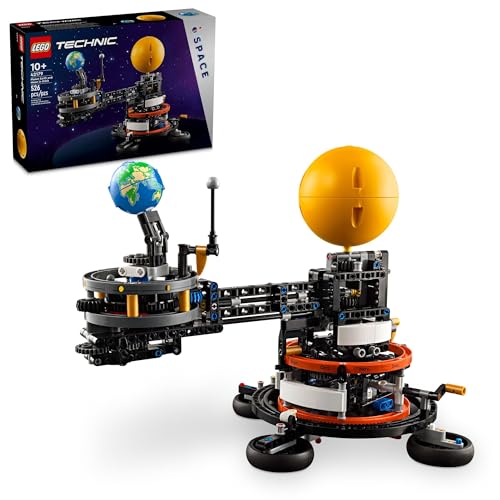
- 526-piece LEGO Technic construction set
- Turn the crank to demonstrate orbital movement
- Includes months and moon phases
Best For: Hands-on STEM learning and reusable space décor for ages 10 and up
Best Classroom Project Kit
Wookidel 64-Piece Solar System Kit

- Foam planets, stars, paints, brushes, and project supplies included
- Designed for coloring and hands-on assembly
- Useful for home, classroom, or family activities
Best For: Customizable school and family astronomy projects
Best Motorized Display
GeoSafari Motorized Solar System

- Planets orbit at different speeds around the Sun
- Star dome projects constellations on walls or ceilings
- Includes eight planets and a 28-page learning guide
Best For: Interactive bedroom or classroom science displays
Best Hands-On Build

- Rotating gear-driven planet model
- STEM activity for ages 8–14
- Eco-friendly, child-safe MDF
Best For: Children who enjoy building and exploring basic astronomy
Best Creative School Project
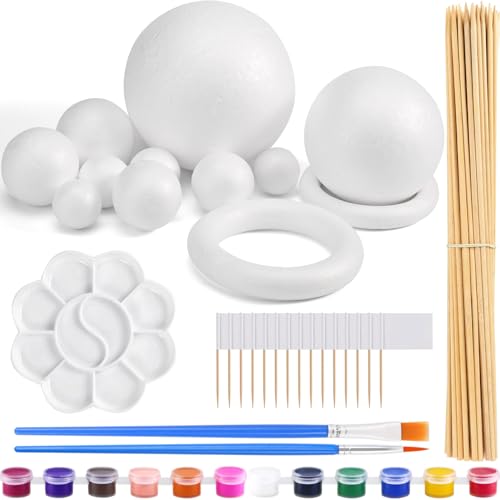
- 48-piece painting and assembly set
- 10 ball sizes show relative scale
- Includes paints, brushes, flags, and sticks
Best For: DIY school projects and personalized space displays
Best for Comfort
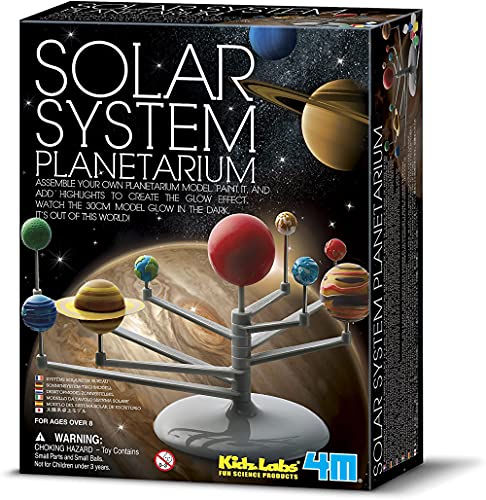
- Paintable planets with glow paint
- Includes chart and quiz questions
- Battery-free kit for ages 8+
Best For: Children who want a display model plus astronomy activities
Interactive STEM Pick
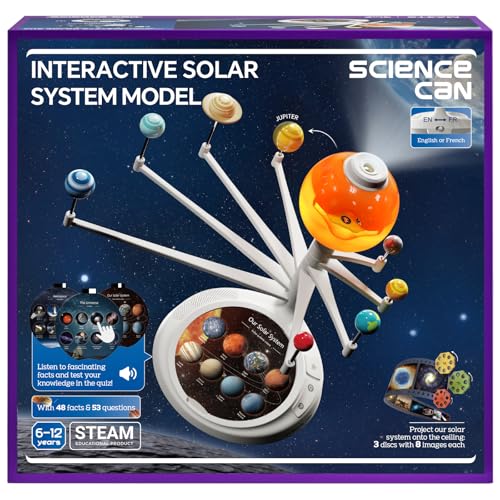
- 48 facts and 53 quiz questions
- Bilingual English/French learning
- Projects 24 colorful space images
Best For: Interactive astronomy learning for children ages 6–12
Hands-On Building Pick
Orbiting Solar System STEM Kit

- Wind-up rotating planetary model
- Explores gear ratios and planetary gears
- Suitable for science fair projects
Best For: Intermediate mechanical STEM building for ages 6–14
Display-Focused Pick

- 1:2,000,000,000 relative scale
- Detailed planetary colors and textures
- Includes manual, tweezers, and gift card
Best For: Astronomy displays, classrooms, and gifts for ages 10+
Best Glow-in-the-Dark Pick – National Geographic Solar System Model
For kids who enjoy hands-on crafts, this National Geographic solar system model combines planet painting, assembly, and display appeal. The finished model includes all eight planets and the Sun, movable arms, glow-in-the-dark accents, and a space-themed poster.
Best For: Children ages 8 and up who want a creative solar system project and bedroom display.
Pros:
- Includes paints, glow paint, brush, palette, decals, and a fact poster.
- Movable arms let kids adjust the planets after assembly.
- Supports construction, creative, coordination, and problem-solving skills.
Cons:
- Painting and assembly require time and adult guidance may be useful for some children.
- The plastic model is designed for display rather than detailed astronomical scale accuracy.
This is a strong choice when creativity and room décor matter as much as learning. Its glow feature gives the completed project extra visual appeal.
Best Interactive Building Set – LEGO Planet Earth and Moon in Orbit
This LEGO Technic solar system model offers a mechanical way to explore orbital movement. Once built, children can turn the crank to see the Earth and Moon move around the Sun, while printed months and moon phases connect the model to seasons and lunar cycles.
Best For: Builders ages 10 and up who prefer an interactive, reusable STEM display.
Pros:
- Crank-operated movement demonstrates Earth and Moon orbits.
- Printed months and moon phases add educational context.
- The 526-piece build includes LEGO Builder app support and makes substantial space décor.
Cons:
- It represents the Earth, Sun, and Moon rather than all eight planets.
- The 526-piece construction may be more involved than a simple classroom craft.
Choose this set for a child who enjoys building mechanisms as much as learning astronomy. Its moving design makes orbital concepts easier to observe than with a static model.
Best Classroom Project Kit – Wookidel 64-Piece Solar System Kit
The Wookidel solar system model kit is designed for coloring and building projects at home or in the classroom. It includes foam pieces, 12 paint colors, brushes, bamboo sticks, toothpick flags, stars, and instructions so children can create a personalized planets display.
Best For: School assignments, family activities, and group astronomy projects for children ages 6 to 12.
Pros:
- Includes 64 pieces and supplies for painting and assembly.
- Foam surfaces are described as smooth and easy to color.
- Encourages creativity, hand-eye coordination, focus, and science learning.
Cons:
- Foam construction may be less durable than a hard plastic or LEGO model.
- Painting and assembly can be messy and require workspace preparation.
- The supplied age details vary between youth, ages 3–5 in a highlight, and manufacturer guidance of 6–12.
This kit makes sense when the goal is an accessible, customizable project rather than a ready-made display. Its generous paint and accessory selection suits school and family activities.
Best Motorized Display – GeoSafari Motorized Solar System
For a ready-to-use solar system model, the GeoSafari Motorized Solar System uses different orbital speeds to create an interactive display of the inner and outer planets. Its swappable domes also turn the unit into a constellation projector and night-light.
Best For: Children ages 8 to 12 who want an interactive bedroom or classroom science display.
Pros:
- Motorized planets orbit the Sun at different speeds.
- Swappable Sun and star domes provide planet and constellation activities.
- Includes eight planets and a 28-page guide with planetary and constellation facts.
Cons:
- Requires four AA batteries, which are not included.
- It is a preassembled display rather than a build-and-paint project.
- The unit has a relatively large footprint for a tabletop model.
This is a practical pick for children who benefit from motion and visual demonstrations without needing to assemble the model. The constellation dome adds useful nighttime functionality beyond standard solar system models.
Best Hands-On Build – Gear-Driven Solar System Kit
The Smartivity DIY Solar System Kit is a strong choice for families seeking solar system models that combine construction with basic astronomy. Designed for ages 8–14, it creates a rotating planet display and introduces concepts such as planets, orbits, day, and night through hands-on play.
Best For: Kids ages 8–14 who enjoy building projects and STEM-focused space activities.
Pros:
- Gear-driven design lets children build and rotate the model.
- Connects construction and creativity with introductory astronomy.
- Uses eco-friendly, child-safe MDF materials.
- Gift-ready packaging suits birthdays and other occasions.
Cons:
- It is designed for ages 8 and up, so younger children may need help.
- The kit is primarily a build-and-display project rather than a detailed planetarium.
Choose this model when active assembly and a moving display matter more than included painting supplies or extensive reference materials. It offers a focused, approachable way to explore how the solar system is organized.
Best Creative School Project – Foam Ball Solar System Kit
This 48-piece kit is one of the more craft-oriented solar system models, giving children foam spheres, paint, brushes, bamboo sticks, rings, and labeling flags. The assortment of sizes supports visual comparisons between the Sun, planets, and Pluto while leaving room for a personalized school or science project.
Best For: Hands-on classroom assignments, homemade displays, and younger children working with an adult.
Pros:
- Includes 10 differently sized foam balls for visual scale comparisons.
- Provides 12 paint colors, brushes, and a paint tray.
- Bamboo skewers and toothpick flags help with assembly and labeling.
- Suitable for crafts, decoration, and school science projects.
Cons:
- Painting and assembly require more preparation than a prebuilt model.
- Foam components may be better suited to supervised use, especially for younger children.
- The supplied notes list a recommended age range of 0–8 years, which may not match every project requirement.
This is a practical pick when the learning value comes from making the model yourself. Its paint and labeling supplies make it especially useful for a customized presentation, though the finished result depends on the builder’s time and care.
Best for Comfort – DIY Solar System Planetarium
The 4M Solar System Planetarium is a well-rounded option for shoppers comparing solar system models with an astronomy-learning component. Children assemble and paint the planets, then use the included glow paint pen, rods, string, wall chart, and quiz questions to extend the activity beyond basic construction.
Best For: Kids ages 8 and up who want a paintable model with glow-in-the-dark features and astronomy facts.
Pros:
- Combines assembly, painting, and glow-in-the-dark play.
- Includes a fact-filled wall chart and 10 sets of Kidz Quiz questions.
- Requires no batteries.
- Complete assembly instructions are included.
Cons:
- Pluto is not included.
- The kit is recommended for ages 8 and up, so younger children may need assistance.
- It focuses on eight planets rather than a scale-accurate display.
This model stands out for children who want an activity that continues after assembly, thanks to the glow feature and educational materials. It is a particularly appealing choice for a bedroom display or science-themed gift, provided the omission of Pluto is acceptable.
Interactive STEM Pick – Talking Solar System Model
For families comparing solar system models, this interactive option combines talking knowledge cards, quizzes, and a planetarium-style projector. It is designed to make introductory astronomy more engaging for children while supporting English and French learning.
Best For: Children ages 6–12 who enjoy interactive, screen-free STEM activities and space-themed play.
Pros:
- Teaches 48 space facts through three knowledge cards, with English and French options.
- Includes 53 quiz questions for reinforcing basic astronomy concepts.
- Projects 24 full-color space images using three included disks.
- The illuminated Sun and hands-on design help demonstrate sunlight and planetary positions.
Cons:
- Requires three AA batteries, which are not included.
- The educational content is aimed primarily at younger children rather than advanced astronomy study.
This is a feature-rich choice for younger learners who benefit from audio prompts, quizzes, and visual demonstrations. Its projector and bilingual modes add versatility for home or classroom use, though families should plan to supply batteries.
Hands-On Building Pick – Orbiting Solar System STEM Kit
Among solar system models, this kit stands out for turning planetary motion into a mechanical building project. Children assemble a rotating display powered by a wind-up motor, while exploring gear ratios and planetary gears without needing batteries.
Best For: Young builders, science fair projects, and intermediate STEM activities for ages 6–14.
Pros:
- Creates a colorful rotating model with a battery-free wind-up motor.
- Introduces gear mechanics, gear ratios, and planetary gears through hands-on construction.
- Connects mechanical motion with celestial orbits and planetary facts.
- Includes an expansion slot for a possible future Planet Nine addition.
Cons:
- Intermediate difficulty may require help from an adult or experienced builder.
- The small plastic kit is focused on construction and motion rather than detailed planet display.
This is a practical choice when the building process matters as much as the finished model. Its wind-up mechanism keeps the activity simple and battery-free, while the gear-focused design makes it especially suitable for STEM demonstrations and science fair work.
Display-Focused Pick – True Scale Solar System Model
For shoppers seeking solar system models with a display-oriented design, this collection emphasizes relative planetary size, realistic colors, and fine surface details. The 1:2,000,000,000 scale makes the Sun and eight planets compact enough for a desk, shelf, classroom, or study area.
Best For: Astronomy enthusiasts, students, classrooms, and gift buyers seeking a detailed miniature display.
Pros:
- Represents the Sun and eight planets at a stated 1:2,000,000,000 scale.
- Uses space-photography-inspired colors and textures, including Earth’s continents and Jupiter’s cloud bands.
- Includes the Sun, eight planets, two Moons, a manual, tweezers, and a gift card.
- Compact presentation works for desks, bookshelves, offices, and classrooms.
Cons:
- Recommended for ages 10 and up, so it may not suit younger children.
- The compact scale is intended for display and observation, not a large interactive orbit demonstration.
This model is a strong fit for buyers who prioritize accurate relative diameters and a polished presentation over moving parts or quizzes. The included manual and accessories add educational and gifting value, while the compact dimensions make it easy to place in everyday spaces.
How We Picked These Solar System Models
We selected models across several common use cases rather than treating every kit as interchangeable. The lineup includes build-and-paint projects, gear-driven and motorized models, talking and interactive educational products, glow-in-the-dark planetariums, construction sets, classroom-friendly activity kits, and a detailed scale display.
We focused on the features that matter most to buyers: recommended age, learning value, quality of the building experience, durability, display potential, included materials, and how clearly each product communicates planetary order and motion. Because no tabletop model can reproduce the solar system’s true distances and sizes simultaneously, we also considered whether a product presents scale honestly and usefully.
Quick Comparison
| Best For | Look For | Potential Trade-Off |
|---|---|---|
| Young learners | Large planets, simple instructions, interactive features | Less scientific detail |
| STEM building | Gears, moving parts, testing, and problem-solving | More assembly time |
| Creative projects | Paints, foam spheres, labels, and customization | Results depend on craft skills |
| Classrooms | Clear planet identification and repeatable activities | May need extra supervision |
| Home display | Accurate details, stable construction, compact footprint | Less hands-on play |
Key Buying Factors for Solar System Models
Age and Supervision
Match the model to the child’s age and patience. Younger children generally benefit from large, easy-to-handle components and guided activities. Older children may prefer mechanisms, painting, research prompts, or a more involved construction challenge. Check for small parts, sharp sticks, paint, batteries, and required tools before buying.
Learning Style and Movement
Decide whether the goal is memorizing the planets, understanding orbit, practicing engineering, or creating a visual display. Motorized and windup models can demonstrate movement, while talking or labeled products support identification. DIY kits offer stronger creative ownership but may require more adult help.
Materials, Size, and Storage
Foam and lightweight plastic are convenient for projects and younger users, while a LEGO or gear-based construction can provide a more substantial building experience. Measure the intended shelf or desk before choosing a rotating model, and consider where loose planets, paints, and accessories will be stored.
Accuracy and Expectations
Look for clearly labeled planets, correct order, informative guides, and transparent scale information. A model can be educational without being physically proportional, so prioritize the type of accuracy that supports your goal: recognizable details for display, clear orbital relationships for teaching, or factual explanations for deeper study.
Who Should Buy Which Solar System Models?
Choose a glow-in-the-dark or simple interactive model for a younger child who wants visual, low-barrier astronomy play. Pick a motorized, windup, or gear-driven kit for children who learn best by assembling mechanisms and watching planets move. A foam-ball or paint-based kit suits school projects and creative families that want to customize the result.
For a gift that combines construction with a polished finished object, a building-set approach is a strong fit. Teachers and homeschoolers should favor models with clear labels, repeatable demonstrations, and enough durability for frequent handling. Adults or older students seeking a conversation piece should look for the true-scale display model, while remembering that even a detailed tabletop product is a simplified representation of an enormously large system.