
Portable function generators are useful when you need reliable test signals without hauling a full bench setup. They can support electronics troubleshooting, circuit development, calibration, and field service work.
This roundup focuses on models that balance output quality, portability, and practical features so you can choose the right generator for your workflow.
Best 10 Portable Function Generators Picks for 2026
Dual-Channel Precision Pick
Koolertron 15MHz DDS Signal Generator

- Dual-channel DDS output with independent settings
- 15MHz sine output with 200MSa/s sampling
- Stores 99 instrument states and 60 custom waveforms
Best For: Electronics labs, teaching, and research needing dual-channel flexibility
High-Frequency Portable Choice
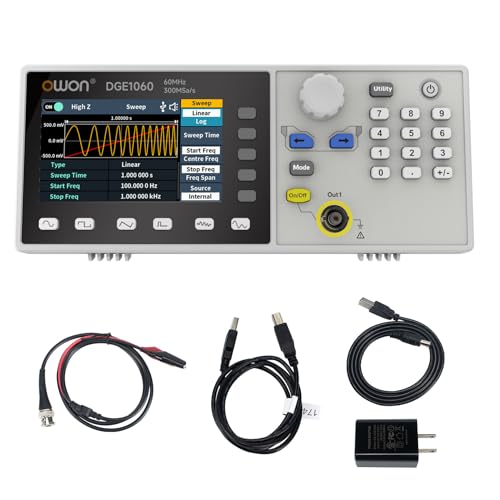
- 60MHz output with 300MSa/s sampling
- 3.6-inch TFT LCD with shortcut keys
- AM, FM, PM, FSK, sweep, and burst support
Best For: Users who want a compact, higher-bandwidth lab generator
Handheld Dual-Channel Pick

- Handheld, battery-powered compact design
- Dual-channel DDS output
- 20MHz signal generation for mobile testing
Best For: Field technicians and users who need battery-powered portability
PC-Controlled Bench Pick
OWON 60MHz Single-Channel Generator

- 60MHz single-channel arbitrary waveform output
- USB PC control with SCPI support
- Waveform editor plus sweep and burst modes
Best For: PC-assisted circuit testing and repeatable bench workflows
RF Workhorse
High Frequency Signal Generator 100KHz-150MHz

- 100KHz-150MHz range across 6 bands
- AM/FM support with low phase noise
- Simple front panel and one-piece build
Best For: Simple RF testing and bench signal generation
Field Service Multitool
4-20mA Signal Generator with Battery
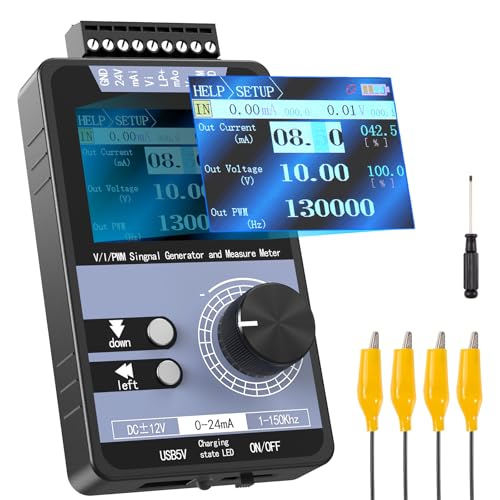
- Output, measurement, and PWM in one device
- Rechargeable 1500mAh battery for cordless use
- One-click calibration plus parameter storage
Best For: On-site electronic maintenance and industrial signal testing
Dual-Channel Lab Pick
DDS Signal Generator Counter 60MHz

- Dual-channel DDS with independent settings
- Wide waveform selection plus custom storage
- Built-in frequency, period, and pulse measurements
Best For: Lab testing and waveform experiments with measurement needs
DIY Precision Starter

- 1Hz-1MHz range for basic test work
- Sine, triangle, and square outputs
- DIY kit requires soldering tools
Best For: Budget-minded hobbyists who can assemble a kit
Portable Waveform Explorer
DDS Generator with Schumann Output
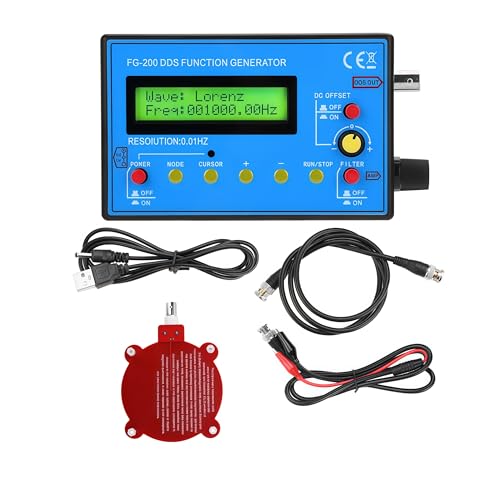
- 0.01Hz-500kHz sine range
- 15 waveform types including Schumann wave
- Compact size for teaching and field use
Best For: Experimenters who want a compact multiwave generator
Bench-Test Utility
FG-200 DDS Signal Source Module

- Sine to 500kHz, other waves to 100kHz
- Saved settings plus DC offset control
- Good fit for oscilloscope calibration
Best For: Oscilloscope users needing a compact test source
Dual-Channel Precision Pick – Koolertron 15MHz DDS Signal Generator
If you want portable function generators with solid flexibility, this Koolertron unit stands out for dual-channel output, built-in counter tools, and a broad set of waveform options. It is geared toward bench work where you need stable DDS signals, user-defined waveforms, and quick access to sweep and measurement functions.
Best For: Electronics engineering, lab work, teaching, and scientific research where dual-channel control matters.
Pros:
- Dual-channel DDS output with independent parameter settings
- Supports sine, square, triangle, sawtooth, pulse, white noise, and user-defined waveforms
- Includes linear and logarithmic sweep functions
- Built-in frequency, period, pulse width, and counting measurements
Cons:
- 15MHz sine output is lower than some higher-bandwidth bench generators
- Larger and heavier than the most compact handheld options
- Best suited to laboratory-style use rather than pocket carry
Overall, this is a practical choice if you value waveform variety, measurement features, and dual-channel flexibility in a portable function generator. Its saved setups and custom waveform storage add convenience for repeated test routines.
High-Frequency Portable Choice – OWON 60MHz DGE1060
This OWON model is a strong option among portable function generators if you need higher bandwidth in a compact design. It combines a 60MHz output range, 300MSa/s sampling, and a 3.6-inch TFT LCD with a practical control layout for routine lab and troubleshooting tasks.
Best For: Lab, research, and education users who want a compact generator with more bandwidth.
Pros:
- 60MHz bandwidth with 300MSa/s sampling rate
- 14-bit vertical resolution and 8K waveform depth
- Includes 5 basic waveforms plus 160 built-in arbitrary waveforms
- Supports AM, FM, PM, FSK, sweep, and burst functions
Cons:
- Single-channel design limits multi-signal setups
- Front-panel display is small compared with larger bench instruments
- Shorter waveform length than some higher-end arbitrary generators
For users who need a portable function generator with stronger frequency capability and modern modulation tools, this OWON is easy to justify. Its compact body, shortcut keys, and PC remote control support make it a convenient everyday instrument.
Handheld Dual-Channel Pick – GME FG-2020 20MHz Generator
For buyers seeking truly handheld portable function generators, the GME FG-2020 is built around a battery-powered compact form factor. It offers dual-channel DDS signal generation in a design aimed at field use, bench testing, and situations where portability is more important than maximum bandwidth.
Best For: Field testing, mobile troubleshooting, and users who want a battery-powered compact generator.
Pros:
- Handheld and battery powered for genuine portability
- Dual-channel DDS signal function generator
- 20MHz output capability
- Compact style suited to mobile work
Cons:
- Fewer published feature details than some competing models
- Bandwidth is lower than 60MHz alternatives
- Best fit for portability-first use rather than feature-heavy lab work
If you need a portable function generator you can carry and power from a battery, this GME model keeps the focus on convenience. It is a straightforward choice for users who prioritize compact size and dual-channel operation.
PC-Controlled Bench Pick – OWON 60MHz Single-Channel Generator
This OWON model fits buyers who want portable function generators with modern PC control and a straightforward single-channel layout. With 60MHz output, 300MSa/s sampling, and SCPI support, it is built for circuit testing, waveform editing, and repeatable bench routines.
Best For: Engineers, students, hobbyists, and small labs that want PC-assisted waveform control.
Pros:
- 60MHz single-channel arbitrary waveform output
- 300MSa/s sample rate and 14-bit resolution
- Supports AM, FM, PM, FSK, sweep, and burst functions
- USB PC control with SCPI and waveform editor support
Cons:
- Single-channel design may not suit dual-signal testing
- No built-in battery-powered specification listed
- Focused more on bench control than handheld use
As a portable function generator, this OWON makes sense if you want software-assisted workflow and custom waveform handling. Its compact size and front-panel controls keep it practical for everyday electronics work.
RF Workhorse – High Frequency Signal Generator 100KHz-150MHz
If you need portable function generators for basic RF and audio-style signal work, this TSG-17 focuses on straightforward operation and a broad frequency span. Its 100KHz-150MHz range, AM/FM support, and low phase-noise design make it a practical choice for testing setups that value signal purity and simple setup over advanced programmability.
Best For: Bench testing, radio-frequency signal generation, and users who want a simple, ready-to-run unit.
Pros:
- Wide 100KHz-150MHz frequency range across 6 bands
- Supports multiple modulation methods, including AM and FM
- Low phase noise helps maintain signal purity
- One-piece structure with clear front-panel controls
Cons:
- Runs on 110V power, so it’s less flexible for battery-free portability
- More focused on RF signaling than feature-heavy waveform generation
Overall, this is a solid pick if you want a durable, easy-to-operate signal source with broad RF coverage. It suits users who value quick setup and dependable output more than advanced generator features.
Field Service Multitool – 4-20mA Signal Generator with Battery
Among portable function generators, this Riiai unit stands out because it combines output, measurement, and PWM generation in one compact tool. It’s built for maintenance and testing work where you need adjustable current and voltage, a rechargeable battery, and a screen that keeps key values easy to read on the move.
Best For: Electronic maintenance, industrial control testing, and field technicians who need one portable calibration tool.
Pros:
- Combines current/voltage output, measurement, and PWM output
- High-precision adjustable output with 0-24mA and ±12V ranges
- 1500mAh rechargeable battery supports cord-free use
- One-click calibration and parameter storage add convenience
Cons:
- Specialized toward 4-20mA and voltage testing rather than general waveform generation
- Compact size may limit how much control surface space you get
For technicians who need a pocketable test instrument instead of a traditional benchtop generator, this is a very practical option. Its mix of portability, measurement, and safety protections makes it especially useful for on-site work.
Dual-Channel Lab Pick – DDS Signal Generator Counter 60MHz
If you want portable function generators with more lab-style flexibility, this Seesii DDS unit offers dual-channel output, waveform variety, and built-in measurement tools. It’s a strong fit for electronics work where you may need sine, square, triangle, pulse, or custom waveforms, plus frequency counting and sweep functions in a compact package.
Best For: Electronics labs, teaching setups, and users who need dual-channel waveform generation with measurement features.
Pros:
- Dual-channel DDS output with independently adjustable settings
- Supports sine, square, triangle, sawtooth, pulse, white noise, and custom waveforms
- Stores 99 instrument states and 60 custom waveforms
- Includes frequency, period, pulse width, and counting functions
Cons:
- At 1 kilogram, it is portable but not ultra-light
- Feature set is broader than a basic plug-and-play signal source
This is the most versatile choice in the group if waveform control matters as much as portability. The combination of stored presets, sweep modes, and measurement tools makes it well suited to hands-on experimentation.
DIY Precision Starter – XR2206 Signal Generator Kit
This portable function generator kit is a practical pick if you want a low-cost, adjustable source for basic lab and hobby testing. It covers sine, triangle, and square outputs from 1Hz to 1MHz, with decent accuracy and a transparent case that makes the assembled module easy to inspect.
Best For: Hobbyists and DIY users who don’t mind soldering and want an affordable adjustable signal source.
Pros:
- Frequency range from 1Hz to 1MHz for general bench and hobby use.
- Outputs sine, triangle, and square waveforms with 600 ohm impedance.
- Good stated precision, with less than 1% distortion at 1kHz and +0.05dB flatness from 1Hz to 100kHz.
- Transparent case shell makes the finished kit easy to view.
Cons:
- Requires soldering tools and assembly experience.
- Amplitude is limited to 0-3V on sine and triangle outputs at 9V DC input.
- Square wave output is listed as 8V no-load, which may be restrictive for some uses.
This kit makes sense when you want an inexpensive, portable function generator and are comfortable building it yourself. It is best suited to basic signal testing rather than a fully featured plug-and-play bench instrument.
Portable Waveform Explorer – DDS Generator with Schumann Output
This portable function generator is aimed at users who want a compact, feature-heavy waveform source for testing and experiments. It offers a very wide 0.01Hz to 500kHz sine range, multiple specialty waveforms, and a 7.83Hz Schumann resonator output for niche applications.
Best For: Users who want a compact multifunction generator with lots of waveform options and Schumann resonance features.
Pros:
- Wide frequency coverage, with sine wave output from 0.01Hz to 500kHz.
- Includes 15 waveform types, such as sine, square, triangle, sawtooth, ECG, pulse, noise, and Schumann wave.
- Small and easy to carry, with a 4.92 x 3.15 x 1.04 inch footprint.
- Simple to set up and described as practical for teaching and field use.
Cons:
- Other waveforms are limited to 0.01Hz to 100kHz.
- Schumann-related claims are specific to the included resonator feature and may not matter for standard bench work.
- Not as focused on traditional lab-style controls as some dedicated function generators.
If you want a compact portable function generator with unusual waveform choices, this model stands out. It is especially appealing for experimentation, but its feature set is broader than a standard signal-source tool.
Bench-Test Utility – FG-200 DDS Signal Source Module
This portable function generator module is built for practical circuit testing, especially when paired with an oscilloscope. It offers sine, square, and sawtooth waveforms, frequency-saving memory, DC offset control, and filter options that help clean up outputs for different measurement tasks.
Best For: Oscilloscope users and electronics hobbyists who want a compact signal source for debugging and calibration.
Pros:
- Useful for circuit test, debugging, and oscilloscope calibration.
- Frequency range extends to 0.01Hz-500kHz for sine and 0.01Hz-100kHz for other waveforms.
- Includes saved settings, DC offset control, run/stop control, and adjustable amplitude.
- Filter switch can help clean sine output, especially near higher frequencies.
Cons:
- Sine amplitude decreases as frequency increases.
- Power options are relatively specific, with 4-9V DC recommended for adapters.
- More advanced users may want a dedicated bench generator instead of a small module.
For hands-on measurement work, this is a sensible portable function generator module with useful control features. It is best viewed as a compact utility source for testing, not a polished standalone lab centerpiece.
How We Picked Portable Function Generators
We prioritized signal range, waveform variety, output accuracy, portability, and control features that matter in real testing. For Portable Function Generators, the best choices also offer clear displays, stable output, and enough flexibility for bench and field use.
We favored units that cover common needs like sine, square, and triangle outputs, while also considering dual-channel support, arbitrary waveform capability, frequency range, and battery or compact form factors.
Quick Comparison
If you mainly need simple signal output, a lower-cost function generator kit or compact DDS unit may be enough. For more demanding work, look for higher bandwidth, better sampling rate, and finer amplitude or frequency control. If you need to verify loops or instrumentation, a signal generator with current, voltage, or PWM output can be more useful than a standard waveform source.
Key Buying Factors for Portable Function Generators
Frequency Range and Stability
Choose a model that covers the signals you actually test. Audio, sensor, control, and RF work all demand different ranges, so wider frequency coverage is helpful if your projects vary. Stability matters as much as maximum frequency.
Waveform Options and Resolution
Basic waveforms are enough for many repairs, but arbitrary waveform support gives you more control for specialized testing. Higher vertical resolution and better sample rates usually translate to cleaner, more useful outputs.
Portability and Power
True portability means more than a small enclosure. Battery operation, lightweight construction, and simple controls all make field use easier. If you plan to move between workspaces, look for a generator that is easy to set up and read in low-light or bench environments.
Connectivity and Control
Some Portable Function Generators include PC control or SCPI compatibility, which is valuable for repeatable workflows and automated testing. Others focus on straightforward manual operation, which may be better if you want quick signal setup without software.
Who Should Buy Which Portable Function Generators?
Choose a compact DDS or handheld model if you want fast setup for general electronics testing, hobby projects, or service work. Pick a higher-frequency arbitrary waveform generator if you need more precision, dual-channel output, or broader application coverage. If your work involves loops, sensors, or industrial signals, a current-and-voltage signal generator may be the best fit. DIY kits are best for budget-conscious users who do not mind assembly and basic calibration.
For most buyers, the right portable function generator is the one that matches your common test signals, fits your workspace, and gives you the control you need without unnecessary complexity.