
Two channels let you view signals side by side—a practical advantage when checking timing, comparing inputs and outputs, or troubleshooting a circuit. But bandwidth alone does not tell you how useful a scope will be: sample rate, display, triggering, and portability matter too.
These 10 options range from handheld multifunction testers to higher-bandwidth bench scopes. Use the guide below to narrow the field around the signals you measure and where you work.
Best 10 2 Channel Oscilloscopes Picks for 2026
Broad Bus Support
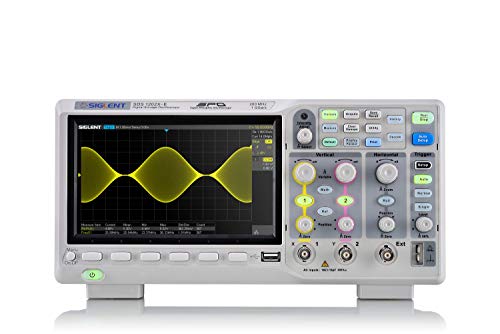
- Two channels, 200 MHz bandwidth
- Up to 1 GSa/s and 14 Mpts
- Decodes I2C, SPI, UART/RS232, CAN, and LIN
Best For: Embedded serial-bus troubleshooting
Touchscreen Portability

- 7-inch touch display
- Battery rated for four hours
- 100 MHz per channel; 1 GSa/s sampling
Best For: Portable, touchscreen-based measurements
12-Bit Detail

- 12-bit resolution; 25 Mpts memory
- Up to 1,000,000 wfms/s
- LAN/SCPI control and serial decode
Best For: Ripple inspection and intermittent-event debugging
Long-Capture Bench Pick

- 200 MHz; up to 1 GSa/s
- 24 Mpts, or 12 Mpts dual-channel
- Records and plays back up to 60,000 frames
Best For: Long-capture bench debugging
Portable 3-in-1 Pick
FNIRSI 2C53T Handheld Oscilloscope

- 50 MHz, two channels, 250 MSa/s
- Built-in multimeter and signal generator
- 1 Kpts record depth
Best For: Portable checks with one multifunction instrument
Deep-Memory Bench Pick

- 100 MHz and up to 1 GSa/s
- Up to 12 Mpts with both channels
- UART, I2C, and SPI decoding
Best For: Longer bench captures and embedded debugging
Trigger-Focused Economy Pick

- 100 MHz, two channels
- 14 trigger modes
- Five serial trigger/decode options
Best For: Bench testing with varied trigger needs
Best Handheld Multitool

- 50 MHz high-speed mode
- 25,000-count multimeter
- Built-in signal generator
Best For: All-in-one field troubleshooting
Best Bench-Style Display
HANMATEK DOS1102 110 MHz Oscilloscope
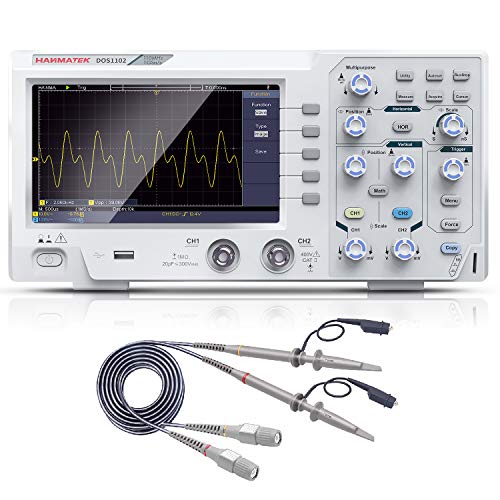
- 110 MHz dual-channel bandwidth
- 7-inch 800 × 480 display
- 30 automatic measurements
Best For: Powered workbench testing
Best High-Bandwidth Multifunction
FNIRSI DPOS350P 350 MHz Oscilloscope

- 350 MHz bandwidth; 1 GSa/s
- Spectrum and frequency-response analysis
- 7-inch touchscreen; 8000 mAh battery
Best For: Multifunction lab and field analysis
Broad Bus Support – Siglent SDS1202X-E 200 MHz
Among 2 channel oscilloscopes, the Siglent SDS1202X-E is a bench option for buyers who need 200 MHz bandwidth and serial-bus troubleshooting. It offers up to 1 GSa/s real-time sampling and up to 14 Mpts of record length.
Best For: Embedded-system work involving several serial-bus protocols.
Pros:
- 200 MHz bandwidth across two channels.
- Up to 1 GSa/s sampling and 14 Mpts record length.
- Standard trigger and decode support for I2C, SPI, UART/RS232, CAN, and LIN.
Cons:
- At 5.5 pounds, it is less convenient to carry than a smaller handheld-style scope.
The broad protocol list is the main reason to choose this model; check that its size and weight suit your workspace.
Touchscreen Portability – FNIRSI 1013D Plus 100 MHz
For buyers comparing portable 2 channel oscilloscopes, the FNIRSI 1013D Plus combines a 7-inch touchscreen with a built-in battery. Its listed bandwidth is 100 MHz per channel, with a 1 GSa/s sampling rate.
Best For: Portable signal checks when a touchscreen and battery operation matter.
Pros:
- 7-inch, 800 × 480 touch display with gesture controls.
- 6,000 mAh battery is rated for four hours of use.
- Stores up to 1,000 screenshots and 1,000 waveform data sets.
- Includes cursor measurements, Lissajous display, and FFT viewing.
Cons:
- 100 MHz bandwidth is lower than the 200 MHz models in this roundup.
- FFT is described as a rough estimate of harmonic content.
This is a practical choice when untethered use and on-screen interaction outweigh the need for higher bandwidth.
12-Bit Detail – RIGOL DHO802 70 MHz
The RIGOL DHO802 stands out among 2 channel oscilloscopes for its 12-bit resolution, which is useful when inspecting small ripple or noise. It pairs 70 MHz bandwidth with up to 1.25 GSa/s sampling and 25 Mpts of memory depth.
Best For: Bench work focused on ripple inspection, long captures, and intermittent events.
Pros:
- 12-bit resolution and up to 25 Mpts memory depth.
- Up to 1,000,000 waveforms per second, plus search and event navigation.
- Standard decode for CAN, RS232/UART, I2C, SPI, and 4-bit parallel signals.
- LAN-based control, SCPI automation, USB, and HDMI connections.
Cons:
- 70 MHz bandwidth is the lowest of these four models.
Choose it for acquisition detail and tools for finding elusive events, provided 70 MHz covers the signals you plan to measure.
Long-Capture Bench Pick – RIGOL DS1202Z-E 200 MHz
For buyers who want 200 MHz bandwidth in a bench-format 2 channel oscilloscope, the RIGOL DS1202Z-E offers up to 1 GSa/s sampling and deep memory. Its specified memory reaches 24 Mpts, or 12 Mpts with both channels in use.
Best For: Bench debugging that benefits from longer captures and waveform review.
Pros:
- 200 MHz bandwidth and an external trigger input.
- Up to 24 Mpts memory, with 12 Mpts in dual-channel use.
- Up to 30,000 wfms/s and recording/playback of up to 60,000 frames.
- RS232/UART, I2C, and SPI decode, plus USB and LAN connections.
Cons:
- Full 24 Mpts memory depth is not available when using both channels.
- Listed serial-decode options do not include CAN or LIN.
Its memory and recording features make it well suited to reviewing long signal captures; confirm its protocol coverage matches your projects.
Portable 3-in-1 Pick – FNIRSI 2C53T Handheld Oscilloscope
Among 2 channel oscilloscopes, the FNIRSI 2C53T is a compact option for buyers who also want a multimeter and signal generator in one handheld device. It offers 50 MHz bandwidth, a 250 MSa/s sampling rate, and a built-in battery rated for up to six hours of standby time.
Best For: Portable electronics checks when carrying separate test instruments is inconvenient.
Pros:
- Combines a two-channel oscilloscope, 19,999-count multimeter, and 13-waveform signal generator.
- Includes math, cursor measurements, persistence, and XY mode.
- Saves waveform images for export to a PC over Type-C.
Cons:
- 1 Kpts record depth is limited for longer captures.
- 2.8-inch display offers less viewing space than a larger bench scope.
Choose this model for its versatile handheld toolset rather than deep waveform storage; its generator output reaches 50 kHz.
Deep-Memory Bench Pick – RIGOL DS1102Z-E
For buyers comparing 2 channel oscilloscopes for a workbench, the RIGOL DS1102Z-E pairs 100 MHz bandwidth with up to 1 GSa/s sampling and memory rated up to 24 Mpts, or 12 Mpts when using both channels. Its capture and review features make it particularly useful when a fault is hard to reproduce.
Best For: Bench debugging that calls for longer captures and embedded serial-bus analysis.
Pros:
- Up to 30,000 waveforms per second and recording/playback of up to 60,000 frames help review intermittent events.
- Supports RS232/UART, I2C, and SPI triggering and decoding.
- 7-inch 800 × 480 display, plus USB and LAN connectivity, suits bench workflows.
Cons:
- At 8.83 pounds, it is less convenient to carry than a handheld instrument.
- Memory capacity drops from 24 Mpts to 12 Mpts in dual-channel use.
This is the strongest fit of the three when deep captures, serial decoding, and a larger display matter more than portability.
Trigger-Focused Economy Pick – Hantek DSO2C10
The Hantek DSO2C10 is a 100 MHz entry among 2 channel oscilloscopes, presented as an economy model with a broad set of triggering options. Its supplied specifications highlight 14 trigger modes and five serial-protocol trigger and decode options.
Best For: Buyers seeking a two-channel bench scope with multiple trigger and serial-decoding options.
Pros:
- 100 MHz bandwidth across two channels.
- Offers 14 trigger modes and five serial-protocol trigger and decode options.
- Product notes list arbitrary waveform output.
Cons:
- Supplied notes do not specify sampling rate or memory depth, making capture performance harder to compare.
- At 4.2 pounds, it is not as portable as a handheld scope.
Its appeal is the stated trigger and decode feature set, but confirm the unspecified sampling and memory specifications before choosing it for demanding captures.
Best Handheld Multitool – ZT-703S 50 MHz Oscilloscope
Among 2 channel oscilloscopes, this battery-powered handheld model is a practical choice when you also need a multimeter and signal generator. It offers a 30 MHz, 200 MSa/s normal mode and a 50 MHz, 280 MSa/s high-speed mode.
Best For: Field troubleshooting that calls for scope, meter, and basic signal-generation functions in one device.
Pros:
- Dual channels with AUTO waveform recognition and 128K storage depth.
- 25,000-count multimeter measures resistance, capacitance, continuity, diodes, and current.
- Signal generator outputs sine, square, triangle, and other waveforms; USB-C handles charging and data transfer.
Cons:
- High-speed mode consumes more power than normal mode.
- Its multiple functions may require time with the user manual.
Choose it for an all-in-one handheld kit rather than for the widest bandwidth in this roundup.
Best Bench-Style Display – HANMATEK DOS1102 110 MHz Oscilloscope
For shoppers comparing 2 channel oscilloscopes with a larger built-in screen, the DC-powered DOS1102 pairs 110 MHz bandwidth with a 7-inch, 800 × 480 display. Its listed real-time sampling rate is 500 MS/s per channel.
Best For: Electronics testing at a workbench where a large display and measurement tools matter.
Pros:
- 7-inch color display supports cursor measurements and waveform tracking.
- Provides 30 automatic measurements and a customizable measurement menu.
- USB device and host interfaces support U-disk storage; SCPI and LabVIEW communication are listed.
Cons:
- Requires DC power rather than running on a listed battery.
- Listed acquisition depth is at least 10K sample points, less than the depths stated for the other two models here.
This is the screen-forward option for a powered workspace, especially if USB storage and instrument communication fit your workflow.
Best High-Bandwidth Multifunction – FNIRSI DPOS350P 350 MHz Oscilloscope
If you need more bandwidth from 2 channel oscilloscopes, the battery-powered DPOS350P lists 350 MHz bandwidth and 1 GSa/s sampling. Its 7-inch touchscreen also gives access to spectrum analysis, frequency-response analysis, and a DDS signal generator.
Best For: Lab or field users who want waveform viewing alongside spectrum, Bode-plot, and signal-generation tools.
Pros:
- Dual-channel scope includes digital phosphor, X-Y mode, zoom, and cursor measurements.
- FFT-based spectrum analyzer offers harmonic markers and 2D/3D waterfall views.
- Frequency-response analyzer and 0–50 MHz DDS generator expand its test functions.
- 8000 mAh battery and USB-C charging support use away from a power outlet.
Cons:
- Listed 47 Kpts acquisition depth is shorter than the handheld ZT-703S’s stated 128K depth.
- At 3.56 pounds, it is heavier than the other two listed models.
Its appeal is the combination of higher stated bandwidth and analysis tools; check whether its acquisition depth and weight suit your work.
How We Picked the Best 2 Channel Oscilloscopes
We focused on two-channel models spanning common buyer needs: affordable bench work, portable troubleshooting, and higher-bandwidth measurement. The selection includes conventional desktop scopes, touchscreen and handheld designs, and combination units with multimeter or signal-generator functions. Published specifications helped establish the broad differences, but a bandwidth label or feature list cannot substitute for checking a model’s manual against your application.
Quick Comparison of 2 Channel Oscilloscopes
For a bench setup, the Siglent SDS1202X-E and RIGOL DS1202Z-E are listed at 200 MHz; the RIGOL DS1102Z-E and Hantek DSO2C10 are listed at 100 MHz. The RIGOL DHO802 pairs a listed 70 MHz bandwidth with 12-bit resolution, which may appeal when amplitude detail matters more than maximum bandwidth. The HANMATEK DOS1102 is listed at 110 MHz and has a 7-inch display.
For work away from a bench, compare the FNIRSI 1013D Plus touchscreen scope with the FNIRSI 2C53T and the handheld automotive 3-in-1 model. The latter two add meter and signal-generation functions and are listed at 50 MHz. The FNIRSI DPOS350P advertises 350 MHz and a 4-in-1 design; verify its complete specifications, probes, and supported functions before choosing it on the bandwidth figure alone.
Key Buying Factors for 2 Channel Oscilloscopes
Bandwidth, Sample Rate, and Memory
Choose bandwidth comfortably above the highest signal frequency you expect to inspect, especially if fast edges or harmonics matter. Check the sample rate with both channels enabled, not just the headline maximum. Acquisition memory affects how much detail remains when you capture a longer event; look for enough depth for your time scales and a responsive way to navigate recordings.
Resolution and Triggering
Higher vertical resolution can help distinguish small voltage changes, though noise and front-end performance also affect the result. Reliable edge triggering covers basic work; if you debug serial buses, intermittent glitches, or pulse-width faults, check the exact trigger and decode options rather than assuming they are included.
Probes, Safety, and Workflow
Confirm probe bandwidth, compensation range, included accessories, and replacement availability. Check the scope’s input and probe voltage ratings for your intended measurements. On typical grounded bench scopes, the probe ground clip is not a floating input; connecting it to the wrong point can cause a short. If you need measurements around mains or high-voltage equipment, plan for appropriately rated differential or isolated equipment. Also compare screen readability, controls, data export, and power requirements for your workspace.
Who Should Buy Which 2 Channel Oscilloscopes?
Pick a 200 MHz bench model if you want headroom for faster general electronics work and have desk space. Consider the DHO802 when 12-bit resolution is a priority and 70 MHz meets your needs. A 100–110 MHz bench option may be a sensible middle ground for routine debugging. Choose a handheld or touchscreen design when carrying the instrument matters most; choose a multifunction model when a built-in meter or generator will genuinely replace separate tools. Whatever the format, confirm the published specifications apply to the modes and channel settings you will actually use.