
The best planetarium projectors can turn a bedroom, classroom, or playroom into an engaging view of the night sky. The models in this roundup combine star fields, constellation and solar-system images, rotating projections, and relaxing light effects.
Use this guide to compare disc variety, image quality, controls, sound features, rotation, and overall ease of use before choosing a projector for education, sleep routines, or ambient room lighting.
Best 10 Planetarium Projectors Picks for 2026
Best Overall

- 13 realistic space projection discs
- 360° rotation with adjustable focus
- Wide 135–754-square-foot coverage
Best For: Families and adults wanting an immersive bedroom planetarium
Best Educational Pick

- Star maps for both hemispheres
- Includes four James Webb image discs
- 15-, 30-, and 60-minute timer options
Best For: Children ages 8+ and family STEM learning
Best Compact Option
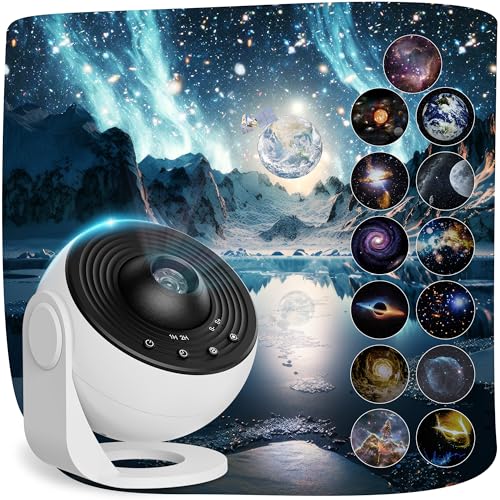
- Compact table-mounted semicircular design
- Two rotation speeds and adjustable focus
- 13 discs with subject introductions
Best For: Bedrooms needing a compact projector with wide coverage
Best Brightness Upgrade

- Claims 2X brighter projection
- 30% wider coverage than the prior version
- 13 educational space discs
Best For: Users wanting brighter, wider bedroom or event projections
Most Versatile
16-in-1 Galaxy Planetarium Projector

- 16 HD space and dinosaur projection scenes
- 29 soothing sounds plus Bluetooth 5.3 audio
- Remote control, rotation, and 1/2/4-hour timer
Best For: Bedrooms, nurseries, and sensory-friendly spaces
Best for Everyday Use
13-Disc Space Planetarium Projector

- 13 educational space projection scenes
- 2X brightness and 30% wider coverage
- Adjustable focus, angle, and rotation speeds
Best For: Educational displays and larger bedrooms or living rooms
Best Simple Setup

- 13 realistic solar system, galaxy, and nebula images
- Nebula, star, and combination projection modes
- 360° stand with simple setup and auto-off timer
Best For: Kids’ rooms, playrooms, and casual home décor
Best Adjustable-Focus Pick

- 13 interchangeable space-themed film discs
- Adjustable focus and 360° rotation
- Simple three-button control with timer
Best For: Families wanting an easy, hands-on tabletop projector
Best Wide-Coverage Pick
FlyLily 13-in-1 Planetarium Projector

- Wide stated coverage up to 754 square feet
- 13 educational space scenes included
- Quiet rotation with multiple timer options
Best For: Large bedrooms, playrooms, and astronomy enthusiasts
Best Kid-Friendly Pick
Pro Meteor-Effect Planetarium Projector

- Built-in meteor-fall effect
- 13 replaceable space-themed discs
- 360° adjustable stand and sleep timers
Best For: Kids' rooms, nurseries, and bedtime stargazing
Best Overall – Galaxy Projector Pro
This versatile choice among planetarium projectors combines 13 realistic space scenes with a rotating display, adjustable focus, and broad coverage. It is designed for dark indoor spaces and can project across walls, floors, or ceilings.
Best For: Families and adults seeking an immersive bedroom planetarium with varied space imagery.
Pros:
- Includes 13 space-themed projection discs, including the Solar System, Milky Way, and black hole.
- 360° rotation, adjustable projection angle, and focus control support flexible setup.
- Projects up to 16 feet with coverage listed from 135 to 754 square feet.
- Offers 1-hour and 2-hour timers plus a default 4-hour auto-off.
Cons:
- Requires a USB power connection and is intended for dark indoor environments.
- The package does not indicate that a wall adapter is included.
With its large selection of discs and wide projection range, this model is a strong all-purpose option for decorative viewing and casual astronomy exploration.
Best Educational Pick – T&K STEM Planetarium Set
For shoppers prioritizing learning, this astronomy set stands apart from typical planetarium projectors with rotating star maps for both hemispheres and a second projector for space imagery. Its tabletop or wall-mounted design suits guided exploration at home.
Best For: Children ages 8 and up and families looking for a STEM-focused astronomy activity.
Pros:
- Includes accurate northern and southern hemisphere star maps and constellation information.
- Dual-mode design can display the star map and separate space images simultaneously.
- Four image discs feature authentic images from the James Webb Space Telescope.
- Nightlight mode includes 15-, 30-, and 60-minute auto-off settings.
Cons:
- Its six-inch size is relatively compact compared with larger room-filling projectors.
- It requires USB-C power and does not use batteries.
This is the most education-oriented option in the group, offering a more structured way to learn constellations while still providing relaxing space imagery.
Best Compact Option – 13-in-1 Galaxy Projector
This compact white model is one of the more straightforward planetarium projectors for bedrooms, offering 13 labeled space scenes, two rotation speeds, adjustable focus, and a USB-C connection. Its semicircular table design is easy to position on a nightstand or shelf.
Best For: Bedroom users who want a compact, feature-focused projector with broad ceiling coverage.
Pros:
- Provides 13 projection discs with brief introductions to the featured space subjects.
- Supports 360° adjustment and two rotation speeds for a calmer or more active display.
- Projects up to 16.4 feet, with stated coverage from 135 to 754 square feet.
- Includes 1-hour, 2-hour, and default 4-hour shutoff settings.
Cons:
- A 5V/2A power adapter is required but not included.
- Bright rooms can reduce projection clarity, so a dark environment is recommended.
Its small footprint and useful controls make it a practical choice when you want expansive projections without a bulky tabletop unit.
Best Brightness Upgrade – Galaxy Projector Pro
This upgraded model is a strong contender among planetarium projectors for shoppers who want brighter, wider room projections. It combines 13 educational space discs with two rotation speeds, adjustable focus, and a claimed 2X brightness and 30% wider coverage than the prior version.
Best For: Kids’ rooms, movie nights, and adults who want a brighter ambient space display.
Pros:
- Includes 13 space scenes with brief introductions for educational viewing.
- Claims 2X brighter output and 30% wider projection coverage than the previous version.
- Supports 360° projection adjustment, two rotation speeds, and manual focus control.
- Offers 1-hour, 2-hour, and default 4-hour automatic shutoff.
Cons:
- For clearest results, it still requires a darker environment.
- A 5V/2A power adapter is not included.
If brightness and room-filling coverage are your priorities, this Pro version offers the most explicitly upgraded projection performance in the lineup.
Most Versatile – 16-in-1 Galaxy Planetarium Projector
Among planetarium projectors, this model stands out for combining 16 HD space and dinosaur scenes with a built-in sound machine and Bluetooth speaker. It is a particularly feature-rich choice for bedrooms, nurseries, and sensory-friendly spaces.
Best For: Families wanting projection, soothing sounds, and music in one bedroom device.
Pros:
- Includes 16 themed projection cards covering space, auroras, dinosaurs, and more.
- Offers 29 built-in soothing sounds, including white, pink, and brown noise.
- Bluetooth 5.3 speaker, remote control, 360° rotation, and 1/2/4-hour timer add convenience.
- Includes a 36-month quality guarantee and stated FCC, CE, and RoHS certifications.
Cons:
- The large number of audio and projection features may be more than needed for simple star projection.
- A power adapter is not specified in the supplied notes.
This is the strongest all-in-one option for shoppers who want planetarium-style visuals plus sleep and entertainment features. Choose it if versatility matters more than keeping the setup minimal.
Best for Everyday Use – 13-Disc Space Planetarium Projector
This planetarium projector focuses on brighter, wider celestial displays and educational space content. Its 13 discs, adjustable focus, and controlled rotation make it a practical pick for projecting detailed scenes on bedroom or living-room walls and ceilings.
Best For: Kids and adults who want educational space scenes with a larger, brighter projection.
Pros:
- Provides 13 labeled space scenes, including planets, nebulae, galaxies, and a black hole.
- Claims 2X brightness and 30% wider coverage, projecting up to 16.4 feet.
- Adjustable focus, 360° projection angle, and two rotation speeds improve positioning flexibility.
- Quiet operation and 1/2/4-hour auto-off settings suit relaxing nighttime use.
Cons:
- A 5V/2A power adapter is required but not included.
- Best image clarity requires a darker environment and correct slide orientation.
With its emphasis on brightness, coverage, and astronomy content, this is a strong choice for users who want more than a simple ambient light. It also makes a thoughtful space-themed gift, provided the missing adapter is accounted for.
Best Simple Setup – 2-in-1 USB Galaxy Projector
This compact USB planetarium projector offers a straightforward way to create a starry ceiling or wall. It combines 13 realistic space images with nebula, star, and combination modes, making it suitable for bedrooms, playrooms, classrooms, and home theaters.
Best For: Shoppers seeking an uncomplicated, budget-conscious projector for kids’ rooms or casual décor.
Pros:
- Includes 13 realistic solar system, galaxy, and nebula projections.
- Three modes let users show nebulae, stars, or a combined effect.
- 360° adjustable stand supports ceiling or wall positioning.
- Three-step setup and 1/2-hour auto-off timers make it easy to use.
Cons:
- The supplied notes list only a 30-day manufacturer warranty.
- It has fewer advanced controls and accessories than the more feature-rich models.
- The included components list identifies the projector but does not mention projection discs separately.
This model is a sensible entry point for families who want simple star and galaxy effects without a built-in audio system. Its adjustable stand and easy setup are especially useful for occasional decorating or children’s spaces.
Best Adjustable-Focus Pick – HD 13-Disc Galaxy Projector
If you want planetarium projectors with hands-on controls and a classic tabletop design, this model offers 13 space-themed film discs, adjustable focus, and 360° rotation. Its simple three-button layout makes it practical for bedrooms, kids’ rooms, and atmospheric home decor.
Best For: Families and adults who want a straightforward projector with multiple interchangeable space scenes.
Pros:
- Includes 13 film discs covering subjects such as Earth, the Moon, the Milky Way, galaxies, and nebulae.
- Adjustable focus helps produce clearer images at different projection distances.
- Offers 360° rotation, two rotation speeds, and 1- or 2-hour timer settings.
- Compact tabletop design includes a USB-C cable and cleaning cloth.
Cons:
- It is intended for dark indoor environments for the best projection effect.
- Its projected coverage is listed at 75.3–172.2 square feet, which may be smaller than some competing models.
This is a sensible choice if ease of use and physical film-disc changes matter more than app-based controls. The focus knob and simple buttons also make it approachable for children and casual users.
Best Wide-Coverage Pick – FlyLily 13-in-1 Planetarium Projector
Among planetarium projectors, the FlyLily stands out for its stated wide projection range and brighter upgraded design. It displays 13 educational space scenes, rotates in 360°, and includes timer settings for quiet bedroom use.
Best For: Users who want broad wall or ceiling coverage, astronomy-themed content, and a calming night-light experience.
Pros:
- The upgraded model is described as twice as bright as its predecessor with a 30% wider projection range.
- Includes 13 scenes such as the Solar System, black hole, wormhole, nebula, Aurora, Earth, and Saturn.
- Projects across a stated coverage area of 135–754 square feet, with a maximum distance of 16.4 feet.
- Offers quiet operation, 360° rotation, two rotation speeds, and 1-, 2-, or 4-hour shutoff options.
Cons:
- It requires a corded USB power connection rather than standalone battery operation.
- The supplied notes do not provide complete technical details or a listed warranty.
Choose this version when projection scale is a priority. Its broad stated coverage and varied educational discs make it especially appealing for turning a larger bedroom or play space into a space-themed display.
Best Kid-Friendly Pick – Pro Meteor-Effect Planetarium Projector
This planetarium projector combines replaceable space discs with a built-in meteor-fall effect and a simple three-step setup. Its adjustable stand, focus knob, silent motor, and timer make it a practical option for kids’ rooms, nurseries, and bedrooms.
Best For: Children and families seeking simple controls, soothing rotation, and a mix of educational and decorative projections.
Pros:
- Includes 13 replaceable discs featuring the Solar System, Milky Way, black hole, observable universe, and other scenes.
- Built-in meteor-fall effect adds a distinctive visual feature.
- Adjustable 0–360° stand can direct the projection toward a wall or ceiling.
- Provides adjustable focus, 1- or 2-hour auto-off timers, and a stated projection area of up to 135 square feet.
Cons:
- The stated maximum projection distance is 3 meters, limiting very large-room use.
- The notes mention a silent motor but do not specify the exact noise level.
- Operation is controlled by push buttons rather than a remote or app.
The straightforward insert, switch, and focus process is well suited to younger users. Its meteor effect and flexible stand give it extra decorative appeal, while the timer supports use as a bedtime light.
How We Picked These Planetarium Projectors
We focused on features that make a projector useful beyond its basic novelty effect. The selection includes models with interchangeable film discs, astronomy-focused imagery, rotating projections, adjustable brightness, and bedroom-friendly controls. We also considered whether each option suits children, casual users, STEM activities, or relaxation.
Because product specifications can vary by listing and package, verify the included discs, power method, remote or control options, sound features, and projection coverage before ordering.
Quick Comparison
| Best For | Features to Prioritize | Why It Matters |
|---|---|---|
| STEM learning | Constellations, solar-system discs, clear images | Supports guided lessons and independent exploration |
| Bedrooms | Quiet rotation, dimming, timer, simple controls | Creates atmosphere without being distracting |
| Children | Durable design, easy operation, safe low-heat lighting | Makes setup and supervised use simpler |
| Relaxation | Soothing colors, sound options, adjustable motion | Helps create a calming nighttime environment |
Key Buying Factors for Planetarium Projectors
Projection Content and Image Clarity
Check how many discs are included and whether they show actual constellations, planets, galaxies, or mostly decorative patterns. More discs provide variety, while sharper images are especially important for educational use. A dark room generally produces the clearest projection.
Coverage, Rotation, and Brightness
A 360-degree rotating head or rotating disc can spread imagery across walls and ceilings. Look for adjustable brightness and motion controls if the projector will be used near a bed. Continuous movement may be entertaining for children but distracting for light sleepers.
Controls, Power, and Sound
Remote controls, onboard buttons, USB power, and timers affect everyday convenience. If built-in sounds or soothing music are included, check whether volume can be adjusted or turned off. USB-powered units are convenient for bedrooms and travel, but you may need to supply a compatible adapter.
Build Quality and Intended Use
For children, choose a stable base and straightforward controls. For classroom demonstrations, favor recognizable astronomy images and easy disc changes. Decorative models may be better for mood lighting than accurate sky instruction, so match the feature set to your goal.
Who Should Buy Which Planetarium Projectors?
Choose an astronomy-focused model if you want constellation and solar-system content for learning. Choose a disc-rich projector if variety matters for regular bedroom use. Choose a sound-enabled model if you want a combined night-light and relaxation machine. Choose a compact USB projector for portability, dorm rooms, travel, or flexible placement. Families should prioritize simple operation, brightness control, and a stable design over extra effects.