
The best light meters for photographers make exposure decisions faster, more repeatable, and less dependent on guesswork. The right model can measure incident or reflected light, evaluate flash, support cinema settings, or help match color temperature across a shoot.
We compared 10 options ranging from dedicated Sekonic exposure meters to affordable digital illuminance meters, focusing on measurement range, controls, portability, display readability, and practical use cases.
Best 10 Light Meters for Photographers Picks for 2026
All-Around Exposure Pick

- Accurate ambient and flash readings
- Photo, Cine, and HD Cine modes
- Compact design with LCD backlight
Best For: Stills, flash, and DSLR or mirrorless video
Smart Color Workflow Pick

- Measures light and color characteristics
- Bluetooth app with real-time sync
- Supports multiple meters up to 80 feet
Best For: Mixed-lighting and multi-meter production workflows
Compact Cine Meter Pick

- Ambient, flash, and reflected metering
- Cine and HD Cine modes
- Lux and foot-candle readouts
Best For: Portable still-photo and filmmaking exposure checks
Illuminance Measurement Pick
UNI-T UT383 Digital Light Meter

- Measures lux and foot-candles
- Wide 199,900-lux maximum range
- Backlit display with hold and max/min
Best For: Simple studio and location light-level checks
Professional Hybrid Meter
Sekonic LiteMaster Pro L-478D-U
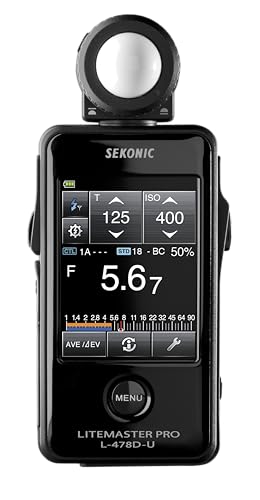
- Incident, flash, and optional reflected metering
- Touchscreen interface with cine controls
- Illuminance and luminance measurement modes
Best For: Professional photography, studio lighting, and hybrid video production
High-Range Illuminance Meter
BTMETER BT-881D Digital Light Meter
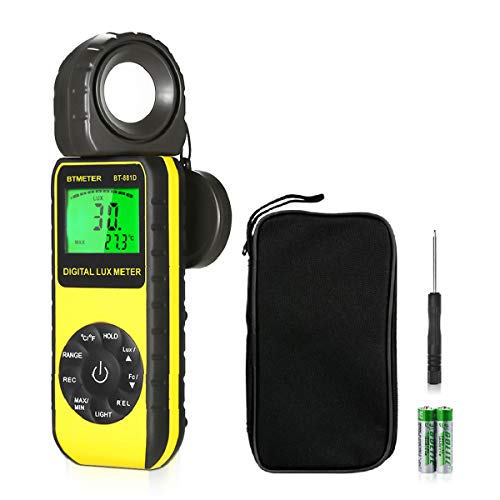
- Measures up to 400,000 lux
- Rotating 270-degree light sensor
- Stores 33 readings for comparison
Best For: Light-intensity checks for studios, LEDs, plants, offices, and outdoor areas
Retro Camera Meter
LightMate AirPro Reflective Meter

- 35-degree reflective metering at ±0.1 EV
- Tactile dials for ISO, shutter, and aperture
- Rechargeable battery rated for over 20 hours
Best For: Film cameras, Leica users, and photographers who prefer tactile controls
Best Value Handheld Meter
Compact 200,000-Lux Light Meter
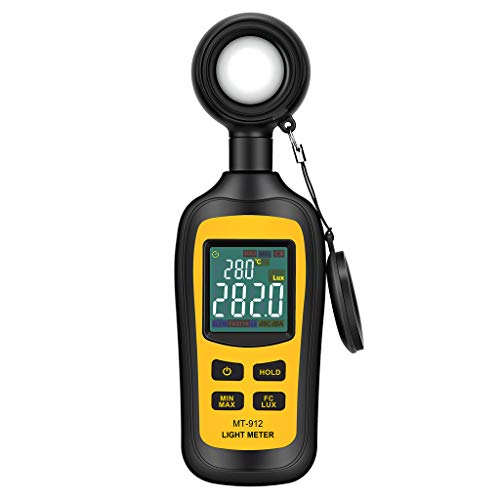
- 0–200,000 lux measurement range
- MIN/MAX, data hold, and auto power-off
- Lightweight design with two-year warranty
Best For: Portable general-purpose light and ambient-temperature checks
Best Budget Dual-Unit Meter
200,000-Lux Digital Illuminance Tester

- Displays readings in LUX or FC
- Automatic range conversion
- Backlight, hold, and MIN/MAX functions
Best For: Photographers needing lux and foot-candle measurements
Best Flexible Sensor Design
Rotating-Sensor Light Meter for Photography
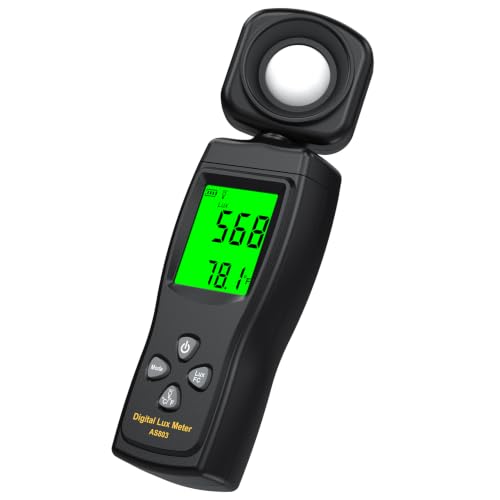
- 180° rotating sensor for angled readings
- 0–200,000 lux range with 0.5-second sampling
- Backlit display plus temperature measurement
Best For: Photography setups and measurements around hard-to-reach light sources
All-Around Exposure Pick – Sekonic L-308X-U Flashmate
For photographers comparing light meters for photographers, the Sekonic L-308X-U is a compact choice that handles both ambient and electronic flash readings. Its Photo, Cine, and HD Cine modes make it useful across still photography and video workflows.
Best For: Photographers and DSLR or mirrorless videographers who need portable ambient and flash metering.
Pros:
- Provides exposure readings accurate to one-tenth of a stop in full-stop mode.
- Supports ambient, corded flash, and cordless flash measurements.
- Includes dedicated Photo, Cine, and HD Cine modes.
- Pocket-sized design with LCD auto backlight and illuminance measurement.
Cons:
- Requires two AAA batteries.
- Its feature set may be more than needed for basic ambient-light readings.
The L-308X-U stands out as a versatile exposure meter when you want one small device for stills, flash, and video. Its broad shutter-speed and flash ranges add flexibility for mixed shooting situations.
Smart Color Workflow Pick – Datacolor LightColor Meter
The Datacolor LightColor Meter is a strong option for photographers seeking light meters for photographers with wireless color-management features. It measures light level, color temperature, and green-magenta balance, then syncs readings to a mobile app over Bluetooth.
Best For: Photographers and production teams balancing mixed lighting or coordinating measurements across multiple meters.
Pros:
- Measures ambient and flash lighting, lux, chromaticity, color temperature, and DUV.
- Covers color temperatures from 1,600K to 20,000K.
- Bluetooth app integration provides real-time data synchronization.
- Supports multiple meters simultaneously at distances up to 80 feet.
Cons:
- App-based operation may be less convenient for users who prefer a standalone meter.
- Requires two AAA batteries, although they are included.
This meter is particularly useful when exposure and color consistency matter as much as brightness. Its wireless workflow and support for varied light sources make it well suited to larger or more technical setups.
Compact Cine Meter Pick – Sekonic L-308X Exposure Meter
Sekonic FLASHMATE L-308X Photographers and Film Makers Exposure Meter - Black/Blue
Check Price On AmazonThe Sekonic L-308X is a compact exposure meter for photographers and filmmakers who need ambient, reflected, and flash readings in a small package. Dedicated Cine and HD Cine modes also make it practical for location scouting and on-set use.
Best For: Still photographers and filmmakers who want a portable meter for ambient, flash, and video exposure work.
Pros:
- Measures ambient and flash lighting with a broad metering range.
- Sliding lumisphere supports ambient readings and reflected readings through a 40-degree lens.
- Dedicated Cine and HD Cine modes support video workflows.
- Offers lux and foot-candle readouts.
Cons:
- Requires an AA battery.
- Does not list wireless app connectivity or color-temperature measurement in the supplied details.
With its wide exposure range and flexible reading methods, the L-308X is a capable general-purpose meter. It is especially appealing to filmmakers who want a quick, lightweight tool for scouting or set work.
Illuminance Measurement Pick – UNI-T UT383 Digital Light Meter
The UNI-T UT383 is a straightforward illuminance meter for photographers who mainly need light-intensity readings. It displays measurements in lux or foot-candles and offers a wide range, making it useful in studios and other practical lighting checks.
Best For: Photographers, studios, and users who need simple lux or foot-candle measurements rather than flash exposure metering.
Pros:
- Measures from 0 to 199,900 lux or 0 to 18,500 foot-candles.
- Provides a large backlit four-digit LCD display.
- Includes 0.5-second sampling, data hold, maximum/minimum readings, and overload indication.
- Compact design with automatic shutdown and low-battery indication.
Cons:
- Measures illuminance only; the supplied details do not list flash or color-temperature functions.
- Accuracy is specified as +/- (4% + 8), which may not suit precision exposure work.
The UT383 is best viewed as a basic light-intensity tool rather than a dedicated photographic exposure meter. Its broad lux range and simple controls make it useful for checking studio, household, office, or location lighting levels.
Professional Hybrid Meter – Sekonic LiteMaster Pro L-478D-U
For photographers comparing light meters for photographers, the Sekonic LiteMaster Pro L-478D-U is a versatile choice for still, studio, and motion work. Its touchscreen interface combines incident and flash metering with optional reflected spot capability and technical illuminance and luminance modes.
Best For: Professional photographers, studio users, and hybrid creators who need ambient, flash, and cine exposure control.
Pros:
- Measures incident ambient and flash light with flash-ratio analysis.
- Touchscreen color display supports quick exposure adjustments.
- Cine controls accommodate frame rate and shutter angle settings.
- Illuminance and luminance modes extend technical measurement options.
Cons:
- Optional reflected spot capability requires an additional attachment.
- Its advanced feature set may be more than casual still photographers need.
The L-478D-U stands out when one meter needs to cover photography and motion production. It is a feature-rich option for users who value broad measurement capability and touchscreen operation.
High-Range Illuminance Meter – BTMETER BT-881D Digital Light Meter
The BTMETER BT-881D is a practical option for photographers and lighting users who need to measure illuminance rather than set camera exposure directly. Its broad range, rotating sensor, and memory function make it useful for checking light levels across indoor and outdoor environments.
Best For: Photographers, studio managers, growers, educators, and anyone comparing light intensity from LEDs or other sources.
Pros:
- Measures from 0.01 to 400,000 lux, or 0.01 to 40,000 foot-candles.
- 270-degree rotating sensor helps measure from different angles.
- Stores 33 sets of readings and includes a relative comparison mode.
- Provides a stated response time of about 0.4 seconds.
Cons:
- It is an illuminance meter, not a dedicated incident or reflected camera exposure meter.
- Accuracy varies by measurement range according to the supplied specifications.
Choose the BT-881D when your priority is quantifying light intensity across a wide range. It is especially suited to lighting evaluation and documentation rather than camera-specific exposure control.
Retro Camera Meter – LightMate AirPro Reflective Meter
The LightMate AirPro takes a camera-mounted, tactile approach to exposure metering. For photographers seeking compact light meters for photographers, its 35-degree reflective metering, physical dials, and multiple automatic and manual modes make it a natural fit for Leica and other film cameras.
Best For: Film photographers who want a compact reflective meter with tactile controls and a retro-style exposure display.
Pros:
- 35-degree reflective metering with stated accuracy of ±0.1 EV.
- Supports aperture-priority, shutter-priority, manual, and EV modes.
- Independent aperture, ISO, and shutter dials provide tactile half-stop adjustments.
- USB-C rechargeable battery offers more than 20 hours of battery life.
Cons:
- Its ISO, shutter, and aperture ranges may not cover every shooting situation.
- Reflective metering requires a different workflow from incident metering.
The AirPro is appealing for photographers who prefer physical controls and a classic camera experience. Its compact metal body and configurable indicators add flexibility while keeping the exposure process hands-on.
Best Value Handheld Meter – Compact 200,000-Lux Light Meter
If you need straightforward light readings without a bulky instrument, this compact model is a practical choice among light meters for photographers. It measures ambient illumination up to 200,000 lux, displays results on a four-digit color LCD, and adds ambient-temperature readings for broader workspace checks.
Best For: Photographers, set designers, and home or office users who want a lightweight lux meter with basic memory and convenience functions.
Pros:
- Measures from 0 to 200,000 lux with stated accuracy of ±3% below 10,000 lux and ±4% above it.
- Includes MIN/MAX readings, data hold, auto power-off, and low-battery indication.
- Lightweight 6.7-ounce design and a stated two-year warranty.
Cons:
- Reports illumination in lux rather than listing a foot-candle mode in the supplied specifications.
- Requires three AAA batteries, which are not stated as included.
This is a sensible all-purpose option when portability and a wide lux range matter more than advanced photographic controls. Its temperature measurement and simple hold and min/max functions make it useful beyond camera work.
Best Budget Dual-Unit Meter – 200,000-Lux Digital Illuminance Tester
This digital illuminance tester is one of the more flexible light meters for photographers who want to switch between lux and foot-candle readings. Its automatic range conversion, large display, and 0-to-200,000-lux capacity suit indoor, outdoor, studio, and general brightness checks.
Best For: Photographers and hobbyists who need a broad measuring range with both LUX and FC display options.
Pros:
- Measures visible brightness up to 200,000 lux, or 18,500 foot-candles.
- Offers automatic range conversion and selectable LUX or FC units.
- Provides MIN/MAX, data hold, backlight, auto power-off, and low-battery functions.
Cons:
- The supplied notes do not provide a measurement-accuracy specification.
- Its feature set is focused on illuminance testing rather than dedicated camera exposure readings.
Choose this model if unit flexibility is important when comparing lighting environments. The included three AAA batteries and backlight also make it convenient for immediate, handheld use.
Best Flexible Sensor Design – Rotating-Sensor Light Meter for Photography
For photographers working around stands, cameras, or unevenly positioned light sources, this model stands out among light meters for photographers with its 180-degree rotating sensor. It measures up to 200,000 lux, samples every 0.5 seconds, and uses a backlit display for quick readings in dimmer locations.
Best For: Photography and film lighting setups, indoor plant monitoring, and users who benefit from flexible sensor positioning and temperature readings.
Pros:
- Measures 0 to 200,000 lux with stated accuracy of ±4% +10.
- 180-degree rotating sensor and backlit LCD support measurements from different angles and in low light.
- Records MAX/MIN values, holds data, measures temperature in Celsius or Fahrenheit, and samples in 0.5 seconds.
- Works with LED, fluorescent, halogen, and HID lighting sources.
Cons:
- The supplied notes do not describe dedicated photographic exposure or aperture readings.
- Its 8-inch listed product dimension may be less compact than some handheld alternatives.
The rotating sensor is the main reason to choose this meter: it can simplify readings when direct positioning is awkward. Its fast sampling, backlight, and environmental temperature display add practical value for studio, indoor, and plant-lighting checks.
How We Picked the Best Light Meters for Photographers
We evaluated these light meters by looking at the type of measurement each one provides, its useful range, control layout, display, power source, and intended audience. Dedicated photographic meters typically offer incident and reflected exposure readings, while general lux meters are better suited to measuring ambient illumination rather than setting camera exposure directly.
We also considered features that matter in real workflows, including flash analysis, cine frame rates, shutter-angle support, color-temperature measurement, Bluetooth connectivity, sensor rotation, rechargeable batteries, and compact portability. Because no single meter is ideal for every photographer, the selection includes tools for stills, film, video, studio lighting, and basic brightness testing.
Quick Comparison
- Best all-around compact exposure meter: Sekonic L-308X-U Flashmate.
- Best for color-aware workflows: Datacolor LightColor Meter.
- Best for advanced video and flash work: Sekonic LiteMaster Pro L-478D-U.
- Best affordable general-purpose lux meters: UNI-T UT383 and the listed 200,000-lux handheld models.
- Best retro-style rechargeable option: LightMate AirPro.
Key Buying Factors for Light Meters for Photographers
Measurement Type
Choose an incident meter when you want to measure light falling on the subject, especially for portraits and controlled lighting. Reflected meters read light from the scene or subject and can be useful for landscapes, stage work, and situations where you cannot stand at the subject’s position. Lux meters measure illumination intensity, but they generally do not replace a photographic exposure meter.
Flash and Video Features
Flash analysis is valuable for studio photographers balancing strobes with ambient light. Videographers should look for cine frame-rate and shutter-angle settings, while photographers working in mixed lighting may benefit from color-temperature readings or Bluetooth-based logging.
Range, Accuracy, and Controls
A broad range helps in bright outdoor scenes and dim interiors, but usable controls are just as important. Look for clearly labeled dials or touchscreen controls, a readable backlight, a responsive sensor, and a display that is easy to view at your normal shooting angle.
Size and Power
Compact meters are easier to carry on location, while rechargeable models reduce battery waste and can be convenient for frequent use. Check battery life, charging requirements, sensor protection, and whether the meter can be operated quickly with one hand.
Who Should Buy Which Light Meters for Photographers?
Portrait and studio photographers should prioritize incident measurement and flash analysis, making dedicated Sekonic models the strongest fit. Film photographers will generally prefer a compact photographic meter with straightforward aperture and shutter readings. Videographers and filmmakers should look for cine modes, frame-rate support, and shutter-angle controls.
Photographers managing mixed or color-critical lighting may prefer a color meter with wireless connectivity. Students, hobbyists, and anyone checking room brightness can save money with a general lux meter, provided they understand that illuminance readings are not the same as camera exposure readings. Before buying, match the meter’s measurement type and features to your shooting style rather than choosing solely by maximum lux range.