
The best oscilloscopes for classrooms make waveform measurement easier to teach, easier to supervise, and practical for students with different experience levels. This roundup covers full-size benchtop models, portable instruments, multifunction devices, and a hands-on DIY kit.
When choosing equipment for a lab, look beyond bandwidth alone. Channel count, controls, display clarity, safety features, included probes, durability, and the needs of your curriculum all affect long-term value.
Best 10 Oscilloscopes for Classrooms Picks for 2026
Classroom Lab Powerhouse

- 200 MHz bandwidth with two channels and 1 GSa/s sampling
- Deep memory and fast waveform capture for complex labs
- Serial decoding, LAN, USB, and recording/playback
Best For: Advanced electronics and embedded-systems classrooms
Budget-Friendly Teaching Tool

- Cost-effective two-channel, 150 MHz oscilloscope
- Arbitrary waveform output for varied lab exercises
- 14 trigger modes and five serial protocol options
Best For: Budget-conscious electronics and communications labs
Protocol Learning Specialist
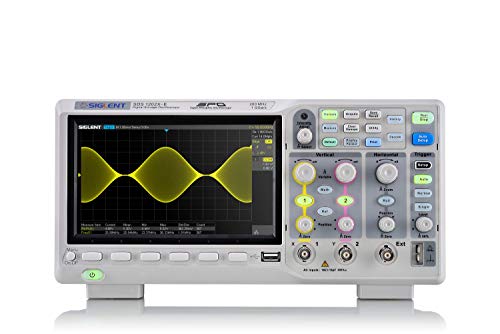
- 200 MHz, two channels, and 1 GSa/s real-time sampling
- 14 Mpts record length for extended captures
- Decodes I2C, SPI, UART, RS232, CAN, and LIN
Best For: Embedded-systems and serial-communications courses
Portable Multi-Tool

- Oscilloscope, multimeter, and DDS generator in one unit
- 250 MSa/s sampling with two channels and 50 MHz bandwidth
- Battery-powered design with storage and Type-C transfer
Best For: Mobile, introductory, and automotive electronics labs
Best All-Around Bench Scope

- 100 MHz, two channels, and 1 GSa/s sampling
- Deep memory and high waveform capture rate
- Serial decoding plus USB and LAN connectivity
Best For: Electronics labs and embedded-systems instruction
Best Portable Multimeter Combo

- 100 MHz, two-channel handheld oscilloscope
- Built-in 6000-count digital multimeter
- Rechargeable 6900 mAh battery and FFT support
Best For: Portable labs and mixed measurement instruction
Best Multifunction Teaching Tool

- 350 MHz, two-channel scope with touchscreen
- Built-in spectrum and frequency response analyzers
- DDS generator and 8000 mAh battery
Best For: Advanced signal-analysis and filter labs
Best Four-Channel Classroom Scope

- Four channels with 110 MHz bandwidth
- 1 GS/s sampling and 7-inch color display
- 30 automatic measurements plus USB storage
Best For: Multi-channel electronics lab demonstrations
Best Budget Lab Scope

- Two-channel design with 100 MHz bandwidth
- Arbitrary waveform output
- 14 trigger modes and serial decoding
Best For: General electronics and embedded-systems courses
Best Hands-On Learning Kit

- DIY assembly teaches oscilloscope fundamentals
- 2.4-inch color display with 1 MSPS operation
- Includes components and probe for student projects
Best For: Introductory electronics and soldering workshops
Classroom Lab Powerhouse – RIGOL DS1202Z-E
For classrooms that need a full-featured instrument, the RIGOL DS1202Z-E gives students room to explore beyond basic waveform viewing. Its 200 MHz bandwidth, dual channels, deep memory, and serial decoding make it a strong choice among oscilloscopes for classrooms focused on electronics, embedded systems, and troubleshooting.
Best For: Advanced electronics labs, embedded-systems instruction, and shared bench use.
Pros:
- 200 MHz bandwidth, two analog channels, and up to 1 GSa/s real-time sampling.
- Up to 24 Mpts of memory and a 30,000 wfms/s capture rate support detailed signal analysis.
- Serial triggering and decoding for RS232/UART, I2C, and SPI aid embedded-systems lessons.
- USB, LAN, recording/playback, and a large 7-inch display support demonstrations and documentation.
Cons:
- Its professional feature set may be more than introductory classes require.
- The desktop form factor is less convenient for portable or space-constrained instruction.
The DS1202Z-E is a particularly capable classroom platform when students need to investigate intermittent glitches, long captures, and digital communication buses—not just read simple periodic waveforms.
Budget-Friendly Teaching Tool – Hantek DSO2D15
The Hantek DSO2D15 is a cost-conscious option for programs building out an electronics lab. With two channels, 150 MHz bandwidth, arbitrary waveform output, and multiple trigger and decoding options, it covers a useful range of classroom experiments without emphasizing unnecessary complexity.
Best For: Budget-conscious electronics, communications, and introductory embedded-systems labs.
Pros:
- Cost-effective design can help equip classrooms with multiple instruments.
- Two channels and 150 MHz bandwidth support common signal-analysis exercises.
- Arbitrary waveform output adds flexibility for source-and-measurement demonstrations.
- Includes 14 trigger modes and five serial protocol trigger/decode options.
Cons:
- The supplied notes do not specify sampling rate, record depth, display size, or connectivity.
- Its economy positioning may mean fewer documented capabilities than higher-end classroom instruments.
For instructors prioritizing equipment quantity and core lab functionality, the DSO2D15 offers a practical starting point, especially where waveform generation and protocol exercises are part of the curriculum.
Protocol Learning Specialist – Siglent SDS1202X-E
The Siglent SDS1202X-E suits classrooms where students need to connect waveform measurements with digital communication troubleshooting. Its 200 MHz bandwidth, two channels, 1 GSa/s sampling, and broad serial-bus support make it a focused choice among oscilloscopes for classrooms teaching embedded electronics.
Best For: Embedded-systems, serial-communications, and intermediate electronics courses.
Pros:
- 200 MHz bandwidth and two channels cover a broad range of classroom measurements.
- Up to 1 GSa/s real-time sampling supports examination of faster signals.
- Up to 14 Mpts record length provides useful room for longer captures.
- Serial triggering and decoding support I2C, SPI, UART, RS232, CAN, and LIN.
Cons:
- The supplied notes do not list display size, included accessories, or connectivity options.
- Its feature emphasis may be less relevant for classes limited to basic analog measurements.
The SDS1202X-E is a sensible teaching instrument when protocol analysis is central to the lab, giving students exposure to several widely used buses alongside conventional oscilloscope work.
Portable Multi-Tool – FNIRSI 2C53T 3-in-1
The FNIRSI 2C53T combines a two-channel oscilloscope, multimeter, and DDS signal generator in a compact battery-powered package. For classrooms that value portability, quick demonstrations, and multiple measurement functions, it offers an accessible alternative to a traditional bench-only instrument.
Best For: Mobile teaching, introductory electronics, automotive electronics, and hands-on hobbyist labs.
Pros:
- Three-in-one design combines oscilloscope, 4.5-digit multimeter, and signal generator functions.
- Two channels, 50 MHz bandwidth, 250 MSa/s sampling, and automatic measurements support basic lab work.
- Built-in battery, 2.8-inch display, and 400 g weight make it easy to move between classrooms or workstations.
- Waveform storage, Type-C transfer, reference-waveform comparison, and 13 generator waveforms add teaching flexibility.
Cons:
- Its 1 Kpt record depth and 50 MHz bandwidth are more limited than those of the larger bench instruments here.
- The small display may be less suitable for whole-class demonstrations.
- The signal generator’s maximum output frequency is 50 kHz.
The 2C53T is best viewed as a versatile student or mobile-lab tool rather than a replacement for a high-end shared bench scope. Its integrated meter and generator can reduce equipment swapping during practical exercises.
Best All-Around Bench Scope – RIGOL DS1102Z-E
For classrooms seeking a capable bench instrument, the RIGOL DS1102Z-E is a strong option among oscilloscopes for classrooms. Its 100 MHz bandwidth, two analog channels, deep memory, and waveform recording features support both introductory lab exercises and more advanced electronics troubleshooting.
Best For: Electronics labs, embedded-systems instruction, and bench-based signal analysis.
Pros:
- 100 MHz bandwidth, two channels, and up to 1 GSa/s real-time sampling.
- Deep memory up to 24 Mpts helps preserve longer captures at higher sample rates.
- Serial decoding supports RS232/UART, I2C, and SPI lessons and troubleshooting.
- LAN and USB connectivity support documentation and lab integration.
Cons:
- At 8.83 pounds, it is less convenient for portable classroom use.
- Its feature set may be more extensive than needed for basic introductory demonstrations.
The DS1102Z-E is a practical shared-bench choice when a classroom needs visibility into intermittent glitches, long captures, and embedded communications rather than only basic waveform viewing.
Best Portable Multimeter Combo – Siglent SHS810X
The Siglent SHS810X offers a useful combination for classrooms that need measurement flexibility. As one of the more versatile oscilloscopes for classrooms, it pairs a 100 MHz, two-channel scope with a digital multimeter, FFT functions, and a rechargeable battery for demonstrations away from a fixed bench.
Best For: Portable lab activities, electrical measurement instruction, and mixed oscilloscope/multimeter exercises.
Pros:
- 100 MHz bandwidth, two channels, and 1 GSa/s sampling support common lab signals.
- Multimeter mode measures voltage, current, resistance, diode, capacitance, and continuity.
- Multiple intelligent triggers—including runt, pattern, and dropout—support varied teaching examples.
- 6900 mAh lithium-ion battery enables cordless demonstrations.
Cons:
- The supplied notes do not specify waveform memory depth beyond the 1 Mpts FFT support.
- At 10 pounds, it may be cumbersome for frequent student handling despite its handheld design.
Choose the SHS810X when a classroom benefits from one instrument covering both waveform observation and general electrical measurements, especially for mobile or equipment-focused lessons.
Best Multifunction Teaching Tool – FNIRSI DPOS350P
The FNIRSI DPOS350P stands out for classrooms that want several lab instruments in one compact unit. It combines a 350 MHz, two-channel oscilloscope with a spectrum analyzer, frequency response analyzer, and DDS signal generator, making it a broad teaching platform among oscilloscopes for classrooms.
Best For: Advanced electronics courses, signal analysis, filter labs, and portable field instruction.
Pros:
- 350 MHz bandwidth, 1 GSa/s sampling, touchscreen control, and 50,000 wfms/s refresh.
- Integrated spectrum analysis supports harmonic markers and waterfall views for EMI work.
- Frequency response analysis enables gain, phase, Bode plot, and filter experiments.
- DDS generator offers 14 standard waveforms, up to 50 MHz output, and custom clipping waveforms.
Cons:
- Its 47 Kpts memory depth is lower than the RIGOL’s stated maximum deep-memory capacity.
- The broad feature set may require more instruction than a basic oscilloscope.
- The supplied notes do not identify a dedicated multimeter mode.
With its 350 MHz bandwidth and four-in-one design, the DPOS350P can reduce the number of separate instruments needed for advanced classroom experiments, while its 3.56-pound body and 8000 mAh battery suit mobile labs.
Best Four-Channel Classroom Scope – HANMATEK DOS1104
For classrooms that need multiple signals displayed at once, the HANMATEK DOS1104 is a capable choice among oscilloscopes for classrooms. It combines four channels, 110 MHz bandwidth, a 1 GS/s real-time sampling rate, and a large 7-inch color display, making it suitable for demonstrations and more involved lab work.
Best For: Electronics labs teaching multi-channel measurements, waveform analysis, and USB-based data storage.
Pros:
- Four channels with 110 MHz bandwidth and 1 GS/s sampling.
- Large 7-inch, 800×480-pixel TFT-LCD screen for shared viewing.
- Includes 30 automatic measurements, cursor measurements, waveform storage, and a built-in frequency meter.
- Supports automatic range, serial communication through USB, LABVIEW communication, and SCPI specifications.
Cons:
- Its broader feature set may require more instruction time for beginners.
- The unit is less compact than a pocket-sized teaching kit.
Overall, the DOS1104 offers the strongest feature set here for a classroom that values simultaneous measurements and a screen students can easily follow. Its four channels and measurement tools also leave room for more advanced lab exercises.
Best Budget Lab Scope – Hantek DSO2C10
The Hantek DSO2C10 is a practical option for programs seeking oscilloscopes for classrooms without moving into a more elaborate four-channel setup. This two-channel digital storage oscilloscope provides 100 MHz bandwidth, arbitrary waveform output, and a selection of trigger and serial protocol functions.
Best For: Budget-conscious electronics, embedded-systems, communications, and research courses that need a general-purpose two-channel instrument.
Pros:
- 100 MHz bandwidth in a cost-effective two-channel design.
- Supports arbitrary waveform output for classroom signal-generation exercises.
- Offers 14 trigger modes and five serial protocol triggers and decodes.
Cons:
- Provides two channels rather than the four channels available on the HANMATEK DOS1104.
- The supplied notes do not specify display size, sampling rate, or storage depth.
Its feature mix makes the DSO2C10 a sensible general-purpose teaching instrument, particularly when serial decoding and waveform output matter. It is best matched to courses that can work effectively with two simultaneous inputs.
Best Hands-On Learning Kit – DSO 138 DIY Oscilloscope
The DSO 138 DIY kit takes a different approach to oscilloscopes for classrooms by making assembly part of the lesson. With a 2.4-inch color TFT display, ARM Cortex-M3 processor, 1 MSPS operation, and included probe and components, it supports introductory waveform observation alongside electronics-building practice.
Best For: Student workshops covering oscilloscope principles, soldering, component identification, and basic low-frequency signal measurements.
Pros:
- DIY format helps students explore the instrument’s structure and principles.
- Includes parts and probe in a compact, pocket-sized package.
- Can be used for audio, video synchronization, low-frequency switching supplies, and infrared signals.
- Its ARM development-board foundation allows software customization for projects such as a millivoltmeter or data recorder.
Cons:
- Requires student assembly, so it is not ready to use immediately.
- The 1 MSPS rate and small 2.4-inch display are oriented toward basic learning rather than advanced measurements.
This kit is especially valuable when the instructional goal is understanding how an oscilloscope works, not simply taking measurements. Teachers should plan assembly time and choose signals appropriate to its low-frequency, introductory focus.
How We Picked the Best Oscilloscopes for Classrooms
We focused on instruments that can support common teaching tasks such as viewing periodic signals, comparing two waveforms, measuring frequency and amplitude, checking timing relationships, and troubleshooting basic circuits. The selection includes models from 50 MHz to 350 MHz, with two- and four-channel options, handheld designs, multifunction units, and a low-cost DIY platform.
We also considered classroom practicality: screen size, interface simplicity, portability, included measurement tools, sampling capability, and whether a device can serve beginners without limiting more advanced students. Specifications should still be checked against the manufacturer’s current documentation before purchase.
Quick Comparison
| Classroom need | What to prioritize | Best-fit options in this roundup |
|---|---|---|
| General electronics instruction | Two channels, clear controls, 100–200 MHz bandwidth | RIGOL DS1202Z-E, Siglent SDS1202X-E |
| Budget lab expansion | Useful core functions at a lower entry cost | RIGOL DS1102Z-E, Hantek DSO2C10 |
| Multiple simultaneous signals | Four independent channels | HANMATEK DOS1104 |
| Portable or field teaching | Battery-friendly handheld design and integrated functions | Siglent SHS810X, FNIRSI 2C53T |
| Advanced bandwidth needs | Higher bandwidth with suitable probes and signal sources | FNIRSI DPOS350P |
| Introductory hands-on learning | Simple hardware and build-oriented instruction | DSO 138 DIY Oscilloscope Kit |
Key Buying Factors for Oscilloscopes for Classrooms
Bandwidth and Sample Rate
Bandwidth determines the range of signal frequencies an oscilloscope can display accurately, while sample rate affects how well it captures waveform detail. For introductory labs, 100 MHz-class equipment is often more than adequate; faster signals or advanced coursework may justify a higher-bandwidth model.
Channels and Classroom Workflow
Two channels cover many demonstrations, including phase comparison and input-versus-output measurements. Four channels can reduce rewiring and make more complex experiments easier, particularly when students monitor several points in a circuit.
Controls, Display, and Safety
Large, readable displays and dedicated controls can shorten the learning curve. Check probe ratings, grounding requirements, input limits, and protective features before connecting student-built circuits. A clear interface is especially valuable when instructors need to troubleshoot several benches quickly.
Portability and Extra Functions
Handheld models suit mobile instruction and crowded workspaces. Integrated multimeters or signal generators can reduce the amount of equipment required, although a multifunction device may not match a dedicated instrument in every area. Confirm that included probes and accessories fit your planned experiments.
Who Should Buy Which Oscilloscopes for Classrooms?
Choose a standard two-channel benchtop oscilloscope for most electronics classrooms: it offers a balanced combination of capability, visibility, and straightforward instruction. Select a four-channel model when students regularly analyze multi-stage circuits or need to monitor several signals at once.
Portable units make the most sense for demonstrations, service training, and labs where equipment moves between rooms. Multifunction models are useful for compact teaching stations, while the DIY kit is best reserved for supervised introductory projects rather than as the primary instrument for a full lab. For advanced courses, prioritize bandwidth, probing quality, and measurement accuracy over headline feature counts.