
The right diagonal can make telescope sessions more comfortable while preserving the sharpness and brightness of the view. This roundup compares 10 lightweight telescope diagonals for common 1.25-inch and 2-inch setups.
We focus on optical design, compatibility, viewing orientation, build quality, and ease of use so you can choose an accessory that suits your telescope and observing style.
Best 10 Lightweight Telescope Diagonals Picks for 2026
High-Reflectivity Pick
SVBONY SV188P Dielectric Diagonal
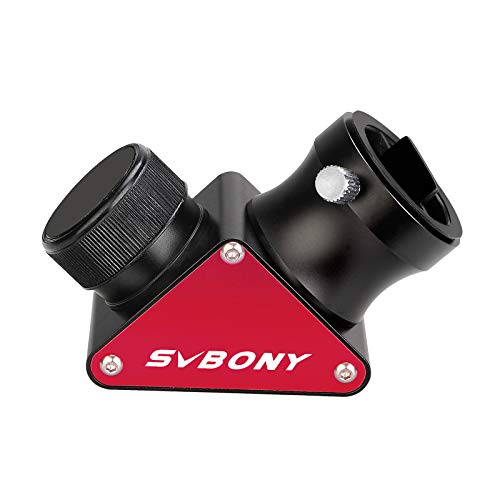
- Over 99% reflective dielectric coating
- 1.25-inch accessory compatibility
- Brass compression ring protects eyepieces
Best For: Bright astronomical viewing with 1.25-inch setups
Established Compact Choice
Celestron 1.25-inch Star Diagonal
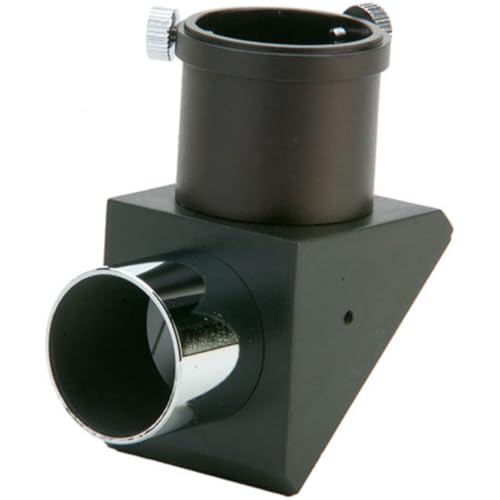
- Lightweight 5.6-ounce construction
- 90-degree overhead viewing angle
- Accepts standard 1.25-inch accessories
Best For: Compact refractor and SCT observing setups
Filter-Friendly Value
SVBONY SV221 90-Degree Diagonal

- Built-in support for 1.25-inch filters
- Lightweight 90-gram body
- Brass pressure ring and internal extinction
Best For: Portable filtered viewing with 1.25-inch refractors
Daytime Viewing Specialist
Celestron 45-Degree Erect Diagonal

- Produces correctly oriented images
- 45-degree terrestrial viewing angle
- Fits refractors, SCTs, and 1.25-inch eyepieces
Best For: Daytime terrestrial viewing through compatible telescopes
Best Compact 1.25-Inch Pick
SVBONY SV188 Dielectric Star Diagonal

- 90% reflectivity dielectric flat mirror
- Standard 1.25-inch accessory compatibility
- Lightweight 150 g full-metal design
Best For: Portable refractor and catadioptric setups
Best Upright-Image Value
Astromania 1.25-Inch Prism Diagonal
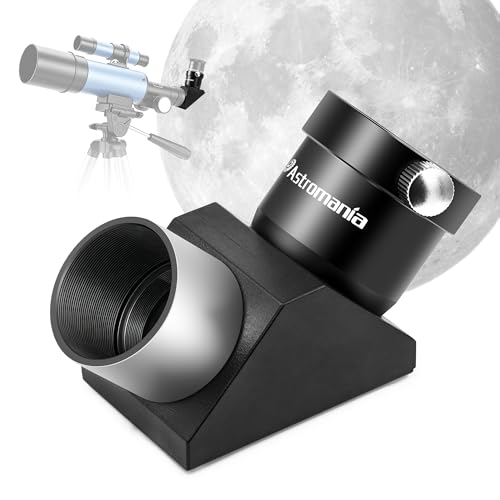
- Amici prism gives upright, non-reversed images
- Fully multi-coated optics with glare-reducing threads
- Supports astronomy and terrestrial observation
Best For: Refractor users needing correct image orientation
Best High-Throughput Upgrade

- 99% dielectric mirror reflectivity
- 2-inch format with 1.25-inch adapter
- Compression ring and stray-light control features
Best For: 2-inch setups prioritizing brightness and capacity
Comfort-Focused Choice
Alstar 1.25-Inch 90-Degree Diagonal

- 90-degree angle supports comfortable viewing
- Multi-coated optics with reflection control
- Threaded and barrel mounting options
Best For: Refractor owners seeking comfortable, flexible visual observing
High-Reflectivity Upgrade
SVBONY SV223 90-Degree Diagonal

- 99% reflective dielectric coating
- 1/10λ surface accuracy and internal baffling
- Click-lock design with 2-inch body and 1.25-inch adapter
Best For: Observers prioritizing secure mounting and high optical specifications
Lightweight Versatile Pick
Astromania 1.25-Inch Erect-Image Diagonal

- Lightweight 4.37-ounce design
- Erect image for astronomy and daytime use
- Accepts 1.25-inch eyepieces and filters
Best For: Portable refractor and compound-telescope setups
High-Reflectivity Pick – SVBONY SV188P Dielectric Diagonal
For observers comparing lightweight telescope diagonals, the SVBONY SV188P combines a compact 1.25-inch format with dielectric coatings rated at over 99% reflectivity. Its 90-degree viewing angle is suited to comfortable overhead viewing, while the brass compression ring helps secure eyepieces without scratching their barrels.
Best For: Astronomical viewing with 1.25-inch refractor setups and users prioritizing high reflectivity.
Pros:
- Dielectric coatings provide over 99% reflective surface performance.
- Accepts 1.25-inch eyepieces, filters, and Barlow lenses.
- Brass compression ring helps hold accessories firmly without barrel scratches.
- Produces an upright image, with left-right reversal noted in the product details.
Cons:
- Limited to 1.25-inch telescope and accessory connections.
- The fixed-focus design offers no focusing adjustment.
At 0.2 kg, this is a practical lightweight telescope diagonal for portable visual observing. Its dielectric coating and secure compression ring make it a strong choice when brightness and accessory handling matter.
Established Compact Choice – Celestron 1.25-inch Star Diagonal
The Celestron 1.25-inch Star Diagonal is a compact option among lightweight telescope diagonals, weighing 5.6 ounces. Its 90-degree viewing angle makes overhead observations more comfortable, and it accepts standard 1.25-inch eyepieces, Barlow lenses, and related accessories.
Best For: Refractor and SCT owners seeking a compact 1.25-inch diagonal with a comfortable viewing angle.
Pros:
- Compatible with telescopes having 1.25-inch focusers or visual backs.
- 90-degree angle improves comfort when observing overhead objects.
- Accepts standard 1.25-inch eyepieces, Barlow lenses, and accessories.
- Dielectric coatings are specified in the product details.
Cons:
- It is not water resistant.
- Compatibility is limited to 1.25-inch interfaces.
With its compact size, aluminum enclosure, and modest 5.6-ounce weight, this Celestron is easy to include in a portable observing kit. It is a straightforward choice for compatible refractor and SCT telescopes.
Filter-Friendly Value – SVBONY SV221 90-Degree Diagonal
The SVBONY SV221 adds useful filter support to the lightweight telescope diagonals category. This 1.25-inch, 90-degree diagonal uses enhanced aluminum coating, internal extinction treatment, and a brass pressure ring for clearer viewing and more secure eyepiece handling.
Best For: 1.25-inch refractor users who regularly use filters and want a compact 90-degree diagonal.
Pros:
- Supports 1.25-inch filters through its filter thread.
- Internal extinction treatment is designed to support clearer, brighter images.
- Brass pressure ring helps reduce eyepiece surface damage and scratches.
- Lightweight 90-gram design is easy to carry.
Cons:
- Uses enhanced aluminum rather than the over-99% dielectric specification listed for the SV188P.
- Limited to 1.25-inch telescope and eyepiece connections.
The SV221 is a practical pick when filter compatibility is more important than maximum coating specifications. Its 90-gram weight and internal baffling treatment suit portable visual observation.
Daytime Viewing Specialist – Celestron 45-Degree Erect Diagonal
For terrestrial use, this Celestron 45-degree erect diagonal stands apart from typical lightweight telescope diagonals by producing right-side-up, left-to-right-correct images. It fits 1.25-inch focusers or visual backs and is designed for comfortable viewing from daytime observing sessions through compatible refractors and catadioptric telescopes.
Best For: Daytime terrestrial viewing with refractors, SCTs, and spotting-scope-style setups.
Pros:
- Corrects image orientation for right-side-up, left-to-right-correct viewing.
- 45-degree angle is suited to comfortable terrestrial observation.
- Compatible with refractors, SCTs, and 1.25-inch eyepieces.
- Supports observing from day to night.
Cons:
- Not designed primarily as a 90-degree astronomical star diagonal.
- Its 136.08-gram package weight is higher than the SV221’s stated 90-gram weight.
- Limited to 1.25-inch eyepiece compatibility.
This is the most specialized option in the group. Choose it when correctly oriented terrestrial images matter more than the overhead comfort and astronomical viewing emphasis of a 90-degree diagonal.
Best Compact 1.25-Inch Pick – SVBONY SV188 Dielectric Star Diagonal
For a lightweight telescope diagonal setup, the SVBONY SV188 is a practical 1.25-inch option for refractors and catadioptric telescopes. Its 90-degree viewing angle makes overhead observing more comfortable, while the dielectric flat mirror is rated for 90% reflectivity.
Best For: Refractor and catadioptric telescope users who want a compact 1.25-inch diagonal for comfortable viewing.
Pros:
- 90% reflectivity helps reduce light loss and supports a clear, sharp field of view.
- Standard 1.25-inch format works with compatible eyepieces and Barlow lenses.
- Full-metal body, brass compression ring, and included dust cover add practical durability and protection.
Cons:
- Not suitable for reflector telescopes.
- Its 1.25-inch format offers less accessory and field-of-view capacity than a 2-inch diagonal.
At 150 g, this is the lightest and simplest choice in the group. Choose it when portability and compatibility with existing 1.25-inch accessories matter more than maximum light throughput.
Best Upright-Image Value – Astromania 1.25-Inch Prism Diagonal
The Astromania diagonal is a versatile choice for shoppers comparing lightweight telescope diagonals for astronomy and daytime viewing. Its Amici prism produces an upright, non-reversed image, and the 90-degree angle supports a more natural observing posture.
Best For: Refractor users who want one diagonal for planets, deep-sky targets, birdwatching, and terrestrial spotting.
Pros:
- Amici prism design provides upright, correctly oriented views.
- Fully multi-coated optics and internal glare-reducing threads support bright, cleaner images.
- Accepts standard 1.25-inch eyepieces and includes a filter thread for compatible moon or nebula filters.
- Compact, lightweight construction is useful for field astronomy and daytime observation.
Cons:
- Not recommended for reflector telescopes.
- Prism design and fixed focus may be less suitable for users specifically seeking a conventional mirror diagonal.
With a listed weight of 4.59 ounces, this Astromania model is easy to carry while adding useful terrestrial versatility. It is a strong fit if correct image orientation is a priority.
Best High-Throughput Upgrade – SVBONY SV188P 2-Inch Diagonal
The SVBONY SV188P is the high-capacity option among these lightweight telescope diagonals, using a 2-inch dielectric mirror rated at 99% reflectivity. It is designed for 2-inch systems but includes a 2-inch-to-1.25-inch converter for broader accessory compatibility.
Best For: 2-inch telescope users who want maximum stated reflectivity, a larger accessory format, and flexible eyepiece support.
Pros:
- 99% dielectric reflectivity is designed to maximize image brightness and clarity.
- 2-inch format supports 2-inch eyepieces and filters while the included adapter accepts 1.25-inch accessories.
- Brass compression ring and anti-contact block help protect eyepieces during tightening.
- Matte interior treatment and velvet-lined cover help control stray light.
Cons:
- At 650 g, it is substantially heavier than the other listed options.
- Its 2-inch format may be excessive for users with only 1.25-inch equipment.
This is the performance-oriented choice rather than the most portable one. Select it when a 2-inch focuser, broader field potential, and high reflectivity outweigh the added weight.
Comfort-Focused Choice – Alstar 1.25-Inch 90-Degree Diagonal
For observers comparing lightweight telescope diagonals, the Alstar offers a practical 90-degree viewing position for refracting telescopes with 1.25-inch fittings. Its multi-coated optics, internal extinction treatment, and aluminum housing are designed to support comfortable, higher-contrast visual observing.
Best For: Refractor owners who want comfortable overhead viewing, flexible filter compatibility, and straightforward installation.
Pros:
- 90-degree angle helps reduce neck strain during extended viewing.
- Multi-coated optics and internal treatment are designed to improve clarity, contrast, and reflection control.
- Supports threaded or barrel mounting and standard 1.25-inch filters through M28.5×0.6mm threads.
- Thumbscrew mounting helps secure the eyepiece during use.
Cons:
- Designed specifically for refracting telescopes with 1.25-inch fittings.
- Produces vertically erect images with lateral inversion rather than a fully corrected terrestrial image.
The Alstar is a sensible lightweight telescope diagonal for users prioritizing ergonomic viewing and broad 1.25-inch accessory compatibility. Its feature set is especially well suited to routine visual observations with refractors.
High-Reflectivity Upgrade – SVBONY SV223 90-Degree Diagonal
The SVBONY SV223 stands out among lightweight telescope diagonals with a 99% reflective dielectric coating, 1/10λ surface accuracy, and a click-lock mechanism. Its 2-inch format includes a 1.25-inch adapter, giving observers a secure and flexible setup for compatible astronomical telescopes.
Best For: Observers who value high reflectivity, precise optical machining, and a twist-lock accessory connection.
Pros:
- 99% reflective dielectric coating is designed to maximize reflected light.
- 1/10λ surface accuracy supports precise optical performance.
- Click-lock mechanism holds the eyepiece or accessory securely without relying on a conventional thumbscrew.
- 2-inch diagonal with a 1.25-inch adapter supports two common accessory sizes.
Cons:
- At 0.69 kg, it is heavier than the smaller 1.25-inch options in this roundup.
- Its 2-inch body and included adapter may be more setup than users with only 1.25-inch equipment need.
Choose the SV223 when secure locking and optical specifications matter more than minimizing weight. The dielectric coating, internal baffling, and precision surface accuracy make it the most feature-rich option here, though its larger format should be matched to your telescope and accessories.
Lightweight Versatile Pick – Astromania 1.25-Inch Erect-Image Diagonal
The Astromania diagonal is a compact option for shoppers seeking lightweight telescope diagonals for refractors and compound telescopes. Its 90-degree design provides a comfortable observing angle, while the erect-image configuration and filter thread also make it useful for daytime terrestrial viewing.
Best For: Beginners and hobbyists using refractor, Schmidt-Cassegrain, or other compatible telescopes with 1.25-inch connectors.
Pros:
- Lightweight 4.37-ounce construction is easy to add to a portable setup.
- 90-degree angle supports comfortable viewing from above.
- Erect-image design works for astronomy and daytime terrestrial observation.
- Accepts standard 1.25-inch eyepieces and filters, including moon, UHC, and polarizing filters.
Cons:
- Not suitable for Newtonian telescopes or other reflector setups.
- Its protective coating is described generally, without the higher reflectivity specification listed for the SVBONY model.
For a simple, portable 1.25-inch setup, the Astromania combines low weight with useful daytime and nighttime versatility. It is a particularly practical choice when an erect image and filter compatibility are more important than advanced optical specifications.
How We Picked These Lightweight Telescope Diagonals
We selected these models to cover the main choices available to amateur astronomers: 90-degree mirror and dielectric diagonals, prism designs, 45-degree erect-image options, and both 1.25-inch and 2-inch formats. We considered advertised optical performance, connection size, viewing orientation, construction, and the kinds of telescopes each diagonal is intended to serve.
Because specifications and included features can vary by seller, confirm the current listing details before ordering. In particular, check whether the model includes a compression ring, nosepiece, eyepiece holder, or adapters required by your telescope.
Quick Comparison
| Type | Best For | Main Advantage | Watch For |
|---|---|---|---|
| 90° mirror | General astronomical viewing | Comfortable high-angle viewing | Image remains inverted |
| Dielectric mirror | Frequent observing and brighter targets | Durable, highly reflective coating | May cost more than basic models |
| Prism | Simple, high-contrast setups | Compact optical path | Can introduce chromatic effects in some systems |
| 45° erect image | Daytime, terrestrial, and casual viewing | Upright, correctly oriented image | Less suited to high-power astronomy |
| 2-inch diagonal | Wide-field eyepieces | Supports larger light path | Heavier and requires a 2-inch focuser |
Key Buying Factors for Lightweight Telescope Diagonals
Compatibility and Barrel Size
Match the diagonal to your focuser or visual back. A 1.25-inch diagonal works with standard 1.25-inch eyepieces, while a 2-inch model is designed for larger eyepieces and a 2-inch focuser. Refractors, SCTs, and some Maksutov telescopes may use different attachment methods, so verify the thread or nosepiece connection.
Mirror, Dielectric, or Prism Design
Standard mirror diagonals are versatile and often affordable. Dielectric versions generally offer strong reflectivity and durable coatings, making them appealing for regular use. Prism diagonals can be compact and provide crisp views in suitable optical systems, but their performance depends on telescope design and focal ratio.
Viewing Angle and Image Orientation
A 90-degree diagonal is usually the most comfortable choice for astronomy because it places the eyepiece in a convenient position. A 45-degree erect-image diagonal produces a more natural orientation and is useful for daytime observation, but it is not always the best choice for demanding planetary or deep-sky viewing.
Weight, Fit, and Handling
Light weight helps reduce strain on small focusers and makes a telescope easier to balance, especially when using heavy eyepieces. Look for a secure thumbscrew or compression ring, a rigid housing, and enough clearance to prevent the eyepiece or diagonal from contacting the mount.
Who Should Buy Which Lightweight Telescope Diagonals?
Choose a 1.25-inch 90-degree mirror or dielectric diagonal if you want a general-purpose upgrade for a refractor, SCT, or compact telescope. A dielectric model is worth considering for frequent observers who prioritize coating durability and high transmission.
Select a 45-degree erect-image model for terrestrial viewing, nature observation, or casual daytime use. A prism diagonal may suit buyers seeking a compact, straightforward option for compatible telescopes. If you regularly use wide-field 2-inch eyepieces and your focuser supports them, a 2-inch diagonal can provide the necessary light path, but confirm that the added weight will not upset your mount.
Before buying, prioritize exact telescope compatibility over coating claims or appearance. The best Lightweight Telescope Diagonals are the ones that fit securely, balance well, and match the eyepieces and observing targets you use most.