
The best science experiment sets turn screen-free play into hands-on discovery. These kits give children structured activities to explore chemistry, physics, earth science, and everyday scientific concepts.
We selected 10 options for different ages, interests, experiment counts, and learning styles—from first science activities for preschoolers to larger laboratory-style kits for children ages 8 to 12.
Best 10 Science Experiment Sets Picks for 2026
Best Magic-Focused Science Experiment Set
National Geographic Science Magic Kit

- 20 included magic experiments
- 85+ bonus experiments
- Battery-free STEM activities
Best For: Kids ages 8+ who enjoy magic-themed science
Best Variety Science Experiment Set

- 150 projects across multiple topics
- Illustrated step-by-step manual
- Includes tools and goggles
Best For: Families wanting extended at-home science activities
Best Earth Science Experiment Set
National Geographic Earth Science Kit

- Volcano and crystal activities
- Two geologic dig kits
- Full-color learning guide
Best For: Kids interested in geology and earth science
Best Chemistry Science Experiment Set
National Geographic Amazing Chemistry Set

- 15 supplied chemistry experiments
- 85 bonus household-item activities
- Includes test tubes and pipettes
Best For: Kids exploring reactions and lab-style chemistry
Most Variety

- Offers up to 80 guided experiments
- Includes a wide range of lab-style tools
- Features colorful activities and reusable materials
Best For: Children 6 and up who want lots of experiment variety
Best Chemistry Focus
National Geographic Chemistry Set

- Includes 45 chemistry experiments
- Features volcano, geyser, and rocket activities
- Uses illustrated, kid-friendly instructions
Best For: Children 8 and up exploring introductory chemistry
Best for Younger Kids
My First Science Experiments Kit

- Designed for children ages 4 and up
- Includes more than 100 guided experiments
- Comes with beginner-friendly lab equipment
Best For: Younger children beginning hands-on STEM exploration
Best Starter Chemistry Kit

- 50 hands-on chemistry experiments
- 20+ kid-friendly lab tools
- Illustrated instructions for ages 4+
Best For: Young beginners exploring chemistry and STEM
Best All-in-One Science Set
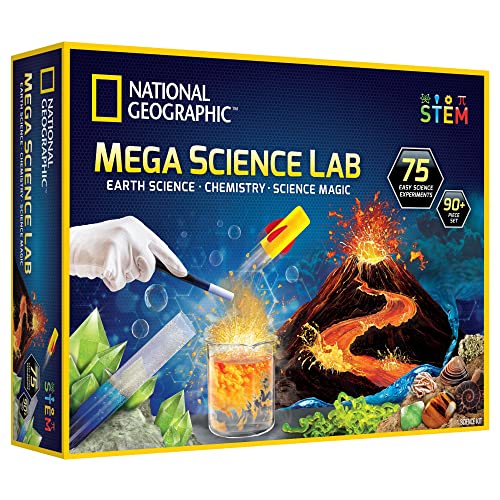
- 75 experiments across three science themes
- Includes Earth science, chemistry, and magic
- Real rock, mineral, and crystal specimens
Best For: Kids who want broad STEM variety
Best Gross-Themed STEM Kit

- 45 gross-themed science experiments
- Covers polymers, reactions, and pH science
- Includes 30 extra household-item activities
Best For: Kids who enjoy messy, humorous STEM activities
Best Magic-Focused Science Experiment Set – National Geographic Science Magic Kit
For kids who enjoy a theatrical twist, this science experiment set combines hands-on STEM activities with magic tricks. It includes materials for 20 magic experiments plus a bonus booklet with more than 85 additional activities, with no batteries required.
Best For: Kids ages 8 and up who enjoy science demonstrations, magic, and STEM learning.
Pros:
- Includes materials for 20 magic experiments.
- Adds a bonus booklet with 85+ additional experiments.
- Supports hands-on STEM learning without batteries.
Cons:
- The magic-focused theme may be less appealing to children seeking traditional chemistry or earth science.
- Additional booklet activities may require common household items.
This is a strong choice when presentation and surprise are part of the appeal. Its large activity count offers plenty of follow-up projects, while the included materials help kids begin experimenting right away.
Best Variety Science Experiment Set – UNGLINGA 150 Experiments Kit
This science experiment set is designed for broad exploration, covering subjects such as earth science, surface tension, chemistry, and physics. It includes 150 DIY projects, a step-by-step illustrated manual, kid-friendly materials, and lab-style tools including goggles.
Best For: Families looking for a wide range of experiments and hands-on science time at home.
Pros:
- Offers 150 experiments across several science topics.
- Uses an illustrated, step-by-step manual.
- Includes many tools and materials, including goggles.
- Encourages shared parent-and-child activity time.
Cons:
- Some projects use regular household items not included in the kit.
- The broad topic range may require more adult guidance for some activities.
Choose this kit when variety is the priority. Its large project count can support repeated use during weekends, school breaks, or family learning sessions, though you should expect to gather some household supplies.
Best Earth Science Experiment Set – National Geographic Earth Science Kit
For young geologists, this science experiment set focuses on earth science through activities such as erupting volcanoes, crystal growing, water tornadoes, and geologic dig kits. It includes more than 15 experiment activities and a full-color learning guide explaining the science behind them.
Best For: Kids ages 8 and up who are interested in rocks, crystals, volcanoes, and earth science.
Pros:
- Includes volcano, crystal-growing, tornado, and geologic dig activities.
- Provides two geologic dig kits and a rock collection activity.
- Full-color guide explains the science behind the projects.
- Designed to support sharing with family, friends, or classmates.
Cons:
- Its earth-science focus may be limiting for children seeking chemistry or physics projects.
- The listed activities include more than 15 core experiments rather than 100 fully supplied projects.
This kit is a practical pick for children drawn to geology and visible demonstrations. The combination of digging, growing, and eruption activities makes the learning tactile, while the guide adds useful scientific context.
Best Chemistry Science Experiment Set – National Geographic Amazing Chemistry Set
This chemistry-centered science experiment set gives kids materials for 15 hands-on experiments, including color-changing reactions, glowing test tubes, crystal growing, and a bouncy ball. It also includes a guide with 85 additional activities using common household items.
Best For: Kids ages 8 and up who want an introduction to chemical reactions and lab-style science.
Pros:
- Includes materials for 15 supplied chemistry experiments.
- Offers 85 bonus activities using household items.
- Includes test tubes, beakers, and pipettes for hands-on exploration.
- Features engaging reactions such as bubbling, color-changing, and glowing activities.
Cons:
- Many bonus experiments require additional household materials.
- The chemistry focus may be less suitable for children seeking earth science or physics variety.
This is a well-matched option for kids curious about reactions and laboratory equipment. The supplied projects provide an accessible starting point, while the bonus guide helps extend the kit beyond the included materials.
Most Variety – 80-Experiment Science Lab Kit
For shoppers comparing science experiment sets, this kit stands out for its broad mix of hands-on activities and included accessories. It covers colorful demonstrations such as rainbow rain, volcanoes, fountains, and bottle-blowing balloons, with guidance cards that move from simpler to more challenging experiments.
Best For: Children ages 6 and up who enjoy role-play, colorful demonstrations, and a large assortment of activities.
Pros:
- Includes materials and tools for up to 80 experiments.
- Comes with goggles, gloves, test tubes, petri dishes, droppers, measuring tools, and more.
- Step-by-step guidance cards explain experiment procedures and scientific principles.
- Small chemical bottles are designed to be tightly closed for continued use.
Cons:
- The kit includes many small components, so organization and adult supervision may be helpful.
- The listed manufacturer age range begins at 36 months, while the product description specifically recommends it for children over 6.
This is a feature-rich choice when variety matters most. Its extensive component list and experiment cards make it suitable for repeated science play, especially for children interested in acting like young laboratory scientists.
Best Chemistry Focus – National Geographic Chemistry Set
Among science experiment sets for older children, this National Geographic kit focuses specifically on chemistry and reaction-based activities. It includes 45 experiments, including a volcano, geyser, rocket, and other fizzy or bubbly demonstrations, supported by illustrated instructions.
Best For: Kids ages 8 and up who want an approachable introduction to chemistry and hands-on chemical reactions.
Pros:
- Provides 45 chemistry-focused experiments.
- Includes attention-getting activities such as a volcano eruption, geyser, and rocket.
- Illustrated, kid-friendly instructions explain each step and the related reactions.
- Introduces the scientific process and safe experiment practices.
Cons:
- Its chemistry-centered activities may be less suitable for children seeking a broad mix of science topics.
- The recommended age is 8 years and up, making it less appropriate for younger children.
This set is a practical pick for families prioritizing chemistry over maximum experiment count. The clear guide and dramatic reaction activities can help make foundational chemistry concepts more engaging.
Best for Younger Kids – My First Science Experiments Kit
For families seeking science experiment sets for younger children, this Doctor Jupiter kit is designed for ages 4 and up. It combines more than 100 experiments with familiar materials and illustrated, step-by-step manuals, including activities such as water fireworks and walking water.
Best For: Preschool and early elementary children who need simple, guided STEM activities with adult participation.
Pros:
- Offers more than 100 experiments and bonus activities for extended screen-free play.
- Includes child-friendly equipment such as beakers, a conical flask, spray bottles, cups, a funnel, and safety goggles.
- Illustrated instructions are designed to help children and adults follow each activity.
- Uses several familiar supplies, including food colors, baking powder, cornstarch, and dried leaves.
Cons:
- Younger children will likely need adult guidance throughout the experiments.
- Some activities depend on the included food additives, colors, and other consumable materials.
This kit makes a strong starting point for introducing science through accessible, playful demonstrations. Its younger recommended age and large activity count are especially useful when you want recurring parent-child experiment sessions.
Best Starter Chemistry Kit – Junior Chemistry Set
For younger children exploring science experiment sets, the National Geographic Junior Chemistry Set offers a hands-on introduction to chemistry. It includes 50 experiments, more than 20 kid-friendly lab tools, and illustrated instructions designed for children ages 4 and up.
Best For: Young beginners who want a simple, guided introduction to chemistry and STEM activities.
Pros:
- Includes 50 hands-on chemistry experiments.
- Comes with more than 20 child-safe lab tools, including test tubes and goggles.
- Illustrated, step-by-step instructions support independent participation.
- Many activities use common household items such as baking soda and vinegar.
Cons:
- The kit is focused primarily on introductory chemistry rather than multiple science disciplines.
- Some experiments require additional household ingredients.
This is a practical choice for families seeking an accessible first science kit. Its lower age recommendation and guided format make it especially suitable for early learners who benefit from straightforward demonstrations.
Best All-in-One Science Set – Mega Science Lab
Among science experiment sets for children ages 8 to 12, the National Geographic Mega Science Lab stands out for its range. It combines Earth science, chemistry, and science magic with 75 total experiments, including activities that use common household items.
Best For: Kids who want variety across geology, chemistry, demonstrations, and STEM projects.
Pros:
- Combines three themes in one kit: Earth science, chemistry, and science magic.
- Offers 45 included experiments plus 30 additional activities in a bonus guide.
- Features a volcano, glow-in-the-dark crystal, water tornadoes, and fossil-digging activities.
- Includes real rock, mineral, and crystal specimens for collecting.
Cons:
- Its broad assortment may be more kit than needed for children interested in only one science topic.
- Some bonus experiments require common household items.
This is the strongest choice for families prioritizing breadth. The three-in-one format provides multiple ways to explore science, while the age recommendation and experiment variety make it suitable for older elementary-age children.
Best Gross-Themed STEM Kit – Gross Science Kit
For kids drawn to unusual demonstrations, the National Geographic Gross Science Kit gives science experiment sets a memorable twist. Designed for ages 8 and up, it includes 15 gross-themed experiments plus 30 additional activities using common household products.
Best For: Children who are motivated by messy, humorous experiments involving chemistry and biology concepts.
Pros:
- Includes 45 experiments, including activities involving slime, glowing worms, and a test tube vomit effect.
- Introduces polymers, chemical reactions, and pH science through entertaining activities.
- Illustrated instructions explain each step and the science behind the results.
- The bonus booklet adds 30 household-item experiments.
Cons:
- The gross-out theme may not appeal to every child or household.
- Some experiments require additional household products.
This kit is a good fit when engagement is the priority. Its humorous theme can make chemistry concepts more approachable, while the illustrated guide keeps the activities structured and educational.
How We Picked These Science Experiment Sets
We focused on kits that offer a clear educational purpose, age-appropriate activities, and enough variety to hold a child’s interest beyond one afternoon. The selection includes chemistry-focused sets, earth science activities, gross-science experiments, magic-based demonstrations, and broad STEM collections.
We also considered the number of included experiments, recommended age range, likely supervision needs, and whether the kit supports open-ended exploration or follows step-by-step instructions. Experiment counts can vary in complexity, so a higher number does not automatically mean better value.
Quick Comparison
- Best for broad variety: Choose a large multi-topic kit with 75 to 150 activities.
- Best for chemistry fans: Select a dedicated chemistry set with laboratory-style experiments.
- Best for younger children: Look for beginner kits designed for ages 4 and up, with simple, closely supervised activities.
- Best for earth science interests: Choose a kit centered on rocks, minerals, geology, weather, or natural processes.
- Best for novelty and engagement: Magic and gross-science kits can make scientific concepts especially memorable.
Key Buying Factors for Science Experiment Sets
Age and Supervision
Start with the child’s age, reading ability, and attention span rather than the experiment count. Younger children usually need an adult to explain instructions, measure materials, and manage cleanup. Older children may be ready for more independent work, but adult supervision remains important for experiments involving chemicals, heat, glass, or small parts.
Subject Matter
Broad kits are useful when a child is still discovering their interests. Chemistry sets suit children who enjoy mixing and observing reactions, while earth-science kits are a better fit for geology and nature enthusiasts. Specialized themes can be more engaging than a larger but less focused collection.
Included Materials and Replenishment
Check what is included and what must be supplied at home. Many kits provide the specialized tools but rely on common household items such as water, vinegar, baking soda, cups, or paper towels. Also consider whether consumable materials can be replaced easily.
Instructions and Learning Value
Look for clear directions, safety guidance, explanations of the underlying science, and prompts that encourage children to make predictions. A good kit should help children understand why an experiment works, not merely follow a recipe.
Who Should Buy Which Science Experiment Sets?
For a first introduction to science, choose a beginner-friendly set for ages 4 and up. Children ages 8 to 12 who want variety may prefer a mega, multi-topic, or 100-plus-experiment kit. Dedicated chemistry sets are ideal for kids who enjoy reactions and lab-style play, while earth-science kits suit budding geologists. Magic-themed kits work well for children who enjoy demonstrations and surprising results, and gross-science sets are a strong choice for kids motivated by unusual, sensory activities.