
Choosing among high-capacity solar charge controllers can be challenging when models vary widely in amperage, voltage range, battery support, and monitoring features.
This roundup compares 10 options for off-grid cabins, RVs, backup systems, and larger solar installations, with practical guidance for matching a controller to your array and battery bank.
Best 10 High Capacity Solar Charge Controllers Picks for 2026
High-Voltage Powerhouse
48V 140A MPPT Solar Charge Controller

- 140A charging and up to 6,500W support
- 500V PV input with adjustable charging current
- LCD monitoring and broad battery compatibility
Best For: Large 48V battery banks and series-connected solar arrays
Connected System Choice
Victron SmartSolar 150V 70A MPPT

- 70A output for 12V to 48V systems
- Bluetooth monitoring through VictronConnect
- Supports synchronized multi-controller charging
Best For: Connected, configurable solar systems with multiple controllers
Broad-Voltage Workhorse
POWLAND 120A MPPT Solar Controller

- Automatic compatibility from 12V to 96V
- 120A charging with 230V PV input
- LCD monitoring and support for several battery chemistries
Best For: Flexible off-grid systems using different battery voltages
Compact Connected Pick
Victron SmartSolar 100V 50A MPPT

- 50A charging for 12V and 24V systems
- Bluetooth app control and performance history
- Compact 1.5 kg design with synchronized charging support
Best For: Compact 12V or 24V systems needing app-based control
Best Overall High-Capacity MPPT
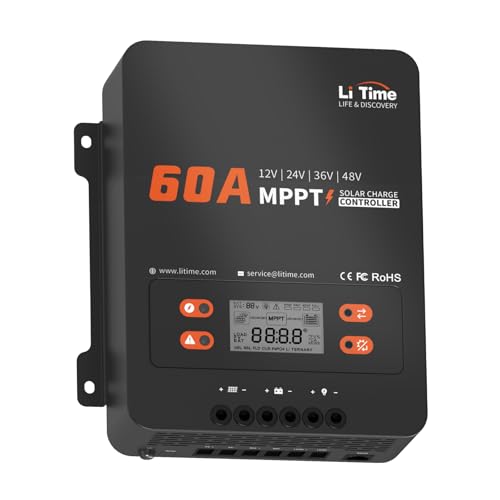
- Up to 3,480W PV input at 48V
- 99% claimed tracking efficiency
- LCD, cooling, and multiple protections
Best For: Medium-to-large LiFePO4 or lead-acid systems
Highest Capacity Option

- Up to 11,520W PV input at 96V
- Supports battery systems from 12V to 96V
- RS485 communication and user charging mode
Best For: Large, expandable off-grid solar systems
Maximum Voltage Choice
120A MPPT Solar Charge Controller
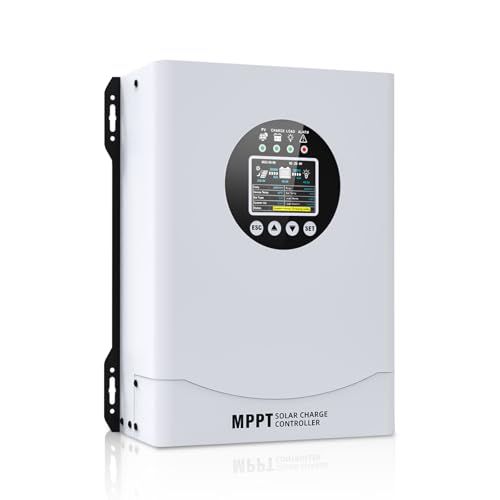
- Supports 12V–96V battery systems
- Up to 11,520W PV capacity at 96V
- LCD, lithium activation, and multiple protections
Best For: High-capacity systems with unusually broad voltage requirements
Smart High-Voltage Pick
100A MPPT Solar Charge Controller

- 250VDC maximum PV input
- Up to 5,200W at 48V
- Optional app monitoring and RS485 Modbus
Best For: Large arrays using higher-voltage panel strings
Balanced System Value

- Supports 12V–48V systems and 150V PV input
- 60A charging with efficient MPPT tracking
- LCD display and four-stage charging
Best For: Medium-sized RV and household solar systems
High-Voltage Powerhouse – 48V 140A MPPT Solar Charge Controller
For demanding energy-storage systems, this high capacity solar charge controller combines 140A charging with up to 500V open-circuit PV input and 6,500W power support. Its adjustable charging current and high-voltage solar input make it suited to installations where efficient long-distance energy transfer matters.
Best For: High-capacity 48V lead-acid or lithium battery banks and larger series-connected solar arrays.
Pros:
- Supports up to 140A charging, 500V open-circuit PV input, and 6,500W of power.
- Works with 48V sealed, gel, flooded, LiFePO4, and lithium-ion batteries, with customizable parameters.
- Large LCD displays PV, battery, charging, production, and diagnostic information.
- Includes multiple protections and dual smart cooling fans.
Cons:
- Its 18A maximum PV input current means panels should generally be connected in series.
- Designed for 48V systems rather than lower-voltage battery setups.
- Requires appropriately sized wiring, including recommended 12AWG PV and 2AWG battery cables.
This is the most power-oriented option in the group, particularly for high-voltage arrays and substantial 48V storage. Buyers should carefully match the array configuration, wiring, and battery settings to its electrical requirements.
Connected System Choice – Victron SmartSolar 150V 70A MPPT
The Victron SmartSolar 150V/70A is a strong high capacity solar charge controller for users who value app-based monitoring and coordinated system management. It supports 12V, 24V, 36V, and 48V batteries while using MPPT tracking to optimize available solar power.
Best For: Multi-controller solar systems and buyers who want Bluetooth setup, monitoring, and configuration through VictronConnect.
Pros:
- 70A charging capacity with support for 12V through 48V battery systems.
- 150V PV rating and MPPT tracking help maximize available solar output.
- VictronConnect provides real-time data, 30-day history, settings, firmware updates, and alarms.
- Multiple units can synchronize their charging stages.
Cons:
- Lower charging capacity than the 120A and 140A controllers in this roundup.
- Its intelligent load output requires careful low-voltage disconnect configuration.
- Advanced features may be more than needed for a simple single-controller installation.
Victron’s emphasis here is connectivity and coordinated charging rather than maximum amperage. It is a practical fit when monitoring, synchronized controllers, and configurable system controls are priorities.
Broad-Voltage Workhorse – POWLAND 120A MPPT Solar Controller
This POWLAND model stands out among high capacity solar charge controllers for its unusually broad automatic battery-voltage range. It supports 12V through 96V systems, provides 120A charging, and accepts up to 230V solar input, making it flexible for varied off-grid and mobile power installations.
Best For: Users needing one controller for different battery voltages, including LiFePO4, AGM, gel, and flooded lead-acid systems.
Pros:
- Automatically supports 12V, 24V, 36V, 48V, 60V, 72V, 84V, and 96V systems.
- Provides 120A charging capacity and up to 230V solar input.
- MPPT operation is rated up to 98% efficiency, according to the supplied specifications.
- LCD dashboard shows PV input, charging stage, warnings, and diagnostics.
Cons:
- Its broad voltage compatibility may require careful setup and verification before installation.
- The listed PV input limit is lower than the 500V rating of the 140A controller.
- Supplied details do not specify Bluetooth or app-based monitoring.
With 120A output and automatic support for systems up to 96V, this is the most voltage-flexible choice here. It is especially compelling for buyers whose battery voltage may vary across projects.
Compact Connected Pick – Victron SmartSolar 100V 50A MPPT
The Victron SmartSolar 100V/50A offers a more compact route into high capacity solar charge controllers for 12V and 24V systems. It combines MPPT tracking with Bluetooth connectivity, synchronized charging support, and a configurable load output in a relatively small 1.5 kg package.
Best For: 12V or 24V installations where compact dimensions, app control, and dependable system configuration are more important than maximum amperage.
Pros:
- 50A charging capacity for 12V and 24V battery systems.
- 100V PV rating with MPPT tracking for improved solar harvesting.
- VictronConnect enables monitoring, configuration, firmware updates, and alarms.
- Supports synchronized charging with multiple SmartSolar controllers and includes intelligent load control.
Cons:
- Not compatible with the 36V or 48V systems supported by the larger Victron model.
- 50A output is modest compared with the other controllers in this roundup.
- The supplied details list no built-in display, so monitoring depends on connected functionality.
This model makes sense for smaller-voltage systems that still benefit from Victron’s connected ecosystem. Its compact format and app features are useful, but buyers with larger battery banks should consider a higher-current alternative.
Best Overall High-Capacity MPPT – LiTime 60A 12V-48V
For shoppers comparing high capacity solar charge controllers, the LiTime 60A MPPT stands out as a flexible option for systems up to 3,480W at 48V. It supports several battery and system voltages, offers an LCD interface, and includes cooling and protection features for off-grid installations.
Best For: Medium-to-large 12V, 24V, 36V, or 48V systems using LiFePO4 or lead-acid batteries.
Pros:
- Supports up to 3,480W of solar input at 48V, with lower wattage limits at lower system voltages.
- Offers claimed tracking efficiency of at least 99% and peak conversion efficiency up to 96%.
- Includes an LCD screen, forced cooling, and protection against overvoltage, overpower, short circuits, and overheating.
- Provides selectable LiFePO4 charging and adjustable compatibility with lead-acid batteries.
Cons:
- Does not include built-in Bluetooth.
- Its 60A capacity is lower than the 100A and 120A alternatives in this roundup.
Choose the LiTime when you want a well-rounded high-capacity controller with broad voltage support, visible system information, and a stated two-year warranty without moving to the largest current ratings.
Highest Capacity Option – 120A Wide-Voltage MPPT
If maximum capacity is the priority, this 120A MPPT is designed for high-capacity solar charge controller applications up to 96V. Its stated 11,520W maximum PV rating, wide battery-voltage support, customizable charging, and RS485 communication make it suited to substantial off-grid systems.
Best For: Large off-grid solar installations requiring up to 120A charging and battery systems from 12V through 96V.
Pros:
- Supports up to 11,520W of PV input at 96V and 120A charging capacity.
- Accommodates 12V, 24V, 36V, 48V, 60V, 72V, 84V, and 96V systems.
- Works with LiFePO4, lithium-ion, lead-acid, and GEL batteries, including user-adjustable charging parameters.
- Provides an LCD display, RS485 communication through an RJ12 port, and multiple protection functions.
Cons:
- Its 8.7-pound metal housing is relatively substantial for installation.
- The supplied notes do not specify a warranty duration.
- The high-voltage, high-capacity design may be more controller than smaller systems require.
This is the strongest fit for buyers scaling a serious off-grid array. Its 230V maximum PV open-circuit voltage and unusually broad system-voltage range offer more expansion headroom than the other listed models.
Best Smart-Display Value – SA100A 12V-48V Controller
For buyers seeking high capacity solar charge controllers with straightforward monitoring, the SA100A combines a 100A rating with automatic 12V-to-48V recognition and a backlit LCD. It also adds dual USB ports, timed load control, memory functions, and support for several common battery types.
Best For: Off-grid homes, backup systems, remote installations, and lighting applications that benefit from detailed display information and timed load control.
Pros:
- Automatically recognizes 12V, 24V, 36V, and 48V systems and supports up to 100A.
- LCD monitoring shows battery voltage, PV charging or discharging current, temperature, and error codes.
- Supports sealed, GEL, flooded, and LiFePO4 batteries.
- Includes dual 5V USB charging ports plus adjustable timing and light-control functions.
Cons:
- Maximum PV input is listed as 100V, lower than the 200V and 230V ratings of the other models.
- The supplied notes do not state a maximum solar-panel wattage.
- Its very light listed weight may not indicate the same substantial metal construction as larger controllers.
The SA100A is a practical choice when display visibility, automatic voltage recognition, USB charging, and load scheduling matter as much as raw charging capacity. Confirm the array’s voltage and intended power level before installation.
Maximum Voltage Choice – 120A MPPT Solar Charge Controller
For buyers comparing high capacity solar charge controllers, this 120A MPPT model stands out for its unusually broad battery-system support, covering 12V through 96V systems. It accepts up to 230V of PV input and uses MPPT tracking to make better use of available panel power than a PWM controller.
Best For: Large off-grid, RV, or backup systems using high-capacity battery banks and multiple battery chemistries.
Pros:
- Supports 120A charging and system voltages from 12V to 96V.
- Rated PV capacity scales from 1,440W at 12V to 11,520W at 96V.
- Includes LCD monitoring, broad battery compatibility, lithium activation, and multiple electronic protections.
Cons:
- The extensive voltage range may be unnecessary for smaller solar installations.
- The supplied notes do not mention app monitoring or communications connectivity.
This is a strong fit when system capacity and voltage flexibility matter most. Confirm your battery voltage, panel wattage, and battery chemistry before installation.
Smart High-Voltage Pick – 100A MPPT Solar Charge Controller
This 100A model is a compelling option among high capacity solar charge controllers if you want high-voltage panel strings and system monitoring. Its 250VDC maximum PV input, 100A continuous-output design, and support for 12V through 48V systems provide flexibility for larger residential, RV, marine, and off-grid installations.
Best For: Larger solar arrays that benefit from 250V panel input, reduced wiring current, and optional app-based monitoring.
Pros:
- Supports up to 250VDC PV input and up to 5,200W at 48V.
- Designed for 100A continuous charging with reinforced power and thermal management features.
- Offers LCD monitoring, optional Bluetooth app compatibility, RS485 Modbus, and broad battery support.
Cons:
- Bluetooth monitoring requires an optional module.
- Its maximum stated PV capacity is lower than the 120A model at higher battery voltages.
The combination of high PV input voltage, 100A output, and expandable communications makes this a practical choice for larger systems. Check the recommended PV limit for your battery voltage and plan for the optional monitoring hardware if needed.
Balanced System Value – POWLAND 60A MPPT Controller
The POWLAND 60A is a more moderate choice for shoppers considering high capacity solar charge controllers without moving to the largest 100A- or 120A-rated units. It supports automatic 12V, 24V, 36V, and 48V recognition, accepts up to 150V input, and includes an LCD for checking system data and operating status.
Best For: RVs, household solar systems, and medium-sized installations using lead-acid or lithium batteries.
Pros:
- Provides up to 60A charging across 12V, 24V, 36V, and 48V systems.
- MPPT tracking is rated at up to 99% PV utilization and 98.1% efficiency.
- Includes four-stage charging, LCD controls, and short-circuit, reverse, overload, and open-circuit protection.
Cons:
- Its 60A rating offers less charging capacity than the other two controllers.
- The supplied notes do not list app monitoring or communications features.
- The plastic construction may be less appealing for installations prioritizing a metal enclosure.
This controller offers a sensible balance of capacity, battery compatibility, and straightforward local monitoring. It is best matched to systems where 60A charging and 150V PV input are sufficient.
How We Picked the Best High Capacity Solar Charge Controllers
We focused on the specifications that most directly affect system compatibility and usable charging performance: maximum charging current, supported battery-bank voltage, maximum photovoltaic input voltage, MPPT functionality, battery chemistry support, monitoring options, and installation flexibility. The selection includes controllers for 12V through 96V systems, as well as models designed specifically for 48V banks and higher-power arrays.
Because advertised ratings are not interchangeable, treat the listed amperage as a starting point rather than a guarantee of continuous output in every installation. Always verify the manufacturer’s wiring, temperature, overcurrent, and solar-array limits before purchase.
Quick Comparison
| What to Compare | Why It Matters |
|---|---|
| Charging current | Determines how much power the controller can deliver to the battery bank. |
| Battery voltage | Must match the nominal voltage of your battery system. |
| Maximum PV voltage | Sets the safe upper limit for the solar panel string voltage. |
| MPPT operation | Helps extract more available energy than basic PWM regulation, especially in changing conditions. |
| Monitoring | LCD, RS485, or app access makes setup and troubleshooting easier. |
Key Buying Factors for High-Capacity Solar Charge Controllers
Match the Battery Bank First
Start with the battery voltage and chemistry. A controller that supports 12V, 24V, 36V, and 48V systems may be more versatile, but broad compatibility does not automatically mean every charging profile is available. Lithium, LiFePO4, AGM, sealed lead-acid, and flooded batteries require different voltage targets and charge behavior. Confirm that the controller provides the settings your battery manufacturer specifies.
Calculate Array Voltage and Current
Check the solar array’s open-circuit voltage at the coldest expected temperature, not only its nominal rating. That figure must remain below the controller’s maximum PV input voltage. Also compare the array’s maximum power with the controller’s output rating and any permitted oversizing limit. A high-amp controller is useful only when the panels, battery bank, cabling, fuses, and disconnects are sized to support it.
Consider Heat, Wiring, and Installation
High-current equipment produces heat and generally needs generous cable sizing, ventilation, and appropriate overcurrent protection. Review terminal capacity, enclosure requirements, grounding instructions, and recommended clearances. For a remote installation, Bluetooth, app monitoring, or RS485 communication can be more valuable than a built-in display alone.
Who Should Buy Which High Capacity Solar Charge Controllers?
Choose a 48V-focused, high-amperage model for a larger off-grid array where the battery bank and inverter already use 48V. A multi-voltage controller is better for owners who may expand or reconfigure a system across several battery-bank sizes. Controllers with 200V or 250V PV input are suited to higher-voltage panel strings, provided the cold-weather voltage calculation stays within limits.
For smaller 12V or 24V installations, prioritize accurate battery settings, reliable protection, and a manageable current rating instead of buying the largest number available. If you need regular system visibility, select a model with app monitoring, RS485, or a clear LCD. Finally, confirm certifications, warranty coverage, replacement support, and the complete installation manual before committing to any of these High Capacity Solar Charge Controllers.