
A well-chosen camera slider for interviews can add subtle movement, improve production value, and help create polished establishing or b-roll shots without a full motion-control rig.
This roundup covers compact manual sliders, longer carbon-fiber rails, and motorized options with app or remote control, so you can match movement, portability, and budget to your interview setup.
Best 10 Camera Slider for Interviews Picks for 2026
Best Long-Track Motorized Pick
NEEWER ER1 47.2-Inch Motorized Slider

- 47.2-inch rail for expansive camera moves
- App control with video and time-lapse modes
- Includes 4400mAh NP-F750 battery
Best For: Long interview moves and repeatable solo filming
Best Compact Motorized Pick
IFOOTAGE PICO Portable Camera Slider

- Compact 15.8-inch design for travel
- 360-degree pan plus linear motion
- App control with repeatable shooting modes
Best For: Lightweight interview rigs and small production spaces
Best Manual Mobile Pick
NEEWER CS1M 16-Inch Carbon Fiber Slider

- Lightweight 16-inch carbon-fiber rail
- Includes phone and action-camera mounts
- Smooth, noiseless manual bearing movement
Best For: Portable lightweight interview and creator setups
Best Mid-Length Motorized Pick

- 31.5-inch rail balances reach and footprint
- App-controlled video and time-lapse modes
- 11-pound horizontal load capacity
Best For: Automated interview moves in medium-sized setups
Portable Quiet Rail
Zecti 24-Inch Carbon Fiber Slider

- Lightweight 24-inch rail with carrying bag
- Supports multiple shooting orientations
- Works with cameras, phones, and action cameras
Best For: Portable manual interview tracking shots
Tabletop Dolly Pick

- Moves in straight lines or circles
- Includes ball head and phone clamp
- Pocket-sized aluminum alloy construction
Best For: Compact tabletop and smartphone interview shots
Automated Production Choice
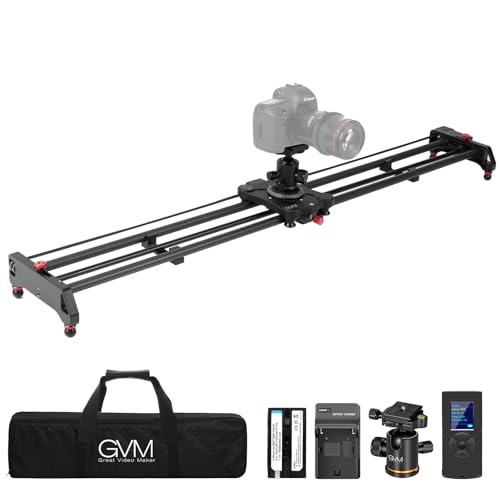
- Motorized 48-inch rail with remote control
- Supports tracking, panorama, video, and time-lapse modes
- Includes tripod ports and six shutter cables
Best For: Repeatable and programmable interview camera moves
Portable Manual Pick
Zecti 16-Inch Carbon Fiber Slider

- Compact 16-inch, 600 g design
- Adjustable legs and bubble level
- Supports horizontal, vertical, and angled shots
Best For: Portable manual interview setups
Automated Interview Pick

- Motorized video, time-lapse, and round-trip modes
- Tripod-compatible 1/4-inch and 3/8-inch holes
- Supports up to 2.5 kg
Best For: Repeatable interview camera movements
Long-Track Pro Pick
GVM 48-Inch App-Controlled Slider

- 48-inch carbon-fiber motorized track
- App-controlled programmable movement
- Tracking, panoramic, and time-lapse modes
Best For: Production setups needing long repeatable moves
Best Long-Track Motorized Pick – NEEWER ER1 47.2-Inch Motorized Slider
For interviews that benefit from a gradual push-in or lateral move, this 47.2-inch NEEWER ER1 is a camera slider for interviews with substantial travel and automated movement. App control, time-lapse support, a quiet motor, and a large included battery make it useful for repeatable shots during longer setups.
Best For: Interview productions needing long camera travel, automated movement, and tripod-mount flexibility.
Pros:
- Long 47.2-inch rail provides generous movement for cinematic interview shots.
- App control supports manual, video, and time-lapse modes with adjustable speed, interval, and exposure.
- Silent stepper motor and included 4400mAh NP-F750 battery support quiet, extended filming.
- Supports horizontal loads up to 11 pounds and includes 1/4-inch and 3/8-inch mounting threads.
Cons:
- 2.4G remote control and charger are not included.
- It is heavier and less compact than the shorter slider options.
- Minor shake may occur during macro photography.
This is the strongest choice here when interview framing calls for a long, controlled move and the setup can accommodate a 120cm rail. Its automated operation is particularly useful for repeatable B-roll and solo filming.
Best Compact Motorized Pick – IFOOTAGE PICO Portable Camera Slider
The IFOOTAGE PICO is a compact camera slider for interviews when portability matters more than extended rail length. Its 15.8-inch design, app control, 360-degree panning, and support for lightweight cameras make it practical for small studios, travel kits, and solo interview B-roll.
Best For: Creators using DJI Pocket 3, action cameras, smartphones, or other lightweight setups in compact spaces.
Pros:
- Compact 15.8-inch design is easy to carry for travel and tabletop filming.
- Combines linear movement with 360-degree panning for push-ins, tracking shots, and panoramas.
- App control supports repeatable moves, time-lapse, stop motion, panorama, and multi-point shooting.
- Designed for DJI Pocket 3, action cameras, smartphones, mirrorless cameras, and lightweight rigs.
Cons:
- The compact rail provides less travel than the 31.5-inch and 47.2-inch alternatives.
- Its compatibility focus is on lightweight creator setups rather than heavier interview rigs.
Choose the PICO when an interview kit needs controlled motion without the bulk of a full-size slider. Its pan-and-slide capability adds flexibility, though larger cameras or wider moves may favor a longer model.
Best Manual Mobile Pick – NEEWER CS1M 16-Inch Carbon Fiber Slider
For a straightforward camera slider for interviews, the manual NEEWER CS1M offers a 16-inch carbon-fiber rail, smooth bearing movement, and broad mounting compatibility. Adjustable legs, a ball head, a phone clamp, and an action-camera mount make it a flexible option for lightweight interview angles and supporting footage.
Best For: Mobile creators using phones, action cameras, or lightweight cameras who want a compact, non-motorized slider.
Pros:
- Four precision bearings provide smooth, noiseless manual movement.
- Adjustable legs and a bubble level help with positioning on uneven surfaces.
- Includes a 360-degree ball head, phone clamp, and action-camera mount.
- Lightweight 615g design includes a carrying bag and supports horizontal, vertical, and 45-degree tilt use.
Cons:
- Its 4.4-pound horizontal capacity is lower than the motorized ER1 models.
- Manual operation does not provide app-based repeatability or automated movement.
- The 16-inch rail limits travel for wider interview-room moves.
The CS1M is a practical choice when portability, accessory flexibility, and quiet manual operation matter most. It suits compact interview kits well, but heavier cameras or automated repeatable moves call for another model.
Best Mid-Length Motorized Pick – NEEWER ER1 31.5-Inch Slider
This 31.5-inch NEEWER ER1 balances the longer travel of a full-size slider with a more manageable footprint, making it a versatile camera slider for interviews. It offers app control, quiet motorized movement, time-lapse support, 45-degree tilting, and an included 4400mAh battery for controlled filming.
Best For: Interview setups seeking a middle-ground rail length with automated, repeatable camera movement.
Pros:
- 31.5-inch rail offers more movement than compact sliders without the full 47.2-inch length.
- App control supports manual, video, and time-lapse modes with adjustable motion settings.
- Silent stepper motor and included 4400mAh NP-F750 battery suit quiet, extended shoots.
- Supports up to 11 pounds horizontally and can operate at a 45-degree tilt.
Cons:
- 2.4G remote control and charger are not included.
- The listed weight is 8.7 pounds, so it is not the lightest travel option.
- Minor shake may occur during macro photography.
The 80cm ER1 is a sensible compromise for interview producers who want automated movement but do not need the longest available rail. It provides a strong feature set for controlled push-ins, tracking shots, and time-lapse work.
Portable Quiet Rail – Zecti 24-Inch Carbon Fiber Slider
The Zecti 24-inch slider is a practical camera slider for interviews when you want controlled horizontal, vertical, diagonal, or sideways movement without adding a motor. Its carbon fiber rail, adjustable legs, bubble level, and multiple mounting threads make it adaptable for cameras, phones, and action cameras.
Best For: Portable interview setups that need manual tracking shots and flexible positioning.
Pros:
- Lightweight 24-inch design weighs about 654g and includes a carrying bag.
- Supports horizontal, vertical, diagonal, and sideways operation.
- Offers multiple 1/4-inch and 3/8-inch mounting holes, adjustable legs, and non-skid feet.
- Compatible with many small cameras, smartphones, and action cameras.
Cons:
- Manual operation does not provide programmable or motorized movement.
- Some users may need to loosen the screws slightly if movement feels noisy or rough.
- The maximum recommended load is 4.4 pounds.
Choose this model when portability and positioning flexibility matter more than automated camera moves. Its adjustable hardware is useful for interview B-roll, but setup may require fine-tuning for smooth motion.
Tabletop Dolly Pick – NEEWER SD001 Camera Dolly
The NEEWER SD001 is a compact camera slider for interviews when a tabletop dolly is more useful than a long rail. Its four adjustable wheels support straight or circular movement, while the included ball head and phone clamp help position small cameras and smartphones quickly.
Best For: Tabletop interview details, compact studio shots, and phone-based recording setups.
Pros:
- Supports both linear and circular movement by adjusting the wheel angles.
- Rubber-padded wheels are designed for smooth, quiet movement on floors, tables, and sliders.
- Includes a 360-degree rotating and 90-degree tilting ball head.
- Compact 3.9-inch design weighs roughly 220g and includes a rotatable phone clamp with a cold shoe.
Cons:
- Not suitable for telephoto lenses.
- Its short tabletop format is less suited to long, dramatic tracking moves.
- The product notes indicate that an adapter may be sold separately for some action cameras.
This dolly is a good fit for creators who need a small, portable movement tool rather than a full-length slider. It is especially convenient for smartphone interviews and close tabletop sequences.
Automated Production Choice – GVM 48-Inch Motorized Slider
The GVM 48-inch motorized slider is a camera slider for interviews when repeatable movement, time-lapse work, or longer tracking shots are priorities. Remote-controlled speed, start and end points, dwell time, pauses, and automatic looping give it more control than a basic manual rail.
Best For: More advanced interview productions needing automated tracking, panoramic movement, or repeatable sequences.
Pros:
- Offers tracking, horizontal, 120-degree panoramic, video, and time-lapse modes.
- Remote control can manage speed, distance, pauses, dwell time, shot count, and looping.
- Supports automatic back-and-forth movement between selected start and end points.
- Includes multiple 1/4-inch and 3/8-inch ports plus six shutter cables and an extension cable.
Cons:
- At approximately 5.42kg, it is substantially heavier and less portable than the compact options.
- The supplied notes identify camera compatibility but do not specify a maximum supported load.
- Its motorized controls and accessories may add setup complexity.
Consider the GVM when consistency and programmable movement outweigh portability. The 48-inch rail provides more room for cinematic motion, while the remote settings support repeatable interview and production workflows.
Portable Manual Pick – Zecti 16-Inch Carbon Fiber Slider
If you need a camera slider for interviews that is easy to pack and set up, the Zecti 16-inch manual slider is a practical option. Its carbon-fiber rail system, adjustable legs, bubble level, and multiple mounting threads support straightforward horizontal, vertical, or angled camera moves.
Best For: Portable interview setups, travel filmmaking, and users who prefer manual control.
Pros:
- Compact 16-inch design weighs about 600 g and includes a carrying bag.
- Carbon-fiber rails and four precision bearings are designed for stable, quiet movement.
- Adjustable legs, nonskid feet, and a bubble level help with positioning on varied surfaces.
- Supports cameras, camcorders, mirrorless cameras, and smartphones with a compatible holder.
Cons:
- Manual operation does not provide automated repeatable moves.
- Some users may need to slightly loosen the screws if the slider feels noisy or rough.
- Maximum recommended load is 4.4 pounds.
The Zecti is a sensible choice when portability matters more than motorized repeatability. Check the screw tension during setup and keep the payload within its stated limit for smoother interview moves.
Automated Interview Pick – GVM 27-Inch Motorized Slider
For a camera slider for interviews that can create consistent motion without manually pushing the carriage, the GVM 27-inch motorized slider adds video, time-lapse, and automatic round-trip modes. Its aluminum-alloy track also supports ground or tripod-mounted use.
Best For: Interview creators who want repeatable motorized moves and multiple shooting modes.
Pros:
- Supports time-lapse, video, and automatic round-trip shooting.
- Multiple 1/4-inch and 3/8-inch mounting holes allow ground or tripod setups.
- Adjustable nonslip feet and a bubble level assist with leveling.
- Works with DSLRs, video cameras, and cellphones, with a stated 2.5 kg maximum load.
Cons:
- At about 2.36 kg and 26.8 inches long when folded, it is less travel-friendly than a compact manual slider.
- It is not water resistant.
- Vertical and steep-angle setups require careful balancing and mounting.
The GVM offers a useful middle ground for interview work: more control and repeatability than a manual rail, without the 48-inch footprint of the longer model. Its weight is worth considering if you frequently transport your kit.
Long-Track Pro Pick – GVM 48-Inch App-Controlled Slider
The GVM 48-inch model is a camera slider for interviews when you need longer tracking moves, programmable motion, and app control. Its carbon-fiber rail supports tracking, video, time-lapse, panoramic, and follow-focus-style workflows, while the multiple mounting ports accommodate different tripod configurations.
Best For: Studio or production setups requiring long, programmable camera movements.
Pros:
- 48-inch carbon-fiber track provides substantially more travel than compact sliders.
- iOS and Android app control supports adjustable start and end points, speed, intervals, stop times, and looping.
- Offers tracking, panoramic, time-lapse, and video shooting modes.
- Includes six shutter-release cables and an extension cable for broad camera compatibility.
Cons:
- Its 4 kg weight and 120 cm folded length make it demanding to transport.
- Battery life is listed at about two hours.
- It is not water resistant.
This is the most capable option here for controlled, cinematic interview motion, especially when the slider can remain in a studio or production vehicle. Choose it only if the long rail and programmable features justify the added size and weight.
How We Picked the Best Camera Slider for Interviews
We focused on the practical demands of interview production: smooth movement, manageable setup, camera support, portability, and control over speed. The selection includes short manual sliders for tight spaces, longer rails for wider tracking shots, and motorized models suited to repeatable moves, time-lapse work, and solo operation.
We also considered useful included accessories, such as ball heads, phone clamps, action-camera mounts, batteries, remotes, and app control. Since interview cameras and lenses vary considerably, buyers should confirm the slider’s stated load capacity and mounting compatibility before ordering.
Quick Comparison
- Best for compact interview kits: A 16-inch manual slider is easier to pack and position on a small set.
- Best for longer camera moves: A 47- or 48-inch rail provides more travel for wide composition changes.
- Best for repeatable movement: Motorized sliders with app or remote control allow consistent speed and programmed motion.
- Best for simple operation: Manual dolly sliders have fewer controls, batteries, or setup steps.
- Best for phones and action cameras: Models with included clamps and dedicated mounts offer more flexibility.
Key Buying Factors for a Camera Slider for Interviews
Length and Travel
Choose rail length based on the movement you actually need and the space available around the interview subject. Short sliders work well for subtle parallax shots and cramped rooms; longer rails create broader lateral movement but need more room, support, and transport space.
Manual or Motorized Control
Manual sliders are quick to deploy and generally quieter, making them useful when recording live dialogue. Motorized models are better when you need consistent speed, hands-off operation, time-lapse capability, or repeatable takes. Check whether the motor, app, and remote support the shooting modes you plan to use.
Load Capacity and Stability
Account for the camera body, lens, battery, cage, monitor, and any microphone or accessory. A slider should have comfortable capacity beyond your total rig weight. For longer rails, use a stable tripod or multiple support points to reduce flex and vibration.
Noise, Speed, and Smoothness
Quiet operation matters when the slider is close to a working microphone. Look for adjustable speed and smooth bearings or motor control. Test movement before recording, especially with heavier lenses or when shooting at higher frame rates.
Portability and Setup
Carbon-fiber rails can reduce carrying weight, while aluminum models may prioritize rigidity and value. Consider packed length, included feet or supports, battery requirements, charging, and how quickly the slider can be leveled on location.
Who Should Buy Which Camera Slider for Interviews?
Choose a compact manual model if you film interviews in small rooms, travel frequently, or mainly want subtle b-roll movement. Choose a long manual rail if you have reliable support and want a straightforward, battery-free setup for wider moves.
Choose a compact motorized slider for solo creators who need controlled movement without carrying a full-size rail. Choose a longer motorized model for studio interviews, repeatable takes, time-lapse sequences, or production teams that can accommodate additional setup and support.
Before buying, verify camera mounting hardware, payload limits, power options, and the slider’s dimensions against your tripod, camera rig, and shooting location. The best Camera Slider for Interviews is the one that delivers the required movement quietly and reliably without complicating the conversation or slowing production.