
Choosing the best camera slider for overhead shots requires more than checking rail length. You also need to consider camera weight, mounting geometry, movement control, and how much workspace the setup occupies.
We’ve selected 10 slider and overhead-mount options for creators filming product demos, tutorials, stop-motion, time-lapses, and other top-down content.
Best 10 Camera Slider for Overhead Shots Picks for 2026
Portable Manual Slider
Zecti 24-Inch Carbon Fiber Camera Slider

- 24-inch lightweight carbon fiber track
- Adjustable legs and multiple mounting threads
- Supports horizontal, vertical, and diagonal use
Best For: Traveling creators and flexible tabletop setups
Overhead Mounting Arm
Glide Gear OH50 Overhead Camera Stand
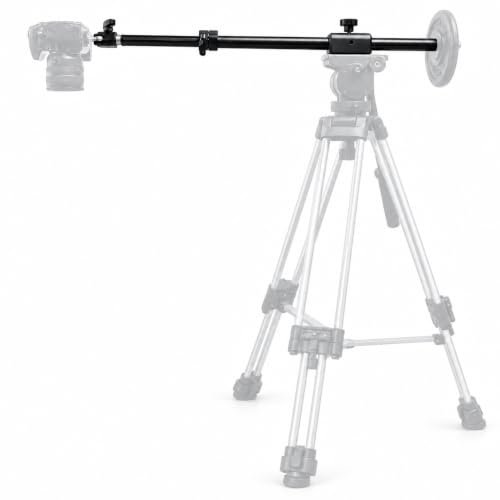
- Adjustable 21- to 36-inch arm
- Includes ball head and smartphone holder
- Mounts to compatible tripods and supports accessories
Best For: Top-down product photos and tutorial videos
Motorized Motion Slider
NEEWER ER1 31.5-Inch App-Controlled Slider

- App control with video and time-lapse modes
- 11-pound horizontal load capacity
- Includes a 4400mAh NP-F750 battery
Best For: Repeatable product videos and time-lapse shooting
Full-Height Overhead Tripod
K&F Concept 76-Inch Camera Tripod

- 76.7-inch maximum height with extension boom
- 8 kg/17.6-pound load capacity
- 360-degree ball head and foldable design
Best For: Tall overhead product and smartphone setups
Best Motorized Pick
GVM 32-Inch Wireless Camera Slider

- Six programmable shooting modes
- Wireless iOS and Android app control
- Carbon-fiber rail with adjustable legs
Best For: Portable automated camera moves and compact overhead setups
Best Dedicated Overhead Rig
NEEWER ST100 Overhead Camera Mount

- Stable steel tabletop overhead platform
- Supports up to 10 pounds
- Height-adjustable columns and accessory points
Best For: Fixed top-down tutorials, flat lays, and product demonstrations
Best Long-Travel Pick
GVM 48-Inch Motorized Camera Slider

- 48-inch carbon-fiber travel length
- Six app-controlled shooting modes
- Adjustable legs and multiple tripod threads
Best For: Wide overhead moves, tracking shots, and panoramic sequences
Best Desk-Mounted Pick
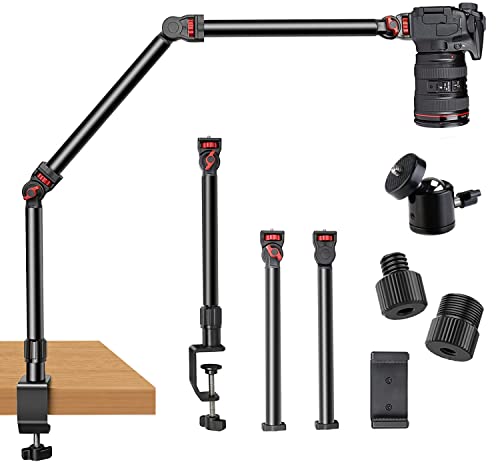
- Three-section arm for adjustable overhead positioning
- Supports cameras, phones, lights, and microphones
- Padded clamp saves desk space and protects surfaces
Best For: Desk-based overhead recording and livestreaming
Best Motorized Movement

- Motorized slider with video, time-lapse, and round-trip modes
- Supports horizontal, vertical, and 45-degree shooting
- 27-inch aluminum rail with tripod mounting options
Best For: Automated product videos and repeatable camera moves
Best Tall Support
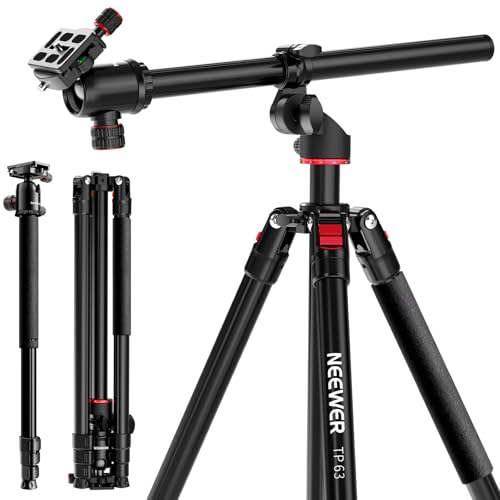
- Center column reaches up to 90.6 inches
- Supports up to 22 pounds of equipment
- Converts to a monopod and supports compatible sliders
Best For: Tall overhead rigs and heavier camera setups
Portable Manual Slider – Zecti 24-Inch Carbon Fiber Camera Slider
If you need a camera slider for overhead shots, the Zecti 24-inch manual model offers a portable setup with adjustable legs, non-skid feet, and multiple mounting threads. Its 60 cm track supports horizontal, vertical, diagonal, and sideways operation for cameras, phones, and action cameras.
Best For: Travelers and creators who want a lightweight manual slider for tabletop, overhead, and varied-angle shooting.
Pros:
- Portable 24-inch carbon fiber design weighs about 1.4 pounds and includes a carrying bag.
- Adjustable legs, rubber feet, and a bubble level support placement on different surfaces.
- Multiple 1/4-inch and 3/8-inch mounting holes accommodate cameras and accessories.
Cons:
- Manual operation requires you to move the carriage yourself.
- Some users may experience noise or rough movement if the screws are overtightened.
- Maximum recommended load is 4.4 pounds.
The Zecti is a practical choice when portability and flexible positioning matter more than motorized repeatability. Check the carriage adjustment before filming, especially if movement feels tight or noisy.
Overhead Mounting Arm – Glide Gear OH50 Overhead Camera Stand
For a camera slider for overhead shots alternative focused on fixed positioning, the Glide Gear OH50 provides an adjustable 21- to 36-inch arm for top-down photography and video. It mounts to a suitable tripod and includes a ball head and smartphone holder.
Best For: Product photographers, tutorial creators, and phone users who need a stable overhead camera position rather than sliding motion.
Pros:
- Arm length adjusts from 21 to 36 inches for different overhead compositions.
- Compatible with tripods using 1/4-inch-20 and 3/8-inch-16 screws.
- Includes a smartphone holder, ball head, and two accessory mounting holes.
- 6061 aluminum construction weighs about 1 pound.
Cons:
- Requires a tripod or stand rated for at least 10 pounds.
- Its listed maximum load is 5 pounds, so heavier camera setups need careful checking.
- This is an overhead arm, not a motorized or sliding camera track.
The OH50 makes sense when repeatable top-down framing is the priority. Its counterweight compatibility can add stability, but the supporting tripod remains an important part of the setup.
Motorized Motion Slider – NEEWER ER1 31.5-Inch App-Controlled Slider
The NEEWER ER1 is a strong camera slider for overhead shots when you want automated, repeatable movement. Its 31.5-inch carbon fiber rail offers app control, manual and time-lapse modes, and support for horizontal or 45-degree tilted shooting.
Best For: Product videos, time-lapse work, and creators who want programmable camera movement with a higher load capacity.
Pros:
- App-controlled motor provides manual, video, and time-lapse shooting modes.
- Supports up to 11 pounds horizontally and 5.5 pounds at a 45-degree tilt.
- Includes a 4400mAh NP-F750 battery for extended operation.
- Offers 1/4-inch and 3/8-inch threaded holes for tripod mounting.
Cons:
- The 2.4G remote control is not included.
- A separate 5V 2A Type-C portable charger is not included.
- Minor shake may occur during macro photography.
- At 8.7 pounds, it is less portable than a compact manual slider.
The ER1 is best suited to controlled shoots where repeatable motion matters. Its weight and power requirements make it more appropriate for a dedicated setup than casual travel use.
Full-Height Overhead Tripod – K&F Concept 76-Inch Camera Tripod
The K&F Concept 76-inch tripod is a versatile camera slider for overhead shots alternative for creators who need a tall support with an extension boom. Its arm rotates from 0 to 180 degrees, while the center column and ball head provide flexible positioning for cameras and smartphones.
Best For: Overhead product photography, smartphone setups, and creators who need a tall, portable support with broad angle adjustment.
Pros:
- Height adjusts from 17.3 to 76.7 inches and folds to about 15.3 inches.
- Extension boom rotates 0 to 180 degrees and supports 360-degree horizontal rotation.
- 8 kg/17.6-pound load rating accommodates a range of camera equipment.
- Includes a 360-degree ball head and carrying bag.
Cons:
- It is a tripod and boom system, not a camera slider with a moving carriage.
- Overhead stability depends on proper tripod placement and balancing.
- The setup weighs about 3.63 pounds before adding the camera and accessories.
This K&F Concept model is a flexible overhead support for larger framing options and elevated setups. Choose it over a track slider when height, boom reach, and load capacity are more important than continuous lateral movement.
Best Motorized Pick – GVM 32-Inch Wireless Camera Slider
The GVM 32-inch motorized slider is a versatile option for creators who need a camera slider for overhead shots as well as tracking, panoramic, time-lapse, and standard video work. App-based control lets you set movement points, speed, pauses, and intervals from an iOS or Android device.
Best For: Creators who want programmable camera movement, wireless control, and a portable carbon-fiber setup for studio or location shooting.
Pros:
- Offers six shooting modes, including tracking, panoramic, time-lapse, and video.
- Bluetooth app control supports adjustable start and end points, speed, dwell time, and pauses.
- Carbon-fiber construction, adjustable legs, multiple mounting threads, and an included carry bag support flexible setups.
Cons:
- The 32-inch rail provides less travel than the 48-inch GVM model.
- Using the full feature set requires a compatible smartphone or tablet.
This is a strong all-around choice when you want automated movement without giving up portability. Its multiple mounting points also make angled and vertical configurations possible, though the shorter rail may limit especially wide overhead moves.
Best Dedicated Overhead Rig – NEEWER ST100 Overhead Camera Mount
The NEEWER ST100 is a tabletop overhead mount rather than a moving slider, making it a practical camera slider for overhead shots alternative when stable top-down framing matters more than motion. Its steel frame supports cameras and phones, with adjustable columns and accessory mounting points for flat lays, cooking videos, drawing, and unboxings.
Best For: Flat-lay photography, tutorials, product demonstrations, cooking content, and other fixed top-down shots on a desk or floor.
Pros:
- Steel construction supports loads up to 10 pounds.
- Height adjusts from 24 to 39 inches using spring-loaded column positions.
- The crossbar includes 12 mounting points, while the frame supports compatible cameras, phones, monitors, and accessories.
Cons:
- It does not provide motorized or sliding camera movement.
- Phone clamps, super clamps, lighting, and backdrop materials are sold separately.
- It requires a flat desk at least 39.4 inches wide for tabletop use.
If your priority is repeatable, shake-resistant overhead framing, the ST100 is more purpose-built than a conventional slider. Choose it for stationary top-down content; choose a motorized slider when you need the camera to travel during the shot.
Best Long-Travel Pick – GVM 48-Inch Motorized Camera Slider
The GVM 48-inch motorized slider is suited to creators who need a longer camera slider for overhead shots and broader camera moves. Its carbon-fiber rail supports tracking, panoramic, time-lapse, and video modes, while the iOS and Android app controls speed, intervals, stops, looping, and other movement parameters.
Best For: Longer tracking moves, panoramic sequences, time-lapse work, and creators who need more rail travel than a compact slider provides.
Pros:
- Provides 48 inches of travel for wider movement across a scene or tabletop.
- Supports six shooting modes with adjustable speed, intervals, stop times, photo count, and looping.
- Carbon-fiber construction, adjustable leveling legs, multiple 1/4-inch and 3/8-inch ports, and a carry bag add flexibility.
Cons:
- Its 120cm length makes it less compact to transport than the 32-inch model.
- The listed battery average life is approximately two hours.
- It is not water resistant.
This model makes the most sense when a short slider would feel restrictive. The extra rail length gives overhead and tracking compositions more room, but it also increases the storage and transport commitment compared with a smaller motorized slider.
Best Desk-Mounted Pick – Flexible Overhead Camera Arm
If you need a camera slider for overhead shots but have limited desk space, this articulating desktop arm offers a compact alternative for fixed-position overhead filming. Its three adjustable sections, rotating base, and 360° ball head make it easy to position a camera, phone, light, or microphone over a workspace.
Best For: Desk-based overhead recording, livestreaming, baking videos, online lessons, and vlogging.
Pros:
- Three-section arm with 180° adjustment points and a 360° rotating base.
- Supports up to 4.5 pounds horizontally and up to 6 pounds maximum.
- Includes 1/4-inch, 3/8-inch, and 5/8-inch screw options, plus a phone holder and ball head.
- Padded C-clamp fits desks up to 2.4 inches thick and helps protect surfaces.
Cons:
- It is an articulating mount rather than a motorized sliding rail.
- Maximum load depends on the arm’s position and orientation.
This mount is a practical choice when overhead framing matters more than continuous camera movement. The lightweight, detachable design also makes it easier to assemble and transport than a larger slider system.
Best Motorized Movement – 27-Inch GVM Camera Slider
For creators who want a true camera slider for overhead shots with repeatable movement, the GVM 27-inch motorized slider adds automated motion to a sturdy aluminum rail. It supports video, time-lapse, and automatic round-trip shooting, while multiple mounting holes allow use on the ground or with a tripod.
Best For: Motorized product footage, time-lapses, interviews, and smooth horizontal, vertical, or angled camera moves.
Pros:
- Supports time-lapse, video, and automatic round-trip shooting modes.
- Offers 27 inches of travel and adjustable non-slip feet for leveling.
- Works horizontally, vertically, and at 45-degree angles; tripod use supports slopes up to 70 degrees.
- Compatible with DSLR cameras, video cameras, and cellphones, with 1/4-inch and 3/8-inch mounting holes.
Cons:
- Its 2.5 kg maximum load may limit heavier camera setups.
- At 26.8 inches long and 2.36 kg, it is less compact than a desk-mounted arm.
This is the strongest match for overhead shots that benefit from controlled camera travel rather than a stationary angle. Its motorized modes can also simplify repeatable sequences, although the larger rail requires more setup space.
Best Tall Support – NEEWER TP63 Overhead Tripod
The NEEWER TP63 is a versatile support option for a camera slider for overhead shots when you need substantial height and a broad range of positioning. Its center column can extend to 90.6 inches and move horizontally, while the included ball head provides additional pan and tilt control.
Best For: Tall overhead setups, studio and event shooting, outdoor work, and supporting compatible sliders or heavier camera equipment.
Pros:
- Flexible center column supports horizontal positioning, 360° rotation, and 120° vertical tilt.
- Extends from 25.2 inches to 65 inches, or up to 90.6 inches with the liftable center column.
- Heavy-duty metal construction supports up to 22 pounds and includes a hook for a sandbag.
- Converts into a monopod and folds to about 21 inches for transport.
Cons:
- It is a tripod and monopod support, not a motorized slider or sliding rail.
- A sandbag for the stability hook is not included.
- The tall extended configuration may require additional stabilization for overhead work.
This support stands out when height, load capacity, and flexible camera placement are priorities. It can also support sliders with compatible mounting systems, making it a useful foundation for more advanced overhead rigs.
How We Picked the Best Camera Slider for Overhead Shots
We compared these setups by looking at the factors that most affect overhead filming: stability, usable travel, mounting flexibility, load support, movement control, portability, and compatibility with cameras, phones, and accessories. The list includes traditional rails, motorized sliders, overhead arms, desk stands, and tall tripod-style systems because “overhead slider” can mean different things depending on the shot.
Motorized models are useful for repeatable moves, time-lapse sequences, and slow tracking shots. Manual sliders are usually simpler, lighter, and quicker to reposition. Overhead arms and stands can be a better choice when you need a fixed top-down angle rather than lateral camera travel.
Quick Comparison
| Setup type | Best for | Main advantage | Trade-off |
|---|---|---|---|
| Manual camera slider | Basic tracking and tabletop work | Simple operation and low maintenance | Movement consistency depends on the operator |
| Motorized slider | Time-lapse and repeatable motion | Programmable, consistent movement | Heavier and more complex |
| Overhead arm or desk stand | Top-down tutorials and product shots | Flexible camera positioning | Requires a stable support surface |
| Tall overhead tripod | Large workspaces and studio setups | Greater height and reach | Needs more room and careful balancing |
Key Buying Factors for a Camera Slider for Overhead Shots
Mounting Stability and Safety
Overhead equipment places extra stress on the tripod, arm, carriage, and camera connection. Check the stated load capacity, use a secure base, and keep the camera’s center of gravity close to the support point. A safety tether is a sensible precaution when working above expensive equipment or fragile products.
Rail Length and Working Distance
A longer rail creates more travel but also increases storage needs and may require support at multiple points. For a small tabletop, a shorter slider is easier to manage. For wide product scenes or large craft projects, a 48-inch or longer system may be more useful.
Manual Versus Motorized Movement
Choose manual operation for occasional pans, quick repositioning, and a lighter kit. Choose motorized control when you need smooth repeatable moves, programmable speed, wireless control, or time-lapse tracking. Confirm whether the system supports your preferred camera orientation and movement direction.
Camera and Accessory Compatibility
Look for standard mounting threads, a suitable ball head or tilt adjustment, and enough clearance for lenses, phones, lights, and microphones. An overhead rig should allow you to frame the subject without the rail, arm, or tripod legs entering the shot.
Portability and Workspace
Carbon-fiber rails tend to favor lower weight, while aluminum systems may prioritize rigidity and value. Measure your desk or studio before buying, including the space needed for legs, clamps, cables, and motor controls.
Who Should Buy Which Camera Slider for Overhead Shots?
- For beginners and occasional tabletop creators: Choose a compact manual slider or straightforward overhead arm that is quick to set up.
- For product photographers and tutorial makers: An overhead mount or desk stand offers direct top-down positioning with minimal camera travel.
- For time-lapse and repeatable video moves: Choose a motorized NEEWER or GVM slider with app or wireless control.
- For larger scenes and longer tracking shots: Consider a 48-inch rail or a tall overhead tripod, provided you have adequate support space.
- For mobile creators: Prioritize lighter carbon-fiber construction, simple controls, and compatibility with a phone mount or compact camera.
Before purchasing, verify the exact payload, rail dimensions, power requirements, and included accessories. The safest and most useful Camera Slider for Overhead Shots is the one that matches your camera weight, available workspace, and intended movement—not necessarily the longest or most feature-packed model.