
A reliable bench power supply makes testing, prototyping, repairing, and charging low-voltage electronics easier—without taking over a compact workspace. The best models for small workbenches balance output range, control precision, safety features, and footprint.
We compared 10 adjustable DC supplies across common voltage and current ratings, display styles, adjustment controls, and useful extras such as USB charging, memory presets, and intelligent charging modes.
Best 10 Bench Power Supplies for Small Workbenches Picks for 2026
Best Compact Precision Pick
NICE-POWER 30V 10A Variable Supply

- Bright four-digit readout for voltage, current, and power
- Separate output switch for safer setup changes
- Compact body with 5V/2A USB port
Best For: Small workbenches and general electronics projects
Best Fixed-Voltage High-Current Pick
Pyramid 12A Linear Bench Supply

- Constant 12V DC output with 12A current rating
- Screw terminals for broad equipment compatibility
- Short-circuit protection and built-in cooling fan
Best For: 12V communications and electronics equipment
Best Charging-Feature Pick
Jesverty SPS-3010C 32V 10A Supply

- Encoder controls offer precise voltage and current adjustment
- 20W USB-A and USB-C quick-charge ports
- Intelligent charging includes automatic full-charge stop
Best For: Bench electronics work with battery and USB charging
Best Universal-Input Pick
YITRANIC 300W 32V 10.1A Supply

- 300W output in a compact 1kg enclosure
- 100-240V auto-detect input for worldwide use
- Memory, key lock, dual-switch control, and five protections
Best For: High-power testing on space-limited or international workbenches
Precision Preset Pick
WANPTEK 0–60V/0–5A Bench Supply

- 0–60V and 0–5A regulated output
- Three memory presets and encoder control
- Compact design with OCP and USB charging
Best For: Repair benches and repeat testing
High-Current Compact Choice

- 0–30V and 0–10A adjustable output
- Coarse/fine encoder adjustment
- 18W USB and Type-C quick charging
Best For: Higher-current electronics work
Compact Fast-Charging Pick

- 0–32V and 0–10A adjustable output
- 20W USB-A and USB-C charging
- Compact body with multiple protections
Best For: Small workbenches needing adjustable power and device charging
Digital Control Pick
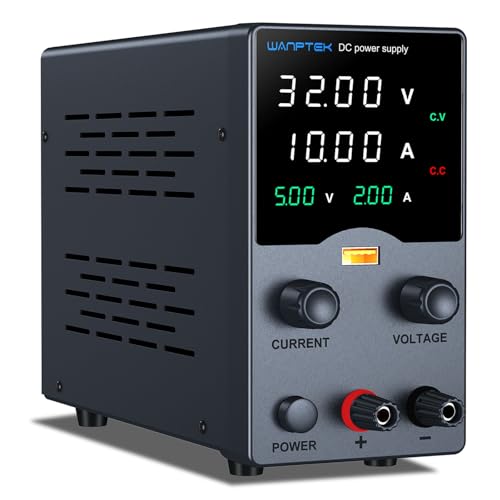
- 0–32V and 0–10A adjustable range
- Four-digit display with fine resolution
- USB current monitoring and three protections
Best For: Precise repair and DIY work on space-limited benches
Best Compact Precision Pick – NICE-POWER 30V 10A Variable Supply
For small workbenches that need adjustable output without taking up much room, the NICE-POWER 30V 10A is a practical choice. Its bright four-digit display shows voltage, current, and power, while the separate output switch lets you set parameters before energizing a connected load.
Best For: Electronics repair, DIY projects, and users who want a lightweight adjustable supply with USB charging.
Pros:
- Displays voltage, current, and power with 0.01V and 0.001A resolution.
- Output on/off control helps prevent accidental power delivery while adjusting settings.
- Compact 8.4 x 3.3 x 5.5-inch design with a 5V/2A USB port.
Cons:
- Designed for 110V input only; 220V input is not available.
- Its switching design may be less suited to buyers specifically seeking a linear supply.
This model balances useful controls, readable measurements, protection features, and a small footprint. It is a strong fit when bench space is limited and adjustable DC output is more important than universal input voltage.
Best Fixed-Voltage High-Current Pick – Pyramid 12A Linear Bench Supply
The Pyramid 12A is a straightforward option among bench power supplies for small workbenches when your projects consistently require 12V DC rather than adjustable voltage. Its linear-regulated design, screw terminals, and built-in protection make it useful for powering compatible communications and electronics equipment.
Best For: CB radios, scanners, HAM radio equipment, cellular devices, and other fixed-voltage 12V applications.
Pros:
- Provides a constant 12V DC output, with 13.8V listed as an output option.
- 12A continuous current and 14A surge capability suit higher-current equipment.
- Screw terminals, short-circuit protection, fuse protection, and a cooling fan are built in.
Cons:
- Does not offer the variable voltage control or digital readout found on the other listed models.
- Larger and heavier than the compact adjustable supplies in this roundup.
- Its fixed-output format is less flexible for varied electronics testing.
This is a purpose-built desktop converter rather than a general-purpose laboratory supply. Choose it when reliable fixed-voltage, higher-current operation matters more than fine adjustment or a space-saving enclosure.
Best Charging-Feature Pick – Jesverty SPS-3010C 32V 10A Supply
The Jesverty SPS-3010C packs several convenience features into a compact enclosure, making it appealing for small workbenches used for electronics development and battery work. Its encoder controls provide fine adjustment, while USB-A, USB-C, output control, and an intelligent charging mode expand its everyday usefulness.
Best For: Arduino and Raspberry Pi projects, electronics repair, battery charging, and users who want fast USB charging at the bench.
Pros:
- Adjustable 0-32V and 0-10A output with 0.01V/0.001A setting resolution.
- USB-A and USB-C ports support 20W quick charging.
- Intelligent charging can stop automatically when a battery is full, with reverse-connection protection.
Cons:
- The product details identify AC115V/230V selectable input, but the specifications also list 115V input; verify the intended configuration before purchase.
- Its plastic/polycarbonate enclosure may feel less substantial than a metal laboratory chassis.
For a crowded bench, the compact 7.1 x 3.6 x 6.2-inch footprint and multifunction controls are notable advantages. It is especially compelling if charging batteries and USB devices is part of your regular workflow.
Best Universal-Input Pick – YITRANIC 300W 32V 10.1A Supply
The YITRANIC 3010MS stands out for combining a full 300W output with a compact 1kg housing, making it a capable choice for small workbenches. Its 100-240V auto-detect input, memory function, key lock, and dual-switch output control are useful for repeat testing and shared workspaces.
Best For: Users needing high-power adjustable output, worldwide input compatibility, and repeatable bench testing.
Pros:
- Adjustable 0-32V and 0-10.1A output with 300W maximum power.
- Compact 220 x 102 x 80mm design with 100-240V auto-detect input.
- Memory recall, key lock, encoder control, and five protection functions support repeatable work.
Cons:
- The listed USB port provides QC3.0 18W, rather than the 20W USB charging offered by the Jesverty model.
- Its advanced controls may be more than needed for simple fixed-voltage projects.
This is one of the most versatile options here for a compact bench that still needs substantial output capacity. The combination of 300W power, automatic CV/CC switching, universal input, and memory features makes it particularly well suited to demanding or repetitive testing.
Precision Preset Pick – WANPTEK 0–60V/0–5A Bench Supply
For shoppers comparing bench power supplies for small workbenches, the WANPTEK TPS-C605 combines a compact horizontal design with adjustable 0–60V and 0–5A output. Its encoder controls, memory presets, output switch, and protection features suit electronics repair and repeat testing.
Best For: Electronics repair, circuit diagnostics, laboratory testing, and users who frequently reuse the same settings.
Pros:
- Digit-by-digit encoder adjustment supports precise voltage and current setup.
- Three memory presets make recurring test configurations quick to recall.
- Output switching, OCP, key lock, and a USB fast-charging port add convenience.
- Compact 8.27 × 5.71 × 3.15-inch form factor saves bench space.
Cons:
- Supplied test leads are not intended for heavy, extended high-current use.
- U.S. users must set the rear input selector to 115V before operation.
The WANPTEK is a practical choice when precision controls and saved presets matter more than maximum current. Plan to use heavier-duty leads for sustained high-current work.
High-Current Compact Choice – HANGELL 0–30V/0–10A Supply
Among bench power supplies for small workbenches, the HANGELL HPS3010 stands out for its 0–30V, 0–10A range and coarse/fine encoder adjustment. The output switch and protection alarms make it useful when you need higher current in a relatively compact benchtop unit.
Best For: Electronics and laboratory equipment work requiring up to 10A, with frequent manual voltage and current adjustments.
Pros:
- 0–10A output provides more current capacity than the other listed models.
- Coarse and fine adjustment modes make setting values more convenient.
- 4-digit display resolves readings to 0.01V and 0.001A.
- Short-circuit alarm plus overvoltage, overcurrent, overtemperature, and overload protection.
Cons:
- Its 0–30V voltage range is lower than the 60V options in this roundup.
- The listed dimensions are compact but may still require planned bench space.
The HANGELL is the strongest fit when current capacity is the priority. Its lower voltage ceiling makes it less suitable for projects specifically requiring outputs above 30V.
Space-Saving Display Pick – Jesverty SPS-6005 0–60V/0–5A
The Jesverty SPS-6005 is a sensible option for small workbenches that need a 0–60V, 0–5A supply without a bulky footprint. Its bright display shows voltage, current, and wattage, while automatic constant-voltage and constant-current operation helps with changing loads.
Best For: Compact repair benches, portable setups, and users who want real-time V/A/W monitoring.
Pros:
- Compact 7.1 × 3.35 × 6.1-inch body weighs approximately 2.5 pounds.
- 4-digit display shows V, A, and W with fine resolution.
- Automatically switches between constant-voltage and constant-current modes.
- Includes short-circuit, overload, and temperature-regulated fan protections.
Cons:
- Included test leads are not recommended for sustained high-current use.
- The included warranty is listed as one year.
- Power-cord and AC-input settings can vary by destination.
Choose the Jesverty when bench space, portability, and power readouts are key considerations. As with the other compact supplies, use appropriately rated leads for demanding high-current applications.
Compact Fast-Charging Pick – Jesverty SPS-3010S
For shoppers comparing bench power supplies for small workbenches, the Jesverty SPS-3010S combines a compact footprint with adjustable 0–32V and 0–10A output. Its encoder controls, USB charging ports, and built-in protection features make it practical for electronics projects, repairs, and portable bench setups.
Best For: Small workbenches that need adjustable DC power plus convenient USB-A and USB-C charging.
Pros:
- Coarse and fine encoder knobs provide 0.01V and 0.001A setting resolution.
- USB-A and USB-C ports support 20W quick charging.
- Compact 7.1 × 3.35 × 6.1-inch body weighs approximately 1.1kg.
- Includes reverse-polarity, short-circuit, and overload protection.
Cons:
- The supplied test leads are intended as a giveaway rather than for long-term high-current use.
- The display changes from settings to real-time output readings after three seconds, which may require adjustment to.
The SPS-3010S is a space-conscious choice when charging ports matter as much as adjustable bench output. Plan to use higher-capacity test leads for sustained high-current work.
Digital Control Pick – WANPTEK GA3010
The WANPTEK GA3010 is a strong option among bench power supplies for small workbenches, offering adjustable 0–32V and 0–10A output in a compact enclosure. Its push-to-select encoder operation and four-digit display are designed for precise, repeatable setup during repair, testing, and DIY work.
Best For: Users who prefer digital encoder adjustment and clear real-time readings in a compact bench supply.
Pros:
- Encoder knobs let you select individual digits and set values from 0–9.
- Four-digit LED display provides readings to 0.01V and 0.001A.
- USB fast-charging port displays the USB output current in real time.
- Includes over-voltage, over-current, and over-temperature protection.
Cons:
- The enclosure is plastic.
- The product information lists both 30V and 32V descriptions, so confirm the exact model specifications before purchase.
With its compact dimensions and digit-selecting controls, the GA3010 emphasizes convenient adjustment and monitoring. It fits projects where bench space is limited and USB charging or repair-tool support is useful.
High-Voltage Compact Pick – Jesverty SPS-12003
For projects that need more voltage than typical low-voltage bench supplies, the Jesverty SPS-12003 provides adjustable 0–120V output with up to 3A current. Despite that higher-voltage range, its compact 7.1 × 3.35 × 6.1-inch format makes it relevant for small workbenches used for testing, development, and repair.
Best For: High-voltage DC experiments and testing where a compact supply with measured power readout is preferred.
Pros:
- Offers a 0–120V adjustable output range with up to 3A current.
- Four-digit display shows voltage, current, and wattage in real time.
- Automatically switches between constant-voltage and constant-current modes.
- Includes short-circuit, overload, grounding, and temperature-regulated fan features.
Cons:
- Its 3A maximum current is lower than the 10A models in this roundup.
- The USB port is rated at 5V/2A rather than 20W quick charging.
- The supplied test leads may not be suitable for sustained high-current use.
The SPS-12003 stands out when voltage headroom is more important than maximum current. Its wattage display and automatic CV/CC operation add useful visibility for controlled bench testing.
How We Picked the Best Bench Power Supplies for Small Workbenches
We focused on specifications that matter in a space-constrained electronics setup: adjustable output range, maximum current, regulation style, control resolution, display readability, protection features, and physical practicality. The selection includes compact switching supplies, a linear-regulated option, and models ranging from basic 30V/10A units to higher-voltage 120V/3A sources.
Because listed specifications can vary by model and seller, confirm the current product page for dimensions, cooling requirements, included cables, accuracy, and protection behavior before ordering.
Quick Comparison
| Output range | Best suited to | Features to prioritize |
|---|---|---|
| 0–32V, up to 10A | General electronics and hobby projects | Fine adjustment, current limiting, USB-C charging |
| 0–30V, up to 10A | Microcontrollers, repair, and prototyping | Four-digit display, encoder controls, output switch |
| 0–60V, up to 5A | Higher-voltage circuits and testing | Presets, lock key, over-current protection |
| 0–120V, up to 3A | Specialized higher-voltage work | Voltage headroom, clear metering, careful safety practice |
Key Buying Factors for Bench Power Supplies for Small Workbenches
Output Range and Power
Choose voltage and current capacity based on the devices you actually test. A 30V/10A supply is versatile for many hobby and repair tasks, while a 60V or 120V model is more appropriate when higher voltage matters. Do not assume the maximum current is available at every voltage.
Control and Measurement
Four-digit LED displays can make small adjustments easier to verify. Encoder knobs, coarse-and-fine controls, and lock functions help prevent accidental changes. Constant-voltage and constant-current operation are especially useful when protecting a circuit or charging a battery.
Protection and Workspace Fit
Look for over-current protection, short-circuit protection, thermal management, and an output-enable switch. On a small bench, also check depth, ventilation clearance, noise, and whether front-facing terminals and controls are easy to reach.
Useful Extras
USB and USB-C outputs are convenient for charging or powering accessories, but they should not replace a properly regulated output for sensitive testing. Preset memory and intelligent charging modes can save time when used with compatible projects.
Who Should Buy Which Bench Power Supplies for Small Workbenches?
For general-purpose prototyping, a 0–30V or 0–32V, 10A supply is the most flexible starting point. Choose a compact linear-regulated model when low electrical noise is more important than maximum efficiency or size. Select a 0–60V supply for projects that exceed typical microcontroller and low-voltage repair ranges. A 0–120V/3A unit is best for experienced users with a clear need for higher voltage—not simply for having the largest specification.
If your bench is especially crowded, prioritize a compact enclosure, front controls, readable metering, and dependable protection over charging extras. Always verify polarity, current limits, ventilation, and the voltage rating of connected components before applying power.