
Finding a capable microscope on a $200 budget is easier when you match the optical design to your work. The best stereo microscopes under $200 can help with soldering, coin inspection, small repairs, crafts, and educational projects.
Our selection includes binocular, trinocular, HDMI, LCD, and wireless digital models. Compare magnification, working distance, lighting, camera features, and included accessories to choose the right fit.
Best 10 Stereo Microscopes Under 200 Picks for 2026
Best Portable Classroom Pick

- 20x binocular viewing
- Battery-powered upper LED light
- Reversible contrast stage plate
Best For: Classrooms, home science, and large specimens
Best Digital Electronics Workstation

- Three interchangeable lenses
- 2160P recording and HDMI output
- Adjustable boom-arm stand
Best For: Soldering, repairs, demonstrations, and recording
Best Specimen-Filled Starter Kit

- 20x and 50x options
- Binocular, adjustable viewing head
- Includes slides, insects, and minerals
Best For: Beginners, children, and classroom exploration
Best Compact Soldering Display

- 5-inch IPS screen
- C-clamp and flexible arm
- PC camera connection without extra software
Best For: Soldering checks and compact electronics work
Best Binocular Starter

- 30X fixed magnification for general inspection
- Dual LED lighting for objects and specimens
- Binocular 45-degree viewing head
Best For: Home, hobby, and basic specimen observation
Best Digital Coin Scope
TOMLOV DM9 7-Inch Digital Microscope

- 7-inch LCD screen for shared viewing
- 12MP photos and 1080P video capture
- Stable metal stand with adjustable lighting
Best For: Coin collecting, electronics, and documented inspection
Best Zoom Upgrade
Trinocular 6X-45X Stereo Microscope

- Continuous 6X-45X zoom magnification
- Trinocular head supports camera attachment
- 56-bulb LED ring light for even illumination
Best For: Detailed observation and camera-ready documentation
Best Portable Pick
Skybasic Wireless Digital Microscope

- Wireless phone and USB computer connectivity
- Eight adjustable LEDs with photo and video capture
- Compact design for casual inspection and travel
Best For: Students, hobbyists, and outdoor viewing
Best Professional Value
SWIFT Trinocular Stereo Zoom Microscope
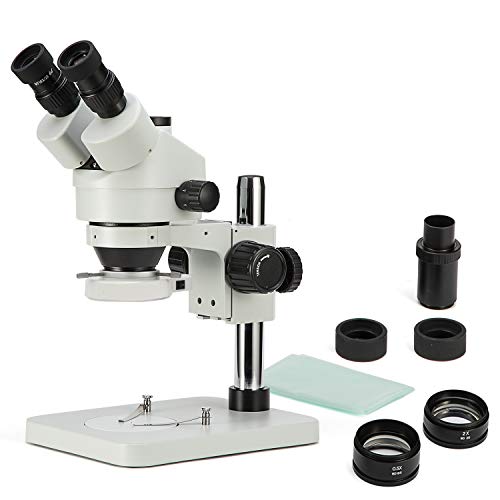
- 3.5X–90X range with auxiliary objectives
- Trinocular port supports camera documentation
- Metal stand and 56-bulb cool LED ring light
Best For: Precision inspection, gemology, and electronics work
Best Boom-Stand Setup
Professional Trinocular Stereo Microscope

- 3.5X–90X magnification with auxiliary lenses
- Flexible single-arm boom stand and heavy steel base
- Trinocular port with two adapter configurations
Best For: Larger specimens and camera-ready bench inspection
Best Portable Classroom Pick – AmScope SE100-LED
AmScope SE100-LED Portable Binocular Stereo Microscope, 20X Magnification | LED Ring Light
Check Price On AmazonIf you want stereo microscopes under 200 for basic specimen inspection, the AmScope SE100-LED is a straightforward binocular option. Its 20x magnification, long-working-distance 2x objective, and battery-powered upper LED illumination suit large objects that need to be handled while viewed.
Best For: Elementary classrooms, home science activities, and hobbyists examining rocks, stamps, jewelry, and other larger specimens.
Pros:
- Binocular viewing with adjustable interpupillary distance
- Longer focal length helps accommodate larger specimens
- Battery-powered upper LED illumination supports portable use
- Reversible black-and-white stage plate improves contrast
Cons:
- Fixed 20x magnification offers less versatility than models with interchangeable eyepieces
- Upper illumination is designed for reflected-light viewing rather than transmitted-light slide work
The SE100-LED keeps operation simple and approachable. Choose it when comfortable binocular viewing and easy handling matter more than advanced magnification or digital imaging.
Best Digital Electronics Workstation – Andonstar AD246S-M
Among stereo microscopes under 200, the Andonstar AD246S-M stands out as a feature-rich digital alternative for repair and demonstrations. It includes three lenses, a 7-inch display, HDMI output, adjustable lighting, recording, and a boom-arm stand suited to electronics work.
Best For: Soldering, PCB and mobile-phone repair, coin inspection, biological slides, and users who want to view or record work on a screen.
Pros:
- Three interchangeable lenses cover repair, general inspection, and biological slides
- 2160P video recording with HDMI output to a larger display
- Adjustable boom arm provides a larger work envelope
- Includes a Micro SD card, prepared slides, remote, and accessories
Cons:
- Digital magnification ranges vary substantially by lens and display setup
- More components and adjustments make it less immediately simple than a basic binocular scope
This is the most versatile choice here for screen-based inspection and repair. Its lens selection and recording features are especially useful if you need more than direct eyepiece viewing.
Best Specimen-Filled Starter Kit – Aomekie 20X/50X
For shoppers comparing stereo microscopes under 200, the Aomekie 20X/50X combines binocular viewing with a substantial starter assortment. Two eyepieces provide 20x and 50x magnification, while the included slides, insect specimens, and minerals make it ready for hands-on exploration.
Best For: Children, classrooms, and beginners inspecting rocks, insects, stamps, jewelry, slides, and integrated circuits.
Pros:
- 20x and 50x magnification options
- Adjustable working range supports larger specimens
- Binocular head has adjustable interpupillary distance
- Includes insect specimens, 10 slides, and 12 mineral specimens
Cons:
- Battery-powered LEDs require two AA batteries, which are not included
- Included specimen materials favor introductory exploration over specialized work
The Aomekie is a strong gift-style package because the accessories encourage immediate use. It offers more magnification flexibility than a fixed-power beginner model while retaining a portable, cord-free design.
Best Compact Soldering Display – Aikokkl 5-Inch LCD
If your search for stereo microscopes under 200 is focused on electronics repair, this Aikokkl digital microscope offers a hands-free setup with a 5-inch IPS screen and C-clamp. Its flexible arm lets you adjust the lens-to-object distance for focusing and digital magnification up to 1000x.
Best For: Soldering checks, PCB repair, coin-error inspection, and compact workbenches where direct screen viewing is preferred.
Pros:
- 5-inch IPS display can operate without a computer
- C-clamp and flexible arm help keep both hands available
- Connects to Windows or Mac as a PC camera without third-party software
- Supports 1080P recording when paired with a compatible Micro SD card
Cons:
- Micro SD card is required for saving photos and videos but is not included
- Manual focusing requires adjusting both working distance and the focus wheel
- Designed for micro-details rather than full views of large objects
This model is practical for electronics benches where screen-based viewing and free hands are priorities. Plan on supplying a Micro SD card if recording is important, and expect manual setup rather than autofocus.
Best Binocular Starter – ESSLNB 30X Stereo Microscope
If you want stereo microscopes under 200 for straightforward home, hobby, or laboratory observation, the ESSLNB offers a simple binocular setup with 30X magnification. Its dual LED lighting and adjustable viewing head make it practical for examining larger specimens and objects.
Best For: Hobbyists, young users, and general inspection of rocks, stamps, jewelry, and biological specimens.
Pros:
- 30X magnification from WF10X eyepieces and a 3X objective.
- Upper and lower LED illumination supports viewing objects or specimens.
- Binocular head has a 45-degree viewing angle and adjustable interpupillary distance.
- Metal enclosure and included one-year warranty add practical reassurance.
Cons:
- Fixed 30X magnification offers less flexibility than a zoom microscope.
- It is listed at approximately 10 kg, so portability may be limited despite the product description.
This is a sensible pick when comfortable binocular viewing and basic dual-light illumination matter more than advanced imaging or variable magnification.
Best Digital Coin Scope – TOMLOV DM9 7-Inch Digital Microscope
Among stereo microscopes under 200, the TOMLOV DM9 stands out for collectors and hands-on projects that benefit from a screen rather than eyepieces. It combines a built-in 7-inch display, adjustable stand, LED lighting, and photo or video capture for documenting fine details.
Best For: Coin collectors, hobby electronics users, teachers, and close-up inspection with shared digital viewing.
Pros:
- Built-in 7-inch LCD screen provides a comfortable enlarged view.
- 12MP camera and 1080P video support photo and video documentation.
- Metal base and adjustable 8.5-inch stand help provide a stable work platform.
- Includes adjustable LEDs, flexible gooseneck lights, PC connectivity, and a 16GB memory card.
Cons:
- Its digital screen-based design is less traditional than a binocular stereo microscope.
- It is primarily suited to close-up surface inspection rather than broad specimen viewing.
Choose the DM9 if recording, sharing, and viewing coins or small components on a screen are central to your workflow. The stand and lighting also make it useful for light soldering and hobby projects.
Best Zoom Upgrade – Trinocular 6X-45X Stereo Microscope
For shoppers comparing stereo microscopes under 200 who want more magnification flexibility, this trinocular model provides a 6X-45X zoom range with WF10X eyepieces. Its camera-ready third port, ring light, and stable aluminum-alloy construction suit detailed observation and documentation.
Best For: Users who need variable magnification, camera attachment capability, and bright uniform illumination.
Pros:
- Continuous 6X-45X zoom range supports both broader and finer views.
- Trinocular head allows binocular viewing while accommodating a camera.
- 56-bulb LED ring light provides bright, uniform illumination.
- Includes a 0.5X CTV adapter and stable aluminum-alloy stand.
Cons:
- The camera attachment requires compatible equipment and is not described as included.
- Its more advanced configuration may be unnecessary for simple fixed-magnification viewing.
This is the most expandable option in the group for users who value zoom control and future imaging. The trinocular design and included adapter make it particularly appealing for documentation-focused work.
Best Portable Pick – Skybasic Wireless Digital Microscope
If you want a compact option among stereo microscopes under 200 for casual inspection, this Skybasic model is easy to carry and works with phones, tablets, and computers. Its 50X–1000X zoom range, adjustable lighting, and wireless connectivity make it useful for viewing small objects, though it is a fixed-focus digital magnifier rather than a traditional professional microscope.
Best For: Students, hobbyists, and outdoor users inspecting plants, insects, minerals, crafts, and other small objects.
Pros:
- Connects wirelessly to Android and iOS devices and by USB to Windows or Mac computers.
- Eight adjustable LED lights help illuminate the viewing area.
- Captures photos and video, with up to 1920×1080 resolution on smartphones.
- Lightweight design is convenient for travel and outdoor use.
Cons:
- It is a fixed-focus digital magnifier, not a traditional stereo microscope.
- Sharp focus requires a working distance of approximately 3–60 mm.
- Computer and phone use may require app, camera, or privacy-setting adjustments.
This is the most portable choice in the group and a practical pick for digital observation, but serious biological or precision work calls for a conventional optical stereo microscope instead.
Best Professional Value – SWIFT Trinocular Stereo Zoom Microscope
For buyers comparing stereo microscopes under 200 for detailed bench work, this SWIFT trinocular model offers a broad optical setup with a 7X–45X standard zoom range and included auxiliary lenses that extend magnification from 3.5X to 90X. Its metal base, long working distance, and ring light suit inspection tasks that require stability and clear illumination.
Best For: Gemology, engraving, electronics, collecting, research, and other precision inspection work.
Pros:
- Trinocular head supports comfortable viewing and camera attachment.
- Included 0.5X and 2.0X objectives expand the stated range to 3.5X–90X.
- 56-bulb LED ring light provides cool, shadow-free illumination.
- Sturdy metal base and 100 mm working distance support hands-on work.
Cons:
- This corded microscope is substantially less portable than a handheld digital model.
- The setup is more specialized and may be excessive for casual viewing.
- Camera and computer use require additional compatible equipment.
Its trinocular design and auxiliary objectives make it the stronger choice for users who need a stable optical platform, documentation capability, and flexible magnification for bench-top work.
Best Boom-Stand Setup – Professional Trinocular Stereo Microscope
This professional trinocular model is worth considering when shopping for stereo microscopes under 200 with a flexible working setup. It combines a 3.5X–90X magnification range, camera adapters, a heavy-duty steel base, and a single-arm boom stand that provides room to position larger specimens beneath the optics.
Best For: Users who need adjustable working space, camera connectivity, and stable inspection for larger or varied specimens.
Pros:
- 0.7X–4.5X zoom with 0.5X and 2.0X auxiliary lenses covers 3.5X–90X.
- Double camera-adapter configurations support electronic eyepieces and digital cameras.
- Heavy-duty 18-pound steel base and ball-bearing boom arm provide stability and flexibility.
- Dimmable 56S LED ring light delivers adjustable, shadow-free illumination.
Cons:
- The large 19.5-inch dimensions require substantial bench space.
- Its professional configuration may be more equipment than casual users need.
- The camera and electronic eyepieces are connection options rather than necessarily included imaging devices.
Choose this model when stand flexibility and documentation matter more than compactness. The boom arm and heavy base make it particularly suitable for hands-on inspection involving larger workpieces.
How We Picked the Best Stereo Microscopes Under 200
We focused on the features that matter most in real-world close-up work: usable magnification, viewing comfort, working distance, illumination, stability, and image output. The lineup includes traditional binocular scopes for depth perception, trinocular models for camera integration, and digital microscopes with built-in screens or wireless connectivity.
We also considered the intended task. Soldering and repair work generally benefits from a stable stand, generous working distance, and adjustable lighting. Coins, insects, and specimens may benefit more from higher digital magnification, a display, or included slides. Because specifications and included accessories can vary by seller, confirm the current listing before ordering.
Quick Comparison
| Best For | Look For | Preferred Design |
|---|---|---|
| Soldering and PCB repair | Long working distance, stand, adjustable light | Binocular or trinocular stereo scope |
| Coins and collectibles | Screen, image capture, strong lighting | Digital LCD or HDMI microscope |
| Specimens and insects | Depth perception, slides, comfortable eyepieces | Binocular stereo microscope |
| Teaching and demonstrations | Shared display output and recording | Digital or trinocular model |
| Portable inspection | Compact stand, USB or wireless operation | Handheld digital microscope |
Key Buying Factors for Stereo Microscopes Under 200
Optical Versus Digital Magnification
Optical stereo magnification provides a more natural, three-dimensional view and is usually preferable for manipulation and repair. Digital magnification can make details appear larger on a screen, but it may reduce clarity at extreme settings. Treat advertised maximum magnification cautiously and prioritize usable image quality.
Working Distance and Zoom Range
Working distance is the space between the lens and your subject. More room makes it easier to use tweezers, soldering irons, or other tools. A zoom range is also more practical than a single high-power setting because it lets you frame the entire subject before examining details.
Lighting and Stability
A ring light can reduce shadows, while adjustable intensity helps with reflective metal, coins, and glossy components. A rigid stand and smooth focus controls are equally important; a shaky mount can make a high-magnification image difficult to use.
Camera and Display Features
Choose HDMI, USB, or Wi-Fi output if you need recording, a larger shared view, or documentation. Built-in LCD models are convenient, but eyepiece-based scopes may provide better depth perception and more natural hand-eye coordination.
Who Should Buy Which Stereo Microscopes Under 200?
Choose a binocular scope if you want comfortable, depth-aware viewing for specimens, crafts, or repair. Pick a trinocular model if you plan to add a camera while keeping both eyepieces available. A digital LCD or HDMI microscope suits coin inspection, demonstrations, and image capture. A wireless handheld model is best for quick, portable checks, provided you can accept less stability and depth perception.