
Make Christmas more curious with hands-on science gifts that invite kids to build, experiment, observe, and play. These ideas span robotics, chemistry, weather, geology, and more.
Choose an activity that fits the child’s interests and age, whether they enjoy colorful experiments, outdoor observations, or figuring out how a machine works.
13 Christmas Science Game Gift Ideas Under $25 to Consider in 2026
Solar Robotics Builder

- Builds into 30 different robot designs from 243 pieces.
- Explores robotics and renewable energy through hands-on building.
- Can run on solar power or a separately purchased AAA battery indoors.
Best For: Ages 8–12 who enjoy building robots and learning about renewable energy.
Screen-Free Coding Pal
My Robotic Pet: Coding Chameleon

- Build a robotic chameleon with three play modes.
- Use physical action cards to program movements without a screen or software.
- The 48-page manual supports assembly and learning about robotics.
Best For: Kids ages 8 and up who like coding, puzzles, and interactive robotics.
Body Systems Builder
Smartivity Interactive Human Body Model

- Build a model with working lung, arm, and food-pipe systems.
- Includes removable organ labels and a booklet about body systems.
- Step-by-step manual guides construction of the model.
Best For: Kids ages 8–14 curious about anatomy and how body systems work.
Light and Prism Explorer
Physics Optical Experiment Set

- Includes lenses, a prism, a reflector, and a three-way light source.
- Explore refraction and reflection with hands-on demonstrations.
- The English color-page manual accompanies the experiment set.
Best For: Older children interested in light, lenses, and color experiments.
Color-Changing Chemistry
Yellow Scope Acids, Bases & pH Kit

- Includes a 24-page lab notebook and 24-piece toolkit.
- Offers 19 or more experiments on acids, bases, and the pH scale.
- Kit includes safety goggles, test tubes, cabbage indicator, and experiment tools.
Best For: Kids ages 8–12 drawn to colorful experiments and beginner chemistry.
Weather Watcher’s Station

- Five-in-one station includes a wind vane, compass, rain gauge, anemometer, and thermometer.
- Designed for observing and recording weather measurements.
- A 32-page manual guides experiments on weather and climate topics.
Best For: Kids ages 6–12 who enjoy outdoor observation and tracking weather.
Pocket-Sized Discovery
Carson MicroBrite Plus Pocket Microscope

- Portable handheld microscope with 60x–120x magnification.
- LED illumination helps light specimens for viewing.
- Designed for exploring prepared slides or everyday objects.
Best For: Young explorers who like examining small details at home or outdoors.
Rock Collector’s Lab
Toysmith Rock & Mineral Science Kit

- Includes 30 rock and mineral specimens for a growing collection.
- Viewer, streak plate, and hardness tools support identification and testing.
- Trays help sort and store the specimens.
Best For: Ages 8 and up who collect stones or want to learn about geology.
Volcano Experiment Maker
National Geographic Ultimate Volcano Kit
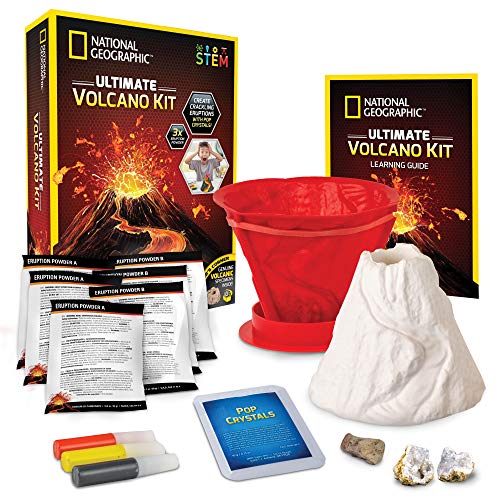
- Includes a reusable volcano mold, paints, and learning guide.
- Eruption powder and pop crystals support volcano experiments.
- Pumice and a geode specimen introduce volcanic rocks.
Best For: Kids ages 8 and up who enjoy earth science and hands-on demonstrations.
Build-And-Launch Engineering
National Geographic Da Vinci Catapult Kit

- Build three working models: a ballista, bombard, and catapult.
- Includes projectiles and paper targets for launching activities.
- Laser-cut wooden components and instructions support assembly without special tools.
Best For: Ages 12 and up who enjoy construction and testing how mechanisms work.
Magnetism in Motion
4M Magnetic Levitation Science Kit

- Explores magnetic force through several hands-on experiments.
- Activities include floating a pencil, levitating a screw, and building a maglev.
- Includes the materials and instructions for the listed experiments.
Best For: Ages 8 and up who are curious about magnets, forces, and motion.
Creative Crystal Growing
National Geographic Crystal Tree Kit

- Grow crystals on six included tree bases and shapes.
- Five watercolor pens let kids choose colors for the trees.
- Includes a geode specimen and a full-color learning guide.
Best For: Ages 8 and up who enjoy crystals, colorful crafts, and science activities.
Dinosaur Dig Discovery
National Geographic Dinosaur Dig Kit

- Includes 12 dinosaur egg-shaped dig bricks with figures inside.
- Digging tools and a learning guide support excavation and identification.
- Individually wrapped eggs make the activity easy to share.
Best For: Ages 8 and up who are dinosaur fans and enjoy digging and discovery.
Christmas Science Game Gift Ideas Under $25
Christmas science game gift ideas under $25 can turn a holiday present into an invitation to explore. The options here range from building and coding to observing weather, light, rocks, and fossils. Start with the child’s interests, then consider the kind of activity they are likely to enjoy: following a guide, assembling a model, testing an idea, or discovering something piece by piece.
How to Choose the Right Science Gift
Match the activity to the recipient’s age and patience. Several kits are recommended for ages 8 and up, while some are aimed at a narrower range or older children. Check each product’s age guidance and the detail of its activity before choosing. A younger child may enjoy a clear, guided experiment with an adult nearby; an older child may prefer a build that involves several steps or more independent exploration.
Think about the subject that already catches the child’s attention. Robotics and coding suit children who like machines and puzzles. Chemistry kits center on color-changing experiments, while optics sets explore how light behaves. Weather tools encourage ongoing observation, and rock, mineral, volcano, crystal, dinosaur, and anatomy activities connect science with collecting, making, or discovery. If the child likes to move between activities, a kit with multiple experiments or play modes may offer variety.
Consider the Space and the Style of Play
Some gifts are primarily tabletop builds or experiments; others are designed for outdoor weather observation or portable viewing. Consider whether the child has room to work, a place to keep the finished model or collection, and an adult available if assembly or supervision would help. Activity kits can involve small parts or materials that require careful use, so read the included directions and age guidance with the child.
Budget Considerations for Gifts Under $25
Set a firm ceiling and compare what each complete gift includes. A lower price does not necessarily mean a simpler activity: some kits include tools, guides, or multiple projects, while others focus on one central build or discovery. Think about the likely use after Christmas as well. A reusable model, observation tool, or collection activity may suit a child who revisits interests, while a focused experiment can make a memorable shared afternoon.
Check whether the listed components cover the intended activity and note any stated exclusions. For example, one robot kit can use a battery indoors when sunlight is unavailable, but the battery is not included; the optics set also specifies batteries that are not included. Keep the total gift within your budget by accounting for any stated extras before you buy.
Personalization Tips for a More Thoughtful Present
Personalize the choice around the recipient rather than adding elaborate wrapping. Pair the gift with a handwritten Christmas note that names the interest it connects to—space for a budding weather watcher, a favorite dinosaur, or a fascination with how things move. For a kit that involves building or testing, offer to set aside time to work on it together. For collecting or observing activities, invite the child to keep notes or display discoveries in a spot they choose.
Use the product’s own theme to guide a simple presentation: a science-themed card or a small label with the recipient’s name can make the package feel considered without changing the activity itself. Avoid promising a particular result; experiments and builds are best framed as opportunities to explore.
Last-Minute Christmas Buying Advice
When time is short, focus on clear product details and practical fit. Confirm the age recommendation, included components, and whether the activity suits the child’s available space and interests. If batteries or other items are explicitly listed as not included, decide whether you can provide them. Check current seller information for price and delivery timing before ordering, since those details can change.
If delivery timing is uncertain, a printed note describing the chosen activity can still make the gift feel intentional on Christmas morning, with the kit to follow when it arrives. Whichever option you choose, the strongest science gift is one that gives the child a reason to ask a question, try something, and keep exploring.