
The best weather stations with data logging do more than show today’s temperature. They record local conditions over time, helping you track rainfall, wind, humidity, pressure, and seasonal patterns from a console or smartphone.
This roundup compares 10 capable models for home monitoring, gardening, property management, and serious backyard weather observation. Focus on sensor coverage, wireless range, app support, storage, and power needs before choosing.
Best 10 Weather Stations with Data Logging Picks for 2026
Best for Long-Term Data Export
Sainlogic 14-in-1 WiFi Weather Station

- Two years of local data storage
- Excel export through the Weatherseed app
- Large 8.5-inch display with broad sensor coverage
Best For: Gardeners and homeowners analyzing historical weather trends
Best Low-Maintenance Sensor Array

- Solar-powered outdoor array
- Ultrasonic and haptic gauges have no moving parts
- Remote monitoring through Ambient Weather Network
Best For: Garden users wanting simple, low-maintenance monitoring
Best for Flexible Wi-Fi Setup
Sainlogic Dual-Band Smart Station

- Works with 5 GHz and 2.4 GHz Wi-Fi
- Two years of storage with Excel export
- Up to 443-foot open-area wireless range
Best For: Connected home, garden, greenhouse, and property monitoring
Best for Smart-Home Integration
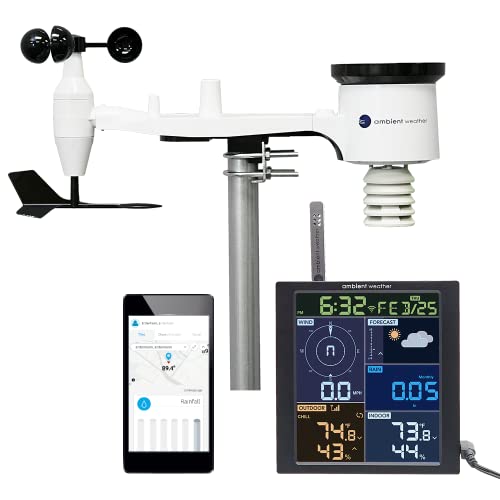
- 16-second real-time console updates
- Works with Alexa, Google Home, and IFTTT
- Remote monitoring through Ambient Weather Network
Best For: Homeowners connecting weather data to alerts and automation
Best for Long-Term Tracking
Sainlogic SA68 Plus Wi-Fi Weather Station
- Stores and exports up to two years of data
- Dual-band 2.4GHz/5GHz Wi-Fi
- 6.5-inch touchscreen with broad weather readings
Best For: Long-term weather analysis and remote monitoring
Best for Everyday Use
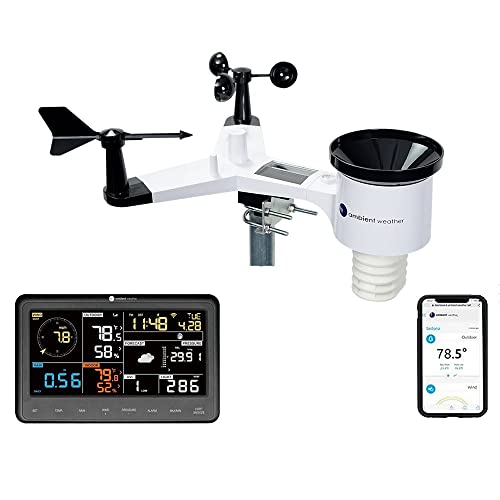
- Measures weather plus UV and solar radiation
- Supports Alexa, Google Home, and IFTTT
- Wi-Fi remote monitoring and customizable alerts
Best For: Connected homes and hyperlocal weather monitoring
Best for Straightforward Historical Monitoring
AcuRite Iris 5-in-1 Wi-Fi Weather Station
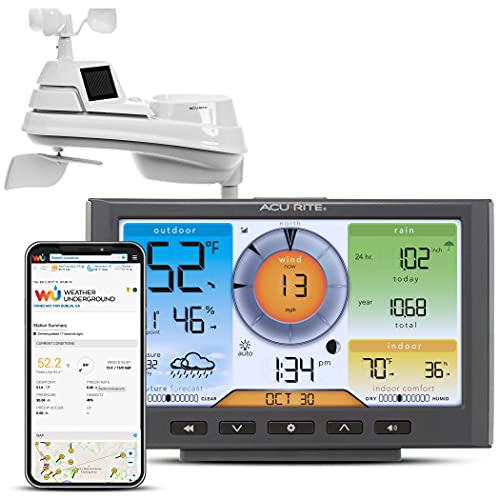
- Tracks more than 25 weather data points
- Connects to Weather Underground
- Includes historical readings and threshold alarms
Best For: Everyday home monitoring with online weather access
Top Smart Pick
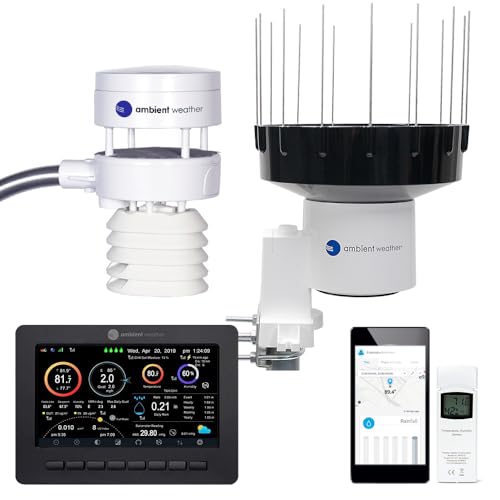
- Five-second updates from an ultrasonic sensor array
- One year of AWN+ graphing and alerts included
- Wi-Fi, remote monitoring, and smart-home support
Best For: Connected home weather monitoring and detailed trend tracking
Best Solar Setup
Logia 18-in-1 Solar WiFi Station

- Solar sensor designed for up to 2.5 years of power
- Tracks weather, wind, rain, UV, and light data
- Shares data with multiple weather platforms
Best For: Broad monitoring with solar-assisted outdoor operation
Best Forecast Display
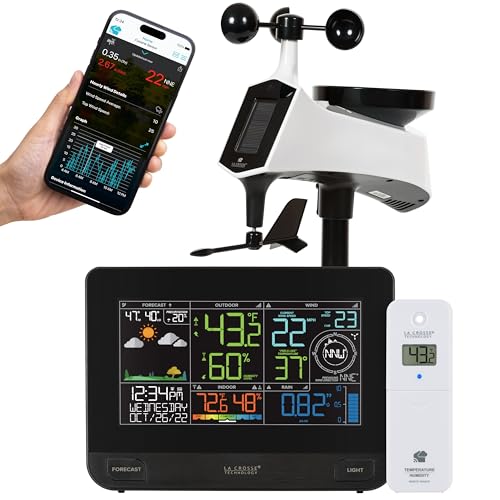
- Logs high/low readings with time and date stamps
- Measures wind, rain, temperature, and humidity
- Wi-Fi adds forecasts, alerts, and app monitoring
Best For: Clear household weather tracking with historical records
Best for Long-Term Data Export – Sainlogic 14-in-1 WiFi Weather Station
For shoppers comparing weather stations with data logging, this Sainlogic model stands out for its two-year storage and Excel export through the Weatherseed app. It combines a large display with readings for temperature, humidity, rainfall, wind, UV, sunlight, pressure, and more, though Wi-Fi connectivity is limited to 2.4 GHz.
Best For: Gardeners, homeowners, and users who want detailed historical weather records and app-based alerts.
Pros:
- Stores up to two years of data and supports Excel exports in periods of up to 30 days.
- Tracks a broad range of conditions, including UV, sunlight, rainfall, wind, temperature, and humidity.
- Large 8.5-inch display and five-minute data updates make readings easy to review.
- Weatherseed app provides forecasts, monitoring, and customizable alerts.
Cons:
- Supports only 2.4 GHz Wi-Fi.
- Three AAA batteries are required and are not included.
- Data export is limited to 30 days per export.
This is a strong choice when logging and export matter as much as live readings. Its broad sensor coverage and large console add convenience, while the 2.4 GHz-only requirement may require a compatible network.
Best Low-Maintenance Sensor Array – Ambient Weather WS-4000
The Ambient Weather WS-4000 is a practical option among weather stations with data logging for shoppers who prioritize durable outdoor hardware and remote monitoring. Its solar-powered, all-in-one array uses ultrasonic wind and haptic rain gauges without moving parts, and it connects to the Ambient Weather Network for data analysis and alerts.
Best For: Garden users seeking a low-maintenance station with solar power and remote access.
Pros:
- Ultrasonic wind and haptic rain gauges have no moving parts.
- Solar-powered outdoor array helps reduce routine battery maintenance.
- Ambient Weather Network supports remote monitoring, analysis, and alerts.
- Includes a color display and a separate indoor temperature, humidity, and pressure sensor.
Cons:
- The supplied notes do not specify a storage duration or export format for logged data.
- Temperature accuracy is listed as 1 °C.
- Wi-Fi capability depends on network setup at the installation location.
The WS-4000 emphasizes straightforward installation and reduced mechanical wear rather than detailed storage specifications. It is a sensible fit for users who want dependable monitoring through Ambient Weather’s network and a compact solar-powered array.
Best for Flexible Wi-Fi Setup – Sainlogic Dual-Band Smart Station
For weather stations with data logging that are easier to connect to modern home networks, this Sainlogic model supports both 5 GHz and 2.4 GHz Wi-Fi, with Bluetooth fast pairing. It records two years of weather data, offers Excel export, and adds app alerts, rainfall tracking, and a long wireless range for larger properties.
Best For: Users who want two-band Wi-Fi, detailed logging, and accurate monitoring for gardens, greenhouses, or larger homes.
Pros:
- Supports dual-band 5 GHz and 2.4 GHz Wi-Fi with Bluetooth pairing.
- Stores two years of data and exports records to Excel in up to 30-day sets.
- Swiss SHT40 sensor provides stated temperature accuracy of ±0.2°C and humidity accuracy of ±1.8%RH.
- Wireless range reaches up to 443 feet in open areas, and the app logs rainfall totals.
Cons:
- Three AA batteries are required.
- Each data export covers no more than 30 days.
- Actual wireless range can vary from the stated open-area maximum.
This is one of the more flexible choices for connected logging, especially where a router’s 5 GHz network is preferred. Its combination of long-term storage, sensor accuracy, rainfall records, and dual-band support makes it well suited to more demanding home or garden monitoring.
Best for Smart-Home Integration – Ambient Weather WS-1965
The Ambient Weather WS-1965 is a straightforward choice for weather stations with data logging when remote access and smart-home features are priorities. Its all-in-one sensor array measures temperature, humidity, pressure, wind, and rainfall, while Wi-Fi connects the station to the Ambient Weather Network and compatible home platforms.
Best For: Homeowners who want live outdoor readings, remote monitoring, alerts, and smart-home connectivity.
Pros:
- Measures temperature, humidity, barometric pressure, wind speed, wind direction, and rainfall.
- Provides real-time console updates every 16 seconds.
- Works with IFTTT, Google Home, Alexa, and the Ambient Weather Network.
- Supports customizable alerts and remote data access.
Cons:
- The supplied notes do not state a data-storage duration or export format.
- Temperature accuracy is listed as ±1.11°C.
- The system uses a battery-powered sensor array.
The WS-1965 is best viewed as a connected monitoring station rather than a clearly specified archival logger. It offers quick updates and broad smart-home compatibility, making it appealing for everyday awareness and automation.
Best for Long-Term Tracking – Sainlogic SA68 Plus Wi-Fi Weather Station
If you want weather stations with data logging for ongoing analysis, the Sainlogic SA68 Plus stands out with storage for up to two years of historical readings and spreadsheet export. Its dual-band Wi-Fi, large touchscreen, and broad sensor coverage make it practical for home, garden, greenhouse, or RV monitoring.
Best For: Users who want extensive historical data logging and remote monitoring.
Pros:
- Logs and exports up to two years of weather data.
- Supports both 2.4GHz and 5GHz Wi-Fi for flexible connectivity.
- Measures temperature, humidity, wind, rainfall, barometric pressure, and more.
- Offers a 6.5-inch touchscreen with adjustable backlight.
Cons:
- Requires three AA batteries for the listed battery-powered setup.
- The many readings and settings may be more than casual users need.
Choose this model if data retention and export matter as much as at-a-glance readings. The long logging period is especially useful for comparing seasonal conditions and tracking climate patterns.
Best for Everyday Use – Ambient Weather WS-2902
Ambient Weather WS-2902 Wi-Fi Smart Weather Station | With Wi-Fi Remote Monitoring and Alerts
Check Price On AmazonThe Ambient Weather WS-2902 is a strong choice among weather stations with data logging for shoppers who also want connected-home features. Its Osprey sensor array measures core backyard conditions plus UV intensity and solar radiation, while Wi-Fi enables remote access, alerts, and optional network sharing.
Best For: Smart-home users who want hyperlocal weather data and connected alerts.
Pros:
- Tracks wind, temperature, humidity, rainfall, UV intensity, and solar radiation.
- Works with IFTTT, Google Home, Alexa, and other smart-home tools.
- Provides remote monitoring and customizable alerts over Wi-Fi.
- Includes a solar-powered sensor array and color LCD console.
Cons:
- Wi-Fi connectivity is listed at 2.4GHz only.
- Requires three AAA batteries in addition to the solar-powered system.
This station is best when automation and remote access are priorities. It also suits users who want to share or view hyperlocal observations through the Ambient Weather Network, although some network features are optional or noted as forthcoming.
Best for Straightforward Historical Monitoring – AcuRite Iris 5-in-1 Wi-Fi Weather Station
The AcuRite Iris 5-in-1 is a practical option for weather stations with data logging when you want detailed home readings without an unusually complex display. It provides more than 25 data points, historical weather information, threshold alarms, and Wi-Fi access through Weather Underground.
Best For: Home users who want broad everyday readings and Weather Underground connectivity.
Pros:
- Measures temperature, humidity, wind, barometric pressure, and rainfall.
- Tracks historical data, heat index, dew point, wind chill, and rainfall history.
- Connects to Weather Underground for remote monitoring and data sharing.
- Includes a color LCD display with adjustable dimming.
Cons:
- Temperature accuracy is listed as plus or minus 2 degrees Fahrenheit.
- The listed lower temperature rating is 32 degrees Fahrenheit.
This model makes sense for households that want a familiar 5-in-1 setup with useful historical context and online access. It covers the main outdoor variables while adding threshold alarms and derived readings for everyday decision-making.
Top Smart Pick – Ambient Weather WS-5000
The Ambient Weather WS-5000 is a strong choice for weather stations with data logging when you want fast updates, remote access, and smart-home integration. Its ultrasonic sensor array reports conditions every five seconds, while the included TFT color console and one year of AWN+ add graphing and alert features.
Best For: Home users who want detailed remote monitoring, rapid readings, and connected-home controls.
Pros:
- Includes one year of AWN+ with advanced graphing, SMS alerts, and customizable layouts.
- Ultrasonic all-in-one sensor array has no moving parts and updates every five seconds.
- Works with Wi-Fi, IFTTT, Google Home, Alexa, and the Ambient Weather Network.
Cons:
- Some advanced features depend on the included one-year AWN+ subscription.
- Temperature accuracy is listed as ±1°C.
The WS-5000 stands out for connected monitoring and frequent updates. It is particularly appealing if you plan to review trends remotely or automate home responses to weather conditions.
Best Solar Setup – Logia 18-in-1 Solar WiFi Station
The Logia 18-in-1 Solar WiFi Weather Station suits shoppers seeking weather stations with data logging, broad measurements, and a low-maintenance outdoor sensor. It combines a solar-powered sensor, color display, four-day forecast, alerts, and the ability to send data to several weather platforms.
Best For: Home weather enthusiasts who want solar-assisted operation, multiple data services, and expandable monitoring.
Pros:
- Solar outdoor sensor is designed to provide up to 2.5 years of power.
- Tracks temperature, humidity, wind, rainfall, UV/light levels, and barometric conditions.
- Can upload or push data to ProWeatherLive, WeatherCloud, Weather Underground, PWS, and Awekas.
- Supports up to seven additional sensors, including soil moisture and temperature sensors.
Cons:
- Additional sensors are sold separately.
- The stated wireless range is up to 492 feet and may require suitable placement.
With its solar sensor and wide platform compatibility, the Logia is a flexible option for collecting and reviewing weather data. Its expandable design also leaves room to add more measurements later.
Best Forecast Display – La Crosse V42-PRO-INT
The La Crosse V42-PRO-INT is a practical pick among weather stations with data logging for households that prioritize an easy-to-read display and recorded high/low values. It combines wind and rain measurements with indoor/outdoor temperature and humidity readings, plus expanded forecast information when connected to Wi-Fi.
Best For: Home users who want a clear console, historical records, customizable alerts, and app-based remote monitoring.
Pros:
- Records high and low readings with time and date stamps, along with rain history.
- Displays wind speed, direction, rainfall, temperature, and humidity data.
- Wi-Fi connection adds extended forecasts, UV index, sunrise and sunset, air quality, and more.
- La Crosse View app supports remote monitoring and customizable alerts.
Cons:
- The station requires a power adapter; its backup battery retains data but does not run the system.
- Outdoor sensors require AA batteries, which are not included.
- Some enhanced forecast features require a Wi-Fi connection.
The V42-PRO-INT emphasizes readable on-console information and useful historical records. It is a well-rounded choice when you want backyard measurements paired with app notifications and expanded online forecasts.
How We Picked These Weather Stations with Data Logging
We selected models that combine useful outdoor sensors with a practical way to view or preserve historical readings. The lineup includes Wi-Fi and dual-band options, solar-powered sensor arrays, ultrasonic wind measurement, dedicated indoor displays, and app-based remote monitoring.
We also considered the types of measurements available, forecast features, wireless range, installation flexibility, ecosystem support, and how well each station fits everyday household use. Because data logging can mean console history, app records, cloud dashboards, or exportable weather data, verify the manufacturer’s exact storage and retention features before buying.
Quick Comparison
| Best for | Look for | Why it matters |
|---|---|---|
| Everyday home monitoring | Reliable display and core sensors | Easy at-a-glance readings indoors |
| Remote access | Wi-Fi app and alerts | Check conditions away from home |
| Rain and irrigation tracking | Rain gauge with historical records | Supports watering and drainage decisions |
| Wind observation | Wind speed, direction, or ultrasonic sensors | Provides more consistent local wind data |
| Long-term observation | Cloud history or data export | Makes trends easier to review and compare |
Key Buying Factors for Weather Stations with Data Logging
Sensor Coverage and Accuracy
Decide which measurements you actually need. Temperature and humidity suit basic monitoring, while rainfall, wind, UV, solar radiation, and barometric pressure add value for gardening, weather watching, and property planning. More sensors can also mean more installation and calibration work.
Logging, App Access, and Data Ownership
Check whether readings are stored on the console, in a mobile app, or in a cloud service. Look for recording intervals, history length, downloadable data, weather-network integration, and any subscription requirements. A station that displays data but does not retain it may not meet a true logging need.
Connectivity and Installation
Confirm whether the station supports your home network, especially if you use a 5GHz-only or mesh setup. Measure the distance between the outdoor array and indoor console, account for walls and interference, and choose a mounting location clear of roofs, trees, exhaust vents, and heat sources.
Power and Maintenance
Solar-assisted arrays can reduce battery changes, but they still need backup power in cloudy conditions. Plan for periodic sensor cleaning, rain-gauge inspection, battery replacement, and firmware or app updates.
Who Should Buy Which Weather Stations with Data Logging?
Choose a basic display-focused model if you primarily want dependable indoor readings. Wi-Fi stations are better for users who want remote monitoring, alerts, historical charts, or weather-network sharing. Solar-powered systems suit installations where reducing battery maintenance matters, while ultrasonic models are appealing when you want wind measurement without moving cups or vanes.
For gardeners and homeowners, prioritize rainfall history, humidity, alerts, and an easy-to-read display. Enthusiasts who compare local conditions over months should favor broad sensor coverage, reliable cloud history, and export options. Before checkout, confirm the app’s compatibility, the station’s maximum wireless range, and whether the advertised logging features require an account or paid service.