
The best USB duplicators with offline operation copy or erase drives without requiring a computer, making them useful for IT departments, technicians, content creators, and backup workflows.
This roundup compares standalone flash-drive duplicators, multi-port USB systems, and dual-bay HDD or NVMe cloners so you can match speed, capacity, drive type, and workload.
Best 10 USB Duplicators with Offline Operation Picks for 2026
Compact USB Workstation

- Standalone USB duplication and erasing
- LCD status and Copy & Compare verification
- Supports file, sector, and overwrite modes
Best For: Technicians handling small USB batches and sanitization
NVMe Clone Dock
ACASIS Dual-Bay NVMe SSD Duplicator

- One-click cloning without a computer
- Supports NVMe drives up to 8TB
- Tool-free aluminum dual-bay design
Best For: Cloning compatible M.2 NVMe SSDs during upgrades
High-Volume USB Station

- One master copies to 15 targets
- No PC or software required
- LCD status and performance feedback
Best For: Large standalone USB duplication batches
Open-Air NVMe Dock

- One-click cloning without a computer
- Dual bays support up to 16TB total
- Tool-free aluminum design with open-air cooling
Best For: Cloning and accessing two M.2 NVMe SSDs
High-Volume Standalone Pick

- Copies one USB drive to seven targets
- No computer or software required
- Supports bit-by-bit and asynchronous copying
Best For: Batch USB duplication for businesses and technicians
Offline Drive-Cloning Pick
ORICO Dual-Bay Hard Drive Dock

- Clones SATA drives without a computer
- Supports 2.5-inch and 3.5-inch HDDs and SSDs
- USB 3.0 supports up to 5Gbps
Best For: Offline SATA drive cloning and backups
Compact Two-Target Pick

- Copies one USB drive to two targets
- Offers quick and bit-for-bit modes
- LCD controls and built-in media tests
Best For: Portable small-batch USB duplication
Best SATA Drive Dock
Sabrent Dual-Bay HDD/SSD Cloner
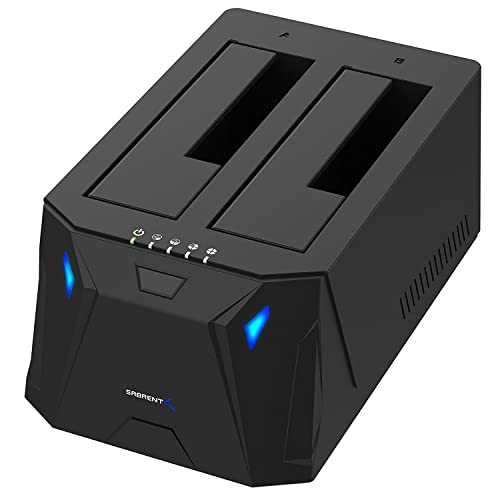
- Offline cloning for 2.5-inch and 3.5-inch SATA drives
- Supports drives up to 10TB
- USB 3.0 transfers up to 5Gbps
Best For: SATA drive upgrades, backups, and standalone cloning
Best NVMe Speed
Rosewill Dual-Bay M.2 Offline Cloner

- Supports M Key and B+M Key NVMe SSDs
- One-button standalone offline cloning
- USB 3.2 Gen 2x2 up to 20Gbps
Best For: Fast M.2 NVMe cloning and drive access
Best Value SATA Clone Dock

- Supports 2.5-inch and 3.5-inch SATA drives
- Offline source-to-target cloning
- UASP support up to 6Gbps
Best For: Flexible SATA cloning, hot-swapping, and drive access
Compact USB Workstation – StarTech 1:2 USB Duplicator
For technicians seeking usb duplicators with offline operation, the StarTech USBDUP12 is a practical 1:2 standalone option. It duplicates or erases USB 3.0 and 2.0 flash media without a computer, with system/file and sector-by-sector copy modes, plus verification.
Best For: IT professionals managing a small number of boot drives, shared USB media, or drive-erasure tasks.
Pros:
- Works without a computer and supports USB 3.0/2.0 flash media.
- Offers file-based, whole-drive, quick-erase, and overwrite modes.
- LCD status display, error scanning, and Copy & Compare verification.
- Asynchronous copying supports replacing completed drives without stopping, when source content is under 64 MB.
Cons:
- Only duplicates two target drives at a time.
- Asynchronous mode has a 64 MB source-content limitation.
- External USB storage may need its own power source.
The StarTech stands out when USB sanitization and verification matter as much as duplication. Its limited 1:2 capacity makes it better for small-batch technical work than high-volume production.
NVMe Clone Dock – ACASIS Dual-Bay NVMe SSD Duplicator
The ACASIS dual-bay dock is designed for usb duplicators with offline operation when the source and target are M.2 NVMe SSDs. Its one-click cloning works without a computer, while the aluminum enclosure helps manage heat during high-capacity drive work.
Best For: Users upgrading or cloning compatible M.2 NVMe SSDs, including drives up to 8TB.
Pros:
- Offline cloning requires no computer, software, or driver installation.
- Supports M.2 NVMe sizes 2230, 2242, 2260, and 2280.
- Tool-free installation and aluminum heat-dissipation design.
- Supports up to 20Gbps on compatible USB 3.2 Gen 2×2 devices.
Cons:
- NVMe only; SATA SSDs are not supported.
- The target SSD must have greater capacity than the source for offline cloning.
- S.M.A.R.T. and TRIM features are unavailable during offline cloning.
This is a focused solution for NVMe upgrades rather than a general-purpose duplicator. Confirm drive type and target capacity before buying, and consider additional cooling for large or extended cloning jobs.
High-Volume USB Station – Nexcopy 1:15 USB Duplicator
For usb duplicators with offline operation and larger batch capacity, the Nexcopy USB115SA provides one master and 15 target connections without requiring a PC or software. Its LCD gives real-time performance and status feedback during duplication.
Best For: Organizations producing many identical USB sticks in a standalone workflow.
Pros:
- Duplicates one master to 15 targets without a computer.
- Asynchronous duplication supports masters up to 256MB.
- LCD provides real-time performance and status information.
- USB sticks are immediately enumerated and ready after processing.
Cons:
- The supplied notes do not specify supported USB generations or erasure modes.
- Its larger target count may be unnecessary for occasional, small-batch users.
- Asynchronous operation is limited to masters up to 256MB.
The USB115SA is the strongest fit here for throughput across many targets. Choose it when 15 simultaneous copies are more valuable than advanced erase, verification, or broader compatibility details.
Open-Air NVMe Dock – UGREEN Dual-Bay NVMe Cloner
The UGREEN CM392 combines usb duplicators with offline operation and a dual-bay NVMe enclosure. Insert two compatible SSDs, then use one-click cloning without a computer. Its open aluminum design provides 360-degree airflow while LEDs show cloning activity.
Best For: Mac mini and universal-system users cloning or accessing two M.2 NVMe SSDs.
Pros:
- One-click offline cloning requires no computer.
- Holds two NVMe SSDs up to 8TB each, for 16TB total stated capacity.
- Tool-free design supports M-Key and B+M-Key NVMe drives.
- Aluminum construction, open-air cooling, LEDs, and anti-slip pads improve usability.
Cons:
- SATA drives are not supported.
- The target drive must be equal to or larger than the source.
- 20Gbps performance requires compatible hardware and cable.
The UGREEN is a convenient choice when you want both offline NVMe cloning and a reusable dual-drive dock. Its compatibility restrictions are straightforward, but SATA users will need a different enclosure.
High-Volume Standalone Pick – Systor 1-to-7 USB Duplicator
For buyers comparing usb duplicators with offline operation, the Systor SYS-USBD-7 is designed for standalone, multi-drive duplication without a computer or software. It copies one USB drive to up to seven targets and supports both synchronous and asynchronous modes.
Best For: Businesses, technicians, and organizations that need to duplicate multiple USB drives at once.
Pros:
- Duplicates one source drive to up to seven USB targets simultaneously.
- Operates independently without a computer or software.
- Supports bit-by-bit copying, synchronous and asynchronous modes, and USB Type-C drives with an adapter.
- Offers copy speeds up to 2GB per minute, with the listed speed maintained as the number of loaded drives increases.
Cons:
- USB Type-C drives require an adapter.
- Its desktop form factor and 10-pound weight make it less portable.
- Copy speed is listed at up to 33MB per second, so it is not the fastest option for very large transfers.
The Systor is the strongest choice here for higher-volume USB deployment. Its seven target ports and standalone design favor repeatable batch work, while the included warranty and lifetime technical support add reassurance for ongoing use.
Offline Drive-Cloning Pick – ORICO Dual-Bay Hard Drive Dock
The ORICO DD28U3-C is a useful alternative for shoppers seeking usb duplicators with offline operation for SATA hard drives and SSDs. Its dual-bay design clones one drive to another without a computer, while USB 3.0 connectivity supports access to installed drives for backups and transfers.
Best For: Users who need offline cloning for 2.5-inch or 3.5-inch SATA HDDs and SSDs.
Pros:
- Performs offline cloning by pressing the CLONE button for about three seconds.
- Supports 2.5-inch and 3.5-inch SATA I/II/III HDDs and SSDs up to a stated 44TB total capacity.
- USB 3.0, UASP, and TRIM support provide listed transfer speeds up to 5Gbps.
- Toolless bays enable quick drive insertion and hot-swapping.
Cons:
- The target disk must be larger than the source disk for offline cloning.
- It requires an independent power adapter and does not power on without a hard drive inserted.
- It clones SATA drives rather than USB flash drives.
Choose the ORICO when your duplication workflow centers on bare SATA drives rather than flash media. The offline clone button is straightforward, but the target-capacity requirement should be checked before starting a job.
Compact Two-Target Pick – BestDuplicator UB300
The BestDuplicator UB300 is a compact option for buyers seeking usb duplicators with offline operation and a modest two-target capacity. It works without Windows or Mac software, offers quick-copy and whole-media modes, and provides an LCD with button controls for monitoring each job.
Best For: Field technicians, schools, IT departments, and small deployments that need portable two-drive copying.
Pros:
- Copies one USB flash drive to two targets simultaneously without a computer.
- Supports both data-only Quick Copy and bit-for-bit Whole Media Copy modes.
- Includes capacity checks, device information, speed testing, and erase functions.
- Compact, lightweight design with an LCD and individual red/green port indicators.
Cons:
- Supports USB 1.1 and USB 2.0 media, rather than newer USB 3.x flash-drive standards.
- Its two-target capacity is less suited to high-volume duplication than larger systems.
- Best performance is achieved when source and target media have similar capacities.
The UB300 emphasizes portability and hands-on control over throughput. It is a practical fit for smaller duplication runs, especially when verification and erase tools are as important as copying itself.
Best SATA Drive Dock – Sabrent Dual-Bay HDD/SSD Cloner
For shoppers comparing USB duplicators with offline operation, the SABRENT EC-HD2B is a practical choice for cloning standard 2.5-inch and 3.5-inch SATA hard drives or SSDs without a computer. It also works as a USB 3.0 drive dock and requires no drivers.
Best For: Users who need straightforward offline cloning for SATA HDDs or SSDs, with support for drives up to 10TB.
Pros:
- Supports both 2.5-inch and 3.5-inch SATA HDDs and SSDs.
- Offline cloning works without a host computer or additional drivers.
- Supports up to 10TB drives and USB 3.0 transfer speeds up to 5Gbps.
- Includes a power supply, USB 3.0 cable, and user manual.
Cons:
- Designed for SATA drives rather than M.2 NVMe SSDs.
- Offline cloning is rated up to 60Mbps, which is slower than its USB transfer rating.
The EC-HD2B combines a two-bay SATA dock with a simple standalone cloning mode. It is a sensible fit for routine drive upgrades, backups, and drive-to-drive copies when broad SATA compatibility matters more than NVMe support.
Best NVMe Speed – Rosewill Dual-Bay M.2 Offline Cloner
The Rosewill RS-N2-CL stands out among USB duplicators with offline operation for users working with M.2 NVMe storage. Its dual-bay design supports M Key and B+M Key NVMe SSDs, while USB 3.2 Gen 2×2 connectivity provides a rated speed of up to 20Gbps.
Best For: NVMe SSD users who want one-button offline cloning, high-speed USB connectivity, and a tool-free dual-bay enclosure.
Pros:
- Supports both M Key and B+M Key NVMe SSDs.
- Provides standalone, one-button offline cloning.
- USB 3.2 Gen 2×2 interface supports speeds up to 20Gbps.
- Includes USB-C and USB-A cables plus a 12V/2A power adapter.
Cons:
- Designed for M.2 NVMe drives, not standard 2.5-inch or 3.5-inch SATA drives.
- Its listed 20Gbps rate depends on compatible host hardware and connections.
With its NVMe-focused design and smart features such as S.M.A.R.T. monitoring and TRIM support, the Rosewill is a strong option for modern SSD workflows. Choose it when speed and M.2 compatibility are higher priorities than universal drive support.
Best Value SATA Clone Dock – WAVLINK Dual-Bay HDD/SSD Dock
The WAVLINK dual-bay dock is a useful option for buyers seeking USB duplicators with offline operation and wide SATA drive compatibility. It handles 2.5-inch and 3.5-inch SATA HDDs or SSDs, supports offline source-to-target cloning, and works as an external dock without requiring drivers.
Best For: Home and office users who need a versatile SATA dock for cloning, hot-swapping, and accessing two drives.
Pros:
- Supports 2.5-inch and 3.5-inch SATA HDDs and SSDs.
- Offline cloning works without drivers and requires the target drive to match or exceed the source capacity.
- UASP supports transfer speeds up to 6Gbps, with USB 3.0 connectivity up to 5Gbps.
- Includes a power switch, automatic sleep mode, and hot-swapping support.
Cons:
- Offline cloning is source-to-target only and does not support online cloning.
- Not compatible with M1- or M2-based Macs according to the supplied notes.
- The listed capacity support is up to 16TB per bay.
WAVLINK gives SATA users a balanced combination of cloning and everyday dock functionality. Its power controls, sleep mode, and broad operating-system support make it practical, though buyers should confirm Mac compatibility and target-drive capacity before purchasing.
How We Picked the Best USB Duplicators with Offline Operation
We focused on devices that can clone, copy, or sanitize storage without desktop software or a host computer. The selection includes dedicated USB flash-drive duplicators, multi-target systems, SATA docking stations, and M.2 NVMe cloners. We considered connection standards, supported drive formats, copy speed, target capacity, ease of use, and whether the design suits occasional home use or repeated professional jobs.
Because “offline” can mean different things, check the product’s exact workflow before buying. Some units duplicate USB flash drives directly, while others clone bare SATA or NVMe drives through a self-contained docking station. A few support erasing or sanitizing functions in addition to copying.
Quick Comparison
| Best For | Recommended Type | What to Prioritize |
|---|---|---|
| Occasional flash-drive copies | 1:2 standalone USB duplicator | Simple controls, format support, and reliable target detection |
| Batch duplication | Multi-port USB duplicator | Number of target ports, sustained speed, and error handling |
| SATA HDD or SSD cloning | Dual-bay docking station | 2.5/3.5-inch support, offline cloning, and capacity limits |
| Modern NVMe drives | Dual-bay M.2 cloner | Key type, PCIe generation, thermal management, and USB bandwidth |
Key Buying Factors for USB Duplicators with Offline Operation
Drive Compatibility
Confirm whether the duplicator handles USB flash drives, 2.5-inch SATA drives, 3.5-inch hard drives, or M.2 NVMe SSDs. For M.2 products, verify the supported key and interface; an enclosure designed for NVMe PCIe drives may not accept SATA M.2 modules.
Copy Speed and Capacity
Advertised speeds are maximums and vary with the source drive, target media, file structure, and interface. A fast USB 3.x or 20Gbps connection helps, but the slowest drive still determines the practical result. The target should normally be equal to or larger than the source, and some devices clone sectors rather than only used files.
Controls and Verification
LCDs, physical buttons, progress indicators, and automatic detection make standalone operation easier. If you are distributing important media, look for verification, error reporting, or a compare function rather than assuming a completed copy is error-free.
Sanitization and Safety
Erase features can be valuable for organizations recycling or repurposing drives, but they are destructive. Prefer models with clear confirmation steps, and keep the source disconnected from power until the target layout and direction are verified.
Who Should Buy Which USB Duplicators with Offline Operation?
Choose a compact 1:2 USB duplicator for occasional flash-drive production, classroom imaging, or small office backups. Choose a multi-port unit when you regularly prepare several identical USB drives at once. For upgrading or replacing SATA disks, a dual-bay dock is usually the simplest option. Pick an M.2 NVMe duplicator for newer solid-state drives, especially when high transfer bandwidth matters. If you need both copying and secure reuse workflows, prioritize a standalone model with sanitization controls and clear status feedback.