
Finding the right telescope eyepiece can make the difference between a relaxed observing session and constant squinting, repositioning, and blurry edges. Glasses wearers typically need generous eye relief, a comfortable eye cup, and a focal length that suits their telescope and target.
This roundup covers 10 telescope eyepieces for eyeglass wearers, including zoom, wide-angle, Plössl, accessory-set, and replacement eye-guard options. Use the guide below to narrow the choices by comfort, magnification, field of view, and compatibility.
Best 10 Telescope Eyepieces for Eyeglass Wearers Picks for 2026
Flexible Zoom Viewing
SVBONY SV135 7–21mm Zoom Eyepiece
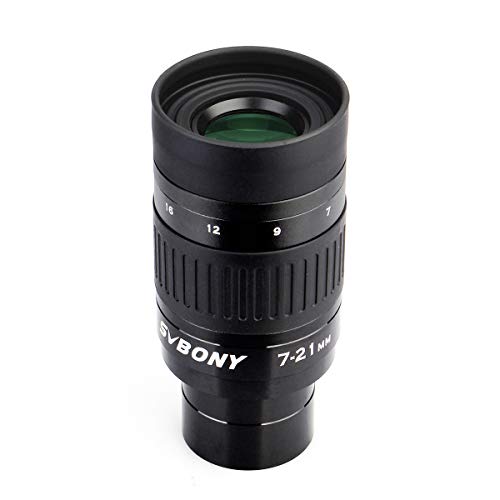
- 7–21mm adjustable focal length
- 18mm–16.3mm stated eye relief
- Fully multi-coated 1.25-inch design
Best For: Eyeglass wearers wanting one versatile zoom eyepiece
Comfort Add-On
Rubber Eyepiece Cover for Eyeglass Wearers

- Soft, flexible multi-fold rubber
- Extends over eyeglasses
- Fits 36mm–43.5mm oculars
Best For: Adding cushioning and glare control to a compatible ocular
Wide-Field Comfort

- 68° ultra-wide-angle field
- Fold-down soft rubber eye guard
- Fully multi-coated 1.25-inch optics
Best For: Eyeglass wearers wanting a fixed wide-field eyepiece
Complete Starter Kit
1.25-Inch Eyepiece Set with Barlow and Filters

- 4mm, 10mm, and 20mm eyepieces
- Includes 5x Barlow and four filters
- Soft eyecups for viewing comfort
Best For: Beginners wanting a broad, ready-to-use 1.25-inch kit
High-Magnification Pick
SVBONY 4mm 62° Aspheric Eyepiece

- 4mm focal length for detailed lunar and planetary views
- 62° wide field with fully coated optics
- Standard 1.25-inch fit and lightweight design
Best For: High-magnification Moon and planet viewing
Comfort Upgrade

- Soft rubber eye cups for added comfort
- Fits compatible 32–35mm openings
- Two eye guards included; eyepieces sold separately
Best For: Upgrading comfort on compatible large-diameter eyepieces
Eyeglass-Friendly Wide-Field Choice
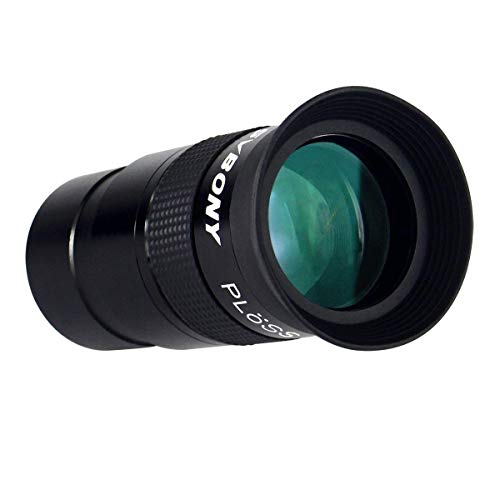
- Fold-down rubber eye guard suits eyeglass wearers
- 40mm focal length with a 40° field of view
- Fully multi-coated, four-element 1.25-inch design
Best For: Comfortable broad-field viewing while wearing glasses
Best Starter Set
Starboosa 4mm, 10mm & 20mm Eyepiece Kit

- Three focal lengths for flexible viewing
- Soft eyecups for added comfort
- Multi-coated optics in a 1.25-inch format
Best For: Beginners seeking a versatile three-eyepiece kit
Best Wide-Angle Set
SVBONY 68° Ultra Wide Angle Eyepiece Set
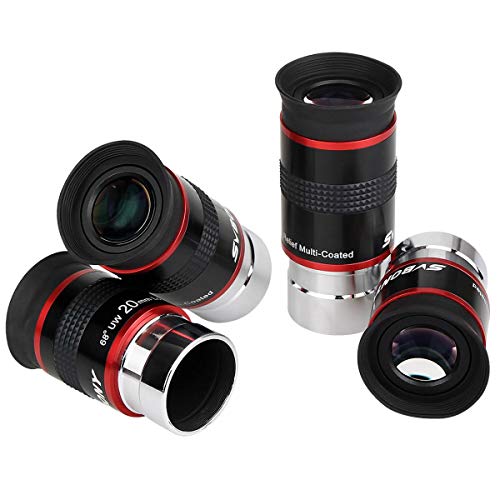
- Four focal lengths from 6mm to 20mm
- Wide 68-degree apparent field
- Fold-down guards suit eyeglass wearers
Best For: Wide-field observers wanting a versatile set
Best Single Eyepiece
SVBONY 20mm 68° Redline Eyepiece
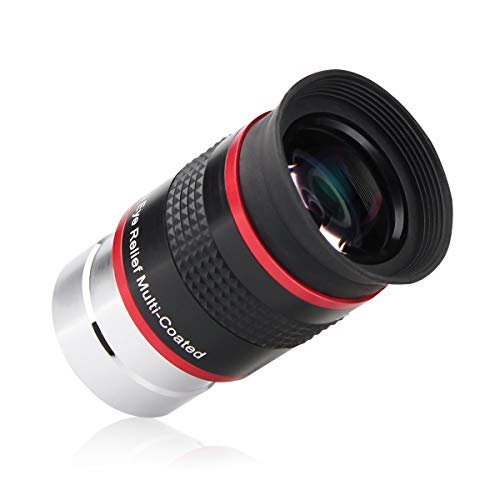
- Low-magnification 20mm focal length
- Wide 68-degree field for object finding
- Fold-down eye guard for glasses users
Best For: Deep-sky viewing with one comfortable wide-field eyepiece
Flexible Zoom Viewing – SVBONY SV135 7–21mm Zoom Eyepiece
For shoppers comparing telescope eyepieces for eyeglass wearers, the SVBONY SV135 offers adjustable 7–21mm focal length in one 1.25-inch eyepiece. Its stated 18mm–16.3mm eye relief, rubber eye guard, and fully multi-coated six-element optical design make it a versatile option for lunar, planetary, and deep-sky viewing.
Best For: Eyeglass wearers who want one eyepiece for changing magnification without swapping lenses.
Pros:
- 7–21mm zoom range can replace several fixed focal-length eyepieces.
- 18mm–16.3mm eye relief is designed with eyeglass wearers in mind.
- Fully multi-coated, six-element, four-group optics and a 40°–57° field of view.
- Standard 1.25-inch barrel fits telescopes accepting 1.25-inch eyepieces.
Cons:
- The field of view changes from 40° to 57° across the zoom range.
- Manual focusing is required.
The SV135 is a practical all-purpose choice when convenience and eye comfort matter more than using a dedicated eyepiece for every magnification.
Comfort Add-On – Rubber Eyepiece Cover for Eyeglass Wearers
This rubber eyepiece cover is an accessory rather than a complete telescope eyepiece, but it can be useful when evaluating telescope eyepieces for eyeglass wearers. The flexible, multi-fold rubber design is intended to extend over eyeglasses, cushion the eye area, reduce glare, and support more consistent eye positioning on compatible oculars.
Best For: Telescope users who already own a compatible 36mm–43.5mm ocular and want added cushioning and glare control.
Pros:
- Soft, lightweight rubber provides a cushioned viewing interface.
- Designed to extend over eyeglasses for more comfortable positioning.
- Helps block glare and encourages repeatable eye relief and alignment.
Cons:
- It is an eyepiece cover, not an optical eyepiece.
- Compatibility is limited to eyepiece sizes from 36mm to 43.5mm.
Check the diameter of your existing ocular before buying. When the fit is correct, this cover offers a simple way to improve the physical comfort of extended observing sessions.
Wide-Field Comfort – SVBONY 15mm 68° UWA Eyepiece
The SVBONY 15mm UWA is a 1.25-inch wide-angle option for shoppers seeking telescope eyepieces for eyeglass wearers. Its 68° apparent field of view, fully multi-coated lens, and fold-down soft rubber eye guard are aimed at comfortable, higher-contrast viewing of planets and other targets.
Best For: Eyeglass wearers who prefer a fixed 15mm eyepiece with a broad viewing field and fold-down eye guard.
Pros:
- 68° ultra-wide-angle field expands the viewing area.
- Fold-down soft rubber eye guard is intended to accommodate eyeglass wearers.
- Fully multi-coated optics are designed for contrast and resolution.
- Blackened barrel interior helps reduce internal light scattering.
Cons:
- Fixed 15mm focal length does not provide zoom flexibility.
- Its 1.25-inch mount requires a telescope with a compatible focuser.
This eyepiece makes sense for observers who want a spacious, fixed-magnification view and a fold-down eye guard, provided their telescope accepts the 1.25-inch format.
Complete Starter Kit – 1.25-Inch Eyepiece Set with Barlow and Filters
This astronomy kit gives shoppers considering telescope eyepieces for eyeglass wearers several focal-length options in one package. It includes 4mm, 10mm, and 20mm eyepieces, a 5x Barlow lens, two moon filters, and two polarizing filters, with soft eyecups intended to make viewing more comfortable.
Best For: Beginners or observers building a flexible 1.25-inch kit for lunar, planetary, and general telescope viewing.
Pros:
- Includes 4mm, 10mm, and 20mm eyepieces for varied magnification choices.
- 5x Barlow lens adds another magnification option.
- Two moon filters and two polarizing filters are included for glare and contrast control.
- Soft eyecups help block ambient light and improve viewing comfort.
Cons:
- The supplied notes do not specify the eye-relief measurements for each eyepiece.
- A 5x Barlow can produce very high magnification, depending on the telescope.
- The set is manual-focus and requires a compatible 1.25-inch telescope setup.
This is a convenient way to cover multiple focal lengths and add filters at once. Eyeglass wearers should verify the individual eye relief if that is a deciding factor.
High-Magnification Pick – SVBONY 4mm 62° Aspheric Eyepiece
For shoppers comparing telescope eyepieces for eyeglass wearers, the SVBONY 4mm is a lightweight, high-magnification option designed for close views of the Moon and planets. Its 62-degree field of view and standard 1.25-inch fit make it compatible with telescopes using a matching focuser, although the supplied notes do not specify an eyeglass-friendly eye relief design.
Best For: Detailed lunar and planetary observation when high magnification is the priority.
Pros:
- 4mm focal length provides high magnification for close planetary and lunar views.
- 62-degree aspheric design offers a broad viewing field with detail across the field.
- Fully coated optics support contrast and light transmission.
- Lightweight 0.09-pound construction and standard 1.25-inch barrel.
Cons:
- The supplied notes do not mention a fold-down eye guard or specified eye relief for eyeglass wearers.
- High magnification can be less suitable for broad, low-power sky sweeping.
This is a focused planetary eyepiece rather than an all-purpose low-power choice. Eyeglass wearers should verify the telescope setup and comfortable viewing distance before choosing it for extended sessions.
Comfort Upgrade – LTKJ 34mm Rubber Eye Guards
For telescope eyepieces for eyeglass wearers, these LTKJ rubber eye guards are an accessory rather than an optical eyepiece. They add a soft contact surface to compatible 32–35mm microscope or telescope lenses, making them worth considering when existing eyepieces need extra eye comfort.
Best For: Adding soft rubber eye protection to compatible large-diameter eyepieces.
Pros:
- Soft plastic rubber construction is designed for more comfortable eye contact.
- 34mm inner diameter suits compatible 32–35mm eyepiece or lens openings.
- Two eye guards are included in the package.
Cons:
- These are eye cups only; eyepieces are not included.
- Compatibility is limited to the stated 32–35mm range and suitable eyepiece designs.
- The supplied notes do not specify fit for standard 1.25-inch telescope eyepieces.
These eye guards can be a practical comfort add-on for a compatible telescope eyepiece, but measure the eyepiece opening first. They are not a replacement for an eyeglass-friendly optical design or a complete eyepiece.
Eyeglass-Friendly Wide-Field Choice – SVBONY 40mm Plossl Eyepiece
Among telescope eyepieces for eyeglass wearers, the SVBONY 40mm Plossl stands out because its soft rubber eye guard folds down for users wearing glasses and helps protect lenses from scratches. The 40mm focal length and 40-degree field of view favor broad lunar, star-cluster, nebula, and deep-sky viewing.
Best For: Eyeglass wearers seeking comfortable, wide-field low-power observing with a standard 1.25-inch telescope.
Pros:
- Fold-down soft rubber eye guard is designed for eyeglass-wearing comfort and lens protection.
- 40mm focal length and 40-degree apparent field of view support broad-field observation.
- Four-element, fully multi-coated optics with blackened lens edges are intended to improve contrast and reduce stray light.
- Standard 1.25-inch barrel and M28.5 x 0.6 filter thread support common accessories.
Cons:
- Its 40mm focal length is aimed at wide, lower-power views rather than high-magnification planetary detail.
- The supplied notes specify a fixed focal length and manual focus, with no image stabilization.
This is the strongest match in the group for eyeglass wearers because the fold-down eye guard is explicitly designed for that use. Its broad-view performance also makes it a versatile starting point for lunar landscapes, clusters, and deep-sky targets.
Best Starter Set – Starboosa 4mm, 10mm & 20mm Eyepiece Kit
For shoppers comparing telescope eyepieces for eyeglass wearers, this three-piece Starboosa set offers several focal lengths in a standard 1.25-inch format. Its upgraded soft eyecups are designed to make eye contact more comfortable during viewing, while the multi-coated optical glass supports clear, contrast-rich images.
Best For: Beginners and observers who want 4mm, 10mm, and 20mm options for viewing the Moon, planets, star clusters, and sky objects.
Pros:
- Includes three useful focal lengths for different magnification needs.
- Soft eyecups can improve comfort for eyeglass wearers.
- Fully multi-coated optical glass is designed for clear images and good contrast.
- Compatible with reflector and refractor telescopes using a 1.25-inch eyepiece format.
Cons:
- It does not provide the wider 68-degree field of view offered by the SVBONY options.
- Higher magnification focal lengths may be less suitable for broad deep-sky viewing.
This is a practical value-oriented kit when flexibility matters more than a specialized wide-angle design. The soft eyecups and range of focal lengths make it a straightforward choice for new observers and shared family use.
Best Wide-Angle Set – SVBONY 68° Ultra Wide Angle Eyepiece Set
Among telescope eyepieces for eyeglass wearers, this SVBONY set stands out for its fold-down soft rubber eye guards and broad 68-degree apparent field of view. The 6mm, 9mm, 15mm, and 20mm focal lengths give observers a useful range, while fully multi-coated lenses are designed to improve light transmission and image sharpness.
Best For: Observers who want a wide-field set for locating celestial objects, viewing star fields, and exploring different magnification levels.
Pros:
- Four focal lengths cover a broad range of observing situations.
- 68-degree apparent field of view provides expansive views.
- Fold-down soft rubber eye guards can accommodate eyeglass wearers and help block stray light.
- Multi-element, fully multi-coated optics support contrast and color correction.
Cons:
- Only compatible with telescopes using a standard 1.25-inch eyepiece mount.
- The set may be more than needed for shoppers seeking one everyday eyepiece.
With four focal lengths and wide-angle viewing, this is the most flexible set in the group for observers who want to experiment with different views. Its fold-down eye guards are a particularly useful convenience for glasses users.
Best Single Eyepiece – SVBONY 20mm 68° Redline Eyepiece
If you are choosing telescope eyepieces for eyeglass wearers but prefer a single low-magnification option, this 20mm SVBONY Redline eyepiece is a focused choice. Its fold-down soft rubber eye guard is intended to improve convenience for glasses users, while the 68-degree field of view is suited to locating objects and viewing broad star fields.
Best For: Deep-sky observers seeking a single 20mm eyepiece for nebulae, star clusters, star fields, and object-finding.
Pros:
- Wide 68-degree field of view helps with locating celestial objects.
- 20mm focal length provides low magnification for larger deep-sky targets.
- Fold-down soft rubber eye guard is convenient for eyeglass wearers.
- Fully multi-coated optics and internal blackening are designed to support contrast.
Cons:
- It offers only one focal length, so additional eyepieces may be needed for higher magnification.
- Compatibility is limited to telescopes with a 1.25-inch eyepiece mount.
This model makes sense when your priority is a comfortable, wide-field 20mm eyepiece rather than a complete kit. Its low magnification and broad view are especially appropriate for larger deep-sky subjects and initial object locating.
How We Picked the Best Telescope Eyepieces for Eyeglass Wearers
We focused on the features that matter most when observing with glasses: stated or practical eye relief, a forgiving viewing position, optical design, field of view, focal-length range, and fit with common 1.25-inch telescope focusers. We also included eye guards and covers because a well-designed eyepiece can still be uncomfortable if the eye cup is too narrow, too short, or poorly positioned.
Product variety was another priority. The selection includes zoom eyepieces for flexibility, wide-angle models for immersive views, longer focal lengths for lower-power observing, short focal lengths for planetary work, and sets that help new users build a useful range quickly.
Quick Comparison
| Type | Best Use | What to Check |
|---|---|---|
| Zoom eyepiece | Convenience and changing magnification | Eye relief, field-of-view change, and optical sharpness |
| Wide-angle eyepiece | Moon, deep-sky objects, and easier object tracking | Edge performance and usable eye relief |
| Long focal length | Low-power, bright views | Whether the exit pupil is appropriate for your telescope |
| Short focal length | Higher-power lunar and planetary viewing | Atmospheric conditions and comfortable eye placement |
| Eyepiece set | Building a starter collection | Included focal lengths, filters, Barlow, and storage |
| Eye guard or cover | Improving fit and blocking stray light | Inner diameter and compatibility with the existing eyepiece |
Key Buying Factors for Telescope Eyepieces for Eyeglass Wearers
Eye Relief and Eye-Cup Design
Eye relief is the distance between the eyepiece’s eye point and the position where the full image is visible. Glasses require extra clearance, so look for a generous eye-relief specification when one is provided. Foldable or adjustable eye cups can help you position your glasses without pressing against the lens, while rubber guards may block stray light and make the viewing position more repeatable.
Focal Length and Magnification
Magnification equals the telescope’s focal length divided by the eyepiece focal length. Longer focal lengths produce lower magnification and are generally easier to use for locating objects and viewing large targets. Shorter focal lengths provide more magnification but demand steadier skies, accurate focusing, and more precise eye placement.
Field of View and Optical Quality
A wider apparent field of view can make tracking objects more comfortable, especially with a manual mount. However, advertised field width does not guarantee sharpness at the edge. Fully coated or broadband-coated optics, suitable baffling, and a clean, well-centered view are more important than the largest number alone.
Fit, Accessories, and Compatibility
Confirm the barrel size before buying; the listed options primarily use the common 1.25-inch format, but your telescope’s focuser or diagonal must match. For sets, check whether the Barlow effectively duplicates included focal lengths and whether filters fit the same barrel. For replacement eye cups, measure the eyepiece’s outer diameter and compare it with the accessory’s stated inner diameter.
Who Should Buy Which Telescope Eyepieces for Eyeglass Wearers?
- Choose a zoom eyepiece if you value convenience and want to adjust magnification without swapping lenses.
- Choose a wide-angle model if you observe with a manual mount or prefer more immersive views and easier tracking.
- Choose a longer focal-length eyepiece for bright, low-power views of the Moon, star fields, and extended deep-sky objects.
- Choose a short focal-length eyepiece if your main targets are planets and lunar details and your local seeing is usually steady.
- Choose a set if you are starting from scratch and want several magnification options at once.
- Choose an eye guard or cover when the optics are satisfactory but stray light, poor positioning, or glasses clearance is reducing comfort.
For most glasses wearers, start with a comfortable moderate or low-power eyepiece, then add higher magnification only after confirming that the eye relief and viewing position work for you.