
Urban skies can wash out faint stars and nebulae, but the right filter can improve contrast and make deep-sky observing more rewarding with a reflector telescope.
This roundup compares 10 options, from broadband light-pollution filters to UHC and dual-band designs, so you can match the filter to your telescope, eyepiece, and favorite targets.
Best 10 Light Pollution Filters for Reflector Telescopes Picks for 2026
Balanced Urban Contrast
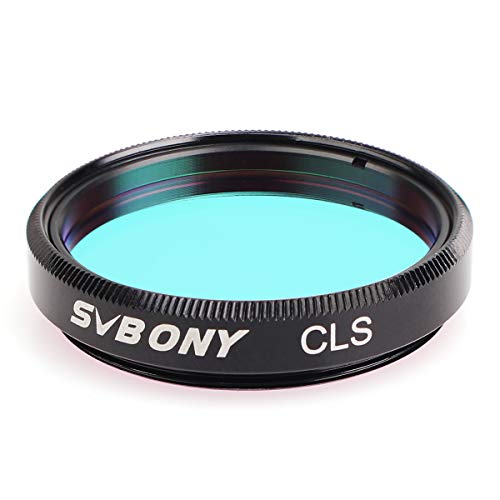
- 90% transmission of listed nebula emission lines
- Designed to suppress specified sodium and mercury wavelengths
- Multi-coated 1.25-inch format for urban observing
Best For: City and suburban deep-sky observing with 1.25-inch accessories
Portable UHC Value
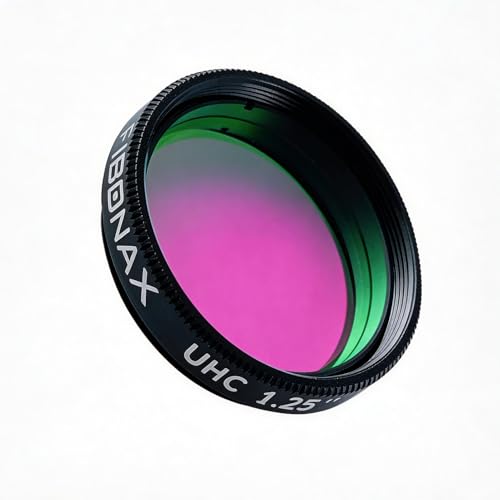
- Targets H-beta and O-III nebula emissions
- Multi-coated glass claims over 90% transmission
- Includes case and stackable M28.5x0.6 threads
Best For: Portable 1.25-inch nebula viewing and astrophotography
Wide-Format Broadband

- 2-inch format for larger reflector accessories
- 90% listed transmission of key nebula lines
- Designed to reduce specified sodium and mercury light
Best For: 2-inch urban deep-sky viewing and imaging
Deep-Sky Nebula Contrast

- UHC design targets artificial-light wavelengths
- Made for stronger contrast on emission nebulae
- Standard 2-inch threading fits compatible reflectors
Best For: 2-inch reflector viewing of Orion, Lagoon, Swan, and similar nebulae
Reliable UHC Contrast
Celestron 1.25-inch UHC/LPR Filter
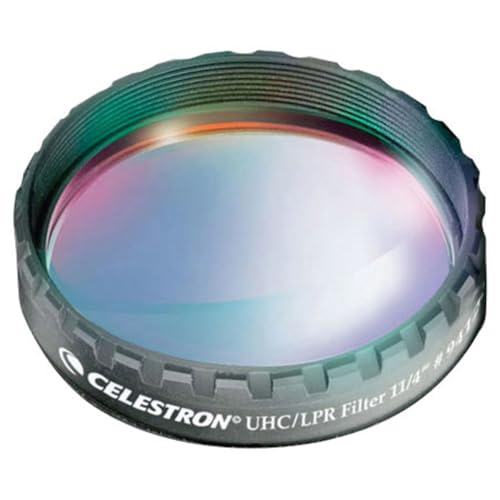
- Reduces selected artificial-light wavelengths
- Designed for darker sky backgrounds and nebula contrast
- Multi-coated optical glass for visual use
Best For: Visual nebula observers using 1.25-inch accessories
Deep-Sky Imaging Versatility
SVBONY SV240 Multi-Narrowband Filter
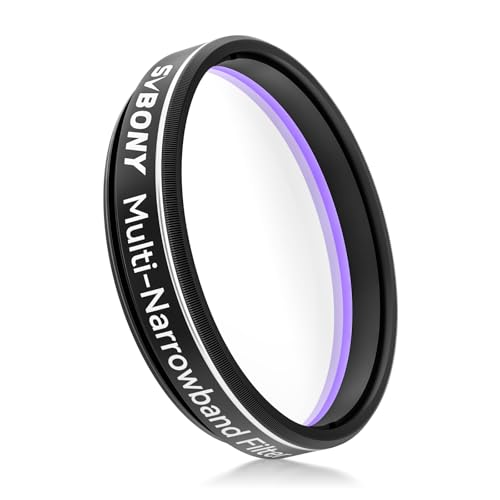
- Passes Ha, OIII, and H-Beta emission lines
- Supports OSC imaging in heavy light pollution
- Also listed for visual deep-sky observation
Best For: OSC-camera astrophotography from urban skies
Budget Threaded Versatility
WEOOEN 1.25-inch Light Pollution Filter

- Fits compatible 1.25-inch threaded accessories
- Optical glass in a durable metal cell
- Suitable for moon, planets, and deep-sky viewing
Best For: Beginners wanting a general-purpose visual filter
Deep-Sky Imaging Pick

- 7nm H-alpha and OIII dual-band design
- Helps suppress moonlight and artificial light
- 1.25-inch format for compatible cameras
Best For: Nebula astrophotography in light-polluted areas
Versatile Visual Set
NEEWER 1.25-Inch 10-Piece Filter Kit

- Includes UHC, lunar, starglow, and color filters
- Variable polarizers reduce glare and adjust brightness
- Ten-piece kit for varied visual observation
Best For: Beginners and visual observers using 1.25-inch accessories
Wide-Aperture Imaging Choice
SV260 2-Inch Star Field Filter
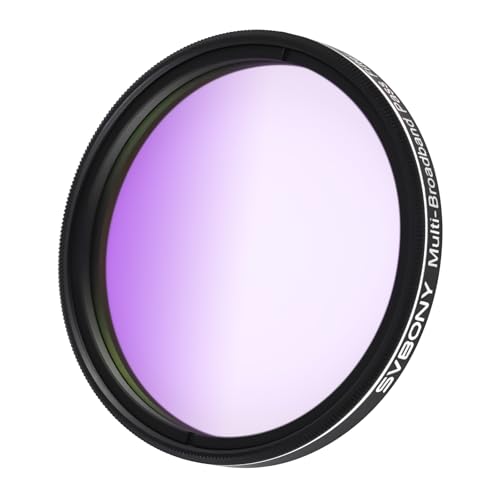
- Five-bandpass design for light-pollution suppression
- Over 90% peak transmittance
- 2-inch M48*0.75 format with 44mm clear aperture
Best For: Star-field and deep-sky imaging with compatible 2-inch systems
Balanced Urban Contrast – SVBONY 1.25-inch CLS Filter
For observers comparing light pollution filters for reflector telescopes, this 1.25-inch SVBONY CLS filter is a practical broadband option for city and suburban viewing. Its listed passband transmission is designed to preserve key nebula emissions while reducing common artificial-light wavelengths.
Best For: Urban deep-sky visual observing and astrophotography with compatible color CCD cameras or unmodified DSLRs.
Pros:
- Claims 90% transmission of key H-alpha, O-III, S-II, and H-beta nebula lines.
- Lists 0.1% transmission for specified sodium and mercury pollution lines.
- Ion-assisted deposition coating is intended to improve scratch resistance and wavelength stability.
- Fits 1.25-inch accessories with a 28.5 mm thread.
Cons:
- Only fits 1.25-inch filter threads, so it is not suited to 2-inch setups without appropriate equipment.
- It is a broadband CLS filter, rather than a more selective narrowband nebula filter.
- The supplied specifications do not list water resistance.
This is a sensible entry point for reflector owners who need a compact filter for reducing urban glare without giving up the main emission lines used in nebula observing and imaging.
Portable UHC Value – FIBONAX 1.25-inch UHC Filter
This FIBONAX UHC filter is worth considering among light pollution filters for reflector telescopes when you want a 1.25-inch filter aimed at stronger contrast on emission nebulae. Its narrowband wavelength isolation is specified around H-beta and O-III emissions, with a threaded frame for stacking compatible filters.
Best For: Beginners and experienced observers using 1.25-inch telescopes or cameras with M28.5×0.6 threads for nebula, lunar, and general contrast work.
Pros:
- Designed to block sodium and mercury streetlight glare while emphasizing emission nebulae.
- Isolates listed H-beta and O-III wavelengths for enhanced nebular contrast.
- Multi-coated optical glass is specified to provide more than 90% light transmission.
- Includes a protective storage case and dual M28.5×0.6 threads for stacking.
Cons:
- Its 1.25-inch format is not a direct fit for 2-inch focusers or accessories.
- UHC-style wavelength isolation is primarily suited to emission targets rather than every deep-sky object.
- The supplied notes do not provide a detailed transmission curve.
With its included case, stackable threads, and stated H-beta/O-III focus, this filter offers a flexible 1.25-inch setup for observers who regularly target nebulae from light-polluted locations.
Wide-Format Broadband – SVBONY 2-inch CLS Filter
For reflector telescopes equipped with 2-inch accessories, this SVBONY CLS filter provides the same broadband light-pollution approach in a larger format. The specifications emphasize transmission of major nebula lines and strong rejection of listed sodium and mercury wavelengths.
Best For: 2-inch visual observing and deep-sky photography with color CCD or unmodified DSLR cameras.
Pros:
- Claims 90% transmission of H-alpha, O-III, S-II, and H-beta emission lines.
- Lists 0.1% transmission for the specified sodium and mercury artificial-light lines.
- Ion-assisted deposition coating is designed for durability and stable central wavelength performance.
- Uses a 2-inch format with a 48.5 mm thread for compatible equipment.
Cons:
- Requires a 2-inch filter thread or compatible adapter.
- Broadband filtering may provide less selective nebula contrast than a UHC-style filter.
- The supplied specifications do not list water resistance.
This model makes the most sense when your reflector already uses a 2-inch focuser or eyepiece system and you want broadband suppression that preserves several important nebula wavelengths.
Deep-Sky Nebula Contrast – Astromania 2-inch UHC Filter
This Astromania 2-inch UHC filter is a strong candidate among light pollution filters for reflector telescopes when your priority is improving contrast on emission nebulae. It is designed to reduce selected artificial-light wavelengths and bring out details in targets such as Orion, Lagoon, and Swan nebulae.
Best For: Reflector owners with 2-inch accessories who observe emission nebulae from city, suburban, or dark-sky locations.
Pros:
- Designed to reduce artificial-light wavelengths while increasing emission-nebula contrast.
- Suitable for both light-polluted and dark-sky observing.
- Optical glass lens and aluminum frame use anti-reflection coatings.
- Standard 2-inch filter threading supports compatible eyepieces and telescope accessories.
Cons:
- Its 2-inch format is not a direct fit for 1.25-inch accessories.
- It is optimized for nebula contrast, so it may not be equally useful on all celestial targets.
- The supplied notes do not specify a transmission percentage or detailed wavelength curve.
Choose this filter if your main goal is a more contrast-focused view of extended emission nebulae and your reflector is already configured for 2-inch filters.
Reliable UHC Contrast – Celestron 1.25-inch UHC/LPR Filter
For observers comparing light pollution filters for reflector telescopes, the Celestron UHC/LPR filter is a straightforward visual-use option. Its 1.25-inch format fits standard threaded eyepieces and accessories, while selective wavelength reduction is designed to produce a darker sky background and improve nebula contrast.
Best For: Visual observers who want a familiar 1.25-inch Celestron filter for nebula viewing under artificial light.
Pros:
- Designed to reduce wavelengths associated with artificial lighting.
- Supports enhanced nebula contrast and darker-looking sky backgrounds.
- Multi-coated optical glass with high-transmission coating.
- Includes a two-year limited warranty.
Cons:
- Limited to 1.25-inch or 31.75mm threaded compatibility.
- Specified for visual use, so it may not suit every imaging setup.
Choose this model if your priority is simple visual contrast improvement from a recognized telescope-accessory brand. Confirm that your reflector’s eyepiece or accessory accepts a 1.25-inch filter before ordering.
Deep-Sky Imaging Versatility – SVBONY SV240 Multi-Narrowband Filter
The SVBONY SV240 takes a more imaging-oriented approach to light pollution filters for reflector telescopes. Its multi-narrowband design targets Ha, OIII, and H-Beta emission lines, aiming to improve contrast and signal-to-noise for deep-sky photography and visual observation in conditions ranging from Bortle 1 to Bortle 8.
Best For: Deep-sky astrophotographers using One-Shot Color cameras, especially under urban or moonlit skies.
Pros:
- Passes key Ha, OIII, and H-Beta emission lines.
- Designed for full-color imaging with One-Shot Color cameras.
- Supports imaging of multiple deep-sky categories, including emission nebulae, galaxies, reflection nebulae, and star clusters.
- Includes a plastic storage box and one-year accessory warranty.
Cons:
- Its 1.25-inch size may not fit larger filter systems or eyepieces.
- The supplied notes emphasize camera compatibility, so verify fit with your specific visual accessories.
- More specialized than a basic visual light-pollution filter.
This is the strongest fit of the three for OSC-camera users who want one filter covering several important emission bands. Before buying, check the stated 1.25-inch format and your camera adapter’s thread requirements.
Budget Threaded Versatility – WEOOEN 1.25-inch Light Pollution Filter
If you want an uncomplicated entry point among light pollution filters for reflector telescopes, this WEOOEN model uses a standard 1.25-inch threaded format. Its optical-glass lens is intended to selectively block urban sky-glow wavelengths, helping increase contrast for deep-sky targets while also supporting moon and planet viewing.
Best For: Beginners seeking a broadly compatible 1.25-inch filter for visual lunar, planetary, and deep-sky observing.
Pros:
- Threaded on both sides for use with compatible 1.25-inch eyepieces and accessories.
- Metal cell and optical-glass lens offer a durable alternative to plastic construction.
- Can be stacked with other filters for additional experimentation.
- Includes a protective storage box, one-year warranty, and lifetime maintenance.
Cons:
- The optical glass has no listed coating.
- Compatibility depends on accessories with matching 1.25-inch threads.
- The supplied notes do not specify a transmission range or named emission-line bands.
This filter makes sense when flexible threading and basic visual use matter more than specialized narrowband performance. Its uncoated design and general specifications are worth weighing against the lower-complexity buying brief it addresses.
Deep-Sky Imaging Pick – SV220 Dual-Band Nebula Filter
For astrophotographers seeking light pollution filters for reflector telescopes, the SVBONY SV220 is a focused 1.25-inch option for one-shot color cameras. Its 7nm dual-band H-alpha and OIII design is intended to improve nebula contrast under artificial light or moonlight.
Best For: Deep-sky photography of gaseous and planetary nebulae from light-polluted locations.
Pros:
- Reduces interference from street lighting, moonlight, and other background light.
- Enhances nebula-to-sky contrast without making the nebula itself brighter.
- Supports high-contrast imaging and can simplify post-processing.
- Multi-coated 1.25-inch glass construction with a 31.75mm thread.
Cons:
- Designed primarily for nebula imaging rather than broad, all-purpose viewing.
- Its 1.25-inch format may not suit telescopes or cameras requiring a 2-inch filter.
The SV220 is a specialized choice when contrast and narrowband imaging matter most. Check your camera and filter-thread compatibility before buying, especially if your reflector telescope uses a larger accessory format.
Versatile Visual Set – NEEWER 1.25-Inch 10-Piece Filter Kit
This NEEWER kit is a practical starting point for users comparing light pollution filters for reflector telescopes and wanting more than a single filter. It includes a UHC filter for manmade light pollution, along with lunar, starglow, planetary-color, and variable-polarizing filters.
Best For: Visual observers who want a broad selection for planets, the Moon, nebulae, and changing brightness levels.
Pros:
- Includes a UHC filter designed to minimize manmade light pollution.
- Five planetary filters can emphasize details and contrast on several planets and the Moon.
- Variable polarizing filters adjust transmission from 40% to 1% to reduce glare.
- All ten filters use a 1.25-inch format for compatible telescope threads.
Cons:
- The set is less specialized for narrowband deep-sky imaging than a dedicated dual-band filter.
- It only fits telescopes with 1.25-inch filter threads.
- Using the full range of filters requires choosing among different visual applications.
For beginners or visual observers, the kit offers more flexibility than a single-purpose light-pollution filter. Its UHC filter addresses urban skyglow, while the included lunar and planetary options broaden its usefulness for reflector telescope sessions.
Wide-Aperture Imaging Choice – SV260 2-Inch Star Field Filter
The SVBONY SV260 is a 2-inch multi-bandpass option for photographers evaluating light pollution filters for reflector telescopes with larger accessory threads. It uses five passbands across a 300–1000nm working range, targeting star-field and deep-sky photography while retaining broad color coverage.
Best For: Star-field, galaxy, and reflection-nebula photography with compatible 2-inch astrophotography systems.
Pros:
- Five-bandpass design is intended to suppress unwanted light pollution while transmitting multiple wavelengths.
- Over 90% peak transmittance helps minimize light loss and preserve celestial colors.
- OD4 cutoff depth provides stronger suppression of unnecessary light.
- 2-inch M48*0.75 format with a 44mm clear aperture.
Cons:
- Requires a 2-inch filter setup and may not fit 1.25-inch accessories.
- Its listed compatibility is centered on specified SVBONY astrophotography systems.
- It is aimed at imaging rather than being a general-purpose visual filter kit.
The SV260 stands out when a larger filter format and broad spectral coverage are priorities. Confirm the M48*0.75 thread and camera or telescope compatibility before choosing it for your reflector telescope.
How We Picked the Best Light Pollution Filters for Reflector Telescopes
We evaluated these filters by optical purpose, advertised bandpass, available barrel size, target compatibility, and practical ease of use. The selection includes broadband and light-pollution-reduction filters for modest contrast improvement, UHC and multi-narrowband models for emission nebulae, and specialized dual-band filters for hydrogen-alpha and oxygen-III emissions.
We also considered whether each option suits common 1.25-inch or 2-inch focuser and eyepiece systems. A filter cannot compensate for heavy cloud, poor collimation, low-quality optics, or an overly bright Moon, so expectations should remain realistic: these products reduce selected wavelengths rather than eliminating skyglow entirely.
Quick Comparison
| Filter type | Best suited to | Typical effect |
|---|---|---|
| Broadband or CLS | General deep-sky viewing under moderate light pollution | Subtle contrast improvement while preserving a relatively natural view |
| UHC | Emission nebulae such as Orion and Lagoon | Stronger background suppression and enhanced nebula contrast |
| Multi-narrowband | Emission nebulae and darker observing sites | More selective transmission of important nebular wavelengths |
| Dual-band H-alpha/O-III | Emission nebulae, especially with suitable imaging or visual setups | Highly selective contrast enhancement; less useful for galaxies and star clusters |
| Planetary, lunar, or mixed sets | Observers wanting several specialized filters | Flexible experimentation rather than one dedicated deep-sky solution |
Key Buying Factors for Light Pollution Filters for Reflector Telescopes
Filter Purpose
Choose a broadband or CLS filter for a general-purpose starting point. A UHC or multi-narrowband filter is usually more effective on emission nebulae. Neither type is a universal upgrade for galaxies, reflection nebulae, open clusters, or planets, which often benefit more from dark skies, sharp optics, and appropriate magnification.
Thread and Barrel Size
Confirm whether your eyepiece accepts a 1.25-inch or 2-inch filter thread. A 2-inch filter can be practical if you use a 2-inch low-power eyepiece, while a 1.25-inch model is usually the economical choice for standard eyepieces. Adapters may introduce clearance or threading issues, so check your focuser and accessories before ordering.
Bandpass and Viewing Conditions
Narrower filters can produce stronger contrast on emission nebulae but may dim stars and demand accurate target selection. Broadband designs tend to provide a more natural, versatile view but cannot remove all modern LED or broadband skyglow. Use the lowest practical magnification first, then increase power as conditions allow.
Build Quality and Coatings
Look for a secure metal cell, clean glass, consistent threads, and protective storage. Optical coatings and transmission specifications are useful when provided, but marketing labels alone do not guarantee performance. Keep the filter capped, handle it by the edge, and avoid cleaning it unnecessarily.
Who Should Buy Which Light Pollution Filters for Reflector Telescopes?
- Beginners in suburban areas: Start with a 1.25-inch broadband or CLS model if you want one versatile deep-sky filter.
- Emission-nebula observers: Choose a UHC or multi-narrowband filter for more noticeable contrast on suitable nebulae.
- Observers with 2-inch accessories: Select a 2-inch filter to use with wide-field eyepieces without relying on a 1.25-inch adapter.
- Experienced users seeking selective performance: Consider a dual-band H-alpha/O-III design, provided your targets and observing setup match its narrow purpose.
- Moon and planetary observers: A mixed filter set may offer useful experimentation, but a light-pollution filter should not be the main reason to buy one.
For the best results, combine the filter with careful collimation, a properly cooled reflector, a dark-adapted eye, and the darkest accessible observing location.