
Hands-on experiments can make homeschool science more engaging, concrete, and memorable. The right kit gives children a structured way to explore chemistry, earth science, physics, and STEM concepts without requiring a long list of separate supplies.
This roundup compares 10 science experiment sets for homeschool, including beginner-friendly chemistry kits, earth science activities, role-play lab sets, and broad experiment collections for children ages 8 and up.
Best 10 Science Experiment Sets for Homeschool Picks for 2026
Best Magic-and-STEM Blend
National Geographic Science Magic Kit

- 20 ready-to-do magic experiments
- 85+ additional experiments in booklet
- No batteries required
Best For: Ages 8+ who enjoy science with a magic theme
Best Overall Variety
UNGLINGA 150-Experiment Science Kit

- 150 projects across varied science topics
- Illustrated step-by-step manual
- Tools and kid-friendly materials included
Best For: Ages 8+ needing a broad home activity library
Best Earth Science Focus
National Geographic Earth Science Kit

- Volcano, crystal, tornado, and dig activities
- Full-color learning guide included
- Designed for sharing
Best For: Ages 8+ studying introductory earth science
Best Core Chemistry Set
UNGLINGA 70 Lab Experiments Kit

- 70 hands-on science experiments
- Includes circuits, rockets, crystals, and volcanoes
- Illustrated guide explains the science
Best For: Ages 8+ learning chemistry and STEM fundamentals
Deep-Dive Chemistry

- 100+ chemistry experiment ideas
- Materials for 15 featured activities
- Includes beakers, test tubes, and pipettes
Best For: Homeschool students ages 8 and up who want extended chemistry practice
Hands-On Discovery

- Includes 80 guided experiments
- Wide assortment of lab tools and materials
- Covers volcanoes, rainbows, fountains, and more
Best For: Children ages 6 and up who enjoy varied, colorful science activities
Young Scientist Start
Junior Chemistry Set with 50 Experiments

- Includes 50 hands-on chemistry experiments
- Features illustrated step-by-step instructions
- Comes with 20+ child-safe lab tools
Best For: Early learners ages 4 and up starting hands-on chemistry
Most Comprehensive Pick
Doctor Jupiter Ultimate Science Kit

- 135+ experiments with 90+ bonus household activities
- Includes lab-style tools and separated ingredients
- Illustrated instructions for ages 8 and up
Best For: Families wanting the largest activity library for ongoing homeschool science
Best Heavy-Duty Pick
Discovery Planet Earth Science Kit
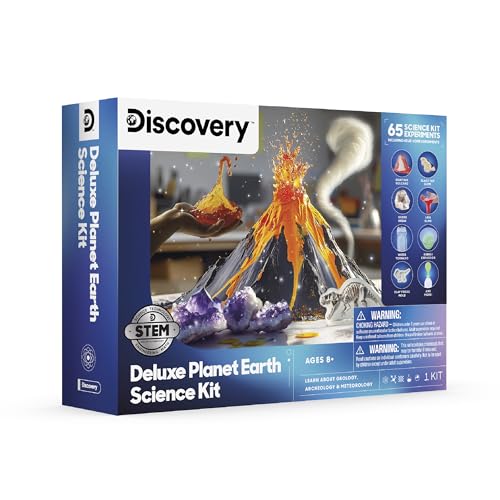
- 65 activities covering geology, weather, and archaeology
- Includes volcano, fossils, crystals, and tornado projects
- Designed for ages 8+ with adult supervision
Best For: Homeschool Earth science units and hands-on geology exploration
Best Creative STEM Set
BenBen 105-Experiment Science Kit

- 105 activities spanning chemistry, Earth science, and physics
- Paint-your-own volcano adds a creative project element
- Includes illustrated instructions and many reusable-style tools
Best For: Creative, screen-free homeschool STEM activities for ages 8–12
Best Magic-and-STEM Blend – National Geographic Science Magic Kit
For families seeking science experiment sets for homeschool, this National Geographic kit combines hands-on STEM activities with a magic theme. It includes materials for 20 experiments and a bonus booklet with more than 85 additional magic experiments, making it a flexible option for lessons, demonstrations, or enrichment.
Best For: Homeschoolers ages 8 and up who enjoy science activities with a magic-trick presentation.
Pros:
- Includes everything needed for 20 magic experiments.
- Bonus booklet adds more than 85 additional experiments.
- No batteries are required.
- Backed by a manufacturer warranty and U.S. support team.
Cons:
- The magic-focused theme may be less suitable for children wanting a dedicated earth science or chemistry kit.
- Some activities may require adult guidance depending on the child.
This is a strong pick when presentation and curiosity matter as much as the underlying STEM concepts. Its large activity count also gives homeschool families plenty of material to revisit.
Best Overall Variety – UNGLINGA 150-Experiment Science Kit
This UNGLINGA set is one of the more expansive science experiment sets for homeschool, offering 150 projects across earth science, surface tension, chemistry, physics, and related topics. The illustrated, step-by-step manual and included lab tools support structured hands-on learning at home.
Best For: Families wanting a broad activity library for ages 8 and up, school breaks, or ongoing weekend science.
Pros:
- Offers 150 experiments across multiple science topics.
- Includes a well-illustrated, step-by-step manual.
- Provides kid-friendly materials and lab tools, including goggles.
- Many projects can also use common household items.
Cons:
- The large number of activities may require sorting and planning.
- Some experiments depend on household materials beyond the included components.
Choose this kit for breadth rather than a tightly focused curriculum. It can help families build a varied science routine while leaving room to connect activities with basic lessons.
Best Earth Science Focus – National Geographic Earth Science Kit
Families comparing science experiment sets for homeschool may prefer this National Geographic kit for its clear earth science focus. Activities include water tornadoes, an erupting volcano, crystal growing, and two geologic dig kits, supported by a full-color learning guide.
Best For: Ages 8 and up studying volcanoes, crystals, rocks, and introductory earth science.
Pros:
- Includes more than 15 experiment activities and 100+ listed activities and experiments.
- Covers volcanoes, crystals, rocks, geologic digs, and water tornadoes.
- Designed to support sharing with family, friends, or classmates.
- Detailed instructions and a full-color guide explain the science.
Cons:
- Its earth science emphasis may offer less variety for families seeking broad chemistry coverage.
- Some activities may be best suited to supervised group use.
This is a practical choice for a unit study or themed homeschool block. The learning guide adds useful context, while the demonstrations provide visible results that can make earth science easier to discuss.
Best Core Chemistry Set – UNGLINGA 70 Lab Experiments Kit
This UNGLINGA kit offers a manageable set of science experiment sets for homeschool centered on foundational chemistry and STEM skills. Its 70 activities include volcanoes, crystal growing, balloon rockets, fruit circuits, and chemical reactions, with illustrated instructions and explanations of the science involved.
Best For: Ages 8 and up seeking a focused starter lab for chemistry fundamentals and scientific process practice.
Pros:
- Includes 70 varied experiments.
- Covers chemistry, circuits, rockets, crystals, and volcanoes.
- Manual uses clear illustrations and explains the chemical reactions.
- Activities emphasize safe, child-friendly experimentation and STEM learning.
Cons:
- Offers fewer activities than the 150-experiment UNGLINGA set.
- The included-components listing is limited, so families should review what each project requires.
With a balance of variety and a more contained project count, this set works well for families that want recurring experiments without the scale of a 150-activity collection. It is especially suitable for introducing core chemistry ideas through demonstrations.
Deep-Dive Chemistry – 100+ Experiment Chemistry Set
For families seeking science experiment sets for homeschool, this National Geographic kit offers a chemistry-focused mix of guided activities and extension ideas. It includes materials for 15 experiments, plus 85 additional projects using common household items, making it suitable for repeated hands-on learning.
Best For: Homeschool learners ages 8 and up who enjoy chemistry, reactions, crystals, and using real lab-style tools.
Pros:
- Includes ideas for more than 100 experiments.
- Provides materials for 15 featured chemistry activities.
- Uses test tubes, beakers, and pipettes for hands-on lab practice.
- Covers engaging projects such as crystal growing, color-changing solutions, and glowing creations.
Cons:
- The recommended age is 8 and up, so it may be too advanced for younger children.
- Many of the bonus experiments require common household items.
This is a strong choice when you want a structured chemistry kit with enough follow-up activities to support an extended homeschool unit rather than a single afternoon of projects.
Hands-On Discovery – 80-Experiment Science Lab Kit
This science kit is a flexible option among science experiment sets for homeschool, combining 80 guided activities with a broad assortment of tools and materials. Projects such as rainbow rain, volcanoes, fountains, and bottle-blown balloons support active exploration and simple scientist role play.
Best For: Children ages 6 and up who benefit from varied experiments, colorful demonstrations, and step-by-step guidance.
Pros:
- Offers 80 experiments ranging from simple to more challenging.
- Includes illustrated guidance cards explaining steps and scientific principles.
- Comes with goggles, petri dishes, test tubes, droppers, measuring tools, balloons, and other accessories.
- Materials are stored in separate bottles with tightly closing lids for continued use.
Cons:
- The supplied information gives a broad recommended range, so adult judgment may be needed for younger children.
- The kit’s large number of components may require organization between lessons.
Choose this set if variety matters most. Its experiment count and included role-play equipment can help keep a homeschool science rotation fresh, especially for children who enjoy visual results.
Young Scientist Start – Junior Chemistry Set with 50 Experiments
Designed as an accessible introduction to chemistry, this National Geographic set is one of the more approachable science experiment sets for homeschool. It combines 50 hands-on experiments with illustrated instructions and more than 20 child-safe lab tools, while also using familiar household items such as baking soda and vinegar.
Best For: Early learners ages 4 and up who need simple, illustrated chemistry activities with minimal setup.
Pros:
- Includes 50 interactive experiments.
- Uses clear, step-by-step illustrated instructions.
- Provides more than 20 child-safe lab tools, including test tubes and goggles.
- Can incorporate common household materials such as baking soda and vinegar.
Cons:
- The set is intended as an introductory chemistry experience rather than an advanced lab program.
- Some activities depend on household items in addition to the included tools.
This kit fits families beginning formal science lessons with younger children. Its illustrations, manageable experiment count, and early-learning focus make it easier to add short chemistry activities to a homeschool routine.
Most Comprehensive Pick – Doctor Jupiter Ultimate Science Kit
For families comparing science experiment sets for homeschool, the Doctor Jupiter Ultimate Science Kit stands out for its unusually broad activity count. It includes more than 135 experiments, from color changes and glowing water to underwater volcanoes, with illustrated, step-by-step instructions and supplies organized in leak-proof bottles.
Best For: Homeschoolers seeking a large, repeatable STEM activity library for children ages 8 and up.
Pros:
- Offers 135+ combined experiments, including 90+ bonus activities using household items.
- Includes kid-friendly equipment such as a measuring cylinder, conical flask, test-tube stand, cups, funnel, and tray.
- Clear instructions and illustrations support parent-child experimentation.
- Leak-proof ingredient bottles can help reduce mess and allow repeat activities.
Cons:
- Recommended for ages 8 and up, so it may not suit younger children.
- Some bonus experiments require additional everyday household materials.
Choose this kit when variety and long-term activity value matter most. Its 100+ hours of potential learning and bonus household experiments make it a practical option for regular homeschool science sessions.
Best Heavy-Duty Pick – Discovery Planet Earth Science Kit
The Discovery Planet Earth Science Kit is a focused choice among science experiment sets for homeschool, combining 25 hands-on experiments with 40 at-home DIY activities. Its topics span volcanoes, fossils, geology, weather, crystals, erosion, and archaeology, giving learners a clear Earth science theme.
Best For: Homeschool lessons centered on geology, weather, fossils, crystals, and other Earth science topics for ages 8 and up.
Pros:
- Provides 65 total experiments and activities across several Earth science subjects.
- Includes engaging projects such as a volcano eruption, crystal growth, fossil excavation, instant snow, and water tornadoes.
- Supplies tools and materials including a volcano mold, fossil molds, excavation bricks, tornado connector, plaster, and crystal-growing powder.
- Useful for home labs, science fairs, and family activities.
Cons:
- Its 65 activities are fewer than some larger general-purpose kits.
- Adult supervision is recommended.
This is a strong match when you want science activities connected by a memorable Planet Earth theme. The focused coverage can make it easier to build a cohesive homeschool unit around geology, meteorology, and archaeology.
Best Creative STEM Set – BenBen 105-Experiment Science Kit
For homeschool families that want science mixed with creative making, the BenBen kit offers 105 hands-on experiments for ages 8–12. Children can paint a volcano before erupting it, make slime and colorful tornadoes, and use the included tools and materials for chemistry, Earth science, physics, and other STEM activities.
Best For: Creative homeschool learners who enjoy building, painting, slime, volcanoes, and screen-free experimentation.
Pros:
- Includes 105 activities across chemistry, Earth science, physics, and STEM topics.
- Lets children paint and customize a volcano before conducting eruption experiments.
- Supplies a broad collection of tools and materials, including beakers, measuring cups, a funnel, dropper, syringe, molds, gloves, and crystal-growing components.
- Features a full-color illustrated guide and materials described as CPC and ASTM F963-17 certified.
Cons:
- The recommended age range is broad, but the kit is especially suited to children ages 8–12.
- Its large number of components may require more setup and organization between activities.
Consider BenBen if engagement and creative ownership are priorities. Painting the volcano and working with varied materials can add an appealing project-based element to routine homeschool STEM work.
How We Picked These Science Experiment Sets for Homeschool
We focused on kits that offer meaningful hands-on activities, clear age guidance, and enough variety to support repeated science lessons. The selection includes sets with approximately 50 to more than 150 experiments, covering chemistry, geology, physics, environmental science, and general STEM topics.
We also considered whether a kit appears suitable for independent exploration or better for adult-led instruction. Experiment count matters, but so do usable materials, understandable directions, educational range, storage, and the likelihood that children will remain interested after the first few activities.
Quick Comparison
| Best For | What to Look For |
|---|---|
| Broad science exploration | Large experiment collections spanning multiple subjects |
| Chemistry practice | Test tubes, measuring tools, safe reaction activities, and clear instructions |
| Earth science | Volcanoes, fossils, crystals, rocks, weather, or geology projects |
| Younger learners | Simple setup, visual instructions, and close adult supervision |
| Structured homeschool lessons | Step-by-step activities that connect experiments to explanations |
Key Buying Factors for Science Experiment Sets for Homeschool
Age and Supervision
Check the recommended age before buying. An age-appropriate kit should be challenging enough to teach new ideas without making every activity frustrating. Children should follow safety instructions, and an adult should supervise experiments involving heat, sharp tools, powders, or chemical reactions.
Experiment Quality and Variety
A high experiment count is useful only when the activities are genuinely different and useable. Look for a balance of demonstrations, build-and-test projects, observation activities, and experiments that encourage children to record results or make predictions.
Included Materials and Refills
Review what is included and what must come from home. Common household supplies can keep costs low, but missing specialty materials may limit the kit’s value. Also check whether consumables are sufficient for one child, multiple children, or repeated lessons.
Educational Fit
For homeschool use, choose a kit that matches your curriculum and teaching style. A chemistry-focused set can support a dedicated unit, while a broad STEM kit may work better for weekly enrichment, unit studies, or unschooling.
Who Should Buy Which Science Experiment Sets for Homeschool?
Choose a broad, high-count kit if you want one purchase to provide months of general science activities. Chemistry sets are a stronger choice for children who enjoy reactions, lab equipment, and scientist-style play. Earth science kits suit learners interested in volcanoes, fossils, rocks, crystals, weather, and the planet.
For younger or less experienced experimenters, prioritize straightforward instructions and activities that can be completed in a short session. Families teaching several children should look for flexible projects and enough reusable equipment to avoid constant turn-taking. If your child already has strong science skills, select a kit with more varied investigations and opportunities to predict, measure, compare, and explain results.