
The best science experiment sets for high school students turn abstract lessons into hands-on investigations. This roundup covers chemistry, physics, electricity, genetics, microbiology, and general lab kits, with options for independent study, classroom practice, and science-fair preparation.
Before choosing, consider the student’s level, the experiments included, safety requirements, equipment quality, and whether consumables need to be replaced. The comparison below helps match each kit with the right type of learner and project.
Best 10 Science Experiment Sets for High School Students Picks for 2026
Advanced Chemistry Pick

- 333+ experiments across 27 chemistry chapters
- Real lab equipment and selected chemicals included
- Detailed safety guidance for ages 12+ with supervision
Best For: Serious students preparing for high school chemistry
Electricity & Magnetism Pick
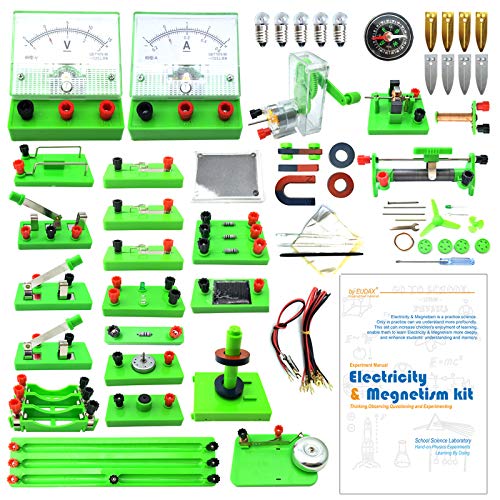
- Builds circuits, electromagnets, and generators
- Includes 79 listed items plus a color manual
- Requires three AA batteries, sold separately
Best For: Grades 9–11 studying introductory electricity and magnetism
Intermediate Chemistry Pick

- Includes 250 experiments in 18 themed chapters
- Adds an alcohol burner for heat-based experiments
- Ages 11+ with adult supervision and safety guidance
Best For: Students moving from beginner chemistry toward high school-level work
Microbiology Project Pick
Evviva Sciences Agar Plate Kit

- Includes 10 ready-to-use pre-poured agar plates
- Provides swabs, pipette, vial, instructions, and eBook
- Designed for microbiology projects ages 15+
Best For: Older students beginning a focused microbiology or science fair project
DNA Discovery Lab

- Covers DNA, cells, chromosomes, and inheritance
- Includes 20 guided experiments
- Features a DNA model and plant DNA activity
Best For: Introductory genetics and biology projects
Microbiology Project Kit

- Includes 10 pre-poured LB-agar plates
- Provides 10 sterile cotton swabs
- Includes a science-fair project e-book
Best For: Guided microbiology and science-fair projects
Hands-On Chemistry Station

- Includes 57 lab-style pieces
- Covers slime, fizzing, bubbles, and chromatography
- Uses non-hazardous chemicals without borax
Best For: Beginner-friendly, hands-on chemistry activities
Most Comprehensive Pick
Ultimate Science Experiments Kit

- More than 135 guided experiments
- Includes lab-style tools and ingredients
- 90+ bonus household-item activities
Best For: Families wanting maximum variety and parent-child STEM activities
Best Physics Focus
Electricity and Magnetism Circuit Kit

- Builds series and parallel circuits
- Covers electromagnets and generators
- Includes organized components and manual
Best For: Grades 7–11 learners focused on electricity and magnetism
Best Chemistry Variety

- Includes 70 guided experiments
- Covers crystals, volcanoes, and reactions
- Explains the science behind activities
Best For: Learners wanting varied introductory chemistry and STEM projects
Advanced Chemistry Pick – Thames & Kosmos CHEM C3000
For students seeking science experiment sets for high school students, the Thames & Kosmos CHEM C3000 is a substantial home chemistry laboratory. It offers more than 333 experiments across inorganic, organic, and electrochemistry topics, with real equipment, chemicals, and a detailed 192-page manual.
Best For: Serious young scientists, homeschoolers, and students preparing for high school chemistry who have consistent adult supervision.
Pros:
- Includes more than 333 hands-on experiments in 27 organized chapters.
- Covers advanced topics such as chemical bonding, electrolysis, redox reactions, and organic chemistry.
- Provides extensive lab equipment, chemicals, safety guidance, and a full-color manual.
- Designed for ages 12+ and manufactured to the EN 71-4 safety standard.
Cons:
- Adult supervision is required throughout, particularly for chemical and heat-based activities.
- Some experiments require common household additions not included in the kit.
- Its advanced scope may be more than beginners need.
The C3000 is the most comprehensive chemistry option in this group. Its broad subject coverage and authentic equipment make it a strong long-term choice, provided the student has suitable supervision and a dedicated workspace.
Electricity & Magnetism Pick – EUDAX Physics Lab Kit
The EUDAX kit is a focused choice among science experiment sets for high school students who want hands-on practice with circuits, electricity, and magnetism. Its included components support projects such as series and parallel circuits, fruit batteries, electromagnets, electric bells, and hand-crank generators.
Best For: Students in grades 9–11 exploring introductory electricity, magnetism, and elementary electronics.
Pros:
- Supports practical experiments involving circuits, Ohm’s law, electromagnetism, and generators.
- Includes 56 electricity items, 21 magnetism items, repair tools, and a color-page manual.
- Components are supplied in a storage bag for organization and portability.
- Provides a hands-on way to connect physics principles with working models.
Cons:
- Three AA batteries are required but not included.
- The kit focuses primarily on electricity and magnetism rather than broad physics coverage.
- The listed recommended age range extends from 8 to 18, so some activities may feel introductory to advanced high school students.
This is a practical, project-oriented option for learners who prefer building and testing over reading-heavy instruction. Check that you have the required batteries before starting.
Intermediate Chemistry Pick – Thames & Kosmos CHEM C2000
The Thames & Kosmos CHEM C2000 offers a structured entry into science experiment sets for high school students who want more than simple demonstrations. With 250 experiments, real lab equipment, an alcohol burner, and a 128-page manual, it builds a foundation in acids, bases, gases, electrochemistry, food chemistry, and chromatography.
Best For: Students ages 11+ who are progressing beyond beginner chemistry and want a guided intermediate home laboratory.
Pros:
- Includes 250 experiments organized across 18 themed chapters.
- Introduces heat-based work with an alcohol burner, tripod components, and related apparatus.
- Covers varied topics including acids and bases, oxygen, carbon dioxide, soaps, food chemistry, and luminol.
- Includes real lab equipment, selected chemicals, safety guidance, and a Parents’ Choice Silver Award.
Cons:
- Adult supervision is required for the experiments.
- Some activities involve an alcohol burner and require careful heat safety.
- It provides fewer experiments and less extensive coverage than the CHEM C3000.
The C2000 is a balanced middle ground: more capable than a beginner set without the full complexity of the C3000. It is especially suitable when the student benefits from step-by-step progression and a broad but manageable chemistry curriculum.
Microbiology Project Pick – Evviva Sciences Agar Plate Kit
For biology-focused science experiment sets for high school students, the Evviva Sciences Microbiology Science Project Kit provides a straightforward way to begin culture-based activities. It includes 10 pre-poured agar plates, swabs, a pipette, a vial, instructions, and an educational experiment eBook.
Best For: Students ages 15 and older working on introductory microbiology or science fair projects.
Pros:
- Pre-poured agar plates eliminate the need to melt and pour agar.
- Includes 10 agar Petri dishes, 10 cotton-tipped swabs, a pipette, and a plastic vial.
- Provides step-by-step instructions and an educational experiment eBook.
- Compact packaging makes the kit convenient for classroom or project use.
Cons:
- The kit is specialized for microbiology rather than a broad range of sciences.
- It is intended for ages 15 and older, limiting its suitability for younger students.
- The included supplies are finite, with only 10 agar plates.
This kit is a convenient starting point for students interested specifically in microbiology. Its ready-to-use plates reduce setup work, making it well suited to a focused classroom investigation or science fair project.
DNA Discovery Lab – Genetics & DNA Lab
For shoppers comparing science experiment sets for high school students, this genetics-focused kit offers a structured introduction to DNA, cells, chromosomes, and inheritance. Its 48-page, full-color manual walks learners through 20 experiments, including isolating plant DNA and assembling a DNA model.
Best For: Students ages 10–16 who want a hands-on introduction to genetics and molecular biology.
Pros:
- Includes 20 guided experiments and a detailed 48-page manual.
- Provides materials for isolating plant DNA in a test tube.
- Combines practical activities with a DNA model, chromosome puzzle, and inheritance worksheet.
Cons:
- Its focus is primarily genetics and DNA rather than broad science topics.
- The manufacturer recommends it for ages 10–16, so older students may want more advanced content.
This is a strong choice for learners interested in biology who benefit from visual models and guided activities. It is especially suited to an introductory genetics unit or a home STEM project.
Microbiology Project Kit – Bacteria Science Kit
Among science experiment sets for high school students, this bacteria kit is geared toward microbiology investigations and science-fair preparation. It includes 10 pre-poured sterile LB-agar plates, 10 sterile cotton swabs, and a science-fair e-book with step-by-step experiment guidance.
Best For: Students ages 13 and up planning a guided bacteria experiment or science-fair project.
Pros:
- Includes 10 pre-poured 100-mm LB-agar plates and 10 sterile swabs.
- Re-sealable packaging supports reuse of remaining materials.
- The included e-book offers experiment instructions, troubleshooting tips, and project advice.
- Product notes provide access to live support from PhD scientists for questions.
Cons:
- The kit centers specifically on bacterial growth rather than a range of science disciplines.
- It is recommended for ages 13 and up, making it less suitable for younger children.
This option makes sense when the goal is a focused microbiology investigation with enough prepared materials for multiple samples. The included project guidance is useful for students who need structure while developing a science-fair experiment.
Hands-On Chemistry Station – Ooze Labs Chemistry Station
For families seeking science experiment sets for high school students that emphasize hands-on chemistry, the Ooze Labs Chemistry Station provides a colorful lab-style setup with 57 pieces. Activities include glowing slime, fizzing reactions, oozing bubbles, and chromatography, with experiment cards and a 16-page manual for guidance.
Best For: Beginners who want an accessible, equipment-rich introduction to chemistry experiments.
Pros:
- Includes 57 pieces, including beakers, test tubes, flasks, pipettes, and other vessels.
- Offers varied activities such as slime, fizzing reactions, bubbles, and chromatography.
- Experiment cards clip onto the station for convenient reference.
- Uses non-hazardous chemicals and does not contain borax.
Cons:
- The manufacturer recommends it for ages 6 and up, so advanced high school students may find it introductory.
- Its emphasis is on engaging demonstrations and activities rather than a specialized high-school chemistry curriculum.
This kit is a practical pick for beginners who value an organized workspace and varied experiments. Older students looking for advanced chemistry concepts may prefer a more curriculum-focused laboratory set.
Most Comprehensive Pick – Ultimate Science Experiments Kit
For families comparing science experiment sets for high school students and older children, the Doctor Jupiter Ultimate Science Kit stands out for sheer variety. It combines more than 135 experiments—including color changes, glowing water, underwater volcanoes, soap making, and bonus activities using household items—with illustrated, step-by-step instructions.
Best For: Families seeking a broad, activity-rich STEM kit for shared learning and repeated experimentation.
Pros:
- Includes more than 135 experiments, plus 90+ bonus household-item activities.
- Provides equipment such as a measuring cylinder, conical flask, test tube stand, cups, funnel, and tray.
- Uses illustrated instructions and separately packaged, leak-proof chemical materials.
- Supports parent-child collaboration and extended educational play.
Cons:
- The manufacturer recommends it for ages 8 and up, so it may be less specialized for advanced high-school physics or chemistry.
- Some experiments require everyday household items beyond the included materials.
This is the strongest choice when variety and guided, hands-on discovery matter most. Buyers specifically seeking a focused high-school lab experience may prefer a subject-specific set.
Best Physics Focus – Electricity and Magnetism Circuit Kit
For students who want a focused option among science experiment sets for high school students, the EUDAX Physics Lab Learning Circuit Kit centers on electricity and magnetism. Its components support projects such as series and parallel circuits, electromagnets, a hand-crank generator, a wind-power car, LEDs, and traffic lights.
Best For: Students in roughly grades 7–11, teachers, and learners who want practical circuit-building experience.
Pros:
- Targets electricity and magnetism with hands-on construction projects.
- Supports simple, series, parallel, switch, electromagnet, generator, and wind-power activities.
- Includes switches, wires, bulbs, LEDs, and a full-color learning manual.
- Parts store in a transparent box for organization.
Cons:
- Two AA batteries are required but not included.
- Its subject focus is narrower than a general chemistry or multidisciplinary science kit.
- The listed manufacturer recommendation is 14–17 years, which may limit suitability for younger learners.
This is the most targeted pick for learning circuit principles through construction rather than demonstrations. It offers a better fit for physics coursework than for broad, mixed-subject experimentation.
Best Chemistry Variety – 70-Experiment Science Kit
The UNGLINGA 70 Lab Experiments kit is a practical choice for shoppers comparing science experiment sets for high school students who want a mix of chemistry and STEM activities. Projects include crystal growing, an erupting volcano, balloon rockets, fruit circuits, and other chemical reactions, with a manual that explains the science behind each activity.
Best For: Learners who want varied, approachable experiments with clear illustrations and introductory chemistry guidance.
Pros:
- Offers 70 experiments across chemistry, simple circuits, and physical science activities.
- Includes popular projects such as crystal growing, volcanoes, balloon rockets, and fruit circuits.
- Provides illustrated instructions and explanations of the chemical reactions involved.
- Designed around STEM learning, critical thinking, problem solving, and safe experiment practices.
Cons:
- The manufacturer recommends it for ages 8 and up, so advanced high-school students may find some activities introductory.
- The supplied details do not list the individual included components.
This kit balances entertainment and explanation well, making it a flexible choice for home learning or group activities. Students seeking deeper, curriculum-specific physics work should consider the EUDAX circuit kit instead.
How We Picked the Best Science Experiment Sets for High School Students
We selected kits that offer meaningful hands-on learning rather than only demonstration-style activities. The lineup includes focused sets for chemistry, circuits, electromagnetism, DNA, and microbiology, along with broader experiment collections for students who want more variety.
We also considered the number and quality of included components, the usefulness of the instructions, suitability for high-school-level work, project potential, and the practical requirements of each kit. Some sets are better for structured lessons, while others are more useful for open-ended investigations or science-fair preparation.
Quick Comparison
| Best For | Recommended Type | What to Look For |
|---|---|---|
| Chemistry fundamentals | Intermediate chemistry set | Lab equipment, varied reagents, and a detailed manual |
| Advanced chemistry practice | Large chemistry laboratory kit | More tools, broader experiment coverage, and careful safety guidance |
| Electricity and circuits | Physics circuit kit | Reusable wires, components, diagrams, and troubleshooting support |
| Microbiology projects | Agar plate kit | Sealed or pre-poured plates, sterile supplies, and disposal guidance |
| Genetics lessons | DNA and genetics lab | Clear explanations of extraction, heredity, and molecular concepts |
| Broad exploration | Multi-topic experiment kit | Experiment variety, age-appropriate instructions, and organized parts |
Key Buying Factors for Science Experiment Sets for High School Students
Subject and Academic Level
Choose a focused kit if the student is studying a specific unit, such as electricity, chemistry, or genetics. A general kit is more flexible, but its activities may be less rigorous than a dedicated laboratory set. Check the recommended age and required background knowledge before buying.
Experiment Depth and Documentation
A high experiment count is useful only when the activities are sufficiently varied and well explained. Look for manuals that identify objectives, materials, procedures, observations, and follow-up questions. Strong documentation helps students connect results to scientific principles.
Equipment, Consumables, and Safety
Reusable tools can improve long-term value, while consumables such as reagents, agar plates, swabs, and test materials may limit the number of activities. Confirm what is included and what must be supplied separately. Safety glasses, gloves, ventilation, adult supervision, and proper disposal are especially important for chemistry and microbiology kits.
Project and Classroom Suitability
For science-fair work, prioritize kits that support controlled variables, repeatable trials, data collection, and a clear research question. For classroom use, organized components and durable parts can matter more than the largest experiment count.
Who Should Buy Which Science Experiment Sets for High School Students?
Students focused on chemical reactions should start with an intermediate or advanced chemistry kit. Those learning current, magnetism, and electromagnetism will get more value from a dedicated physics circuit set. Genetics kits suit learners interested in heredity and DNA, while agar-based microbiology kits are appropriate for supervised projects involving bacterial growth.
Choose a broad experiment collection for younger or undecided learners who want to sample several subjects, but verify that its difficulty matches high-school expectations. Finally, parents and teachers should favor kits with clear safety instructions, complete parts lists, and realistic plans for replacing used materials.