
Choosing among the best resin printers for prototypes means balancing detail, build volume, speed, material performance, and workflow convenience. The right machine can shorten design iterations while preserving the fine features needed for accurate fit checks and presentation models.
This roundup covers compact MSLA printers, high-resolution production-oriented models, large-format options, wash-and-cure bundles, and prototype-friendly resins so you can match equipment to your parts, budget, and expected workload.
Best 10 Resin Printers for Prototypes Picks for 2026
Fast Detail Pick

- 9K resolution with 1818μm XY detail
- Up to 150mm/h printing with tilt release
- AI camera, sensors, and Wi-Fi workflow
Best For: Detailed prototypes and connected maker workflows
Large-Format Production Pick

- 18.3L build volume for oversized prototypes
- 14-inch 12K screen for smooth detail
- Heated tank and auto-leveling simplify production
Best For: Large prototypes and high-volume batch runs
High-Resolution Speed Pick

- 16K screen with 14 × 19μm XY resolution
- Up to 150mm/h with tilt-release technology
- Heated tank, auto-leveling, and AI monitoring
Best For: Intricate prototypes requiring speed and consistency
Optically Clear Detail Pick

- 385nm light source supports transparent models
- 16K display with 14 × 19μm XY resolution
- Heated resin and rigid Z-axis for stable detail
Best For: Transparent prototypes and precision engineering models
Best Beginner Pick
- One-click automatic leveling
- 4K mono LCD for detailed prints
- Built-in alerts and overheat protection
Best For: Beginners making detailed resin prototypes
Best Tough Prototype Resin

- Heat resistance up to 55°C
- Tough, impact-resistant printed models
- Low shrinkage with fast curing
Best For: Functional prototypes requiring durability and drillability
Speed & Precision Pick

- 16K resolution with 14 × 19 μm XY detail
- Prints up to 150mm/h
- AI camera and smart mechanical sensing
Best For: Fast, highly detailed prototype iterations
Functional Prototype Material
- Tough, impact-resistant formulation
- Low shrinkage for accurate parts
- Compatible with many 405nm LCD/DLP printers
Best For: Durable functional prototypes and mechanical parts
Fast Detail Pick – ELEGOO Mars 5 Ultra
For resin printers for prototypes, the ELEGOO Mars 5 Ultra combines a 9K monochrome screen with fast printing and monitoring features. Its 1818μm XY resolution, resin calibration, and tilt-release system support detailed prototype work while helping reduce print interruptions.
Best For: Makers and small teams needing detailed prototypes with fast, connected operation.
Pros:
- 9K LCD and 92% light uniformity support detailed, consistent models.
- Print speeds reach up to 150mm/h with tilt-release technology.
- AI camera and mechanical sensors can identify common print problems.
- Wi-Fi transfer, remote control, and cluster printing support multiple-printer workflows.
Cons:
- Its build size is more limited than the large-format option in this roundup.
- The printer weighs 24.6 pounds, so it still requires a stable workspace.
The Mars 5 Ultra is a practical balance of resolution, speed, and automation for prototype makers who want less hands-on monitoring without moving to a larger machine.
Large-Format Production Pick – ANYCUBIC Photon P1 Max
The ANYCUBIC Photon P1 Max stands out among resin printers for prototypes when build capacity matters most. Its 18.3L build volume can handle oversized parts or dense batches, while auto-leveling, heated resin, and precision motion hardware support repeatable production.
Best For: Engineering teams and makers producing large prototypes or multiple parts per run.
Pros:
- 285.5 × 214 × 300mm build volume accommodates large or batch-printed prototypes.
- 14-inch 12K screen with 24.8 × 24.8μm pixels supports smooth surfaces and fine detail.
- Heated 1900ml resin tank helps maintain resin flow up to 35°C.
- Auto-Leveling 3.0 and C7-grade ball screws support easier setup and ±0.01mm repeat positioning accuracy.
Cons:
- Its 68.9-pound weight and large footprint demand substantial workspace.
- The large resin tank and build volume may be more than needed for occasional small prototypes.
The P1 Max is the strongest capacity-focused choice here, particularly for users who value fewer print cycles and more stable operation in cooler workshops.
High-Resolution Speed Pick – ELEGOO Saturn 4 Ultra 16K
The ELEGOO Saturn 4 Ultra 16K is a compelling option among resin printers for prototypes that require both fine detail and quick turnaround. Its 14 × 19μm XY resolution, heated resin tank, automatic leveling, and claimed 150mm/h speed are designed to support reliable, detailed production.
Best For: Users making intricate prototypes who want high resolution, speed, and automated monitoring.
Pros:
- 16K LCD delivers 14 × 19μm XY resolution for intricate models.
- Automatic heating activates below 25°C to help maintain suitable resin conditions.
- Tilt-release technology and increased light intensity support claimed speeds up to 150mm/h.
- AI camera, mechanical sensors, Wi-Fi transfer, and power-on resume improve oversight.
Cons:
- The 8.33 × 4.66 × 8.66-inch printing area is not intended for the largest prototypes.
- Its 35.4-pound weight may make relocation inconvenient.
Choose the Saturn 4 Ultra 16K when prototype detail is a priority but production speed and easier temperature management are also important.
Optically Clear Detail Pick – UniFormation GK3 Pro 16K
The UniFormation GK3 Pro targets demanding resin printers for prototypes, especially projects involving transparent models and fine surface detail. Its 385nm light source, 16K display, rigid Z-axis, and heated resin system are designed for precise, stable printing across changing workshop conditions.
Best For: Professional prototype work, transparent models, engineering parts, and small-batch applications.
Pros:
- 385nm illumination is designed to reduce light scattering and over-curing, including for transparent models.
- 16K resolution and 14 × 19μm XY resolution capture fine textures and smooth surfaces.
- Ball screw, heavy-duty linear guide, and fixed-frame structure support stable Z-axis movement.
- Heating supports resin fluidity at temperatures as low as 5°C, while the app enables remote monitoring.
Cons:
- At 53.7 pounds, it is less convenient to move between work areas.
- Its advanced feature set may be more than casual users need for basic prototype prints.
The GK3 Pro is the specialized choice for users who prioritize optical clarity, micro-detail, and mechanical stability over a lightweight or minimalist setup.
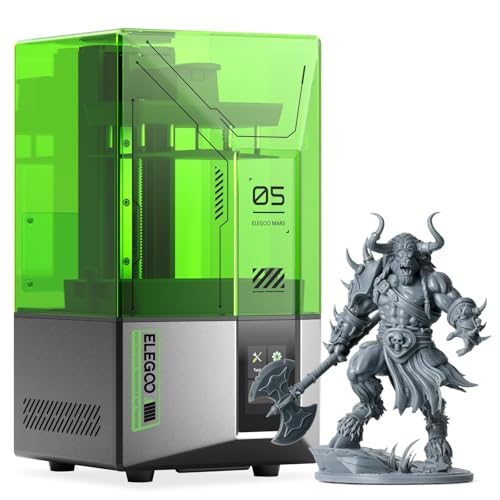
Best Beginner Pick – ELEGOO Mars 5
If you want resin printers for prototypes without a lengthy setup process, the ELEGOO Mars 5 is a practical choice. One-click automatic leveling, self-checks, and a 4K mono LCD make it approachable while still supporting detailed prototype work.
Best For: Beginners and makers who want detailed resin prototypes with simplified setup and built-in safety checks.
Pros:
- One-click automatic leveling reduces calibration work.
- 4K mono LCD and COB lighting support fine details and textures.
- Residue detection, resin shortage alerts, and leveling-failure alarms help reduce wasted materials.
- Overheat protection pauses printing if LED temperature exceeds 80°C.
Cons:
- Its stated print features are centered on a 4K LCD rather than the higher-resolution output of larger premium models.
- The printer’s listed dimensions may require dedicated workspace.
The Mars 5 stands out for reducing routine setup and monitoring tasks. It is a sensible entry point for prototype-focused users who value convenience alongside detailed prints.
Best High-Resolution Bundle – ELEGOO Saturn 4 Ultra 16K Kit
For larger or more demanding resin printers for prototypes, this bundle combines the ELEGOO Saturn 4 Ultra 16K with a Mercury Plus V3.0 wash and cure station. Its large build area, stated 150mm/h speed, and included post-processing station create a more complete prototyping workflow.
Best For: Users producing larger prototype parts or multiple models who want printing, washing, and curing equipment together.
Pros:
- 16K resin printer is designed for highly detailed output.
- Large 8.33 x 4.66 x 8.66-inch printing size supports bigger prototypes.
- 150mm/h stated high-speed printing can support faster production.
- Mercury Plus V3.0 provides 7.5 L capacity for washing and curing.
Cons:
- The larger printer and wash-and-cure station require more workspace than a standalone compact setup.
- This bundle may be more equipment than occasional users need.
This is the strongest option here for a more capable prototype workflow, especially when resolution, build volume, speed, and post-processing convenience matter more than compactness.
Best Tough Prototype Resin – ELEGOO ABS-Like 3.0+ Resin
Not every prototype needs a new printer; material choice can matter just as much. ELEGOO ABS-Like 3.0+ resin is formulated for tougher models, with impact resistance, low shrinkage, and heat resistance up to 55°C for functional prototype testing.
Best For: Functional prototypes that need more toughness, drillability, and resistance to moderate heat.
Pros:
- Models can bend without breaking easily and tolerate certain stresses.
- Printed parts can be tapped and drilled without cracking.
- Low shrinkage and high precision support accurate, smooth prototypes.
- Good fluidity and fast curing can improve printing efficiency and success rates.
Cons:
- Heat resistance is specified up to 55°C, so it is not intended for high-temperature applications beyond that range.
- This is resin rather than a printer, so a compatible LCD 3D printer is required.
- The 2,000 g package may be more material than casual users need.
For users who already have a compatible resin printer, this ABS-like formulation is a practical way to make prototypes that are less brittle than standard detail-focused models. Its combination of toughness and precision suits iterative functional testing.
Speed & Precision Pick – ELEGOO Saturn 4 Ultra 16K
For resin printers for prototypes, the ELEGOO Saturn 4 Ultra stands out when fast production and fine detail are priorities. Its 16K monochrome LCD, tilt-release technology, and up-to-150mm/h print speed support detailed prototype work with less waiting.
Best For: Makers and product developers who need detailed prototypes quickly and want automated monitoring features.
Pros:
- 16K resolution with 14 × 19 μm XY resolution for fine details.
- Print speeds up to 150mm/h with selectable fast and slow modes.
- Smart sensor system can detect low resin, debris, and high lamp temperature.
- Built-in AI camera monitors issues such as empty build plates and model warping.
Cons:
- At 40.7 pounds, it is a substantial desktop machine.
- The supplied details do not specify the printer’s build volume.
The heated resin tray, one-click calibration, and power-loss recovery make this a convenient choice for repeated prototype runs. Choose it if speed and high-resolution surface detail matter more than maximum build size.
Functional Prototype Material – ELEGOO ABS-Like Resin 3.0
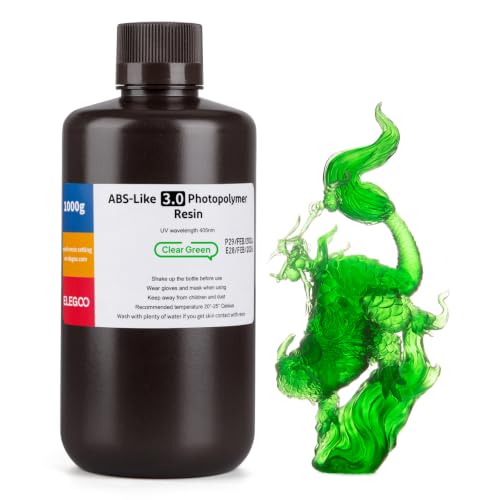
For resin printers for prototypes, material choice is just as important as printer resolution. ELEGOO ABS-Like Resin 3.0 is formulated for functional models that need strength, toughness, dimensional stability, and a smooth finish.
Best For: Functional prototypes, mechanical parts, and industrial-style models that may face drilling or certain impacts.
Pros:
- High strength, impact resistance, and toughness support functional parts.
- Low shrinkage helps preserve detail and dimensional accuracy.
- Lower viscosity than the company’s earlier ABS-like formulas supports rapid flow and peeling.
- Compatible with a wide range of 405nm LCD and DLP resin printers.
Cons:
- This is resin material, not a printer, so printer compatibility and settings still matter.
- The clear green color may not suit every prototype presentation.
Its combination of toughness, precision, and fluidity makes it a practical choice when prototypes need more than a visual mockup. The stable formulation and broad 405nm compatibility also support consistent repeat printing.
Large-Format Prototype Pick – ELEGOO Jupiter 2 16K
For resin printers for prototypes that need larger parts or batch production, the ELEGOO Jupiter 2 offers a 302.4 × 161.98 × 300mm build volume. Its 16K exposure system combines large-format capacity with detailed output for bigger concepts and multiple models.
Best For: Teams and advanced makers producing large prototypes or several smaller prototypes in one print job.
Pros:
- Large 302.4 × 161.98 × 300mm build volume supports bigger parts and batch printing.
- 16K resolution and 20 × 26 μm XY resolution provide detailed results.
- Auto leveling, smart tank heating, and automated resin replenishment simplify operation.
- Camera monitoring, power-loss recovery, and safety sensors support longer jobs.
Cons:
- Its 63.8-pound weight and large footprint require substantial workspace.
- The larger format may be excessive for small, occasional prototypes.
The Jupiter 2 is designed for throughput and scale, with Wi-Fi cluster management, a quick-swap release film, and a resin drip tray adding practical convenience. It is the strongest fit here when prototype size or batch capacity is the deciding factor.
How We Picked These Resin Printers for Prototypes
We focused on specifications and features that directly affect prototype development: XY resolution, usable build volume, print speed, exposure consistency, leveling or calibration assistance, resin compatibility, and post-processing requirements. We also considered whether each option suits one-off design iterations, small batches, larger enclosures, or detailed presentation parts.
Resolution matters, but it is not the only measure of accuracy. A stable motion system, reliable exposure screen, effective platform adhesion, and predictable resin profiles can have a greater effect on repeatable results. Large-format printers were included for teams that need to consolidate multiple parts into one build, while smaller models remain useful for economical iteration.
Quick Comparison
| Best For | What to Prioritize | Recommended Type |
|---|---|---|
| Small, detailed parts | Fine XY resolution and easy calibration | Compact 9K or 16K MSLA printer |
| Multiple prototypes | Build volume and print speed | Mid-size or large-format model |
| Large housings and assemblies | Platform capacity and stable mechanics | Large 16K resin printer |
| Beginner-friendly workflow | Auto-leveling, sensors, and guided setup | Automated consumer MSLA printer |
| Frequent production | Post-processing throughput | Printer paired with a wash-and-cure station |
Key Buying Factors for Resin Printers for Prototypes
Detail, Accuracy, and Surface Finish
Higher LCD resolution can reproduce small text, holes, edges, and surface features more cleanly, but resin selection and exposure settings remain essential. For fit-check parts, prioritize dimensional consistency and calibration over headline resolution alone.
Build Volume and Productivity
Measure your largest expected prototype rather than choosing solely by average project size. A larger platform can print several design variations at once, reducing turnaround time, while a compact machine may waste less resin and fit more easily in a small workspace.
Speed and Reliability
Advertised speeds depend on layer height, resin, geometry, and lift settings. Look for rigid mechanics, dependable sensors, uniform exposure, and straightforward replacement parts. Features such as auto-leveling can reduce setup time, especially when several users share the printer.
Resin and Post-Processing
Use engineering, ABS-like, or tough resin when prototypes need improved impact resistance or functional testing. Standard resin is often better for highly detailed visual models. Washing and curing are mandatory parts of the workflow, so budget for a suitable station, gloves, ventilation, and safe resin handling.
Who Should Buy Which Resin Printers for Prototypes?
Choose a compact Mars-class printer if you need affordable, detailed prototypes and mostly work with small parts. A Saturn-class model is a stronger fit for designers who regularly print assemblies, multiple iterations, or medium-sized enclosures. Large-format options such as the Jupiter are better suited to oversized parts, batch production, and teams that value fewer separate prints.
Choose a high-resolution model when fine lettering, textured surfaces, or small mechanical details are central to your work. Pick a printer with automation and sensors if you want simpler operation or shared studio use. A bundle with washing and curing equipment makes sense for frequent users who want a more consistent end-to-end workflow, while prototype-focused ABS-like resin is a practical upgrade for parts that must survive handling and repeated fit tests.