
The best power inverters for camping make it easier to charge phones, run small appliances, and keep essential gear working away from the grid. The right choice depends on your wattage needs, battery setup, and whether you want a simple vehicle adapter or a self-contained power station.
We selected 10 options spanning portable power stations, car inverters, RV-ready systems, and tool-battery converters. Use the guide below to match output, portability, and power-source compatibility to your camping style.
Best 10 Power Inverters for Camping Picks for 2026
Best Compact Power Station
DaranEner 192Wh LiFePO4 Power Station

- 300W pure sine wave output with 600W surge
- LiFePO4 battery rated for 3,500+ cycles
- Six-device charging and built-in LED light
Best For: Lightweight camping power for electronics and essentials
Best Vehicle Inverter
Pro Chaser 400W Car Power Inverter
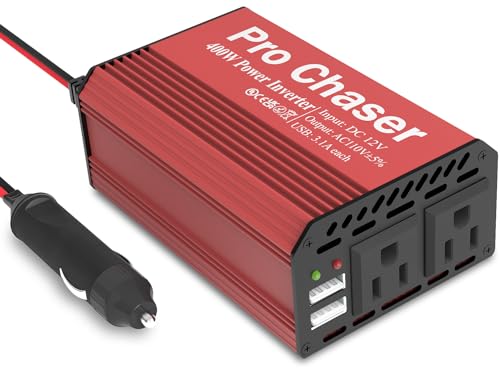
- 400W output and 800W peak capacity
- Dual AC outlets plus two USB ports
- Compact design with 30-inch power cord
Best For: Road trips and car-based camping
Best Lightweight Power Station
Jackery Explorer 300 Portable Power Station

- 292Wh capacity with 300W rated output
- Six-device charging with 100W USB-C PD
- LiFePO4 battery and optional solar charging
Best For: Portable campsite power for electronics and essential gear
Best High-Output RV Inverter
LANDERPOW 3000W Pure Sine Wave Inverter

- 3,000W continuous and 6,000W peak output
- Pure sine wave power for sensitive electronics
- Remote monitoring, heavy-duty cables, and safety protections
Best For: RV and off-grid setups with a 12V battery bank
Best Solar-Ready Power Station
GRECELL 330W Portable Power Station
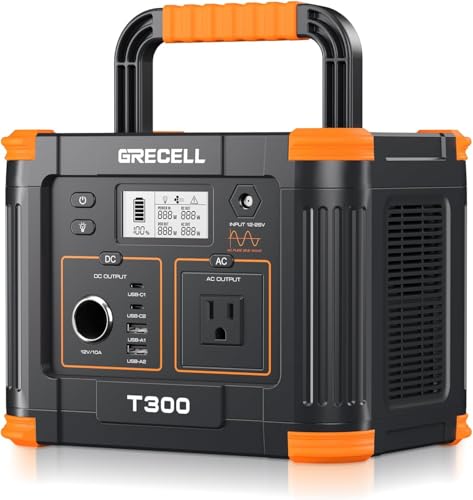
- 230.88Wh capacity with 330W pure sine wave output
- Six output options, including 60W USB-C PD
- Recharges via AC, car outlet, or solar panel
Best For: Campers needing flexible battery power for electronics and select low-wattage devices
Best Car-Powered Option
BESTEK 300W Car Power Inverter
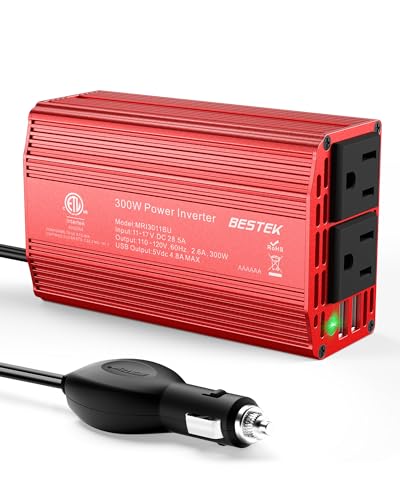
- 300W continuous and 700W peak output
- Two AC outlets and two 4.8A USB ports
- Compact aluminum design with a 32-inch vehicle cable
Best For: Vehicle-based camping and road trips requiring several charging outlets
Best for EGO Battery Owners
EGO POWER+ 400W Portable Inverter

- 400W continuous and 800W peak pure sine wave output
- Works with EGO 56V ARC Lithium batteries
- Includes USB charging, pass-through charging, and LED lights
Best For: EGO battery users seeking quiet portable power for camping or emergencies
Best Compact Car Inverter
PiSFAU 200W Car Power Inverter

- Two AC outlets plus four USB charging ports
- Compact 8.8-ounce vehicle-powered design
- Multiple built-in safety protections
Best For: Car camping and road-trip charging
Best Milwaukee Battery Inverter
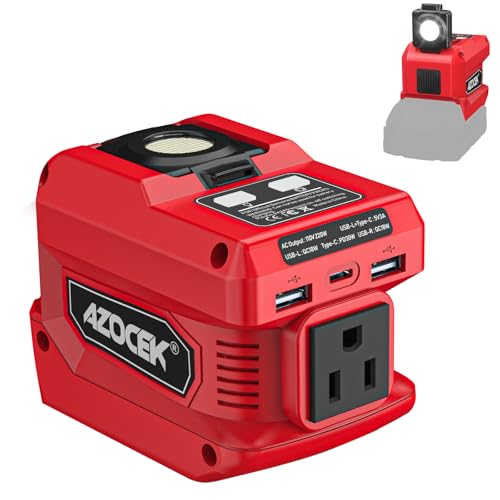
- Converts compatible Milwaukee 18V batteries to AC power
- Includes USB QC, USB-C PD, and one AC outlet
- Built-in 400-lumen adjustable LED work light
Best For: Battery-based camping and emergency lighting
Best Pure Sine Wave Battery Inverter
350W Dewalt-Compatible Converter

- 350W continuous and 600W peak output
- Pure sine wave power for sensitive electronics
- LCD monitoring, USB charging, and LED work light
Best For: Higher-output camping, RV, and emergency use
Best Compact Power Station – DaranEner 192Wh LiFePO4 Power Station
For campers who want flexible power in a compact package, the DaranEner is one of the more versatile power inverters for camping. Its 300W pure sine wave output can run phones, laptops, lights, cameras, fans, and CPAP machines, while multiple charging options support use at a campsite, in a vehicle, or during an outage.
Best For: Campers needing lightweight, clean power for small electronics and essential devices.
Pros:
- 192Wh LiFePO4 battery with a claimed 3,500+ cycle lifespan
- 300W pure sine wave output with 600W surge capacity
- Six-device charging, 60W USB-C PD, and built-in LED light
Cons:
- Not designed for appliances exceeding 300W or demanding startup surges
- Solar input is limited to 60W, and panels are not included
At 5.73 pounds, this power station is easy to pack and offers useful connectivity for weekend trips. Its modest capacity and output make it better for electronics and medical devices than high-draw camping appliances.
Best Vehicle Inverter – Pro Chaser 400W Car Power Inverter
The Pro Chaser is a compact choice for turning a vehicle’s 12V outlet into portable AC power. Among power inverters for camping, it suits road trips and car-based campsites where you need to charge devices or run modest loads such as laptops, cameras, bottle warmers, or DVD players.
Best For: Vehicle campers and travelers who need convenient AC and USB charging from a 12V socket.
Pros:
- 400W continuous output with an 800W peak rating
- Two 110V AC outlets and dual USB ports with 4.8A combined output
- Small 14.08-ounce design, 30-inch cord, cooling fan, and safety protections
Cons:
- Uses a modified sine wave rather than pure sine wave output
- Designed for vehicle use, so it depends on a 12V power source
This inverter is easy to carry and install for short charging sessions, but its modified sine wave output makes it less suitable for especially sensitive electronics. Keep it in a cool, dry environment as recommended by the manufacturer.
Best Lightweight Power Station – Jackery Explorer 300 Portable Power Station
The Jackery Explorer 300 combines a 292Wh capacity with a portable 7.5-pound design, making it a practical option for campers who need more reserve power than a basic car inverter. Its 300W output and six-device charging layout cover common campsite electronics, while optional solar charging supports longer off-grid stays.
Best For: Campers who want a portable power station for laptops, cameras, drones, CPAP equipment, and small electronics.
Pros:
- 292Wh capacity with 300W rated and 600W peak output
- Two AC outlets, 100W USB-C PD, USB-A ports, and a 120W car port
- LiFePO4 battery rated for more than 4,000 cycles and optional solar charging
Cons:
- Solar panel is optional rather than included
- 300W output limits use with larger camping appliances
With an integrated handle and several output types, the Explorer 300 is easy to move between a vehicle and campsite. Its capacity is well suited to personal electronics and essential gear, but not extended operation of high-wattage appliances.
Best High-Output RV Inverter – LANDERPOW 3000W Pure Sine Wave Inverter
For RVs and demanding campsite setups, the LANDERPOW delivers substantially more capacity than compact power stations or vehicle plug-in models. This 12V-to-120V unit provides 3,000W of continuous pure sine wave power and 6,000W of surge capacity for appliances, tools, and sensitive electronics when paired with a suitable battery system.
Best For: RV owners and off-grid users running high-draw appliances or tools from a 12V battery bank.
Pros:
- 3,000W continuous and 6,000W peak pure sine wave output
- Three AC outlets, hardwired terminal, USB charging, and 30W PD port
- Includes thick 1 AWG battery cables, 15-foot remote, and multiple protection features
Cons:
- Requires a 12V battery connection and substantial installation space
- It is much less portable than a self-contained power station
The high output and pure sine wave design make this a strong fit for serious RV and off-grid power needs. Because it draws directly from a battery system and includes heavy-duty cabling, plan for careful installation rather than casual plug-and-play campsite use.
Best Solar-Ready Power Station – GRECELL 330W Portable Power Station
For campers who want more than a car outlet, the GRECELL EB300 is a compact power station with a 230.88Wh battery and 330W of pure sine wave AC output. It can run or recharge common camping electronics, and its solar, wall, and vehicle charging options add flexibility for longer trips.
Best For: Camping, car trips, and family outings where portable battery power and multiple recharging options are useful.
Pros:
- 330W continuous output with 600W surge capacity and pure sine wave power.
- Six charging outputs, including USB-C PD 60W, USB-A QC 18W, an AC outlet, and a car port.
- Built-in MPPT controller supports efficient solar charging, alongside AC and car charging.
- Overload, overcharge, and short-circuit protection, plus dual cooling fans.
Cons:
- The 230.88Wh capacity is better suited to smaller electronics and select low-wattage devices than extended high-power use.
- Solar charging requires a compatible solar panel, which is not listed among the included components.
With its lightweight 7.3-pound design and broad port selection, the EB300 is a versatile choice among power inverters for camping. Its pure sine wave output and built-in protections make it especially practical for sensitive electronics, while its capacity sets a limit on how long larger loads can run.
Best Car-Powered Option – BESTEK 300W Car Power Inverter
The BESTEK MRI3011BU is a straightforward car-powered option for camping and road trips. It converts 11–17V vehicle power into 300W of continuous AC power, with two AC outlets and two USB ports for charging several devices from a compatible vehicle.
Best For: Campers who primarily need to charge phones, laptops, cameras, and other electronics from a vehicle.
Pros:
- 300W continuous output and 700W instantaneous peak power.
- Two 110V AC outlets plus two 4.8A USB charging ports.
- Compact, lightweight aluminum housing with a 32-inch cigarette-lighter cable.
- Includes a fuse and protection against overheating, voltage issues, and short circuits.
Cons:
- Uses a modified sine wave output rather than pure sine wave power.
- It depends on a vehicle’s 11–17V system and does not include an internal battery.
- The supplied details list an 18-month warranty, while the product bullets also mention a 60-month replacement warranty; verify coverage before purchase.
As one of the more compact power inverters for camping, the BESTEK is convenient when your vehicle is the power source. Its multiple outlets are useful at a campsite or during a road trip, but the modified sine wave design makes checking device compatibility important.
Best for EGO Battery Owners – EGO POWER+ 400W Portable Inverter
The EGO POWER+ PAD5000 is a battery-powered inverter that delivers 400W continuously and up to 800W at peak. It produces pure sine wave power through a 120V outlet, while USB-C and USB-A ports make it a convenient fit for campers who already use EGO 56V ARC Lithium batteries.
Best For: EGO 56V battery owners who want portable, quiet power for camping, electronics, and emergency lighting.
Pros:
- 400W continuous and 800W peak output with pure sine wave power.
- Provides one 120V outlet, one USB-C port, one 100W USB-C PD port, and one USB-A port.
- Pass-through charging can charge an EGO 56V ARC Lithium battery while powering devices.
- Built-in LED lights provide ambient illumination during outages or at camp.
Cons:
- Battery and charger are not included.
- It is designed for EGO 56V ARC Lithium batteries, so buyers outside that battery system face an additional compatibility cost.
- The single AC outlet may be limiting when several AC-powered devices are needed.
For existing EGO users, the PAD5000 is a capable alternative to traditional power inverters for camping, combining clean power with a familiar battery platform. Its usefulness depends heavily on owning or purchasing a compatible EGO battery and charger.
Best Compact Car Inverter – PiSFAU 200W Car Power Inverter
For straightforward vehicle-based power inverters for camping, the PiSFAU 200W model offers a compact way to charge small electronics from a 12V car socket. It provides two AC outlets plus four USB charging ports, making it useful for road trips and campsite stops.
Best For: Travelers who need lightweight charging for phones, tablets, laptops, lights, and other small electronics from a vehicle.
Pros:
- Two AC outlets and four USB ports support several devices at once.
- Compact 5-by-2.7-by-1.4-inch design weighs about 8.8 ounces.
- Includes protection against overheating, undervoltage, overvoltage, overload, and short circuits.
- Designed with heat dissipation technology for quieter, more efficient operation.
Cons:
- Its 200W output is intended for small electronics rather than high-draw appliances.
- The modified sine wave output may not suit every sensitive device.
- It requires access to a vehicle’s 12V power socket.
The PiSFAU is a practical pick when portability and multiple charging connections matter more than high wattage. Its vehicle-powered design makes it especially convenient for car camping and road-trip charging.
Best Milwaukee Battery Inverter – Azocek 220W Power Inverter
The Azocek 220W is one of the more flexible power inverters for camping if you already use compatible Milwaukee 18V batteries. It converts battery power to 110V-120V AC and adds fast USB charging, an adjustable work light, and several protective features. Battery is not included.
Best For: Campers, job-site users, and emergency-kit owners with compatible Milwaukee 18V batteries who need portable power and lighting.
Pros:
- Compatible with listed Milwaukee 18V battery models.
- Offers one AC outlet, two 18W USB QC ports, and one 30W USB-C PD port.
- 400-lumen LED light includes adjustable brightness, strobe mode, and a 90-degree angle.
- Provides protection against short circuits, overcurrent, low voltage, overheating, overload, and over-discharge.
Cons:
- Battery and charger are not included.
- With one AC outlet and 220W output, it is aimed at small electronics rather than larger appliances.
- It uses modified sine wave output.
The Azocek combines a battery adapter, charging hub, and work light in one portable unit. It makes the most sense for users already invested in the supported 18V battery platform.
Best Pure Sine Wave Battery Inverter – 350W Dewalt-Compatible Converter
For campers who need more output, this 350W model is a capable option among power inverters for camping. It delivers pure sine wave AC power, supports one or two compatible Dewalt 20V MAX batteries, and includes an LCD display, USB charging, cooling fans, and an LED work light. Batteries and charger are not included.
Best For: Camping, RV trips, emergencies, and outdoor work where monitoring battery status and powering small appliances or sensitive electronics are useful.
Pros:
- Provides 350W continuous output with a 600W peak for startup surges.
- Pure sine wave output is suitable for electronics, laptops, TVs, fans, and power tools as specified.
- LCD shows battery status, output power, operating mode, and protection alerts.
- Includes dual USB-C ports, USB charging, adjustable LED lighting, and a five-year warranty.
Cons:
- Battery and charger are not included.
- Full-power operation depends on suitable high-discharge 20V MAX batteries.
- Its cooling fans may be more noticeable during extended operation.
The PIT350 is the strongest choice of these three for users who prioritize higher output and pure sine wave power. Its display and safety monitoring also make it easier to manage battery-powered campsite equipment.
How We Picked These Power Inverters for Camping
We focused on the factors that matter most outdoors: continuous and peak wattage, power-source compatibility, portability, outlet selection, charging flexibility, and practical use cases. The lineup includes compact inverters for phones and laptops, portable power stations with built-in batteries, and higher-output models suited to RVs or demanding equipment.
Because inverter performance depends on the connected battery or vehicle electrical system, wattage claims should be treated as a starting point. Always check the manufacturer’s specifications and your device’s startup requirements before use.
Quick Comparison
| Type | Best For | Main Advantage | Key Limitation |
|---|---|---|---|
| Portable power station | Flexible campsite power | Built-in battery and multiple outputs | Limited runtime at high loads |
| Vehicle inverter | Charging from a car | Simple and compact | Requires the vehicle’s 12V system |
| RV inverter | Large appliances and fixed setups | Higher output | Less portable and more installation-sensitive |
| Tool-battery inverter | Users with compatible batteries | Uses batteries you already own | Battery capacity and compatibility vary |
Key Buying Factors for Power Inverters for Camping
Continuous and Peak Wattage
Match continuous output to the device’s running wattage, then leave headroom for startup surges from motors, pumps, refrigerators, and other inductive loads. A model rated for 200 to 400 watts is generally suited to small electronics, while high-output RV models are intended for substantially larger demands.
Pure Sine Wave Versus Modified Sine Wave
Pure sine wave power is the safer choice for sensitive electronics, chargers, medical devices, and appliances with motors. Modified-sine models can be adequate for basic chargers and simple loads, but verify compatibility before relying on one outdoors.
Battery Capacity and Charging
Power stations list capacity in watt-hours, which helps estimate runtime: divide watt-hours by the device’s watt draw, then account for inverter losses. Solar input, vehicle charging, USB-C Power Delivery, and AC recharging can significantly improve convenience on longer trips.
Ports, Safety, and Portability
Count the outlets and USB ports you actually need, and look for protections against overload, overheating, short circuits, and low voltage. A lighter unit is easier to carry, while a larger battery may be worth the added weight for multi-day camping.
Who Should Buy Which Power Inverters for Camping?
Choose a compact car inverter if you mainly need phone, camera, laptop, or small-device charging while driving. A portable power station is the better all-around choice for quiet campsite use, built-in battery operation, and solar charging. Select a tool-battery inverter if you already own compatible Milwaukee or DeWalt batteries and want a lightweight backup.
For RV owners or anyone running higher-draw equipment, prioritize a properly sized pure sine wave inverter and confirm that the battery bank, wiring, fusing, and installation can support the expected load. If your needs are modest, avoid paying for large peak-wattage ratings you will rarely use.