
Choosing among oscilloscopes for circuit testing depends on more than bandwidth. Signal type, channel count, portability, probing needs, and built-in tools can all affect how efficiently you troubleshoot a circuit.
This roundup compares 10 selected models across bench, handheld, automotive, and multifunction designs so you can match the instrument to your workspace, test range, and budget.
Best 10 Oscilloscopes for Circuit Testing Picks for 2026
Best Overall
RIGOL DS1202Z-E 200MHz Digital Oscilloscope

- 200 MHz bandwidth with two channels and 1 GSa/s sampling
- Deep memory and fast capture for transient troubleshooting
- Serial decoding plus USB, LAN, and AUX connectivity
Best For: Bench-based electronics debugging and embedded development
Best Multifunction Tool
FNIRSI 2C53T 3-in-1 Oscilloscope

- Combines oscilloscope, multimeter, and signal generator
- Two channels, 50 MHz bandwidth, and 250 MSa/s sampling
- Portable design with 3000 mAh battery and Type-C charging
Best For: Portable troubleshooting that requires several test functions
Best Touchscreen Option
FNIRSI 1013D Plus 100MHz Oscilloscope

- 7-inch touchscreen with 1 GSa/s sampling
- Stores up to 1000 screenshots and waveform sets
- Includes FFT and Lissajous display functions
Best For: Portable analysis with a large, touch-operated display
Best Budget Handheld
YP101A 3-in-1 Digital Oscilloscope
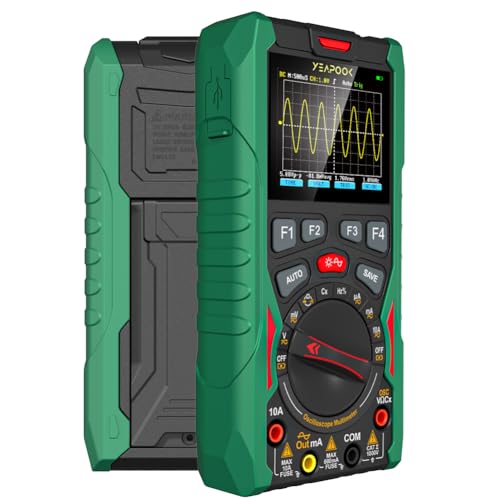
- 12 MHz scope, 6000-count multimeter, and signal generator
- Lightweight 250 g design with over eight hours of use
- Simple controls and automatic measurements for beginners
Best For: Basic repair, DIY testing, and introductory electronics work
Portable Touchscreen Pick
FNIRSI 1013D 100MHz Oscilloscope

- Two channels with 100MHz bandwidth and 1GSa/s sampling
- 7-inch touchscreen with cursor measurements
- Lissajous, FFT, and extensive waveform storage
Best For: Portable circuit testing and hands-on waveform analysis
Automotive Testing Pick
702S Handheld Oscilloscope Multimeter

- Combines a 10MHz oscilloscope with a 9,999-count multimeter
- Measures voltage, current, resistance, capacitance, frequency, and temperature
- Includes trigger modes, square-wave output, and USB data transfer
Best For: Automotive diagnostics and general electrical repair
All-in-One Analysis Pick
FNIRSI 2C53P 3-in-1 Oscilloscope

- Two channels, 50MHz bandwidth, and 250MS/s sampling
- Combines a 19,999-count multimeter with a DDS generator
- Supports 12 waveforms, X-Y mode, and FFT analysis
Best For: Multi-purpose electronics repair and circuit testing
Best Pocket Scope
FNIRSI DSO152 Handheld Oscilloscope

- 200 kHz bandwidth and 2.5 MS/s sampling
- One-key automatic waveform setup
- About four hours of battery operation
Best For: Portable maintenance, education, and basic waveform checks
Best All-in-One Tester
70MHz Dual-Channel Handheld Oscilloscope

- 70 MHz bandwidth and 200 MS/s sampling
- True RMS multimeter plus signal generator
- Stores waveform and multimeter records
Best For: Portable professional and hobbyist electrical testing
Best Value Multifunction Scope
HO-13 3-in-1 Handheld Oscilloscope

- 12 MHz bandwidth and 50 MS/s sampling
- True RMS multimeter and signal generator included
- 1,500 mAh battery with Type-C charging
Best For: DIY repairs, student labs, and general electronics debugging
Best Overall – RIGOL DS1202Z-E 200MHz Digital Oscilloscope
For demanding oscilloscopes for circuit testing, the RIGOL DS1202Z-E combines 200 MHz bandwidth, two analog channels, deep memory, and a fast waveform capture rate. It is well suited to bench work where capturing intermittent glitches, reviewing long recordings, and decoding common embedded buses matter.
Best For: Electronics debugging, embedded bring-up, education labs, and power testing.
Pros:
- 1 GSa/s real-time sampling with up to 24 Mpts standard memory.
- Up to 30,000 wfms/s capture rate helps expose intermittent events.
- Supports RS232/UART, I2C, and SPI triggering and decoding.
- USB, LAN, and AUX interfaces support bench integration and documentation.
Cons:
- Desktop design is less portable than the handheld options.
- Only two analog channels are provided.
The DS1202Z-E is the strongest choice here when capture depth, waveform visibility, and protocol troubleshooting are more important than compact size.
Best Multifunction Tool – FNIRSI 2C53T 3-in-1 Oscilloscope
The FNIRSI 2C53T is a practical choice for oscilloscopes for circuit testing when you also need a multimeter and signal generator. Its two-channel, 50 MHz oscilloscope includes automatic measurements, waveform storage, and a 50 kHz generator in a compact rechargeable package.
Best For: Automotive repair, electronics education, hobby projects, and general service work.
Pros:
- Combines a two-channel oscilloscope, 4.5-digit multimeter, and signal generator.
- Measures up to 400 V on the oscilloscope and includes built-in high-voltage protection.
- Offers math, cursor, persistence, XY mode, and automatic measurements.
- 3000 mAh battery and Type-C charging support portable use.
Cons:
- Its 1 Kpts record depth is modest for long waveform captures.
- 50 MHz bandwidth is lower than the RIGOL and 1013D Plus.
This model provides broad test capability in one handheld instrument, making it especially useful when carrying separate measurement tools is inconvenient.
Best Touchscreen Option – FNIRSI 1013D Plus 100MHz Oscilloscope
For oscilloscopes for circuit testing with a portable touchscreen interface, the FNIRSI 1013D Plus offers two channels, 100 MHz bandwidth, and a 1 GSa/s sampling rate. Its storage tools, cursor measurements, FFT view, and Lissajous display add useful ways to inspect and compare signals.
Best For: Portable waveform analysis, signal comparison, and electronics repair.
Pros:
- 7-inch, 800 × 480 capacitive touchscreen supports gesture operation.
- 1 GSa/s sampling rate and 100 MHz × 2 bandwidth handle a broad range of signals.
- 1 GB storage can hold up to 1000 screenshots and 1000 waveform sets.
- FFT and Lissajous views help assess harmonics, phase, and signal relationships.
Cons:
- Battery runtime is listed at approximately four hours.
- The supplied notes do not identify serial decoding or LAN connectivity.
The 1013D Plus stands out for its large touch display and signal-analysis features, balancing bench visibility with a thinner, battery-powered form.
Best Budget Handheld – YP101A 3-in-1 Digital Oscilloscope
The YP101A is a compact option for oscilloscopes for circuit testing when basic waveform checks, voltage measurements, and simple signal generation are the priority. It combines a 12 MHz oscilloscope with a 6000-count multimeter and generator, while its one-key controls suit beginners.
Best For: DIY electronics, home-appliance repair, car maintenance, and introductory training.
Pros:
- Three functions are combined in a small 250 g handheld instrument.
- One-key mode switching and automatic measurement simplify operation.
- 1500 mAh battery supports more than eight hours of continuous use.
- Stores 100 multimeter readings and 10 waveforms.
Cons:
- 12 MHz bandwidth and 50 MSa/s sampling limit higher-frequency testing.
- Waveform storage is limited to 10 records.
- Its compact design offers less display and analysis capability than larger models.
The YP101A is best viewed as an accessible service tool for low-bandwidth work rather than a replacement for a full-featured laboratory oscilloscope.
Portable Touchscreen Pick – FNIRSI 1013D 100MHz Oscilloscope
For buyers comparing oscilloscopes for circuit testing, the FNIRSI 1013D combines a 100MHz bandwidth, two channels, and a 1GSa/s sampling rate in a portable touchscreen design. Its built-in measurement tools, waveform storage, and battery operation make it practical for bench work and mobile troubleshooting.
Best For: Portable circuit testing, waveform comparison, and users who want touchscreen controls with built-in analysis features.
Pros:
- Two channels, 100MHz bandwidth, and 1GSa/s sampling rate.
- 7-inch touchscreen supports cursor measurements and gesture-based waveform navigation.
- Includes Lissajous display, FFT viewing, and storage for up to 1,000 screenshots and waveform sets.
- Built-in 6,000mAh battery provides about four hours of use.
Cons:
- At 2.16 pounds, it is less compact than smaller handheld instruments.
- The notes specify FFT as a rough estimate of harmonic content rather than a detailed spectrum-analysis system.
The FNIRSI 1013D is a strong fit when screen size and hands-on waveform inspection matter. Its two-channel layout and storage features are especially useful for comparing signals during circuit testing.
Automotive Testing Pick – 702S Handheld Oscilloscope Multimeter
The 702S is a practical choice among oscilloscopes for circuit testing when you also need full multimeter functions. Its handheld format combines a 10MHz oscilloscope with auto-ranging voltage, current, resistance, capacitance, frequency, temperature, diode, and continuity measurements.
Best For: Automotive diagnostics, electrical repair, and users who want oscilloscope and multimeter functions in one instrument.
Pros:
- Combines a two-mode oscilloscope and 9,999-count multimeter.
- Measures up to 750V AC, 999.9V DC, 9.999A, 99.99MΩ, and 9.999mF, with temperature testing up to 1,000°C.
- Includes automatic, normal, and single trigger modes plus one-key waveform capture.
- Offers a 4V/1kHz square-wave signal generator and USB charging/data transmission.
Cons:
- The 10MHz bandwidth and 48MS/s sampling rate are more limited than those of higher-bandwidth oscilloscopes.
- Its 2.8-inch display is smaller than the screens on the other listed models.
The 702S favors versatility over advanced oscilloscope performance. It makes sense for repair benches and automotive work where quickly switching between waveform checks and conventional electrical measurements is more valuable than wide bandwidth.
All-in-One Analysis Pick – FNIRSI 2C53P 3-in-1 Oscilloscope
For circuit testing that benefits from multiple tools, the FNIRSI 2C53P combines a two-channel, 50MHz oscilloscope with a 19,999-count multimeter and DDS signal generator. Its 250MS/s sampling rate, touchscreen interface, X-Y mode, and FFT analysis support both routine measurements and more involved signal checks.
Best For: Electronics repair and circuit testing where waveform capture, multimeter readings, and signal generation are needed in one handheld device.
Pros:
- Two-channel oscilloscope offers 50MHz bandwidth and 250MS/s sampling.
- Integrated 19,999-count multimeter displays five measurement values with maximum and minimum readings.
- DDS generator supports 12 waveforms with output up to 10MHz.
- Includes X-Y mode, FFT spectrum analysis, automatic/normal/single triggering, and about four hours of battery life.
Cons:
- The 4.3-inch screen is smaller than the FNIRSI 1013D’s 7-inch display.
- The supplied notes do not specify the exact ranges for the multimeter functions.
The 2C53P is the most feature-dense option in this group. Its signal generator and multimeter reduce the need for separate equipment, while the two-channel oscilloscope and analysis modes cover a broad range of circuit-testing tasks.
Best Pocket Scope – FNIRSI DSO152 Handheld Oscilloscope
For basic oscilloscopes for circuit testing, the FNIRSI DSO152 emphasizes portability and straightforward waveform checks. Its 200 kHz bandwidth, 2.5 MS/s real-time sampling, automatic setup, and trigger modes make it practical for maintenance, education, and quick field diagnostics.
Best For: Portable troubleshooting, automotive maintenance, education, and simple analog or digital waveform checks.
Pros:
- Compact, lightweight assembled design with a 2.8-inch display.
- One-key AUTO setup simplifies waveform capture and measurement.
- Includes Auto, Normal, and Single trigger modes.
- Built-in 1,000 mAh battery provides about four hours of use.
Cons:
- Its 200 kHz bandwidth and 2.5 MS/s sampling rate are suited to lower-frequency work rather than demanding high-speed analysis.
- The small 320 × 240 display may provide less viewing space than a benchtop scope.
The DSO152 is a sensible choice when convenience and easy operation matter more than advanced bandwidth. Verify that its measurement range and probe rating match your circuit before testing.
Best All-in-One Tester – 70MHz Dual-Channel Handheld Oscilloscope
For oscilloscopes for circuit testing that also handle broader electrical measurements, this 3-in-1 handheld combines a dual-channel oscilloscope, True RMS multimeter, and signal generator. Its 70 MHz bandwidth, 200 MS/s sampling, data storage, and safety features support more demanding bench and field work.
Best For: Technicians and hobbyists who want waveform testing, electrical measurements, and signal generation in one portable instrument.
Pros:
- Dual-channel 70 MHz scope with 200 MS/s sampling.
- 20,000-count True RMS multimeter covers voltage, current, resistance, capacitance, frequency, diode, and continuity tests.
- Built-in adjustable sine, triangle, and square-wave generator.
- Stores up to 1,000 multimeter records and 200 waveform records.
Cons:
- The replaceable 18650 battery provides about four hours of continuous use.
- Its compact display is convenient for portability but smaller than many dedicated benchtop scopes.
This is the most capable multifunction option of the group for users who value versatility and measurement documentation. Its IEC 1010-1 specification, CAT II 1000 V rating, and fuse protection add useful safeguards, but circuits should still be tested within the stated limits.
Best Value Multifunction Scope – HO-13 3-in-1 Handheld Oscilloscope
The HO-13 is a practical entry-level choice among oscilloscopes for circuit testing, combining a single-channel scope with a True RMS multimeter and signal generator. Its 12 MHz bandwidth and 50 MS/s sampling suit audio circuits, sensor outputs, microcontroller signals, and power-supply waveform checks.
Best For: Students, DIY electronics users, and technicians performing general circuit debugging and repair.
Pros:
- Combines oscilloscope, multimeter, and signal generator functions.
- 50 MS/s sampling and 12 MHz bandwidth cover many mid- to low-frequency tasks.
- True RMS measurements include voltage up to 1,000 V and current up to 10 A.
- Generator produces sine, square, and triangle waves from 100 Hz to 100 kHz.
Cons:
- Its single-channel design is less suitable for comparing multiple signals simultaneously.
- The 12 MHz bandwidth is more limited than higher-bandwidth multifunction models.
With a 1,500 mAh rechargeable battery, Type-C charging, and a compact color display, the HO-13 offers a convenient toolset for everyday electronics work. Choose a higher-bandwidth scope if your circuits contain faster signals or require more advanced analysis.
How We Picked These Oscilloscopes for Circuit Testing
We grouped the selected instruments by the features that matter during real circuit work: bandwidth, sampling rate, channel count, display usability, portability, measurement functions, and integrated tools. The list includes traditional two-channel digital oscilloscopes as well as compact models that combine an oscilloscope with a multimeter and signal generator.
Because these products serve different users, specifications should be viewed in context. A 200MHz bench scope is suited to faster digital and analog signals, while a 10MHz or 12MHz handheld may be more practical for automotive diagnostics, low-frequency control circuits, or field service.
Quick Comparison
| Use case | Features to prioritize | Best-fit type |
|---|---|---|
| Bench electronics and development | Higher bandwidth, two channels, faster sampling | RIGOL or 100MHz FNIRSI bench-style models |
| Portable troubleshooting | Battery operation, compact design, clear screen | Handheld digital oscilloscope |
| Automotive work | Multimeter functions, True RMS, portability | Automotive oscilloscope-multimeter combo |
| General hobby use | Simple controls, adequate bandwidth, low cost | Entry-level 12MHz to 50MHz model |
| Low-frequency inspection | Basic waveform viewing and easy setup | Compact DSO such as the DSO152 |
Key Buying Factors for Oscilloscopes for Circuit Testing
Bandwidth and Sampling Rate
Bandwidth determines the highest frequency range the scope can display accurately, while sampling rate affects how precisely it reconstructs the waveform. Choose a scope with comfortable headroom above the signals you expect to measure; a scope operating at its limit can hide fast edges and distortion.
Channels and Probing
Two channels are useful for comparing input and output signals, checking timing, or observing a control signal alongside a supply rail. Also verify probe quality, attenuation settings, grounding options, and whether the included probes match the instrument’s input specifications.
Measurements and Integrated Tools
Automatic measurements can speed up checks of frequency, period, amplitude, and duty cycle. Combo units add multimeter and signal-generator functions, which can reduce the amount of equipment needed for field work, but they may offer a smaller display or fewer advanced controls than a dedicated bench scope.
Display, Controls, and Portability
A larger screen and direct controls generally make waveform analysis faster. Touchscreen handhelds are convenient in tight spaces, while traditional front-panel controls may be preferable for repeated bench measurements. Consider battery life, weight, storage, and input protection if you will work away from a bench.
Who Should Buy Which Oscilloscopes for Circuit Testing?
Choose a higher-bandwidth bench scope if you design or repair digital electronics, switching supplies, embedded systems, or faster analog circuits. Choose a multifunction handheld if portability and having a multimeter or signal generator in the same device matter most. Choose an automotive-focused model for vehicle sensors, actuators, charging systems, and mobile diagnostics. Choose an entry-level compact scope for education, basic hobby projects, and low-frequency signal checks.
Before ordering, confirm the actual bandwidth, sampling rate, input limits, included accessories, software support, and warranty. The best oscilloscope is the one that provides enough performance for your signals without sacrificing the controls and portability your testing routine requires.