
Choosing among oscilloscope kits for beginners is easier when you focus on how you plan to learn: hands-on assembly, portable troubleshooting, or a more capable bench setup.
The best starter kit should match your comfort level, test needs, and budget without adding confusing features you will not use yet.
Best 10 Oscilloscope Kits for Beginners Picks for 2026
Portable Pocket Option
FNIRSI DSO152 Handheld Oscilloscope

- Assembled finished machine with no soldering required
- One-key AUTO and full trigger modes simplify setup
- 2.5 MS/s sampling, 200 KHz bandwidth, built-in battery
Best For: Beginners who want a portable, ready-to-use scope
Learning Demo Kit
Velleman EDU06-VP Oscilloscope Tutor Kit

- Assembled and tested, with no soldering required
- Demonstrates AC, DC ripple, rectified AC, and oscillator signals
- Compact tutor-style design for learning basics
Best For: New learners who want a simple waveform tutor
All-in-One Upgrade
FNIRSI 2C53T 3-in-1 Handheld Scope

- Scope, multimeter, and DDS generator in one device
- 50 MHz bandwidth with 250 MSa/s sampling
- Cursor, persistence, XY mode, and save features
Best For: Beginners who want a versatile all-in-one tester
Hands-On Build Choice
DSO 138 Open Source Oscilloscope Kit

- Pre-soldered boards with case assembly still required
- Open-source platform supports experimentation and learning
- Includes trigger modes, HOLD, and waveform storage
Best For: Beginners who like partially built DIY learning kits
Economy Bench Pick

- 100MHz bandwidth with 2 channels
- 1GSa/s sampling and 8M memory depth
- 14 trigger modes with serial decode support
Best For: Beginners wanting an affordable bench scope with advanced features
DIY Starter Kit
DSO 138 Pocket Oscilloscope Kit

- Assembled DIY-friendly pocket oscilloscope
- 2.4-inch TFT display with basic measurement readouts
- 1Hz/3.3V test source and open-source appeal
Best For: Beginners who want a compact, hands-on learning kit
Premium Lab Upgrade

- 200MHz scope with 2 channels and 1GSa/s
- 24 Mpts memory and 30,000 wfms/s capture
- UART, I2C, SPI decode plus LAN connectivity
Best For: Beginners seeking a future-ready bench scope for lab work
DIY Learning Kit
DSO 138 Pocket Oscilloscope Kit

- DIY assembly teaches oscilloscope basics.
- 2.4-inch color TFT display for waveform viewing.
- Works for low-frequency audio and power-supply signals.
Best For: Students and beginners who want a hands-on learning kit
Feature-Rich Bench Pick
Hantek DSO2D15 Digital Storage Oscilloscope

- 150MHz bandwidth and 1GSa/s sampling.
- Built-in 25MHz waveform generator included.
- 7-inch display with measurements and protocol analysis.
Best For: Beginners who want a capable bench scope with growth room
Upgrade DIY Kit
Dorhea DSO 150 Digital Oscilloscope Kit
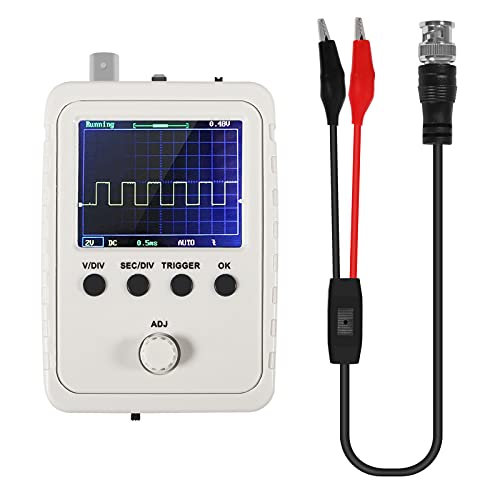
- Color 2.4-inch TFT LCD with encoder navigation.
- Auto, normal, and single trigger modes.
- Waveform storage and hold functions included.
Best For: Beginners who want a compact DIY scope with added convenience
Portable Pocket Option – FNIRSI DSO152 Handheld Oscilloscope
If you want oscilloscope kits for beginners that skip the soldering step, the FNIRSI DSO152 is an easy place to start. It arrives assembled, includes one-key AUTO setup, and pairs a 2.8-inch color display with a 2.5 MS/s sampling rate for quick basic waveform checks.
Best For: Beginners who want a ready-to-use handheld scope for portable troubleshooting and learning.
Pros:
- Assembled finished machine, so there is no welding or assembly to deal with
- One-key AUTO helps display waveforms without cumbersome manual setup
- Full trigger modes: Auto, Normal, and Single
- Built-in 1000 mAh battery and Type-C charging for portable use
Cons:
- 200 KHz bandwidth is suited to basic and mid-level signal work, not advanced high-frequency use
- Single-channel handheld design is more limited than bench-style options
- Smaller 2.8-inch screen may feel cramped for extended analysis
For a beginner-friendly handheld scope, the DSO152 focuses on convenience first. It is practical for maintenance and education use, especially if you value portability and want to get measuring quickly.
Learning Demo Kit – Velleman EDU06-VP Oscilloscope Tutor Kit
Velleman EDU06-VP Oscilloscope Tutor Kit, 9-12VAC, 100mA, 4.6" x 2.9" x 0.9" Size
Check Price On AmazonThe Velleman EDU06-VP is one of the simplest oscilloscope kits for beginners if your goal is to learn what common signals look like. It is assembled and tested already, and it demonstrates AC, rectified AC, smoothed DC, ripple, and astable oscillator signals in a compact tutor format.
Best For: New learners who want a hands-on signal tutor without soldering.
Pros:
- Assembled and tested, so no soldering is required
- Shows a useful range of instructional signals, including AC, DC ripple, and oscillator output
- Compact size makes it easy to use as a learning tool
Cons:
- Focused on tutoring rather than broad measurement features
- Requires 9-12VAC power and 100mA, so it is not battery portable
- Limited details suggest it is less flexible than full-featured scopes
This kit is best thought of as a learning aid rather than a general-purpose oscilloscope. If you want a simple visual guide to basic waveform behavior, it does that job well.
All-in-One Upgrade – FNIRSI 2C53T 3-in-1 Handheld Scope
If you want oscilloscope kits for beginners that can grow with you, the FNIRSI 2C53T combines a scope, multimeter, and DDS signal generator in one handheld unit. It adds features like cursor measurement, persistence mode, XY mode, and one-click save, making it useful for learning both signal behavior and basic electrical testing.
Best For: Beginners who want a versatile handheld tester that covers scope, meter, and generator functions.
Pros:
- 3-in-1 design combines oscilloscope, multimeter, and signal generator
- 50 MHz bandwidth and 250 MSa/s sampling rate provide stronger measurement capability than basic entry models
- Added tools like math, cursor measurement, persistence mode, and XY mode support learning
- Built-in 3000 mAh battery and Type-C charging improve portability
Cons:
- More functions mean a steeper learning curve for absolute beginners
- Smaller 1 Kpts record depth limits some deeper waveform capture use cases
- Handheld format may be less comfortable than a larger bench unit for long sessions
The 2C53T stands out if you want one device that can handle more than basic scope work. It is a practical step-up choice for hobbyists, students, and school labs that need versatility in a small package.
Hands-On Build Choice – DSO 138 Open Source Oscilloscope Kit
The DSO 138 is a classic pick among oscilloscope kits for beginners who want to learn by assembling part of the system and exploring the hardware. The circuit boards are pre-soldered, the case needs assembly, and the kit includes a 2.4-inch TFT display, a 1 Hz/3.3 V square wave source, and simple trigger modes for basic waveform capture.
Best For: Beginners who want a partially built open-source kit and a more hands-on learning experience.
Pros:
- Pre-soldered boards reduce build difficulty while still leaving some assembly to do
- Includes useful learning features like HOLD, trigger modes, and waveform storage
- Shows waveform parameters such as frequency, period, duty ratio, and peak-to-peak values
- Open-source design can support experimentation and development on the hardware
Cons:
- The case is unassembled, so some physical build work is still required
- 1 Msps sampling is modest compared with higher-end handheld scopes
- More hobbyist-oriented than polished plug-and-play alternatives
This kit is appealing if you want a beginner scope that also teaches hardware familiarity. It is less convenient than a fully assembled unit, but more rewarding if you enjoy tinkering and learning how the platform works.
Economy Bench Pick – Hantek DSO2C10 100MHz 2CH
If you’re comparing oscilloscope kits for beginners and want a more capable bench instrument than a bare-bones starter board, the Hantek DSO2C10 is a practical step up. It offers 100MHz bandwidth, 2 channels, 1GSa/s sampling, and 8M memory depth, making it a useful budget-friendly option for learning core measurement tasks while still handling a wide range of debug work.
Best For: Beginners who want an affordable bench oscilloscope with extra trigger and decode features for learning and lab use.
Pros:
- 100MHz bandwidth with 2-channel input and 1GSa/s sampling
- 8M memory depth for capturing longer signals
- Includes 14 trigger modes plus serial protocol trigger/decoding support
- Also supports arbitrary waveform output for added flexibility
Cons:
- More of a bench oscilloscope than a true DIY learning kit
- Heavier and larger than pocket-size beginner boards
For a beginner who wants an economical oscilloscope that still has room to grow into more serious electronics work, this Hantek model is the most feature-rich of the lower-cost options here. Its broad trigger and decode support makes it especially useful if you expect to work with embedded or serial signals.
DIY Starter Kit – DSO 138 Pocket Oscilloscope Kit
Among oscilloscope kits for beginners, the DSO 138 stands out as a compact DIY-friendly choice that is already assembled and ready to use. It includes a 2.4-inch TFT display, automatic/regular/one-shot modes, a 1Hz/3.3V square-wave test source, and basic waveform measurement readouts, so it works well as a hands-on learning tool for simple signal observation.
Best For: Beginners who want a pocket-size learning oscilloscope with DIY and open-source appeal.
Pros:
- Assembled and ready to use, with DIY parts and probe included
- 2.4-inch color TFT display in a pocket-size form factor
- Automatic, regular, and one-shot modes for simple captures
- Waveform readouts include frequency, period, duty ratio, and peak-to-peak values
Cons:
- 1MSPS sampling is modest compared with full bench scopes
- Best suited to basic learning and signal checking rather than advanced debugging
If your priority is a small, approachable project-style oscilloscope rather than a high-end lab tool, the DSO 138 fits that beginner niche well. The open-source and expandable nature also makes it appealing if you want to tinker while you learn.
Premium Lab Upgrade – RIGOL DS1202Z-E 200MHz 2CH
If you’re shopping oscilloscope kits for beginners but want a model that can also support more serious lab work later, the RIGOL DS1202Z-E is a strong upgrade pick. It combines 200MHz bandwidth, 1GSa/s sampling, 24 Mpts deep memory, and a 7-inch intensity display, giving learners a clearer view of fast events and longer captures as their projects get more advanced.
Best For: Beginners who want a future-proof bench oscilloscope for education, debugging, and embedded work.
Pros:
- 200MHz bandwidth with 2 channels and up to 1GSa/s sampling
- Deep memory up to 24 Mpts for longer captures
- 30,000 wfms/s capture rate helps reveal intermittent glitches
- Serial decode support for UART, I2C, and SPI plus LAN connectivity
Cons:
- More advanced and likely more than a casual beginner needs
- Larger bench unit rather than a simple pocket learning device
This RIGOL model makes sense when you want beginner-friendly fundamentals but don’t want to outgrow the instrument quickly. Its deep memory, fast capture rate, and serial decoding are especially useful for electronics labs and embedded troubleshooting.
DIY Learning Kit – DSO 138 Pocket Oscilloscope Kit
If you want oscilloscope kits for beginners that focus on hands-on learning, the DSO 138 is a compact DIY option built around assembly and fundamentals. It uses an ARM Cortex-M3 processor, a 2.4-inch color TFT display, and is meant to help users observe low-frequency signals in scenarios like audio, video sync, switching power supplies, and infrared work.
Best For: Students and beginners who want an assembly-first kit for learning oscilloscope structure and basic signal observation.
Pros:
- DIY kit helps students understand oscilloscope structure and principles.
- 2.4-inch color TFT display for basic waveform viewing.
- Useful for low-frequency signal checking in audio, video, and switching power supply applications.
- Can be adapted for secondary projects like a millivoltmeter or data recorder.
Cons:
- Requires self-assembly.
- Positioned as a learning kit rather than a higher-end bench scope.
Overall, this is a strong pick if your goal is to learn by building rather than just measuring. It is more educational than polished, which is exactly what many first-time buyers need from a beginner oscilloscope kit.
Feature-Rich Bench Pick – Hantek DSO2D15 Digital Storage Oscilloscope
Hantek DSO2D15 Digital Storage Oscilloscope 150MHz 1GSa/s 8M,2 Channel,2CH+1CH with Signal Source
Check Price On AmazonFor buyers comparing oscilloscope kits for beginners with room to grow, the Hantek DSO2D15 is a much more advanced bench oscilloscope. It offers 150MHz bandwidth, 1GSa/s sampling, 8M memory depth, two channels, and a built-in 25MHz waveform generator, so it covers far more than a starter DIY kit.
Best For: Beginners who want a capable bench oscilloscope with advanced features and extra measurement tools.
Pros:
- 150MHz bandwidth and 1GSa/s sampling for higher-performance measurement work.
- Built-in 25MHz waveform generator with arbitrary and burst output support.
- Includes auto measurements, protocol analysis, and data saving options.
- 7-inch TFT display makes readings and menus easy to view.
Cons:
- More complex than a basic beginner DIY kit.
- Bulkier and heavier than pocket-style learning scopes.
This is not the simplest entry point, but it is the most feature-packed option in the group. If you want a beginner-friendly scope that can still support more serious bench work later, this model is a practical step up.
Upgrade DIY Kit – Dorhea DSO 150 Digital Oscilloscope Kit
If you are comparing oscilloscope kits for beginners and want a more polished DIY experience, the Dorhea DSO 150 is an upgraded take on the popular DSO138 style kit. It includes a 2.4-inch color TFT LCD, optical encoder navigation, trigger modes, waveform storage, and detailed readouts such as frequency, duty ratio, and peak-to-peak values.
Best For: Beginners who want a compact assembled DIY scope with extra convenience features.
Pros:
- Upgrade to the DSO138-style kit with a color TFT display.
- Auto, normal, and single trigger modes help capture waveforms more easily.
- Displays several waveform parameters, including frequency and duty ratio.
- Waveform storage and hold functions add useful convenience.
Cons:
- Requires a 9V DC power charger, which is not included.
- Still a DIY-style kit, so it is less plug-and-play than a finished bench scope.
For beginners who want a kit with more usability than the most basic entry-level builds, this model strikes a good balance. It keeps the learning aspect while adding features that make everyday capture and review easier.
How We Picked These Oscilloscope Kits for Beginners
We focused on beginner-friendly designs that balance ease of use, learning value, and practical measurement capability. That means clear displays, approachable controls, useful bandwidth for entry-level electronics, and options that make sense for students, hobbyists, and first-time repair users. We also considered whether a kit is truly educational, portable, or more suitable as a first serious bench instrument.
Quick Comparison
For hands-on learning, DIY and tutor-style kits are ideal because they teach assembly and basic signal tracing. For everyday troubleshooting, handheld models are easier to carry and use around the house, workshop, or field. If you expect to grow into more advanced projects, a bench oscilloscope with higher bandwidth, dual channels, and deeper memory is the better long-term choice. In short, Oscilloscope Kits for Beginners range from simple training builds to more capable instruments that can stay useful as your skills improve.
Key Buying Factors for Oscilloscope Kits for Beginners
Bandwidth and Sample Rate
Choose bandwidth based on what you will measure most often. Simple audio, Arduino, and low-speed sensor work do not need much bandwidth, while switching power supplies and faster digital signals benefit from a faster scope. A higher sample rate helps preserve waveform detail and reduces the chance of missing events.
Channels and Memory Depth
Two channels are usually the sweet spot for beginners because they let you compare input and output signals or track timing relationships. Deeper memory is helpful when you want to capture more of a waveform at higher resolution, especially for sporadic faults.
Display, Portability, and Controls
A readable screen and simple menu layout matter more than flashy specs for first-time users. Handheld units are convenient for field checks and small benches, while larger bench models are easier to read during longer sessions.
Kit Style and Learning Value
If you want to learn soldering and circuit basics, a DIY kit can be a great starting point. If you want immediate troubleshooting, a fully assembled unit is less frustrating and faster to put into service.
Who Should Buy Which Oscilloscope Kits for Beginners?
Buy a DIY training kit if you want the build process to be part of the learning experience. Choose a handheld oscilloscope if portability and quick diagnostics matter most. Go with a bench model if you want the best balance of accuracy, dual-channel testing, and room to grow. Among Oscilloscope Kits for Beginners, the right choice is the one that fits your projects today and still feels useful as you take on more complex work tomorrow.