
When it comes to enhancing your educational experience, the right optical spectroscope can make a significant difference. These tools not only provide hands-on learning but also foster a deeper understanding of light and its properties. With various options available, from premium models to economical classroom packs, you’re bound to find one that fits your needs. Let’s explore the top choices that can transform your approach to science.
EISCO Premium Quantitative Spectroscope (400-700nm Range)

The EISCO Premium Quantitative Spectroscope is an excellent choice for educators and students alike, especially those delving into the domains of light and color analysis. Measuring wavelengths from 400 to 700nm with an accuracy of +/- 5.0nm, it’s perfect for studying light sources and analyzing color spectra. You can explore charged gas tubes and conduct flame tests, making your scientific inquiries more engaging. Its innovative design secures the diffraction grating, ensuring clear readings. With a high-performance grating of 500 lines/mm, you’ll enjoy precise results that bolster your confidence in experiments involving light properties.
Best For: The EISCO Premium Quantitative Spectroscope is best for educators and students engaged in light and color analysis.
Pros:
- Provides accurate wavelength measurements from 400 to 700nm with a precision of +/- 5.0nm.
- Innovative design secures components for clear and reliable readings.
- High-performance diffraction grating (500 lines/mm) enhances measurement detail and accuracy.
Cons:
- May require some initial training to effectively use the spectroscope.
- Limited to a wavelength range of 400-700nm, which excludes ultraviolet and infrared light analysis.
- Not designed for high-intensity light sources, which could affect measurement reliability.
EISCO Economy Spectroscope Tube Pack of 6 for Classroom Optics

Perfect for classroom settings, the EISCO Economy Spectroscope Tube Pack of 6 lets students explore light spectrum analysis and diffraction studies. Each spectroscope measures 10.25 inches long, making them easy to handle and perfect for group activities. These tools provide a hands-on introduction to optics, allowing you to analyze visible light spectra and understand optical properties. With a built-in diffraction grating, you can break light into its constituent wavelengths. Plus, the adjustable slit cap lets you control diffraction patterns for precise results. This pack encourages collaborative learning, making your classroom experience both engaging and educational.
Best For: Students and educators looking for hands-on tools to explore optics and light spectrum analysis in a classroom setting.
Pros:
- Encourages collaborative learning with a pack of 6 spectroscopes.
- Features a built-in diffraction grating for effective spectrum analysis.
- Adjustable slit cap allows for precise control over diffraction patterns.
Cons:
- May not be suitable for advanced optical studies.
- Limited to visible light spectra analysis only.
- Durability may be a concern with frequent classroom use.
Gem Spectroscope with Adjustable Focus for Gemstone Identification

For anyone passionate about gemology, the Gem Spectroscope with Adjustable Focus stands out as an essential tool for gemstone identification. This compact and lightweight device, measuring just 1.8 x 1.8 x 7.6 cm and weighing 0.04 kg, is perfect for on-the-go analysis. Its adjustable focus allows you to accurately examine gems of various sizes, making it suitable for both professionals and hobbyists alike. Crafted from durable optical glass and powder-coated aluminum, this spectroscope guarantees longevity. With its high-quality prism beam splitter, you’ll achieve precise and clear readings, enhancing your learning experience at gemological tests, antique fairs, or educational settings.
Best For: Gem enthusiasts, professionals, and students seeking a reliable tool for gemstone identification.
Pros:
- Adjustable focus allows for precise analysis of various gem sizes.
- Lightweight and compact design makes it highly portable for field use.
- Durable materials ensure longevity, suitable for both lab and field applications.
Cons:
- Limited to gemstone analysis and may not serve other optical needs.
- Requires some practice to master the use of the spectroscope effectively.
- The small size may make it easy to misplace or lose during fieldwork.
Prism Spectroscope for Gemstone Identification

Gemstone enthusiasts and professionals alike will appreciate the precision of the Prism Spectroscope, which features an adjustable focus designed for meticulous gem analysis. With a range of 400-700nm, its optical glass prism delivers reliable spectral readings, ensuring you can confidently identify gemstones. The precision-engineered beam splitter and high-quality optics enhance clarity, making it suitable for both educational and professional use. Its heavy-duty aluminum body guarantees durability, whether in a lab or field setting. Plus, its compact design (18 x 18 x 76mm, 40g) makes it easy to carry in your pocket or pouch, perfect for gemology education and appraisals.
Best For: Gemstone enthusiasts, professionals, and educators seeking a reliable tool for precise gemstone identification.
Pros:
- High-quality optics ensure clear and accurate spectral readings.
- Durable aluminum body makes it suitable for both laboratory and field use.
- Compact and lightweight design allows for easy portability.
Cons:
- Limited range of 400-700nm may not cover all gemstone types.
- Adjustable focus might require practice for optimal use.
- Professional-grade price may be a consideration for casual users.
Handheld Spectroscope Light Emission Spectroscopy Spectrum Hobby Kit

The Handheld Spectroscope Light Emission Spectroscopy Spectrum Hobby Kit is an excellent choice for hobbyists and students enthusiastic to explore the world of light analysis. This kit lets you analyze light spectra from various sources, including the Sun’s emission spectrum, right in your hands. With its optical glass construction and composite prism, you’ll easily generate a parallel light beam for effective analysis. It’s user-friendly, making it perfect for all skill levels, whether you’re conducting a science fair project or just experimenting for fun. Immerse yourself in hands-on learning and broaden your understanding of light with this economical, high-resolution tool!
Best For: Hobbyists, amateur scientists, and students looking to explore light analysis in a hands-on way.
Pros:
- User-Friendly: Designed for all skill levels, making it easy to operate for beginners and experienced users alike.
- High Resolution: Offers clear and detailed observations of light spectra for effective analysis.
- Versatile: Suitable for a wide range of light spectrum investigations, including various light sources like the Sun.
Cons:
- Limited Advanced Features: May not provide the advanced capabilities sought by professional scientists.
- Fragility: Optical glass construction can be delicate and may require careful handling.
- Requires Natural Light: Effectiveness may depend on the availability of adequate light sources for analysis.
EISCO Premium Quantitative Spectroscope – 400-700nm Range, 5nm Accuracy
With its impressive wavelength range of 400-700nm and an accuracy of +/- 5.0nm, the EISCO Premium Quantitative Spectroscope stands out as an ideal tool for students and educators in grades 9-14. This durable device securely holds the diffraction grating and scale, enhancing your readings. You’ll observe light through a slit, allowing for precise measurements of various light wavelengths. Whether you’re measuring spectra from charged gas tubes, conducting flame tests, or exploring basic astronomy, this spectroscope provides numeric wavelength data for in-depth analysis. At just 1.44 ounces, it’s lightweight and portable, making it perfect for classroom use.
Best For: The EISCO Premium Quantitative Spectroscope is best for students and educators in grades 9-14 who are exploring light measurements and spectroscopy.
Pros:
- Durable construction ensures longevity and reliable performance.
- Lightweight design (1.44 ounces) makes it easily portable for classroom use.
- Provides numeric wavelength data for detailed analysis across various applications.
Cons:
- Limited wavelength range (400-700nm) may not be suitable for all scientific applications.
- Accuracy of +/- 5.0nm may not meet the needs of advanced research.
- Target audience is specific to educational settings, limiting broader market appeal.
Eisco Labs Economy Spectroscope Tube, Pack of 24

For educators looking to enhance their science curriculum, the Eisco Labs Economy Spectroscope Tube offers a practical solution. This pack of 24 spectroscopes, each measuring 10.25 inches, is designed specifically for classroom use. You can easily introduce students to the properties of visible light and optics, allowing them to identify constituent wavelengths of light. The adjustable thin slit cap enables the creation of diffraction patterns, making learning interactive and engaging. With a lightweight design of just 1.43 pounds, it’s easy to manage. Enhance your lessons with these affordable, effective tools that spark curiosity in the world of light!
Best For: Educators seeking affordable tools to teach students about the properties of visible light and optics in a classroom setting.
Pros:
- Interactive Learning: Allows students to engage with light and optics through hands-on experiments.
- Affordable: Comes in a pack of 24, making it cost-effective for classroom use.
- Lightweight Design: Easy to handle and manage for both teachers and students.
Cons:
- Limited Advanced Features: May not offer advanced functionalities found in more expensive spectroscopes.
- Durability Concerns: Being an economy model, longevity might be a concern with frequent use.
- Basic Instructional Guidance: Lacks detailed instructional materials for complex experiments or concepts.
3B Scientific Diffraction Grating Spectroscope

Designed for educational settings, the 3B Scientific U19500 Diffraction Grating Spectroscope offers a high-quality optical system that makes exploring the visible spectrum engaging and accessible. With a diameter of 25mm and a length of 115mm, it’s compact yet powerful. The fixed slit prism system features a slit width of just 0.2 millimeters, ensuring precision in your observations. The grating, housed in a robust metal sleeve, enhances durability while maintaining a linear relationship with respect to wavelength. Whether you’re conducting experiments or demonstrations, this spectroscope provides a reliable tool to enhance your learning experience. Discover more product details for additional specifications!
Best For: Educational settings and students looking to explore the visible spectrum through a reliable and compact spectroscope.
Pros:
- High-quality optical system provides clear and precise observations of the visible spectrum.
- Compact design (25mm diameter x 115mm length) makes it easy to handle and transport.
- Durable metal sleeve protects the grating and ensures longevity of the instrument.
Cons:
- Fixed slit width of 0.2 millimeters may limit versatility in certain experiments.
- Limited to visible spectrum observations, which may not meet all research needs.
- Additional specifications may require further research to fully understand all features.
Handheld Diffraction Spectroscope, Pocket-Sized Gemological Spectrometer
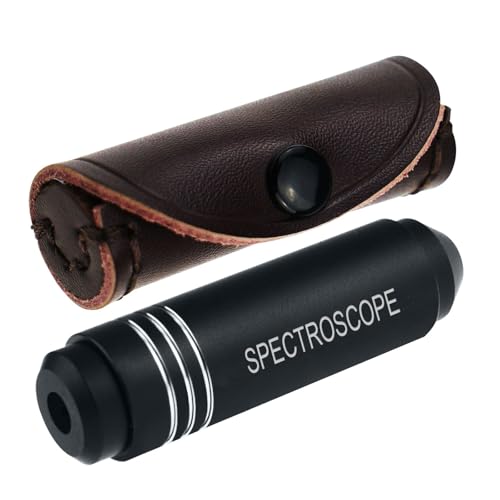
The Handheld Diffraction Spectroscope is an ideal tool for aspiring gemologists and enthusiasts who need a reliable, portable solution for quickly identifying gemstones. Its compact design, measuring just 2.17 inches, easily fits in your pocket, making it perfect for gem markets or trade shows. Crafted from durable aircraft aluminum, it’s built to last. Featuring high-quality grating, this spectroscope helps you confidently identify gemstones, including diamond stimulants like YAG and Cubic Zirconia. With its user-friendly display showing absorbed wavelengths as vertical lines, you’ll enhance your gemological skills effortlessly. Experience the convenience and empowerment this pocket-sized gemological spectrometer offers.
Best For: Aspiring gemologists and enthusiasts seeking a reliable, portable tool for quick gemstone identification.
Pros:
- Compact design allows for easy portability, fitting comfortably in pockets or bags.
- Durable construction from aircraft aluminum ensures longevity and resistance to wear and tear.
- User-friendly display simplifies the identification process with clear visual representation of absorbed wavelengths.
Cons:
- Battery-powered functionality may require occasional battery replacements.
- Limited to identifying gemstones and may not cater to other scientific applications.
- Customer reviews indicate varying levels of user experience and satisfaction.
Spectroscope Focusing Spectrometer Handheld for Gem Testing

Gem enthusiasts and professionals alike will appreciate the Spectroscope Focusing Spectrometer Handheld for its adjustable focus and wide 400-700nm range. This tool’s heavy-duty aluminum housing guarantees durability for both laboratory and field use. With optical glass prisms, you’ll experience stable performance during gem testing. Its compact and lightweight design makes it easy to carry, so you can take it anywhere you need. The built-in high-quality grating allows for accurate measurements, making it perfect for identifying gemstones and jewelry. Whether you’re a hobbyist or a professional, this spectrometer is an essential addition to your toolkit.
Best For: Gemstone enthusiasts and professionals who require a reliable and portable tool for gem testing and identification.
Pros:
- Durable heavy-duty aluminum housing suitable for both laboratory and field applications.
- Compact and lightweight design ensures portability and ease of use.
- Adjustable focal length and high-quality grating provide accurate measurements for gem identification.
Cons:
- Limited to a specific wavelength range of 400-700nm, which may not cover all gem types.
- Requires some familiarity with optical instruments for optimal use.
- May be less effective in poorly lit environments without additional light sources.
Factors to Consider When Choosing Optical Spectroscopes for Education
When you’re selecting optical spectroscopes for education, several key factors come into play. You’ll want to take into account the measurement range, durability, and ease of use to guarantee they fit your classroom needs. Additionally, think about how well they support group learning and the quality of optics for accurate results.
Measurement Range Importance
Choosing the right optical spectroscope hinges on understanding its measurement range, as this determines the wavelengths of light you can analyze. A spectroscope that spans 400 to 700 nm effectively covers the visible light spectrum, allowing you to investigate light’s colors and their properties. However, if you want to explore beyond visible light, a wider measurement range is vital. This enables you to study ultraviolet to infrared light sources, enhancing your grasp of light behavior. Don’t forget accuracy within that range; a precision of +/- 5.0 nm is essential for collecting reliable data during experiments. Ultimately, selecting a spectroscope with the appropriate measurement range aligns your educational goals with the specific scientific inquiries you’re pursuing.
Durability for Classroom Use
Durability is a key factor in selecting optical spectroscopes for classroom use, as these instruments endure frequent handling by students. You’ll want to prioritize models with heavy-duty aluminum construction, which resists impacts and guarantees longevity. A lightweight design is also essential, making it easier for students to transport spectroscopes between different learning environments without compromising their structural integrity. Look for components made from optical glass, as they enhance clarity and performance while being resilient to scratches and damage. Additionally, consider spectroscopes with reinforced housing or protective features that safeguard the internal optical elements from accidental drops or mishandling during experiments. Choosing a durable model will help maintain functionality and extend the lifespan of the instrument, securing a better learning experience.
Ease of Use
Optical spectroscopes should be easy to use, especially in an educational setting where students need to quickly grasp concepts. Look for models with simple assembly and operation that allow students to immerse themselves in learning without complications. User-friendly designs with adjustable slit caps and focus mechanisms make it easy to tweak settings for peak results. Lightweight and portable spectroscopes encourage hands-on experiments in various environments, making them accessible for all skill levels. Additionally, verify the readings are clear and legible so students can accurately interpret their data during experiments. By prioritizing ease of use, you’ll foster an engaging atmosphere that enhances understanding of optical principles and encourages curiosity among students.
Group Learning Capabilities
When considering optical spectroscopes for educational settings, it is essential to prioritize their group learning capabilities. Opting for packs designed for classroom use allows you and your students to engage in hands-on experiments simultaneously, fostering collaboration. Look for spectroscopes with adjustable features like slit caps, enabling experimentation with different diffraction patterns and wavelengths as a group. The design and size should facilitate easy handling, making group activities smooth and effective. Choose models that are simple to operate; this encourages participation from all group members, regardless of their skill levels. Incorporating spectroscopes into group projects enhances peer learning, allowing students to share findings and insights, ultimately deepening their understanding of light and optics.
Optical Quality and Accuracy
Engaging in group learning with optical spectroscopes isn’t just about collaboration; it also hinges on the quality and accuracy of the instruments being used. When choosing a spectroscope, focus on precision-engineered components like diffraction gratings and prisms, as these directly impact the clarity of your spectral readings. Look for accuracy specifications around +/- 5.0 nm, which is standard for educational models. High-quality optics minimize distortions and enhance light spectrum resolution, vital for effective learning. Guarantee the wavelength range spans from 400 to 700 nm to analyze visible light properly. Finally, consider the construction materials and design, as these factors determine the spectroscope’s durability and performance in classrooms and field studies, making sure it stands up to frequent use.