
The right laser engraver can turn jewelry customization into a faster, more consistent, and more profitable process. However, metal marking performance varies widely between fiber, infrared, diode, and dual-laser machines.
This roundup compares 10 selected models for engraving names, dates, logos, patterns, and other designs on jewelry and related materials. Use the buying guide below to match power, workspace, portability, and software features to your projects.
Best 10 Laser Engraver for Jewelry Picks for 2026
Best for Mobile Jewelry Customization

- Dual 20W fiber and diode lasers
- Engraves metals and craft materials
- Portable design for on-site personalization
Best For: Mobile sellers and versatile craft studios
Best Compact Metal Marker

- 1064nm infrared metal marking
- Standalone touchscreen operation
- Compact desktop footprint
Best For: Small studios and gift personalization
Best for High-Volume Production

- 20W fiber and diode laser system
- Camera-assisted batch personalization
- Enclosed design with safety features
Best For: Commercial shops and retail production
Best for Countertop Personalization

- Built-in touchscreen design tools
- 1064nm marking for suitable metals
- Lightweight 3kg portable format
Best For: Gift shops and customer-facing counters
Professional Metal Marking Pick

- 20W fiber source for detailed metal marking
- Two lenses: 110×110mm and 200×200mm
- Supports LightBurn, EzCad2, and rotary work
Best For: Jewelry makers and businesses engraving gold, silver, and other metals
Beginner-Friendly Vision Bundle

- Smart camera helps position designs accurately
- Engraves metal and glass; cuts wood and acrylic
- Includes enclosure, honeycomb bed, and starter materials
Best For: Beginners and hobbyists wanting a versatile enclosed machine
Portable Dual-Laser Pick
- 5W IR plus 15W diode laser versatility
- 50MP camera with up to 0.1mm alignment accuracy
- Up to 6000mm/s for small-batch personalization
Best For: Portable jewelry personalization and on-site customization
Portable Pick

- Portable handheld design with roller included
- 0.05 mm spot and three resolution options
- Limited to coated and brushed metals, not pure metal
Best For: Portable engraving on coated metal, wood, leather, and cylindrical items
Metal-Marketing Choice

- Combines 7W blue and 1.2W infrared lasers
- Infrared laser marks bare metals and jewelry
- Enclosed Class 1 design with HD camera
Best For: Jewelry makers needing bare-metal marking plus broader material support
Large-Workspace Option

- 300-by-300 mm area for batches and larger layouts
- 20,000 mm/min maximum engraving speed
- Enclosed design with multiple safety features
Best For: Batch production and larger mixed-material craft projects
Best for Mobile Jewelry Customization – LaserPecker LP5
The LaserPecker LP5 is a strong laser engraver for jewelry makers who also work with wood, leather, acrylic, and other craft materials. Its dual 20W fiber and diode lasers support detailed metal engraving, faster production, and portable use at markets, craft fairs, or retail kiosks.
Best For: Mobile sellers, mall kiosks, and makers who need one machine for jewelry metals and non-metal crafts.
Pros:
- Fiber laser handles metals including gold, steel, brass, and titanium.
- Dual-laser design supports both jewelry work and non-metal materials.
- Portable 6.02kg build and claimed 10,000mm/s engraving speed suit on-site customization.
- Supports 3D grayscale work and fine 0.0027mm precision.
Cons:
- Its 23.2-pound listed item weight may still be substantial for frequent travel.
- Advanced features may be more than needed for simple surface lettering.
The LP5 is the most versatile choice here for creators who want jewelry-metal engraving without giving up broader craft capability. Its portability and dual-laser setup are especially useful for customer-facing personalization.
Best Compact Metal Marker – AlgoLaser Pixi Infrared
The AlgoLaser Pixi is a compact laser engraver for jewelry focused on clean surface marking rather than cutting or deep engraving. Its 1064nm infrared laser is designed for jewelry, metal tags, coated metals, and small personalized gifts, with touchscreen controls for standalone operation.
Best For: Beginners, gift shops, and small studios that primarily mark jewelry and other metal keepsakes.
Pros:
- 1064nm infrared laser is designed for fine marking on suitable metal surfaces.
- 3.5-inch touchscreen and AlgoOS allow operation without a constant PC connection.
- Compact 7.24-pound desktop design fits small workspaces.
- Includes a 1-year warranty and customer support.
Cons:
- Not intended for wood cutting, deep engraving, or large-scale cutting.
- Reflective metals may require slower speeds or marking spray for darker results.
- Requires proper safety practices, including suitable goggles and ventilation.
Choose the Pixi when your work centers on names, logos, dates, and patterns on metal. It is less suitable as an all-purpose engraver, but its focused infrared marking workflow keeps small personalization projects straightforward.
Best for High-Volume Production – xTool F1 Ultra
The xTool F1 Ultra is a high-capability laser engraver for jewelry and commercial personalization. Its 20W fiber and diode lasers cover metals and many non-metal materials, while the enclosed design, camera system, and optional conveyor support faster batch workflows.
Best For: Established personalization businesses, retail customization counters, and makers producing detailed or repeated designs.
Pros:
- 20W fiber laser engraves metals such as gold, silver, copper, stainless steel, brass, and titanium.
- 20W diode laser supports wood, acrylic, leather, glass, rubber, and fabric.
- 16MP camera, up to 10,000mm/s speed, and optional conveyor support batch production.
- Enclosed cover, smoke extraction, fire alarm, and emergency stop support in-store use.
Cons:
- The Auto Conveyor is sold separately.
- At 43.8 pounds, it is less portable than compact desktop alternatives.
- Its Class 4 laser system and advanced features may require a more involved setup and safety workflow.
The F1 Ultra is the strongest fit for businesses that value throughput, material range, and repeatable production. It costs more space and complexity than a simple jewelry marker, but offers substantially broader production capability.
Best for Countertop Personalization – AlgoLaser Pixi Touchscreen
The AlgoLaser Pixi Touchscreen is a practical laser engraver for jewelry and small metal keepsakes when you want to personalize items close to the customer. Its 1064nm infrared laser, built-in touchscreen tools, and compact 3kg design make it suited to names, dates, motifs, and simple artwork.
Best For: Gift retailers, market sellers, and small businesses adding on-counter metal personalization.
Pros:
- 3.5-inch touchscreen supports text, drawing, previews, and more than 300 built-in designs.
- 1064nm infrared laser is intended for detailed marking on suitable metal pieces.
- Compact approximately 3kg body is easy to move between a counter and market table.
- Compatible with LightBurn and LaserGRBL for computer-designed artwork.
Cons:
- Its focus is metal surface marking, not broad material cutting or deep engraving.
- Small working format is best suited to tags, nameplates, and keepsakes rather than large items.
The Pixi Touchscreen is a convenient choice for businesses that want customers to choose personalization at the counter. Its built-in design tools reduce dependence on a computer for straightforward jewelry and keepsake projects.
Professional Metal Marking Pick – ComMarker B4 20W Fiber Laser
For shoppers seeking a laser engraver for jewelry, the ComMarker B4 is a focused option for detailed marking on gold, silver, stainless steel, aluminum, copper, and other metals. Its 20W fiber source, 1064nm wavelength, LightBurn and EzCad2 support, and two included lenses make it suitable for both compact designs and larger marking areas.
Best For: Jewelry makers and small businesses primarily engraving metal items, tags, pens, and tumblers.
Pros:
- 20W fiber laser is designed for precise metal marking, including gold and silver.
- Includes 110×110mm and 200×200mm lenses for two marking areas.
- Supports LightBurn, EzCad2, and rotary accessories.
- Desktop-and-handheld design adds flexibility for different workpieces.
Cons:
- Its 37.9-pound weight makes it less portable than compact diode machines.
- The fiber-laser format is more specialized for metal marking than general craft cutting.
The B4 stands out when jewelry and metal engraving are the priority. Its dual-lens setup and included accessories offer useful flexibility, while the fiber platform is less suited to shoppers wanting an all-purpose wood-and-acrylic cutter.
Beginner-Friendly Vision Bundle – BlazeX M3 10W Laser Engraver
The BlazeX M3 is a versatile laser engraver for jewelry and general DIY work, combining a 10W laser with a smart camera for design placement. It can engrave metal and glass, cut wood and acrylic, and arrives with an enclosure, honeycomb bed, tool kit, and 13 engraving materials.
Best For: Beginners and hobbyists who want camera-assisted positioning, included starter materials, and broad project flexibility.
Pros:
- Smart camera previews designs on the material to help reduce placement errors and waste.
- Supports engraving on metal and glass as well as cutting wood and acrylic.
- Class 1 safety design includes an enclosure, lid and tilt sensors, and smoke exhaust.
- Works with LightBurn, LaserGRBL, and CutLabX across several operating systems.
Cons:
- The 10W output is less specialized for deep metal marking than a fiber laser.
- Rotary, air-assist, and purifier capabilities require additional accessories.
Choose the M3 if ease of setup and material versatility matter more than dedicated jewelry-metal performance. The camera and enclosed Class 1 design make it approachable for home studios, though serious metal marking may call for a fiber machine.
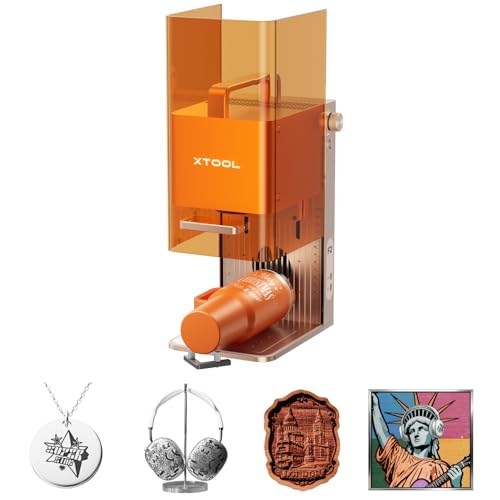
Portable Dual-Laser Pick – xTool F2 Dual Laser Engraver
The xTool F2 is a compact laser engraver for jewelry and small-batch personalization, pairing a 5W IR laser with a 15W diode laser. Its IR laser is intended for vivid metal color marking, while the diode handles 3D embossing and thicker-material cutting. A built-in 50MP camera supports precise placement on small pieces.
Best For: On-site customization, jewelry personalization, and small businesses needing fast, camera-guided work.
Pros:
- Dual laser sources expand capability across more than 300 materials.
- 50MP camera provides up to 0.1mm alignment accuracy for small items.
- Advertised speeds reach up to 6000mm/s for efficient small-batch work.
- Fully enclosed, assembled design weighs about 10 pounds and is easy to transport.
Cons:
- The 5W IR source is lower powered than the 20W fiber laser in the ComMarker B4.
- Some batch and cylindrical-item capabilities require optional accessories such as the Slide Extension or RA3.
- It is identified as a Class 4 laser, so operating requirements deserve careful attention.
The F2 is compelling for portable personalization and precise small-item placement, especially where speed and camera guidance are valuable. It is a flexible choice for jewelry color marking, though users seeking maximum fiber-laser power should look elsewhere.
Portable Pick – LaserPecker LP2
If you want a portable laser engraver for jewelry and small craft projects, the LaserPecker LP2 is designed for easy setup and handheld use. Its 0.05 mm compressed spot and selectable 1K, 1.3K, and 2K resolutions support detailed work, while the included rotary roller handles cylindrical items.
Best For: Portable engraving of coated metal, brushed stainless steel, wood, leather, and cylindrical items such as jewelry-related blanks and accessories.
Pros:
- Portable design with smartphone and PC connectivity.
- Fast engraving speeds up to 1,417 inches per minute.
- Included electric roller supports 360-degree cylinder engraving and extended engraving modes.
- Supports common files including JPG, PNG, and G-code.
Cons:
- Cannot engrave pure or shiny metal.
- Light-colored or transparent materials may need black paint or spray first.
- Wood cutting is limited to material up to 0.2 inches thick.
The LP2 is a convenient choice when portability and roller-based flexibility matter most. However, shoppers primarily engraving jewelry made from bare or shiny metal should consider a model with a dedicated infrared laser instead.
Metal-Marketing Choice – Carverall A1 Pro Dual Laser
The Carverall A1 Pro is a versatile laser engraver for jewelry because it combines a 7W blue diode laser with a 1.2W infrared laser. The blue laser covers materials such as wood, leather, acrylic, glass, and coated metals, while the infrared laser is intended for bare stainless steel, aluminum, brass, and jewelry.
Best For: Beginners, hobbyists, and small businesses that need one enclosed machine for both jewelry-metal marking and general craft materials.
Pros:
- Dual-laser setup handles both nonmetal materials and bare metals.
- HD camera supports ready-out-of-the-box alignment and listed 0.01 mm precision.
- Fully enclosed Class 1 design includes lid-open and tilt safety shutoffs.
- Supports app control, LightBurn, LaserGRBL, offline batch jobs, and repeat-job memory.
Cons:
- The compact 3.94-by-3.94-inch work area limits larger projects.
- The two laser heads must be swapped manually.
- Roller attachment and air purifier accessories are optional.
For jewelry makers working across bare metals and other craft materials, the A1 Pro offers the broadest material flexibility in this group. Its compact workspace is best suited to small jewelry pieces, tags, blanks, and other detailed projects.
Large-Workspace Option – L2 MAX 10W Enclosure
The L2 MAX is a practical laser engraver for jewelry and small-business production when you need more workspace. Its 300-by-300 mm area can hold larger designs or multiple smaller pieces, while the 10W laser and 0.01 mm square focus support detailed engraving on compatible materials.
Best For: Makers and small businesses producing batches of jewelry-related items, gifts, signs, leather goods, and other custom products.
Pros:
- Large 300-by-300 mm engraving area supports batch layouts.
- Up to 20,000 mm/min speed can help reduce production time.
- 360-degree enclosed design includes flame detection, emergency stop, safety lock, and tilt protection.
- Supports LightBurn, LaserGRBL, CutLabX, Wi-Fi, USB, app, and TF-card control.
Cons:
- The supplied notes specify compatible materials rather than unrestricted bare-metal engraving.
- Air Assist and the rotary roller are optional accessories.
- Its larger enclosed format is less portable than a handheld engraver.
The L2 MAX stands out for workspace, speed, and enclosed operation. It is a strong fit for organized batches and mixed craft production, but jewelry buyers should verify that their specific metal type is supported before purchasing.
How We Picked the Best Laser Engraver for Jewelry
We evaluated these machines by focusing on the features that matter most for jewelry work: compatibility with precious and nonferrous metals, laser type, stated precision, engraving speed, workspace, camera or alignment aids, portability, and ease of control. Fiber and 1064nm infrared lasers generally offer the strongest fit for marking metals, while diode lasers can add flexibility for wood, leather, coated materials, and other craft projects.
We also considered practical factors such as rotary compatibility, handheld use, touchscreen or app controls, LightBurn support, enclosed versus open designs, and whether a model is better suited to occasional personalization or ongoing small-business production.
Quick Comparison
| Best For | Features to Prioritize | Models to Consider |
|---|---|---|
| Metal jewelry marking | Fiber or 1064nm infrared laser, precise focus, rotary support | LaserPecker LP5, AlgoLaser 1064nm, ComMarker B4 |
| Mixed-material crafting | Dual laser, camera alignment, broad software support | xTool F1 Ultra, xTool F2, BlazeX M3 |
| Portable personalization | Compact design, handheld operation, simple controls | LaserPecker LP2, AlgoLaser Pixi |
| Larger work areas | Expanded bed, higher travel speed, batch workflow | 10W 300×300mm engraver |
Key Buying Factors for a Laser Engraver for Jewelry
Laser Type and Metal Compatibility
For stainless steel, aluminum, brass, titanium, and many coated metals, a fiber or infrared laser is usually the most relevant choice. A diode laser may handle painted, anodized, or coated surfaces but is not automatically suitable for bare precious metals. Check the manufacturer’s supported materials before buying.
Power, Detail, and Speed
Higher power can improve productivity and support deeper marking, but jewelry also demands controlled detail. Look for a suitable spot size, stated precision, adjustable power and speed, and reliable focus adjustment. Speed claims are useful for comparison but should not replace checking real material results.
Workspace and Rotary Accessories
Small pendants and flat tags do not require a large bed, while bracelets, rings, and batch orders may benefit from a rotary attachment or a more versatile workspace. Confirm whether the required rotary fixture is included or sold separately.
Software, Alignment, and Safety
Built-in cameras, preview functions, touchscreen controls, and compatible design software can reduce setup errors. For frequent use, prioritize an enclosed machine or appropriate protective equipment, ventilation, emergency controls, and clear operating instructions.
Who Should Buy Which Laser Engraver for Jewelry?
Choose a fiber or 1064nm infrared model if your primary goal is crisp metal marking on rings, pendants, bracelets, or tags. A dual-laser machine is better for makers who want one system for jewelry plus wood, leather, acrylic, or coated materials. Portable models suit markets, workshops, and occasional personalization, while larger or faster machines make more sense for businesses handling repeat orders. Before purchasing, verify material support, included accessories, software compatibility, and the machine’s safety requirements for your workspace.