
The best interactive globes turn geography into hands-on discovery, combining maps with voices, augmented reality, apps, lights, games, and age-appropriate facts.
We compare 10 options for preschoolers, elementary students, classrooms, and curious families so you can choose the right mix of technology, durability, educational depth, and price.
Best 10 Interactive Globes Picks for 2026
Best AR Globe for Curious Kids
Orboot Earth Interactive Globe

- 1000+ AR facts, games, and quizzes
- Includes passport and travel stickers
- Designed for ages 4–10
Best For: Young learners who enjoy app-supported STEM exploration
Best Video Globe for World Discovery
LeapFrog Magic Adventures Globe
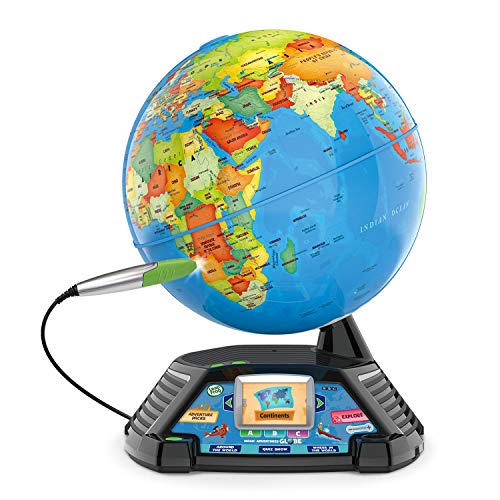
- Built-in 2.8-inch video screen
- BBC videos, facts, and animations
- Three interactive geography games
Best For: Kids ages 5–12 who learn through guided multimedia
Best Talking Globe for Trivia Practice
Little Experimenter Smart Pen Globe

- Wireless pen reads location-based facts aloud
- Includes 300 trivia questions
- Covers geography, languages, and cultures
Best For: Ages 8–12 and focused geography practice
Best Light-Up Globe for Preschool Exploration
LeapFrog LeapGlobe Touch Globe

- 48 touch points and colorful lights
- Three modes for exploration and play
- Designed for ages 3 and up
Best For: Preschoolers learning geography through touch and music
App-Connected Learning
10-Inch Interactive Globe for Kids

- App-based exploration works with iOS and Android devices
- Includes 400 wonders and 1,000+ facts
- LED constellations also function as a world lamp
Best For: Kids who like app-guided geography and astronomy
Hands-On Earth Science
Openable Talking Globe for Kids
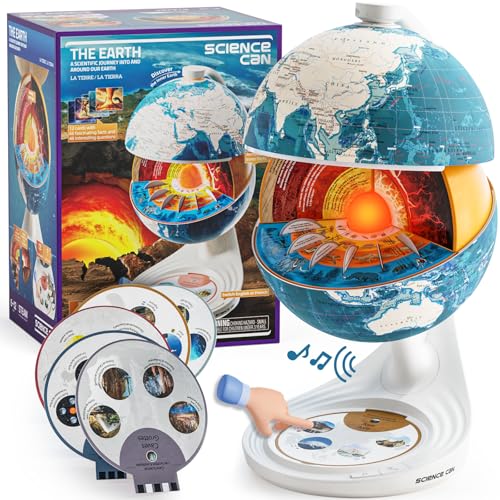
- Opens to show crust, mantle, and inner core
- Offers 48 bilingual geography and landmark facts
- Includes knowledge and quiz modes with an LED core
Best For: Kids ages 6–12 exploring geology and Earth science
Detailed STEM Exploration

- Detailed political map includes capitals and major geographic features
- App adds text, sound, and visuals about countries
- LED display shows 88 constellations and the Milky Way
Best For: STEM learners seeking detailed geography and astronomy features
Best AR Adventure

- AR app features 400+ wonders and 1,000 facts
- Constellation mode covers 60+ constellations
- Includes magic stylus and exploration accessories
Best For: Kids ages 4+ who like geography games and AR play
Best Talking Globe

- Rechargeable pen narrates thousands of facts
- Includes a 60-page discovery book
- Adds touch features, trivia, and comparison games
Best For: Young learners who prefer guided audio exploration
Best Simple Pick

- Opens into surface, crust, mantle, and glowing core
- Covers 1,000+ geography and Earth science facts
- App has no subscriptions, ads, or Wi-Fi requirement after setup
Best For: Ages 4–10 exploring geology through hands-on play
Best AR Globe for Curious Kids – Orboot Earth Interactive Globe
For families seeking interactive globes with a strong technology component, the PlayShifu Orboot Earth combines augmented-reality activities with hands-on map exploration. Its app-supported content includes more than 1,000 facts, games, and quizzes covering animals, cultures, places, and monuments.
Best For: Children ages 4–10, homeschoolers, and classrooms looking for an AR-based STEM learning activity.
Pros:
- AR content offers more than 1,000 facts, games, and interactive activities.
- Supports geography, problem-solving, memory, and early STEM learning.
- Includes a passport, visa stamp, and sticker booklet for imaginative travel play.
- The 10-inch globe encourages hands-on exploration at home or in class.
Cons:
- Interactive features require the free Orboot app and a compatible device.
- Its plastic construction may feel more toy-like than display-oriented.
Orboot Earth is a particularly engaging choice when you want an interactive globe that blends physical play with app-based discovery. The combination of quizzes, AR content, and travel-themed accessories gives younger learners several ways to revisit geography concepts.
Best Video Globe for World Discovery – LeapFrog Magic Adventures Globe
The LeapFrog Magic Adventures Globe stands out among interactive globes for its built-in 2.8-inch video screen and stylus. Children can explore countries, cultures, animals, habitats, landmarks, and geography through BBC videos, narrated facts, games, and quizzes.
Best For: Children ages 5–12 who prefer guided video content and structured geography games.
Pros:
- Built-in screen displays BBC videos and animations without requiring a separate app.
- Provides thousands of facts across topics such as animals, habitats, cultures, and landmarks.
- Three interactive games include racing, quizzes, and mystery-solving activities.
- The included stylus supports direct interaction with the globe.
Cons:
- Requires four AA batteries for regular use.
- The screen is relatively small at 2.8 inches.
- It is designed for one player at a time.
This globe is a good fit for kids who respond well to short videos and game-based instruction. Its broad subject coverage and guided activities make it more structured than a basic talking globe, though battery use is worth considering.
Best Talking Globe for Trivia Practice – Little Experimenter Smart Pen Globe
The Little Experimenter Talking Globe is one of the more focused interactive globes for children who like fact-based learning. Its wireless smart pen provides spoken information when children touch locations, while 300 trivia questions reinforce countries, capitals, languages, currencies, populations, and other geography topics.
Best For: Children ages 8–12, classroom activities, and families seeking a compact globe with voice feedback and trivia.
Pros:
- Smart pen delivers real-time spoken information through the built-in speaker.
- Covers a wide range of geography facts, including capitals, climates, and national anthems.
- Includes 300 trivia questions for practice and review.
- The 9-inch size works well for home or classroom use.
Cons:
- Its content is oriented toward ages 8–12 rather than very young learners.
- The compact size provides less physical map area than a larger globe.
Choose this model if spoken facts and quiz practice matter more than videos or augmented reality. The smart pen creates an interactive learning loop, while the compact design makes it practical for desks, shelves, and classroom tables.
Best Light-Up Globe for Preschool Exploration – LeapFrog LeapGlobe Touch Globe
The LeapFrog LeapGlobe is a beginner-friendly option among interactive globes, using 48 touch points, colorful lights, and simple category buttons to introduce young children to geography. Its exploration, music, and Find-It modes cover animals, landmarks, greetings, foods, and world music.
Best For: Children ages 3 and up who need an accessible first globe with light-up and sound-based activities.
Pros:
- Features 48 touch points for hands-on discovery.
- Includes exploration, music, and Find-It modes for varied play.
- Introduces animals, landmarks, foods, and greetings in French, Mandarin, and Spanish.
- Light-up effects and international music make early learning engaging.
Cons:
- Requires two AA batteries for regular use.
- Its content and controls are aimed at younger beginners rather than advanced geography study.
The LeapGlobe is best viewed as an introductory learning toy rather than a detailed reference globe. Its straightforward touch points, lights, music, and quiz mode make it approachable for preschoolers beginning to explore the wider world.
App-Connected Learning – 10-Inch Interactive Globe for Kids
This 10-inch option stands out among interactive globes for its app-based learning and illuminated night-sky display. Children can explore countries, cities, landforms, and other geographic details through the Click Word Atlas app, while the globe also works as a decorative world lamp.
Best For: Children who enjoy app-guided geography activities and a globe that doubles as a room light.
Pros:
- App works with iPad, iPhone, and Android devices.
- Includes information on 400 wonders and more than 1,000 facts through the app.
- LED display features 88 constellations, zodiac signs, and the Milky Way.
- Full-swing meridian and stable stand support hands-on exploration.
Cons:
- Interactive app features require a compatible device.
- Its 10.23-inch size may need more display space than a compact globe.
Choose this model if you want geography learning, astronomy content, and ambient lighting in one kid-friendly package. Its detailed map and app provide more exploration than a traditional globe, though the connected features are most useful when a mobile device is available.
Hands-On Earth Science – Openable Talking Globe for Kids
This 8-inch model gives interactive globes a science-focused twist by opening to reveal Earth’s crust, mantle, and inner core. It combines a geological display with bilingual talking facts, a quiz mode, and an LED core for a more hands-on introduction to Earth science.
Best For: Children ages 6–12 who are interested in geology, Earth’s structure, and quiz-based learning.
Pros:
- Openable design shows the planet’s layered internal structure.
- Talking mode provides 48 facts about Earth’s geography and landmarks.
- Supports English and French.
- Knowledge and quiz modes encourage active learning.
Cons:
- At 8 inches, it has a smaller display than the 10-inch options in this roundup.
- The globe opens only when the upper triangle marker aligns with the globe marker.
This is a strong choice when geology matters as much as geography. The openable construction makes Earth’s layers easy to visualize, while the bilingual talking and quiz functions add useful interaction without relying on a phone or tablet.
Detailed STEM Exploration – 10-Inch Illuminated App Globe
This 10-inch interactive globe combines a detailed political map with the Click Word Atlas app and illuminated constellations. It is designed for children who want to investigate geographic features, countries, and night-sky patterns using both a rotating physical globe and digital content.
Best For: STEM-oriented learners who want detailed geography alongside app activities and astronomy displays.
Pros:
- App is compatible with iPad, iPhone, and Android phones.
- Map includes mountain ranges, ocean currents, deserts, lakes, state capitals, and major cities.
- LED illumination shows 88 constellations, zodiac signs, and the Milky Way.
- Full-swing meridian allows rotation left, right, up, and down.
Cons:
- App content requires a compatible mobile device.
- Its 10.5-inch size and 2.8-pound weight make it less compact than a small tabletop globe.
This model suits buyers prioritizing map detail and astronomy features in a single STEM learning tool. Its wooden and acrylic base materials give it a display-oriented design, while the rotating meridian and app add practical ways to explore the map.
Best AR Adventure – Orboot Earth Explorer
For families seeking interactive globes with a strong game element, the PlayShifu Orboot Earth Explorer combines app-based augmented reality with hands-on activities. Kids can explore more than 400 wonders and 1,000 facts, test their knowledge with quizzes, and use the included stylus for creative play.
Best For: Kids ages 4 and up who enjoy screen-assisted geography games, quests, and creative activities.
Pros:
- AR app adds interactive facts, games, quizzes, and scavenger hunts.
- Constellation mode displays more than 60 constellations.
- Includes a magic stylus, passport, stamp, sticker book, and two Zap-on panels.
- Large 10-inch globe provides an engaging hands-on format.
Cons:
- A compatible device is required but is not included.
- The experience depends on using the companion app.
This is a lively choice when you want geography learning to feel like an activity rather than a reference lesson. Its constellation mode and game-based features give it added appeal for curious young learners.
Best Talking Globe – Replogle Intelliglobe
The Replogle Intelliglobe is one of the more traditional interactive globes, using a rechargeable talking pen to introduce children to countries, cultures, geography, and world facts. Its 12-inch size and included discovery book make it suitable for both learning spaces and bedroom or classroom display.
Best For: Children ages 4–8 who benefit from narrated facts, touch-and-explore activities, and structured geography games.
Pros:
- Includes a rechargeable pen and 60-page World Discovery Book.
- Offers narrated facts about anthems, populations, politics, flora, fauna, and landmarks.
- Provides 20 touch-and-explore features, comparison activities, trivia, and find games.
- Its 12-inch format is easy to use for classroom or home learning.
Cons:
- The pen battery lasts up to 2.5 hours before recharging.
- Interactive functions require the included pen to be charged and read labels correctly.
Choose this model if you prefer guided audio learning over app-based augmented reality. The included book and broad collection of touch features give children several ways to revisit core world geography topics.
Best Simple Pick – Orboot Core Interactive Globe
The PlayShifu Orboot Core stands out among interactive globes by opening into three layers: the surface, fossil-filled crust, and mineral-rich mantle. Its AR app adds more than 1,000 facts, while the physical design gives children a direct way to explore geology alongside geography.
Best For: Kids ages 4–10, homeschoolers, and classrooms looking for a tactile introduction to Earth science and geography.
Pros:
- Three-layer design reveals fossils, minerals, and a glowing core.
- Includes more than 1,000 facts covering geography, culture, fossils, minerals, and geology.
- App access has no subscriptions or in-app purchases after setup.
- Can be used offline without Wi-Fi or ads after the initial setup.
Cons:
- App-based features still require a compatible device for the digital experience.
- The specialized layered design may be more suitable for science-focused play than simple map practice.
This is the strongest pick for families who want a globe that explains what lies beneath Earth’s surface, not just where countries are located. Its reusable, hands-on design can remain engaging as children move from basic geography toward geology.
How We Picked These Interactive Globes
We evaluated the selected models by looking at age range, learning features, map design, ease of setup, included accessories, and the type of interaction each globe provides. The list includes AR globes that use a smartphone or tablet, talking and touch-activated models, app-compatible designs, and illuminated globes that can double as night lights or room décor.
We also considered whether each product supports independent exploration or works best with adult guidance. Since specifications and app compatibility can change, check the current listing for supported devices, included batteries, software requirements, and the latest educational content before purchasing.
Quick Comparison
- Best for augmented reality: PlayShifu Orboot Earth and Orboot Earth Explorer.
- Best for preschool introductions: LeapFrog LeapGlobe and Science Can Globe.
- Best for talking, guided learning: LeapFrog Magic Adventures Globe and Replogle’s interactive talking globe.
- Best for older elementary learners: Little Experimenter Interactive Globe.
- Best for visual display: Illuminated, constellation-focused, and LED globe models.
- Best for layered exploration: PlayShifu Orboot Core, with its openable globe design and AR content.
Key Buying Factors for Interactive Globes
Age and Learning Level
Ages three to five generally benefit from large controls, simple prompts, recognizable animals, and short activities. Older children may prefer detailed maps, country facts, quizzes, fossils, constellations, and broader STEM content.
Technology and Setup
Touch and talking globes are usually ready to use with minimal setup. AR and app-connected models can offer richer content, but they require a compatible phone or tablet and may need charging, downloads, updates, or an internet connection. Confirm whether the device is included; it typically is not.
Size, Construction, and Visibility
Consider where the globe will be used. An 8- or 9-inch model is easier for a child to handle, while a 10- or 12-inch globe can provide more readable labels and a stronger classroom presence. A stable stand, sturdy controls, and a clear map matter for frequent use.
Educational Content
Look for subjects that match the child’s interests, such as animals, landmarks, cultures, geography, history, space, or constellations. A globe with many facts is useful only if the interface makes that content easy to find and understand.
Who Should Buy Which Interactive Globes?
Choose an AR model for children who enjoy phones, tablets, games, and visual discovery. Pick a talking or touch globe for straightforward, screen-light learning and guided practice. An illuminated constellation globe suits children interested in astronomy and families wanting a decorative display. For classrooms or shared playrooms, prioritize a larger globe with a stable base, readable labels, and durable controls. If you want the widest long-term use, choose a model with layered content, quizzes, and age-flexible topics rather than one built around a single activity.