
Accurate airflow measurements are easier to capture and review when your meter can store readings instead of relying on handwritten notes. The best anemometers with data logging combine dependable wind-speed sensing with useful features such as CFM calculations, temperature measurement, Bluetooth connectivity, or app-based data storage.
This roundup compares 10 models for HVAC technicians, building inspectors, maintenance teams, weather observers, and other users who need repeatable measurements in the field.
Best 10 Anemometers with Data Logging Picks for 2026
Top Pick
General Tools CIH20DL Hot Wire Data Logging Anemometer

- Stores 20,000 timestamped data points
- Measures low airflow with ±3% accuracy
- Includes CFM/CMM, temperature, and PC software
Best For: HVAC and industrial airflow documentation
Heavy-Duty Logging Pick
Extech SDL300 Metal Vane Thermo-Anemometer

- Exports timestamped readings in Excel format
- Stores up to 20 million readings with a 2GB SD card
- Metal vane measures up to 6,900 ft/min
Best For: SD-card-based HVAC and industrial measurement
HVAC Testing Pick
Hot Wire Anemometer AM-286 for Duct Testing

- Telescopic probe reaches ducts and diffusers
- Calculates CFM/CMM airflow volume
- USB connection supports export and reporting
Best For: Duct balancing and ventilation diagnostics
Connected Portable Pick
Kethvoz 866B-APP Bluetooth Anemometer

- Saves and downloads readings over Bluetooth
- Measures 0.3–30 m/s with ±5% accuracy
- Includes wind chill, wind force, and tripod mount
Best For: Portable connected wind and HVAC monitoring
Best Professional Pick
Elitech ANE-200W HVAC Anemometer
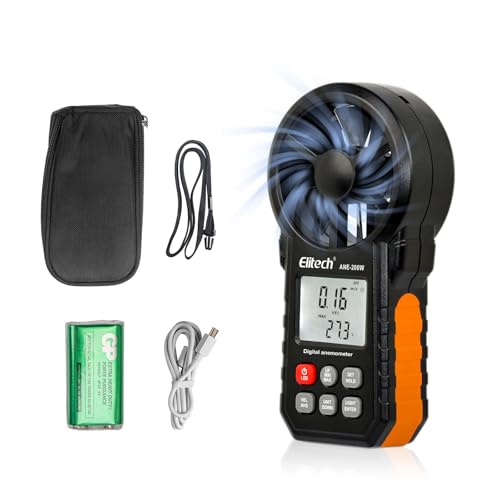
- Measures airflow, wind velocity, and temperature
- Bluetooth and USB logging with Excel export
- Includes AVG, MAX, MIN, data hold, and LED light
Best For: HVAC balancing and professional reporting
Best Multi-Function Meter

- Measures air velocity from 0.4 to 30.0 m/s
- Also measures humidity, temperature, and illuminance
- Compact design with Type K thermocouple input
Best For: Indoor facility and laboratory inspections
Best Portable Bluetooth Option
BTMETER BT-100APP Bluetooth Anemometer

- Bluetooth app logging with Excel and TXT export
- Measures wind speed, temperature, and wind chill
- Tripod-ready, lightweight, and suitable for HVAC checks
Best For: Portable testing and wireless data logging
HVAC Data Logger
Kethvoz KE-846A Split-Type Anemometer

- Stores up to 600 groups of measurements
- Calculates airflow up to 999,900 CFM/CMM
- 2-meter separated sensor for duct and vent checks
Best For: HVAC airflow testing and CFM recording
Connected Wind Meter
Bluetooth APP Anemometer for Data Storage

- Logs and exports readings through an Android/iOS app
- Displays current, max, min, and average wind speed
- Tripod thread enables hands-free monitoring
Best For: Mobile data collection and app-based reporting
Weather-Tracking Logger
BTMETER BT-8806WM-APP Cup Anemometer

- Records and shares data in Excel through Bluetooth
- Measures wind, pressure, humidity, altitude, and temperature
- Cup sensor captures wind from any direction
Best For: Outdoor monitoring and multi-sensor weather checks
Top Pick – General Tools CIH20DL Hot Wire Data Logging Anemometer
General Tools CIH20DL Hot Wire Data Logging Anemometer with Cfm/Cmm & 8: 1 Irt Thermometer
Check Price On AmazonFor buyers comparing anemometers with data logging, the General Tools CIH20DL combines sensitive hot-wire airflow measurement with long-term record keeping. It can timestamp up to 20,000 data points at user-selected intervals, while also measuring airflow volume and surface temperature.
Best For: HVAC and industrial users who need detailed, time-stamped airflow records and low-velocity measurement.
Pros:
- Stores up to 20,000 timestamped readings at selected intervals.
- Hot-wire sensor detects airflow as low as 2 ft/min with ±3% accuracy.
- Measures air speed, CFM/CMM, and surface temperature.
- Includes USB cable, AC adapter, PC logging software, and hard carrying case.
Cons:
- At 2.6 pounds, it is less lightweight than simpler handheld meters.
- The built-in laser thermometer is a Class II laser product, so users must follow laser-safety precautions.
This is a strong choice when logging capacity and low-airflow sensitivity matter more than compactness. Its bundled software and accessories also make it suitable for documented inspections.
Heavy-Duty Logging Pick – Extech SDL300 Metal Vane Thermo-Anemometer
The Extech SDL300 is a practical option among anemometers with data logging for users who prefer removable SD-card storage. It displays air velocity and temperature together, then saves readings in Excel format with date and time stamps for computer analysis.
Best For: Technicians who need durable vane measurements, Excel-ready records, and a broad storage capacity.
Pros:
- Logs readings to an SD card in Excel format with date and time stamps.
- Supports manual storage of 99 readings or up to 20 million with a 2GB SD card.
- Metal vane handles air velocities up to 6,900 ft/min and temperatures up to 158°F.
- Includes Type K/J thermocouple input, MIN/MAX recall, data hold, and auto power-off.
Cons:
- The 2.8-inch vane may be less convenient in tight spaces than a remote probe.
- SD-card logging requires a compatible card for the stated high-capacity storage.
Choose the SDL300 if straightforward file transfer and high storage capacity are priorities. Its metal vane and extended temperature and velocity ratings support demanding measurement tasks.
HVAC Testing Pick – Hot Wire Anemometer AM-286 for Duct Testing
The AM-286 is designed for duct and vent work, making it a useful choice for shoppers seeking anemometers with data logging and PC connectivity. Its telescopic, bendable hot-wire probe reaches into ducts and diffusers, while CFM/CMM calculations help with airflow verification.
Best For: HVAC technicians balancing ducts, checking vents, and documenting airflow performance.
Pros:
- Remote telescopic probe reaches deep into ducts and ceiling diffusers.
- Calculates airflow volume in CFM or CMM after duct area is entered.
- Hot-wire sensing is suited to low-speed ventilation measurements.
- USB PC connectivity supports real-time monitoring and data export.
Cons:
- The supplied notes do not specify a memory capacity for onboard data logging.
- It is focused on airflow diagnostics rather than a dedicated weather-monitoring feature set.
The AM-286 is compelling when probe access and HVAC-focused calculations are more important than extensive internal memory. Its MAX, MIN, AVG, and data-hold functions help document variable readings during field checks.
Connected Portable Pick – Kethvoz 866B-APP Bluetooth Anemometer
The Kethvoz 866B-APP brings app-based connectivity to the anemometers with data logging category. It transmits real-time wind data over Bluetooth so readings can be saved and downloaded to a mobile device or computer, while its compact design suits indoor and outdoor use.
Best For: Portable wind monitoring, HVAC checks, outdoor activities, and users who want Bluetooth-based data export.
Pros:
- Bluetooth connection supports saving and downloading measurement data.
- Measures wind speed from 0.3 to 30 m/s with stated ±5% accuracy.
- Provides AVG, MAX, and MIN modes across five wind-speed units.
- Displays wind force, wind chill, and temperature, with a 1/4-inch tripod mount.
Cons:
- Temperature measurement is limited to -10°C to 45°C (14°F to 113°F).
- Its 30 m/s maximum wind-speed range may not suit higher-speed applications.
- Data transfer depends on a compatible Bluetooth-connected mobile device or computer.
This model stands out for convenient wireless logging and portability rather than large onboard memory. The tripod mount and backlit display are helpful for hands-free monitoring in changing outdoor or HVAC conditions.
Best Professional Pick – Elitech ANE-200W HVAC Anemometer
The Elitech ANE-200W is a strong choice among anemometers with data logging for HVAC professionals who need airflow, wind-speed, and temperature readings in one instrument. Bluetooth app monitoring and USB PC software support logged data, curve displays, Excel export, and reporting.
Best For: HVAC balancing, duct traversing, fume hood checks, and professional environmental measurements.
Pros:
- Measures wind velocity, airflow in CMM and CFM, and temperature.
- Offers real-time, average, maximum, and minimum wind-velocity readings.
- Supports Bluetooth app monitoring plus USB data logging and Excel export.
- Includes a backlit display, LED work light, data hold, and adjustable units.
Cons:
- Its professional software and recording features may be more than casual users need.
- The notes do not specify a wind-speed accuracy rating or measurement range.
Choose this model when documented measurements and flexible data management matter more than a basic handheld meter. Its combination of onboard records, app connectivity, and PC export makes it particularly suitable for repeatable HVAC work.
Best Multi-Function Meter – LM-8000A 4-in-1 Anemometer
The LM-8000A combines anemometer readings with humidity, temperature, and illuminance measurement, making it a practical option for users who want broader indoor testing capability. Its listed applications include clean rooms, ventilation balancing, pharmaceutical environments, and data centers.
Best For: Indoor air-velocity checks and multi-parameter inspections in laboratories, clean rooms, and facilities.
Pros:
- Measures air velocity from 0.4 to 30.0 m/s with 0.1 m/s resolution.
- Adds humidity, temperature, and light measurements to wind testing.
- Supports Type K thermocouple probes for a wide temperature range.
- Compact 160 g design with a wristlet for portable use.
Cons:
- The supplied notes do not clearly describe the data-logging workflow or export format.
- No warranty is listed.
- Its 20,000-lux light range may be limiting for some brighter environments.
This is a sensible pick when anemometer readings are only one part of the inspection. Buyers specifically prioritizing documented, exportable logs should verify the logging functions before purchase, while facility testers may value its added humidity, temperature, and light modes.
Best Portable Bluetooth Option – BTMETER BT-100APP Bluetooth Anemometer
The BTMETER BT-100APP is a compact choice among anemometers with data logging, pairing with iPhone, iPad, Android phones, and tablets through its Bluetooth app. It can log measurements for export in Excel or TXT format and includes airflow-related functions useful for HVAC and outdoor activities.
Best For: Portable HVAC checks, outdoor wind measurements, tripod-based monitoring, and app-based record keeping.
Pros:
- Logs data through the Bluetooth app and exports it in Excel or TXT format.
- Measures wind speed in five units and displays temperature and wind chill.
- Provides MAX, MIN, AVG, data hold, and manual or automatic backlight functions.
- Compact 155 g body includes a 1/4-inch tripod mounting hole.
Cons:
- Airflow in CFM must be calculated manually using velocity and duct area.
- Wind-speed accuracy is listed as ±5% of readings.
- Bluetooth app compatibility depends on the user’s phone or tablet.
This model fits buyers who want wireless logging without carrying a larger professional instrument. Its tripod mount and exportable app records are useful for longer tests, while HVAC users should remember that CFM calculation is manual rather than directly measured.
HVAC Data Logger – Kethvoz KE-846A Split-Type Anemometer
For technicians comparing anemometers with data logging, the Kethvoz KE-846A stands out as an HVAC-focused option with a separated sensor, airflow calculations, and storage for up to 600 groups of measurements. It measures wind speed, temperature, and air volume, making it practical for duct and vent work.
Best For: HVAC installation, airflow balancing, duct troubleshooting, and recording CFM measurements.
Pros:
- Stores up to 600 groups of wind measurement data and includes a data-hold function.
- Measures airflow from 0.3 to 45 m/s and air volume up to 999,900 CFM/CMM.
- Separated sensor extends up to 2 meters for overhead or hard-to-reach airflow checks.
- Offers maximum, minimum, average, and 2/3 maximum measurement modes.
Cons:
- Its feature set is oriented more toward HVAC work than general outdoor weather monitoring.
- It is heavier than the compact Bluetooth model listed here, at approximately 0.9 kg.
The KE-846A is a sensible pick when internal data storage and direct CFM measurement matter more than smartphone connectivity. Its split-probe design adds useful flexibility for professional duct and vent inspections.
Connected Wind Meter – Bluetooth APP Anemometer for Data Storage
If you want anemometers with data logging that can transfer readings to a phone, this Bluetooth handheld meter pairs with Android and iOS devices through its dedicated app. It records and exports wind speed, temperature, and airflow data while retaining a straightforward handheld format.
Best For: App-based reporting for HVAC diagnostics, duct testing, drone planning, sailing, and other mobile wind-measurement tasks.
Pros:
- Bluetooth connectivity enables remote monitoring, data logging, and export through the companion app.
- Measures wind speed in five units with stated accuracy of ±5% and includes temperature readings.
- Displays current, maximum, minimum, and average wind speeds on a backlit LCD.
- Built-in tripod thread supports hands-free, longer-term monitoring.
Cons:
- App functionality depends on smartphone compatibility and wireless connectivity.
- Its stated wind-speed accuracy is lower than the Kethvoz model’s claimed ±3% accuracy.
This model is the better fit for users who want to move measurements from the meter into digital reports or spreadsheets. The combination of Bluetooth logging, a tripod mount, and a compact 7.04-ounce build supports both fieldwork and remote observation.
Weather-Tracking Logger – BTMETER BT-8806WM-APP Cup Anemometer
Among anemometers with data logging, the BTMETER BT-8806WM-APP is aimed at buyers who want more than wind speed. Its Bluetooth connection supports recording and Excel sharing, while the cup sensor and additional weather indicators cover outdoor, HVAC, and drone-related measurements.
Best For: Outdoor wind monitoring, weather-aware HVAC checks, drone use, and activities such as sailing, fishing, hiking, and camping.
Pros:
- Bluetooth supports remote monitoring plus data recording and Excel sharing.
- Measures wind speed from 0.3 to 42 m/s with current, maximum, minimum, and average modes.
- Adds barometric pressure, temperature, humidity, dew point, wind chill, altitude, and compass information.
- 360-degree cup sensor and a 1/4-inch screw hole support outdoor and continuous monitoring setups.
Cons:
- Its 16 groups of barometric pressure data are more limited than the wind-measurement storage offered by the Kethvoz.
- The broader weather-feature set may be unnecessary for buyers who only need basic HVAC airflow readings.
The BT-8806WM-APP makes the most sense when logged wind data needs to be considered alongside humidity, pressure, altitude, or wind chill. It is a versatile outdoor instrument, though its additional sensors may add complexity for simple duct checks.
How We Picked the Best Anemometers with Data Logging
We focused on meters that support stored readings, onboard logging, or app-based data capture, then compared the features that matter during real airflow and environmental measurements. Our evaluation emphasizes measurement functions, sensor design, ease of use, portability, connectivity, and suitability for specific jobs.
Models include hot-wire sensors for low-speed airflow and duct testing, vane meters for general ventilation work, and multifunction instruments for weather or environmental monitoring. Because logging methods vary, buyers should confirm whether a meter stores readings internally, exports through Bluetooth, or requires a connected phone or tablet.
Quick Comparison
- Best for HVAC duct testing: Hot-wire models with CFM/CMM calculations and temperature measurement.
- Best for general field use: Vane anemometers with clear displays and straightforward controls.
- Best for mobile data collection: Bluetooth meters that save, label, and export readings through an app.
- Best for broader environmental readings: Multifunction or cup-style meters that add humidity, altitude, barometric pressure, illuminance, or UV-related measurements.
Key Buying Factors for Anemometers with Data Logging
Sensor Type and Measuring Range
Hot-wire probes are typically useful for low-velocity airflow from vents, ducts, and grilles, while vane sensors are convenient for larger openings and general wind measurements. Check the stated velocity range and accuracy against your expected application. A telescoping or remote probe can also make measurements easier in cramped ducts.
Airflow Calculations
If you need volume rather than velocity, choose a model that calculates CFM or CMM and allows duct or opening dimensions to be entered. This saves time, but results still depend on correct area measurements and consistent probe placement.
Logging and Connectivity
Review logging capacity, sampling intervals, timestamping, memory retention, and export options. Bluetooth models can simplify reporting, but app compatibility, phone permissions, and battery life may affect field usability. An onboard memory function is valuable when working where phones are impractical.
Temperature and Additional Sensors
Temperature measurement is useful for HVAC diagnostics and comfort studies. Extra functions such as humidity, pressure, altitude, light, or UV readings can be worthwhile for environmental work, but they may add cost and complexity without improving basic airflow testing.
Who Should Buy Which Anemometers with Data Logging?
HVAC technicians and building inspectors should prioritize hot-wire or vane meters with CFM/CMM calculations, temperature readings, and a probe suited to ducts and registers. Maintenance teams may prefer durable handheld models with simple controls and onboard storage. Engineers and consultants should look for reliable sampling intervals, exportable records, and app features that support organized reports. Weather enthusiasts, drone operators, and outdoor users may benefit from Bluetooth or cup anemometers with broader environmental measurements.
Before buying, verify the unit system, calibration expectations, battery type, display readability, and whether the included probe or accessories match your measurement setup. The best choice is the one whose sensor, logging workflow, and range fit the conditions you measure most often.