
Choosing among the best compound microscopes for biology means looking beyond headline magnification. Optical quality, illumination, stage control, viewing comfort, and camera support determine how useful a microscope will be for cells, tissues, microorganisms, and prepared slides.
This roundup compares 10 options for students, educators, hobbyists, and laboratory users, with practical guidance to help match each microscope’s features to your specimens and workspace.
Best 10 Compound Microscopes for Biology Picks for 2026
Best Overall
Swift SW380T Trinocular Microscope

- 40X–2500X range with six magnification levels
- Trinocular port supports optional imaging
- Mechanical stage and precise focusing
Best For: Advanced students, clinicians, and hobbyists
Best Budget-Friendly Pick
AmScope M150C Cordless Microscope

- 40X–1000X magnification for introductory work
- LED lighting supports outlet or battery use
- All-metal frame with optical glass elements
Best For: Beginners, students, and home school use
Best Complete Imaging Kit
Swift SW350T Microscope with Camera

- Includes a 2.0MP USB camera and software
- Comes with 200 slide and coverslip supplies
- 40X–2500X optics with mechanical stage
Best For: STEM classes, lab reports, and digital documentation
Best Advanced Digital Setup
OMAX 2500X Darkfield Lab Microscope

- 10MP USB 3.0 camera for imaging and measurement
- Brightfield and oil darkfield capabilities
- 40X–2500X range with trinocular head
Best For: Advanced lab work and high-resolution digital imaging
Balanced Binocular Choice
AmScope B120B 2000X Microscope
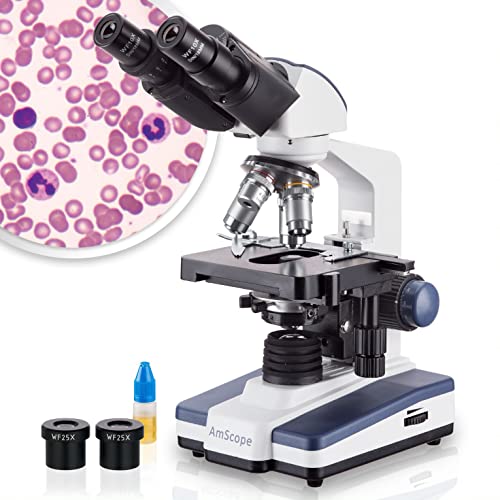
- 40X–2000X range with eight magnification settings
- Binocular head with 360° rotation and 30° inclination
- Mechanical stage, Abbe condenser, and dimmable LED
Best For: Students and educators needing controlled binocular slide work
Expandable Lab Setup
Woehrsh Trinocular Microscope 5000X

- Stated 40X–5000X magnification range
- Trinocular design with electronic eyepiece support
- Includes slides, tools, phone holder, and lab accessories
Best For: Advanced learners and labs wanting trinocular expansion
Beginner-Friendly Kit
BEBANG 2000X Biology Microscope
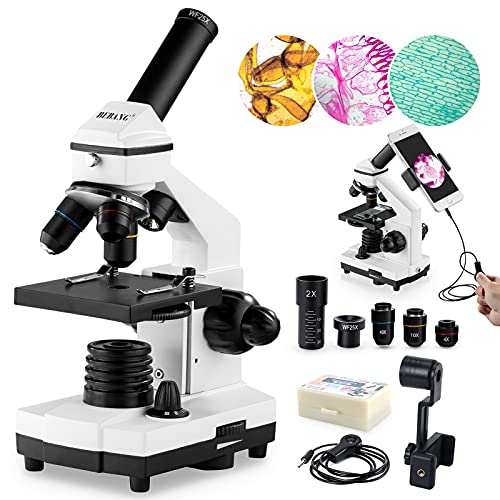
- Six settings from 100X to 2000X
- Dual LED illumination with condenser and disc diaphragm
- Includes slides, carrying bag, and phone adapter
Best For: Beginners and students learning biology at home or school
Best Lab-Ready Choice
OMAX Binocular Compound Microscope
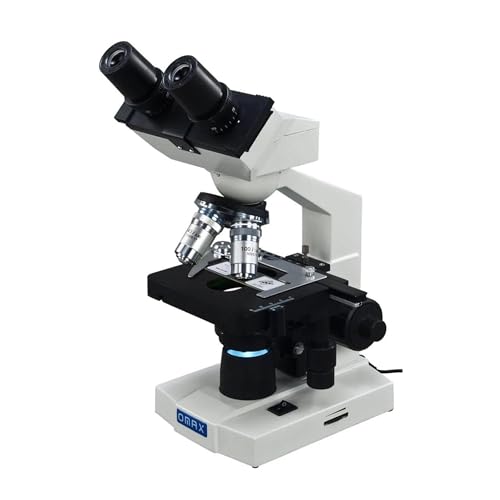
- 40X–2000X range with achromatic objectives
- Mechanical stage and binocular viewing
- Includes slides, covers, and cleaning paper
Best For: Biology students, labs, and serious home users
Best Beginner Kit

- 100X–2000X settings with 4X, 10X, and 40X objectives
- Dual LED lighting for opaque and translucent objects
- Includes prepared slides and phone adapter
Best For: Kids, beginners, homeschool, and family learning
Best Wide-Range Alternative
Herwicm Binocular Compound Microscope

- Binocular wide-angle eyepieces and dual LED lighting
- Two-layer mechanical stage with moving scale
- Coaxial coarse and fine focus controls
Best For: Students, beginners, and biology hobbyists
Best Overall – Swift SW380T Trinocular Microscope
For biology students, clinicians, and serious hobbyists, the Swift SW380T is a versatile choice among compound microscopes for biology. Its achromatic objectives, mechanical stage, precise focusing, and trinocular head support both detailed slide viewing and optional camera-based documentation.
Best For: Shared lab use, advanced students, clinicians, and hobbyists who want camera compatibility.
Pros:
- Provides six magnification levels from 40X to 2500X.
- Includes interchangeable 10X and 25X wide-field glass eyepieces.
- Trinocular head supports an additional eyepiece or microscope camera.
- 30-degree tilt and rotatable Siedentopf head support comfortable shared viewing.
Cons:
- Camera and additional eyepiece attachments are not included.
- Requires AC power.
The SW380T balances high magnification, ergonomic viewing, and imaging flexibility. It is a strong all-purpose option when you want a research-oriented compound microscope without a bundled digital camera.
Best Budget-Friendly Pick – AmScope M150C Cordless Microscope
The AmScope M150C is a straightforward option for students and home learners exploring compound microscopes for biology. Its all-metal construction, optical glass elements, five magnification settings, and battery-capable LED illumination make it practical for basic slide work in classrooms or at home.
Best For: Elementary through high school students, home school use, and beginners who need cordless operation.
Pros:
- Offers useful 40X to 1000X magnification for introductory biology.
- Uses wide-field optical glass elements and a disc diaphragm.
- LED illumination works with an adapter or three AA batteries.
- Sturdy all-metal framework is suited to regular educational use.
Cons:
- Monocular head is less suitable for extended shared viewing than binocular models.
- Maximum magnification is lower than the other microscopes in this roundup.
The M150C emphasizes simplicity and portability rather than advanced imaging features. Its cordless lighting and approachable controls make it a sensible starting point for learning basic microscopy.
Best Complete Imaging Kit – Swift SW350T Microscope with Camera
The Swift SW350T is a complete solution for biology learners and labs that need digital documentation. This compound microscope for biology combines 40X–2500X optics with a 2.0MP USB camera, Windows and Mac software, a mechanical stage, and a 200-piece slide and coverslip bundle.
Best For: Lab reports, STEM education, clinics, and users who want immediate photo and video capture.
Pros:
- Includes a 2.0MP USB camera for photo and video capture.
- Software supports measurement, image stitching, and extended depth of field.
- Comes with 100 blank slides and 100 glass cover slips.
- Achromatic optics, Abbe condenser, and mechanical stage support detailed viewing.
Cons:
- Requires corded electric power.
- The bundled camera is 2.0MP rather than the higher-resolution option in the OMAX system.
With imaging hardware and basic slide supplies included, the SW350T reduces setup time for classroom and laboratory documentation. It is especially appealing when digital capture matters as much as direct eyepiece observation.
Best Advanced Digital Setup – OMAX 2500X Darkfield Lab Microscope
The OMAX M8311Z-A191 is the most feature-rich choice here for advanced compound microscopes for biology. It pairs 40X–2500X magnification with brightfield and oil darkfield capabilities, a trinocular head, and a 10MP USB 3.0 camera for high-resolution imaging and measurement.
Best For: Advanced biology work, digital documentation, users needing darkfield illumination, and laboratory-style imaging.
Pros:
- Includes a 10MP USB 3.0 camera with image capture, video, and measurement tools.
- Offers both brightfield and oil darkfield illumination options.
- Provides 40X–2500X magnification with wide-field 10X and 25X eyepieces.
- Includes a mechanical stage, Abbe condenser, and adjustable LED illumination.
Cons:
- Oil darkfield work requires immersion oil and careful specimen handling.
- Its advanced features may be more than beginners need.
- Requires a computer for USB imaging functions.
The OMAX stands out when imaging resolution and illumination flexibility are priorities. Its darkfield condenser and 10MP camera make it a strong fit for users prepared to manage a more advanced laboratory setup.
Balanced Binocular Choice – AmScope B120B 2000X Microscope
For shoppers comparing compound microscopes for biology, the AmScope B120B offers a practical binocular setup with broad magnification coverage, achromatic objectives, and built-in LED illumination. Its mechanical stage and adjustable condenser support more controlled slide work for education and routine biological observation.
Best For: Students, educators, and users who want a binocular microscope with precise stage movement and magnification up to 2000X.
Pros:
- Eight magnification settings from 40X to 2000X using 4X, 10X, 40X, and 100X objectives with 10X and 20X eyepieces.
- Siedentopf binocular head adjusts for 53–77mm interpupillary distance, rotates 360 degrees, and inclines at 30 degrees.
- Double-layer mechanical stage, coaxial coarse and fine focusing, and a 1.25 NA Abbe condenser support controlled slide examination.
- LED brightfield illumination includes a dimmer for adjusting viewing brightness.
Cons:
- The 100X spring objective requires immersion oil, adding a step to high-magnification viewing.
- Its 240-volt specification may require careful power compatibility checking.
The B120B is a well-rounded option when comfortable binocular viewing and mechanical slide control matter more than camera connectivity. It is especially suited to structured classroom or home-lab work where users may need to return to recorded slide coordinates.
Expandable Lab Setup – Woehrsh Trinocular Microscope 5000X
Among compound microscopes for biology, this Woehrsh trinocular model stands out for its high stated magnification, camera-oriented design, and included laboratory accessories. Its achromatic objective system, dual mechanical stage, and LED lighting are aimed at users who want a more expandable setup for observation and teaching.
Best For: Advanced students, instructors, and laboratory users who want trinocular viewing with an electronic eyepiece and supplied specimen-preparation accessories.
Pros:
- Includes WF10X and WF25X eyepieces, 2X magnifying lenses, and high-pixel electronic eyepieces.
- Offers a stated 40X–5000X range with real 195 achromatic objectives and an infinity optical system.
- Features LED illumination, dual coaxial coarse and fine focusing, a double-layer mechanical stage, and a 306-degree swivel head.
- Comes with slides, coverslips, sections, Petri dishes, tools, a phone holder, and other accessories for getting started.
Cons:
- The product’s many accessories and adjustments may be more than beginners need.
- Its corded-electric design and 240-volt specification call for power-planning before purchase.
- The supplied notes do not identify a specific camera resolution or computer software package.
This is the most feature-rich choice in the group for users who value trinocular expansion and a broad accessory bundle. Before buying, confirm that the stated magnification range and electronic-eyepiece setup match your intended imaging workflow.
Beginner-Friendly Kit – BEBANG 2000X Biology Microscope
For beginners seeking compound microscopes for biology, the BEBANG YW-3006 combines a compact metal frame with a straightforward monocular design and a useful starter kit. Its six magnification settings, dual LED illumination, and included phone adapter make it suitable for guided learning at home or in school.
Best For: Kids, students, adults, and first-time users who want an accessible biology microscope with slides, accessories, and smartphone compatibility.
Pros:
- Provides six settings from 100X to 2000X using a WF25X eyepiece, optional 2X lens, and 4X, 10X, and 40X objectives.
- Coarse and fine focusing knobs help users make more precise focus adjustments.
- Top and bottom LED illumination can be used together with a 0.65 NA condenser and disc diaphragm.
- Includes a phone adapter, carrying bag, 15-piece slide set, and 10 operating accessories.
Cons:
- The monocular design offers less shared viewing flexibility than a binocular or trinocular microscope.
- The included 2.4-pound frame and compact format may provide less stage capacity than larger laboratory models.
- The notes do not specify a mechanical stage.
The BEBANG is a sensible entry point for basic specimen observation and biology education. Its included materials reduce the need for immediate add-on purchases, while the phone adapter supports simple documentation with a compatible smartphone.
Best Lab-Ready Choice – OMAX Binocular Compound Microscope
For buyers comparing compound microscopes for biology, the OMAX offers a sturdy, lab-oriented setup with binocular viewing, a mechanical stage, achromatic objectives, and magnification options from 40X to 2000X. Its included slides, covers, and lens-cleaning paper make it practical for getting started immediately.
Best For: Biology students, laboratories, and serious home users who want a metal-framed binocular microscope with broad magnification and precise slide control.
Pros:
- Binocular head has adjustable interpupillary distance and diopters on both eyetubes.
- Double-layer X-Y mechanical stage and coaxial coarse/fine focus support controlled specimen positioning.
- Includes 100 blank slides, 100 cover slips, and 50 sheets of lens-cleaning paper.
- Five-year manufacturer warranty is included.
Cons:
- It is corded electric, so it is less convenient for portable use.
- The 100X objective requires immersion oil, adding a cleaning and handling step.
The OMAX is the most clearly lab-focused option here, combining a solid metal frame, adjustable LED illumination, and useful mechanical controls. It is a strong fit when repeatable slide work matters more than compactness.
Best Beginner Kit – PALOBIL Compound Microscope
The PALOBIL is a versatile entry point for compound microscopes for biology, pairing six listed magnification settings from 100X to 2000X with prepared slides and beginner accessories. Dual LED lighting, a metal frame, and a phone adapter make it suitable for guided exploration at home or in a classroom.
Best For: Kids, beginners, homeschool learners, and families who want an accessory-rich microscope for introductory biological observation.
Pros:
- Includes prepared slides, blank slides, droppers, tweezers, a phone adapter, and other starter accessories.
- Offers top incident and bottom transmitted LED lighting for opaque and translucent objects.
- Metal construction and adjustable focus are designed for straightforward beginner use.
- Can run from an AC adapter or three AA batteries, though batteries are not included.
Cons:
- The one-year warranty is shorter than the OMAX’s listed five-year warranty.
- Its beginner-oriented accessory kit may be less suitable for advanced laboratory work.
- The maximum magnification claim should be viewed alongside its supplied 4X, 10X, and 40X objectives.
PALOBIL emphasizes convenience and learning rather than laboratory refinement. The lighting choices and included experiment materials lower the barrier to entry, while the phone adapter can help users document observations.
Best Wide-Range Alternative – Herwicm Binocular Compound Microscope
For shoppers seeking compound microscopes for biology with a broad stated range, the Herwicm combines binocular viewing with WF10X and WF25X eyepieces, 4X/10X/40X objectives, dual LED illumination, and a two-layer mechanical stage. Its coaxial focusing controls are positioned on both sides for easier adjustment.
Best For: Students, adult beginners, and hobbyists who want binocular viewing, dual lighting, and a mechanical stage for general specimen observation.
Pros:
- Ultra-wide-angle binocular eyepieces are designed for a larger field of view.
- Top and bottom LED lights support viewing with adjustable illumination.
- Two-layer mechanical stage includes a spiral moving scale for specimen positioning.
- Coaxial coarse and fine focus controls are available on both sides of the base.
Cons:
- The supplied details contain an inconsistent maximum-magnification specification, listing both 40X–2500X and 40X.
- Unlike the PALOBIL, the supplied notes do not list prepared slides or a starter accessory kit.
- The body uses a combination of metal and plastic rather than a fully metal construction.
The Herwicm has a useful control layout and flexible lighting for introductory biology work. Because the listed magnification information conflicts, buyers should verify the actual optical configuration before choosing it for high-magnification applications.
How We Picked These Compound Microscopes for Biology
We focused on the features that most affect real biological observation: objective and eyepiece quality, usable magnification, mechanical-stage precision, illumination, head configuration, construction, and included accessories. Models with binocular or trinocular viewing received attention for longer sessions, while digital systems were considered for documentation, teaching, and sharing images.
We also considered the intended user. A beginner may benefit from a straightforward kit and prepared slides, while advanced users typically need better focusing control, a stable metal frame, oil-immersion capability, or a camera port. Advertised maximum magnification was not treated as the only measure of performance, because resolution and optical alignment matter more than extreme numbers.
Quick Comparison
| Best for | Look for | Typical advantage |
|---|---|---|
| Students and families | Simple controls, LED lighting, included slides | Easy learning and setup |
| Classrooms | Binocular viewing, mechanical stage, durable frame | Comfortable repeated use |
| Lab and advanced hobby use | Achromatic objectives, fine focus, higher-grade stage | More precise observation |
| Imaging and teaching | Trinocular head, compatible camera, software support | Capture and share specimens |
Key Buying Factors for Compound Microscopes for Biology
Optics and Useful Magnification
Common biology magnifications include 40X, 100X, 400X, and 1000X when using a 10X eyepiece with standard objectives. A 2000X or 2500X label can sound impressive, but magnification beyond the system’s resolving power may produce a larger, softer image rather than more detail. Look for achromatic objectives, clear eyepieces, and smooth parfocal focusing.
Illumination and Specimen Contrast
LED illumination is efficient, stays relatively cool, and usually provides consistent brightness. A built-in condenser with an adjustable iris helps control contrast. Biology specimens can look very different under brightfield, so users working with low-contrast samples may also value darkfield compatibility or other contrast accessories.
Stage, Focus, and Viewing Comfort
A two-layer mechanical stage makes it easier to position slides accurately than simple spring clips. Coaxial coarse and fine focus controls are especially useful at high power. Binocular heads reduce eye strain during extended viewing, while a trinocular head is preferable when you plan to observe and record at the same time.
Camera and Connectivity
Digital cameras vary widely in sensor quality, frame rate, resolution, and software compatibility. USB imaging is useful for demonstrations and documentation, but confirm operating-system support and whether the camera replaces an eyepiece or uses a dedicated trinocular port.
Who Should Buy Which Compound Microscopes for Biology?
For Beginners, Children, and Home Learning
Choose a stable LED model with straightforward controls, prepared slides, and a mechanical stage if possible. Avoid paying extra for extreme magnification that the learner may rarely use.
For Biology Students and Classrooms
A binocular microscope with a sturdy metal body, reliable stage movement, and standard objectives is usually the best balance. Prioritize comfort and serviceability over bundled accessories.
For Advanced Users and Small Labs
Look for a research-oriented trinocular or binocular system with fine focusing, a good condenser, oil-immersion support, and upgradeable objectives. These features matter more than a large maximum-magnification claim.
For Digital Documentation
Select a trinocular microscope or a model with a proven camera system. Confirm the camera’s resolution, software, mounting method, and lighting compatibility before buying.