
The best compact compass gives you dependable direction without adding bulk to a hiking kit, emergency bag, or everyday carry setup. These 10 options range from straightforward recreational models to wrist, keychain, lensatic, and multifunction designs.
Use this guide to compare construction, readability, portability, and navigation features so you can choose a compass that fits your experience level and outdoor plans.
Best 10 Compact Compasses Picks for 2026
Reliable Trail Pick

- Compact baseplate for map navigation
- Liquid-filled capsule and steel needle
- Battery-free northern hemisphere design
Best For: Recreational hiking and orienteering
Everyday Carry Pick

- Just 0.5 ounces with lanyard
- Glow-in-the-dark face for low light
- Weatherproof and easy to attach
Best For: Quick orientation and emergency backup
Beginner Map-Reading Pick

- Rotating bezel with liquid-filled needle
- Magnifying glass and 1:24000 scale
- Lightweight acrylic design with lanyard
Best For: Scouts and introductory map navigation
Ultra-Compact Adventure Pick

- Clips to straps, sleeves, or map edges
- Waterproof for hiking and underwater use
- Luminous markings for low light
Best For: Hands-free adventure and underwater navigation
Best Wrist-Mounted Backup
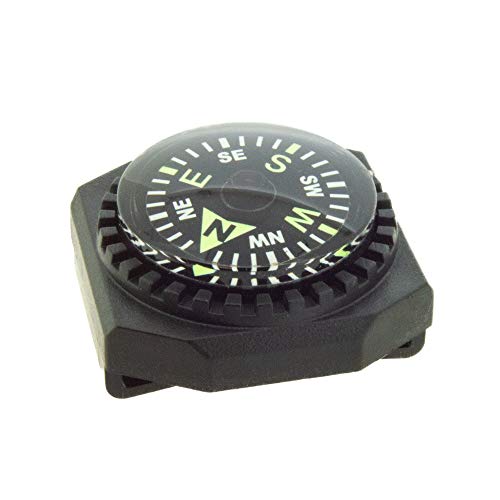
- Fits watch bands or paracord bracelets
- Luminous liquid-filled compass
- Durable, compact ABS housing
Best For: Accessible backup navigation on hikes, camping trips, and survival kits
Best Feature-Rich Pocket Pick

- Prism lens and bubble level
- Glow-in-the-dark interface
- Water-resistant pocket design
Best For: Outdoor users wanting added accuracy features in a portable compass
Best Clip-On Option

- Built-in carabiner for gear attachment
- Liquid-filled directional readings
- Lightweight aluminum construction
Best For: Quick-access navigation on backpacks, belts, and camping gear
Trail Navigation Value
Coghlan's Liquid-Filled Compass

- Liquid-filled for dependable readings
- Rotating bezel aids course setting
- Clip attaches to packs, belts, or keychains
Best For: Basic hiking, camping, and beginner navigation
Rugged Metal Case Choice

- Metal case with mirror-finished surface
- Clear luminous dial for low-light visibility
- Compact design for hiking and camping
Best For: Kids, families, casual outdoor use, and gifts
Reliable Trail Pick – SUUNTO A-10 Compass
The SUUNTO A-10 is a practical choice among compact compasses for hikers and recreational orienteers who want straightforward map-and-compass navigation. Its liquid-filled capsule, steel needle, and fixed declination support simple, stable operation without batteries.
Best For: Hiking, trekking, trail running, mountain biking, and basic map navigation.
Pros:
- Compact baseplate design with inch and centimeter scales.
- Liquid-filled capsule and high-grade steel needle help provide stable readings.
- Portable, battery-free design made in Finland.
Cons:
- Balanced for northern hemisphere use rather than worldwide use.
- Fixed declination may be less flexible for users needing adjustable correction.
The A-10 focuses on dependable fundamentals instead of extra features, making it a sensible compact compass for recreational outdoor navigation.
Everyday Carry Pick – Brunton TAG-Along
The Brunton TAG-Along is one of the smallest compact compasses for quick orientation, emergency backup, or everyday carry. Its glow-in-the-dark face, weatherproof construction, and bright lanyard make it easy to keep accessible on a pack, jacket, or keychain.
Best For: Camping, hiking, travel, emergency kits, and quick directional checks.
Pros:
- Very lightweight at 0.5 ounces.
- Phosphorescent face remains readable in low-light conditions after exposure to light.
- Weatherproof construction and high-visibility orange lanyard.
- Made in the USA by Brunton.
Cons:
- Designed for basic north-finding rather than detailed map navigation.
- Its very small format offers fewer navigation features than a baseplate compass.
The TAG-Along is a convenient backup compass when portability and visibility matter more than advanced route planning.
Beginner Map-Reading Pick – Advanced Scout Compass
This acrylic orienteering compass is a feature-rich option among compact compasses for beginners, scouts, and casual hikers. It combines a rotating 360-degree bezel, liquid-filled needle capsule, magnifying glass, directional markings, and a 1:24000 ruler scale for basic map work.
Best For: Scouts, families, beginner hikers, camping, and introductory topographic-map navigation.
Pros:
- Rotating bezel and orienting lines support basic route planning.
- Magnifying glass helps with reading map details.
- Includes a 1:24000 ruler scale for route mapping.
- Lightweight, portable design with lanyard.
Cons:
- Short 30-day warranty.
- Acrylic construction may be less rugged than premium compass materials.
With more map-reading tools than a simple direction finder, this compass offers a useful starting point for learning land navigation without a complicated setup.
Ultra-Compact Adventure Pick – SUUNTO Micro Compass
The SUUNTO Micro Compass is an especially compact option for users who want navigation close at hand without carrying a full-size baseplate. It clips to a sleeve, watch strap, backpack strap, or map edge, while luminous markings and a waterproof build support low-light and underwater use.
Best For: Hiking, adventure travel, low-light navigation, and underwater orientation in the northern hemisphere.
Pros:
- Extremely small 1.18-by-0.94-inch design.
- Clip mount supports hands-free attachment to several surfaces.
- Waterproof and suitable for underwater navigation.
- Luminous markings aid operation in low light.
Cons:
- Its micro size is less suited to detailed map navigation.
- Balanced for northern hemisphere use.
- Rotating bezel adjusts in 10-degree increments, limiting fine adjustments.
This Micro Compass is best viewed as an always-available directional aid: exceptionally portable, waterproof, and useful when a larger compass would be inconvenient.
Best Wrist-Mounted Backup – Slip-On Wrist Compass
For hikers and campers who want compact compasses close at hand, the Sun Company Slip-On Wrist Compass is designed as a lightweight backup to a primary navigation tool. Its small ABS housing slips onto most standard watch bands or a homemade paracord bracelet.
Best For: Hikers, campers, and survival kits needing an accessible wrist-mounted backup compass.
Pros:
- Fits most standard watch bands and can attach to paracord bracelets
- Liquid-filled, luminous design supports low-light readings
- Durable ABS housing with cushion-mounted compass
- Very compact 1-by-0.6-inch form
Cons:
- Intended as a backup rather than a full-featured primary compass
- Requires a compatible watch band or bracelet for wrist mounting
This is a practical choice when convenience and immediate access matter more than advanced navigation features. Its wrist-mounted format keeps a basic directional reference available without taking up much room in an outdoor kit.
Best Feature-Rich Pocket Pick – Lensatic Hiking Compass
Compass, Hiking Compass for Survival with Lensatic – Water-Resistant Durable and Pocket-Sized
Check Price On AmazonAmong compact compasses, this pocket-sized lensatic model is suited to users who want more built-in tools for outdoor navigation. It combines a prism lens, bubble level, clear scales, fluorescent markings, and water-resistant construction in a portable design.
Best For: Hikers, campers, and mountaineers who want a durable pocket compass with lensatic features.
Pros:
- Lensatic function, prism lens, and bubble level support precise readings
- Fluorescent design and glow-in-the-dark interface aid low-light use
- Water-resistant construction is suited to rough outdoor conditions
- Includes a carrying case, lanyard, or pouch for portability
Cons:
- At 0.22 kg, it is heavier than ultralight clip-on options
- Its additional features may be more than casual users need
This compass makes sense for buyers who prioritize a broader feature set over the absolute lightest carry. The included carrying accessories also make it easier to keep ready for on-the-go navigation.
Best Clip-On Option – Coghlan's Carabiner Compass
Coghlan’s Carabiner Compass is one of the most convenient compact compasses for gear organization. Its built-in carabiner clips to a backpack, belt, or other equipment, while the liquid-filled design provides smooth directional readings.
Best For: Backpackers, campers, and hikers who want quick-access navigation attached to their gear.
Pros:
- Built-in carabiner supports hands-free, quick-access carry
- Liquid-filled design provides smooth directional readings
- Luminous markers improve visibility in low-light conditions
- Lightweight aluminum construction weighs 0.6 ounces
Cons:
- Its clip-on format may be less suitable for detailed navigation than larger compass designs
- Compact size leaves less room for additional navigation features
This is a strong everyday carry choice for outdoor kits where fast access and low weight are priorities. Clip it to a pack or belt and keep a basic navigation tool available without adding much bulk.
Giftable Titanium Pocket Pick – Mini Glow Compass
Among compact compasses, this mini titanium, brass, or copper model stands out for lightweight everyday carry and presentation. Its IPX5 water resistance, glow-in-the-dark feature, necklace, and carrying case make it suited to hikes, survival kits, or a meaningful outdoor-themed gift.
Best For: Hikers, scouts, students, gift-givers, and anyone wanting a tiny compass for a pocket, necklace, backpack, or keychain.
Pros:
- Very compact and lightweight at about 17.87 g.
- IPX5 water resistance and a glow-in-the-dark dial support outdoor use.
- Includes a necklace and carrying case for flexible carry or gifting.
- Corrosion-resistant metal construction with a smooth CNC-machined surface.
Cons:
- Its small size may be less convenient to read than a larger compass.
- Accuracy can be affected by metal objects, electronics, strong magnetic fields, and uneven surfaces.
- Requires light exposure before the glow feature is visible.
This is a particularly appealing choice when portability and gift presentation matter as much as basic direction finding. Use it level and away from magnetic interference for the best readings.
Trail Navigation Value – Coghlan's Liquid-Filled Compass
Coghlan's Compass – Trail, Lightweight Navigation Tool for Hiking, Camping, Survival & Orienteering
Check Price On AmazonFor shoppers comparing compact compasses for basic trail navigation, Coghlan’s Trail Compass offers a practical, lightweight design. Its liquid-filled housing, rotating bezel, direction-setting arrow, and integrated clip provide useful features without adding much bulk to a pack.
Best For: Hikers, campers, beginners, and minimalist outdoor kits that need a clip-on navigation tool.
Pros:
- Liquid-filled design supports accurate and reliable readings.
- Rotating bezel and direction-setting arrow help with course adjustments.
- Integrated clip attaches to backpacks, belts, or keychains.
- Lightweight plastic construction is easy to carry.
Cons:
- Plastic construction may feel less substantial than a metal-cased compass.
- The compact 1-by-1-inch format may provide limited visual space for detailed navigation.
- It is a basic trail compass rather than a feature-rich or illuminated model.
This is a sensible low-bulk option for straightforward hiking and camping use. The clip keeps it accessible, while the bezel adds more control than a simple fixed-dial pocket compass.
Rugged Metal Case Choice – Camping Survival Compass
This metal-cased option is one of the compact compasses to consider when a bright, traditional-looking housing is part of the appeal. It has a clear luminous dial, a smooth mirror-finished case, and a portable size for hiking, camping, hunting, or family outdoor activities.
Best For: Kids, families, casual hikers, campers, and gift buyers seeking a compact metal compass with a luminous dial.
Pros:
- Compact and portable design weighs about 0.04 kg.
- Clear luminous dial improves visibility in low-light conditions after illumination.
- Metal case has a smooth, mirror-finished surface.
- Suitable for multiple outdoor activities and gifting.
Cons:
- Notes do not specify water resistance or a clip, lanyard, or carrying case.
- Readings can be disturbed by nearby magnetic objects.
- Must be held horizontally for correct operation.
This compass combines a classic metal appearance with a useful luminous dial and family-friendly portability. It is best treated as a straightforward outdoor tool and used on a level surface away from magnetic interference.
How We Picked These Compact Compasses
We focused on practical navigation tools that are small enough for pockets, packs, watch bands, or keychains. The selection includes traditional baseplate compasses, lensatic designs, liquid-filled models, wrist-mounted options, and compact novelty-style compasses. We considered portability, durability, readability, water resistance, carrying convenience, and suitability for hiking, camping, survival practice, and basic orienteering.
Because compact designs often involve trade-offs, we prioritized matching each style to a realistic use case rather than treating every compass as interchangeable. A simple baseplate model may be better for map work, while a wrist or carabiner compass may be more convenient for quick directional checks.
Quick Comparison
| Compass Type | Best For | Main Advantage |
|---|---|---|
| Baseplate | Hiking and map reading | Clear, practical navigation layout |
| Lensatic | Survival and field navigation | Rugged aiming design |
| Wrist-mounted | Hands-free use | Fast access while moving |
| Carabiner or keychain | Everyday carry and emergency kits | Easy attachment and portability |
| Decorative mini compass | Light carry or gifting | Very small and convenient |
Key Buying Factors for Compact Compasses
Readability and Navigation Layout
Choose a clearly marked dial with enough contrast to read quickly. If you plan to use a paper map, a transparent baseplate, direction-of-travel arrow, and orienting lines are more useful than a tiny decorative dial. Beginners generally benefit from a simple layout that is easy to understand at a glance.
Size, Weight, and Carrying Method
A smaller compass is easier to carry, but an extremely tiny model can be harder to read and hold steadily. Pocket models suit hiking and emergency kits, while wrist, carabiner, and keychain designs are convenient when you want immediate access. Check attachment compatibility before relying on a compass mounted to a watch band or bracelet.
Construction and Weather Resistance
For outdoor use, look for a durable case, a liquid-filled capsule, and stated water resistance. Water resistance helps protect against rain and splashes but does not necessarily mean the compass is designed for immersion. Metal cases can add durability, while lightweight plastic designs may be more comfortable for long hikes.
Accuracy and Intended Use
A compass should be treated as a navigation instrument, not just an accessory. Confirm that the model is appropriate for your hemisphere and understand that nearby metal, electronics, vehicles, and magnetic objects can affect readings. For serious backcountry navigation, practice with a map and compass before relying on a small backup model.
Who Should Buy Which Compact Compasses?
For Casual Hikers and Campers
Choose a straightforward baseplate or recreational compass with clear markings and a comfortable size. It should be simple enough for occasional directional checks and basic map practice.
For Survival Kits and Emergency Bags
A rugged, water-resistant lensatic or liquid-filled compass is a sensible choice. Prioritize durability and a readable dial over decorative details, and store it where it can be accessed quickly.
For Kids and Beginners
Look for an uncomplicated design with large, contrasting markings and a sturdy case. A compact model can make learning navigation approachable, but supervised practice is still important.
For Minimalist Everyday Carry
Wrist, keychain, carabiner, and pocket compasses work well when space is limited. Pick the most readable option that fits your preferred carrying method, and remember that convenience should not come at the expense of dependable orientation.