
The best anemometers make it easier to measure wind speed and airflow accurately, whether you are checking HVAC performance, planning outdoor activities, or monitoring ventilation.
This roundup compares 10 selected models across handheld, vane, Bluetooth, CFM, and smart-probe designs so you can match features and accuracy to your work.
Best 10 Anemometers Picks for 2026
Best for Clear Outdoor Readings
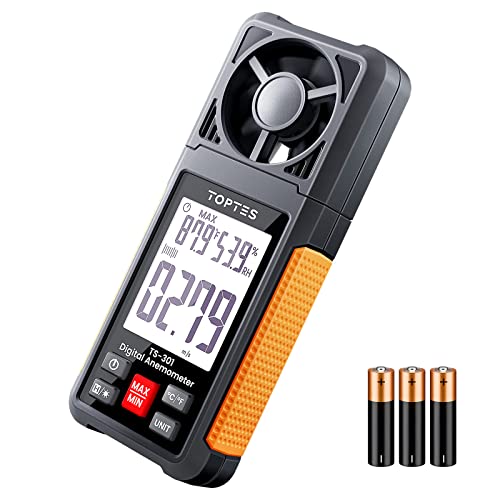
- Large 2.26-inch backlit display
- Six wind-speed measurement units
- Measures temperature and humidity
Best For: Outdoor activities and basic HVAC airflow checks
Best for Smart HVAC Testing
Testo 410i Smart Vane Anemometer

- Measures velocity, volume flow, and temperature
- Calculates volume flow from duct dimensions
- Supports timed and multipoint averaging
Best For: Smartphone-based HVAC testing and balancing
Best for Versatile Handheld Use
HoldPeak 866B Digital Anemometer

- Measures wind speed and temperature
- Provides max, min, and average readings
- Includes tripod mount and protective pouch
Best For: Outdoor wind checks and low-airflow HVAC work
Best for HVAC Data Logging
BTMETER BT-846A Pro CFM Anemometer

- Measures wind speed, temperature, CFM, and CMM
- Stores 600 groups of measurements
- Exports data to a PC
Best For: HVAC troubleshooting, balancing, and recorded measurements
Best Versatile Pick
Mcbazel 3-in-1 Digital Anemometer

- Measures wind speed, temperature, and Beaufort level
- Offers five wind-speed unit options
- Backlit display with MAX/MIN/AVG and data hold
Best For: General HVAC, sailing, fishing, and outdoor monitoring
Best Professional HVAC Pick
testo 405i Wireless Anemometer

- Measures velocity, temperature, and in-duct airflow
- 15-inch telescopic shaft reaches confined spaces
- Bluetooth app supports graphs, storage, and reports
Best For: Professional HVAC inspections and airflow documentation
Best Compact Pick
BTMETER BT-816B Wind Speed Meter

- Measures wind speed, temperature, and wind chill
- Provides current, maximum, and average modes
- Lightweight 53-gram body with backlit LCD
Best For: Portable outdoor measurements and quick HVAC spot checks
Best with Extra Features
Kethvoz KE-846A CFM Anemometer

- Measures speed, temperature, and CFM/CMM airflow
- 2-meter split sensor helps reach overhead ducts
- Stores up to 600 groups of measurements
Best For: HVAC troubleshooting, airflow balancing, and duct measurements
Connected Testing Choice
BTMETER BT-100APP Bluetooth Anemometer

- Bluetooth app supports logging and file export
- Displays wind speed, temperature, and wind chill
- Lightweight body includes a tripod mount
Best For: App-based logging, portable testing, and outdoor activities
Simple 3-in-1 Option

- Measures speed, temperature, and Beaufort wind level
- Speed range starts at 0.06 m/s
- Includes MAX, MIN, AVG, hold, and backlight modes
Best For: Basic HVAC, sailing, surfing, and outdoor wind checks
Best for Clear Outdoor Readings – TopTes TS-301
The TopTes TS-301 is a practical choice among anemometers for outdoor activities and basic indoor airflow checks. Its large backlit display, six selectable wind-speed units, and built-in temperature and humidity readings make it easy to monitor changing conditions.
Best For: Sailing, windsurfing, drone flying, golf, shooting, hiking, and general HVAC airflow checks.
Pros:
- Large 2.26-inch backlit LCD is easy to read.
- Measures wind speed in six units, including mph, knots, and m/s.
- Also measures relative humidity and temperature.
- Includes three AAA batteries, a user manual, and a carry pouch.
Cons:
- Temperature and humidity sensors may need at least 30 minutes to adjust to a new environment.
- Automatically shuts down after 10 minutes of inactivity.
Choose this model if you want a lightweight, pocket-friendly anemometer with broad unit support and useful environmental readings for everyday use.
Best for Smart HVAC Testing – Testo 410i Smart Vane Anemometer
Testo 0560 1410 410I Vane Anemometer Smart and Wireless Probe, 1" Height, 2" Width, 6" Length
Check Price On AmazonThe Testo 410i is a specialized option among anemometers for technicians who need smartphone-operated measurements. This vane probe measures air velocity, volume flow, and temperature, while supporting timed or multipoint averaging for more consistent airflow profiles.
Best For: HVAC professionals measuring duct airflow, checking registers, and balancing air systems.
Pros:
- Measures air velocity, volume flow, and temperature.
- Automatically calculates volume flow after duct dimensions are entered.
- Supports timed and multipoint averaging for airflow profiles.
- Multiple smart probes can be used to measure several outlets simultaneously.
Cons:
- Smartphone operation may be less convenient for users seeking a standalone meter.
- Its compact probe format is more specialized than a general-purpose handheld anemometer.
This is a strong fit when coordinated HVAC measurements and airflow balancing matter more than a simple display-based handheld design.
Best for Versatile Handheld Use – HoldPeak 866B Digital Anemometer
The HoldPeak 866B is one of the more versatile handheld anemometers for outdoor wind checks and low-airflow HVAC work. It combines multiple wind-speed functions with wind temperature, min/max/average readings, a backlight, and a tripod mount.
Best For: Drone flying, sailing, surfing, shooting, boating, and checking airflow at vents or ducts.
Pros:
- Measures wind speeds from 0.67 to 67.1 mph with stated accuracy of ±2% of readings.
- Provides maximum, minimum, and average wind-speed readings.
- Includes a tripod hole, hand strap, backlight, and protective carrying pouch.
- Supports five wind-speed units and Celsius or Fahrenheit temperature readings.
Cons:
- Its stated wind-speed range is lower than the 100-mph range of some professional meters.
- Includes a one-year warranty, shorter than some competing options.
Consider the 866B if you want a capable handheld anemometer with useful statistics, mounting flexibility, and accessories for field work.
Best for HVAC Data Logging – BTMETER BT-846A Pro CFM Anemometer
The BTMETER BT-846A stands out among anemometers for HVAC measurement projects that require records and analysis. It measures wind velocity, temperature, and CFM or CMM airflow, stores up to 600 groups of data, and can export measurements to a PC.
Best For: HVAC troubleshooting, register testing, air balancing, and dust-collection measurements.
Pros:
- Measures wind speed up to 100 mph and supports CFM/CMM airflow readings.
- Stores 600 groups of measurements and exports data to a PC.
- Extendable separated vane sensor helps with hard-to-reach testing.
- Supports current, maximum, minimum, 2/3 maximum, and average readings.
Cons:
- At 1.7 pounds, it is heavier than the compact handheld models in this roundup.
- Its advanced data-storage features may be unnecessary for occasional outdoor wind checks.
For users who need documented airflow measurements, the BT-846A offers the most comprehensive logging and CFM-focused feature set here.
Best Versatile Pick – Mcbazel 3-in-1 Digital Anemometer
If you want anemometers for general indoor and outdoor use, the Mcbazel 3-in-1 is a flexible choice. It measures wind speed, wind temperature, and Beaufort wind level, while its backlit display keeps readings visible in low-light conditions.
Best For: HVAC checks, sailing, fishing, and everyday wind monitoring.
Pros:
- Measures wind speed, temperature, and Beaufort scale level simultaneously.
- Supports m/s, km/h, knots, ft/s, and mph.
- Includes MAX, MIN, AVG, data hold, backlight, and low-battery functions.
Cons:
- AAA batteries are required but not included.
- Its general-purpose design may be less specialized than a professional HVAC probe.
The Mcbazel stands out for combining several useful measurements in a compact, portable meter. It is a practical option when you want straightforward readings across multiple activities without a more specialized setup.
Best Professional HVAC Pick – testo 405i Wireless Anemometer
For professional airflow work, the testo 405i is one of the more specialized anemometers in this group. Its hot-wire sensor measures air velocity and temperature, while the extendable telescopic shaft helps reach ducts, vents, and other confined areas.
Best For: HVAC inspections, air-conditioning service, and professional in-duct airflow measurements.
Pros:
- Measures air velocity, temperature, and in-duct airflow.
- Telescopic shaft extends to 15 inches for hard-to-reach areas.
- Bluetooth connectivity and Smart Probe App support readings, graphs, storage, and reports.
Cons:
- App operation requires a compatible smartphone or tablet.
- Its professional HVAC focus may be more than casual users need.
The testo 405i is the strongest fit when measurement access and reporting matter. Its hinged shaft and app-based workflow make it particularly useful for technicians who need to inspect airflow in ducts or document service results.
Best Compact Pick – BTMETER BT-816B Wind Speed Meter
The BTMETER BT-816B is a compact option for shoppers comparing portable anemometers. It measures wind speed and temperature, adds real-time wind chill, and uses a backlit LCD for convenient one-handed readings in dim conditions.
Best For: Sailing, climbing, shooting, golf, HVAC spot checks, and other portable outdoor measurements.
Pros:
- Measures wind speed from 0.3 to 30 m/s and displays temperature and wind chill.
- Provides current, maximum, and average wind-speed modes.
- Lightweight 53-gram design includes a backlit display and lanyard.
Cons:
- Its compact size may mean a smaller display than larger handheld meters.
- Specified wind-speed accuracy is ±5% of the reading.
Choose the BT-816B if portability is a priority. Wind-chill measurement adds useful context for outdoor activities, while the selectable units and measurement modes make it adaptable for quick checks in different settings.
Best with Extra Features – Kethvoz KE-846A CFM Anemometer
Among anemometers for HVAC work, the Kethvoz KE-846A stands out for its split sensor, broad measurement range, and built-in airflow calculations. It measures wind speed, temperature, and air volume, making it useful for checking ducts, vents, dryer outlets, and dust-collection systems.
Best For: HVAC technicians who need extended-reach measurements and direct CFM/CMM readings.
Pros:
- Measures air speed from 0.3 to 45 m/s and airflow up to 999,900 CFM.
- Separate sensor extends up to 2 meters for overhead or hard-to-reach airflow checks.
- Offers MAX, MIN, average, and 2/3 MAX modes, plus 600 groups of data storage.
- Includes a backlit display, data hold, carrying case, and lifetime technical support.
Cons:
- Its professional HVAC-focused feature set may be more than casual users need.
- At 0.9 kg, it is heavier than some compact handheld anemometers.
The KE-846A is the most specialized option here for airflow balancing and service work. Its split probe and direct volume readings add practical value when measuring ducts or vents, while data logging supports later recordkeeping.
Connected Testing Choice – BTMETER BT-100APP Bluetooth Anemometer
The BTMETER BT-100APP is one of the more versatile anemometers for users who want portable measurements and phone-based logging. It displays wind speed, temperature, wind chill, and battery status, while Bluetooth connectivity lets compatible mobile devices record and export results.
Best For: Users who want app data logging for HVAC checks, weather activities, sailing, or tripod-mounted testing.
Pros:
- Connects to iPhone, iPad, Android phones, and tablets through its Bluetooth app.
- Logs data and supports export in Excel or TXT formats.
- Measures wind speed in five units and includes temperature and wind-chill readings.
- Compact 155-gram design includes a tripod mounting hole and automatic backlight controls.
Cons:
- Airflow in CFM must be calculated manually using velocity and duct area.
- Its stated wind-speed accuracy is ±5% of readings, less precise than the Kethvoz model.
This BTMETER is a strong fit when documentation and wireless access matter as much as the live reading. It is especially convenient for repeated tests because the app can log and export measurements, although it does not calculate CFM directly.
Simple 3-in-1 Option – Soonkoda Handheld Wind Meter
The Soonkoda handheld meter keeps anemometer functions straightforward by combining wind speed, wind temperature, and wind level readings. Its wide range of stated uses includes HVAC, ventilation, sailing, surfing, aviation, and other outdoor activities.
Best For: Buyers seeking a basic multi-purpose wind meter with Beaufort readings and essential hold and memory functions.
Pros:
- Measures wind speed from 0.06 to 30.0 m/s.
- Displays wind speed and temperature together on a double-line LCD.
- Includes Beaufort wind levels from 1 to 12 and five speed units.
- Provides MAX, MIN, AVG, data hold, backlight, and low-battery indicators.
Cons:
- The supplied specifications do not mention Bluetooth, app support, or data export.
- The notes do not specify a direct CFM calculation function.
- Product dimensions are listed as 0.01 inches, which is insufficient for judging its physical size.
The Soonkoda is a sensible entry-level choice for general wind checks when speed, temperature, and wind-level readings are enough. It offers useful essentials without the more specialized airflow and connectivity features found on the other options.
How We Picked These Anemometers
We selected these Anemometers to represent the main buying choices available: straightforward handheld wind meters, HVAC-focused CFM testers, vane probes, Bluetooth-connected instruments, and models with added temperature or data-logging functions. We considered measurement range, display readability, portability, airflow capabilities, connectivity, probe design, and the type of user each model is best suited to.
Because specifications and included accessories can vary by listing, verify the manufacturer’s stated accuracy, supported units, battery type, and calibration information before purchase—especially for professional HVAC or compliance-related work.
Quick Comparison
| Best For | Look For | Product Types to Consider |
|---|---|---|
| Outdoor wind checks | Wide wind-speed range, backlit display, compact body | Basic handheld meters |
| HVAC airflow testing | CFM calculations, temperature readings, duct probe | Vane meters and telescoping probes |
| Remote monitoring | Bluetooth, app support, stored readings | Smart or Bluetooth anemometers |
| Job documentation | Data logging, PC export, multiple units | Data-storage models |
Key Buying Factors for Anemometers
Measurement Range and Accuracy
Choose a range that covers your expected conditions without sacrificing low-speed sensitivity. Outdoor users may prioritize maximum wind speed, while HVAC technicians often need reliable readings at modest airflow levels. For professional diagnostics, check stated accuracy, resolution, and calibration support rather than relying on range alone.
Wind Speed, CFM, and Temperature Functions
A wind-speed meter is sufficient for sailing, drone flying, ventilation checks, and general weather observations. For ductwork and registers, CFM calculations are more useful because they combine air velocity with area measurements. Temperature sensing can help identify supply-air differences and troubleshoot comfort problems.
Display, Probe, and Portability
A large backlit screen is useful in dim mechanical rooms or outdoors. Vane meters are simple and quick for open airflow, while telescoping probes are better for reaching ducts and grilles. If you carry the instrument frequently, prioritize a compact design, protective case, accessible controls, and a clear low-battery indicator.
Connectivity and Data Handling
Bluetooth and app-enabled models can simplify remote readings, recordkeeping, and sharing results. Built-in memory or PC export is valuable when you need to compare multiple locations or document service work. For occasional checks, these features may add cost without improving your results.
Who Should Buy Which Anemometers?
- For casual outdoor use: Choose a compact handheld model with a readable backlight and the wind-speed units you use most.
- For HVAC technicians: Select a CFM-capable meter, preferably with temperature measurement and a probe suited to registers or ducts.
- For repeated inspections: Favor data logging, PC export, Bluetooth, or app support to reduce manual note-taking.
- For sailing, surfing, or drone flying: Prioritize portability, fast readings, a broad speed range, and simple one-handed operation.
- For demanding professional work: Verify accuracy specifications, calibration options, and manufacturer support before treating readings as compliance documentation.