
The best advanced robotics sets turn abstract programming concepts into hands-on projects involving sensors, motors, cameras, robotic arms, and autonomous movement. The right kit depends on the learner’s age, coding experience, project goals, and tolerance for assembly and troubleshooting.
These 10 options range from Arduino-compatible robot cars and beginner-friendly building kits to open-source 6-axis arms designed for AI vision and imitation learning. Use the guide below to compare capabilities and choose a set that fits both current skills and future ambitions.
Best 10 Advanced Robotics Sets Picks for 2026
Advanced AI Research Pick

- LeRobot-compatible imitation learning platform
- Dual cameras for manipulation and environment vision
- 12 high-torque servos with calibration tools
Best For: Adult makers and AI robotics researchers
Advanced STEM Explorer

- Three robot configurations in one kit
- Scratch and Arduino programming support
- Sensors, gyroscope, LEDs, and Bluetooth included
Best For: Kids, families, classrooms, and coding clubs
Connected Coding Favorite

- FPV camera with app and Wi-Fi control
- Line tracking and ultrasonic obstacle avoidance
- Guided wiring with Arduino programming
Best For: STEM learners and family coding projects
Mechanical Building Challenge

- 975-piece tracked robotic-arm build
- Gripper, bucket, and drill attachments
- RC control plus three smart app modes
Best For: Hands-on STEM builders ages 8 and up
Best Advanced AI Arm

- 6DOF aluminum arm with smart bus servos
- Arduino-compatible ESP32 platform
- 200+ tutorials and open-source resources
Best For: Advanced STEM learners and adult makers
Best Build-and-Play Set

- 975-piece mechanical construction kit
- Three interchangeable tool heads
- Remote control and app action programming
Best For: Kids ages 8–14 and beginner STEM builders
Best Multi-Language AI Kit
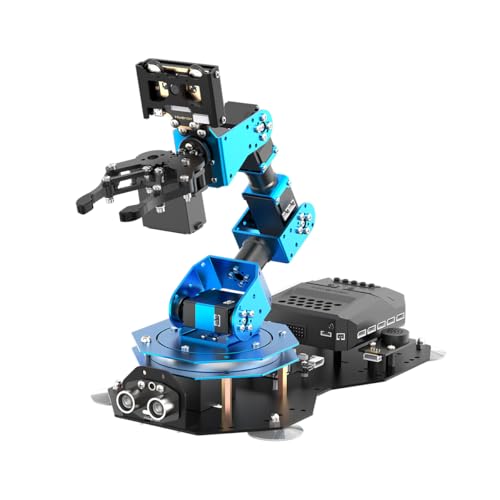
- Arduino, Scratch, and Python support
- Integrated AI vision and voice modules
- 6DOF aluminum arm with expandable controller
Best For: Students progressing from beginner to advanced coding
Best Modular Build
ACEBOTT 4-in-1 Robot Arm Tank Car

- Four modular robot configurations
- 5DOF arm with ESP32 control
- Arduino, Scratch, app, and remote support
Best For: Kids and teens 12+ exploring varied robot builds
Best Open-Source Arm
miniArm Arduino 5DOF Robotic Arm Kit

- Arduino-compatible Atmega328 platform
- Open-source code and expansion ports
- Aluminum arm with Bluetooth control
Best For: Older teens and adults building custom arm projects
Best Omnidirectional Car
ACEBOTT 5DOF Mecanum Arm Robot

- 5DOF arm with metal-gear servos
- Mecanum wheels move in multiple directions
- Arduino, Python, and Blockly support
Best For: Teens and adults exploring mobile robot coding
Advanced AI Research Pick – SO-ARM101 6-Axis Robotic Arm
For advanced robotics sets aimed at serious experimentation, the Hiwonder SO-ARM101 combines a six-axis arm, AI vision, bus servos, and open-source compatibility. Its assembled format makes it a practical starting point for researchers and experienced hobbyists exploring imitation learning.
Best For: Adult makers, robotics researchers, and programmers working with AI, computer vision, and LeRobot.
Pros:
- Supports end-to-end imitation learning through the LeRobot open-source framework.
- Dual-camera setup supports both close manipulation and wider environmental awareness.
- Twelve high-torque bus servos and included debugging software support smooth motion and calibration.
Cons:
- Its 16+ recommendation and advanced AI focus may be excessive for beginners.
- The assembled advanced kit is less focused on hands-on construction.
This is the most research-oriented option in the group. Choose it when AI experimentation and precise robotic-arm control matter more than a traditional build-and-play experience.
Advanced STEM Explorer – Makeblock mBot Ranger 3-in-1
The Makeblock mBot Ranger is one of the more versatile advanced robotics sets for children and families. Its three transformable designs, metal construction, and Scratch and Arduino support create a broad path from guided building to more independent programming.
Best For: Kids ages 10 and up, families, classrooms, and coding clubs seeking multiple robot projects in one kit.
Pros:
- Builds as a tracked Land Raider, self-balancing Nervous Bird, or three-wheel Dashing Raptor.
- Supports Scratch and Arduino programming through the mBlock5 app.
- Includes multiple sensors, RGB LEDs, a buzzer, Bluetooth, and a gyroscope.
- Metal parts, tracks, and strong motors support indoor and outdoor experiments.
Cons:
- Six AA batteries or lithium batteries are required and not included.
- Its many configurations and modules may require more setup time than simpler kits.
The Ranger stands out for variety and progression. It is a strong choice when a learner wants to keep rebuilding, testing different drive systems, and advancing from block coding toward Arduino.
Connected Coding Favorite – ELEGOO UNO R3 Smart Robot Car
The ELEGOO UNO R3 Smart Robot Car is a practical choice among advanced robotics sets for learners who want to build, code, and drive a working vehicle. It combines app and IR control with FPV video, line tracking, and obstacle avoidance for immediately visible programming results.
Best For: Beginners and intermediate students, STEM classes, coding clubs, and family projects with adult guidance.
Pros:
- Offers FPV video through an ESP32-WROVER-based camera and Wi-Fi module.
- Supports line tracking, obstacle avoidance, auto follow, app control, and IR control.
- Keyed connectors, an illustrated tutorial, and example programs make assembly approachable.
- Includes a rechargeable 2000 mAh lithium-ion battery.
Cons:
- First-time builders may still need adult guidance, particularly during wiring and setup.
- Its acrylic and plastic construction is more focused on learning than heavy-duty use.
This kit offers a balanced introduction to sensors, electronics, Arduino programming, and wireless control. It is especially appealing when live camera feedback and mobile operation are priorities.
Mechanical Building Challenge – 3-in-1 Technical Robotic Arm
This 3-in-1 technical arm is a hands-on option among advanced robotics sets, pairing a 975-piece tracked build with a motorized articulated arm. Interchangeable attachments and app-based control give builders several ways to explore movement, sequencing, and mechanical problem solving.
Best For: Kids ages 8 and up, teens, and adults who enjoy construction-focused STEM projects and remote-controlled models.
Pros:
- Three interchangeable attachments provide gripping, scooping, and simulated drilling functions.
- Four motors power the tracked chassis, arm lifting, and attachment movement.
- App modes include drag-and-drop programming, gyroscope control, and custom path drawing.
- The 975-piece build provides a substantial construction and display project.
Cons:
- The large piece count can make assembly time-consuming.
- Its plastic interlocking-block design is intended for STEM play and display rather than industrial work.
This is a good fit for builders who value the construction process as much as the finished robot. The combination of tracks, arm functions, and app modes offers more variety than a basic remote-control vehicle.
Best Advanced AI Arm – LeArmAI Advanced Kit
For shoppers comparing advanced robotics sets for serious STEM learning, the LeArmAI Advanced Kit combines an aluminum 6DOF arm with Arduino-compatible programming, smart bus servos, and inverse-kinematics motion planning. Its expansion ports and extensive learning materials make it suited to hands-on experimentation rather than simple remote-controlled play.
Best For: Older teens and adults exploring Arduino programming, robotic-arm mechanics, AI sensors, and secondary development.
Pros:
- ESP32 controller with Arduino compatibility, Bluetooth, and expansion ports.
- Six smart bus servos and inverse kinematics support precise, smooth movement.
- Supports AI vision, voice, ultrasonic, and acceleration sensor projects.
- Includes 200+ tutorials, sample experiments, open-source code, and schematics.
Cons:
- Its 16-plus recommendation and programming focus may be too advanced for younger children.
- At 3.08 kg, it is better suited to a tabletop workspace than frequent relocation.
- Advanced sensor-based projects may require additional compatible modules.
Choose this set when expandability and structured learning resources matter more than quick assembly. It offers a strong foundation for progressively complex Arduino and AI robotics projects.
Best Build-and-Play Set – 3-in-1 Tracked Robot Arm
This 3-in-1 set is one of the more accessible advanced robotics sets for builders who want mechanical construction plus hands-on control. The 975-piece model combines a tracked base with interchangeable gripper, drill, and bucket attachments, while app programming and remote control add interactive play after assembly.
Best For: Kids ages 8–14, teens, and families seeking a construction-focused STEM gift with remote and app control.
Pros:
- Includes 975 building pieces for an involved mechanical build.
- Three interchangeable tool heads provide gripper, drill, and bucket functions.
- Tracked undercarriage is designed for movement, climbing, and obstacle crossing.
- Offers both remote control and programmed action sequences through the app.
Cons:
- Its plastic construction is less suited to advanced electronics experimentation than aluminum robotic-arm kits.
- The app programming features are described as action sequencing rather than full Arduino, Scratch, or Python development.
- Assembly requires time and attention before the robot can be operated.
This is a practical choice for younger builders who value the satisfaction of assembling a working machine. It emphasizes mechanical play and accessible controls over open-ended AI or coding development.
Best Multi-Language AI Kit – xArmAI Advanced Kit
For learners who want advanced robotics sets with a clear software progression, the xArmAI Advanced Kit supports Arduino, Scratch, and Python. Its 6DOF aluminum arm adds AI vision and voice interaction, while the CoreX controller provides ports for compatible servos, motors, and sensors.
Best For: Students and adult beginners developing coding skills across block-based and text-based programming environments.
Pros:
- Supports Arduino, Scratch, and Python for multiple learning levels.
- WonderCam vision and WonderEcho voice modules enable recognition, tracking, broadcasting, and voice control.
- Inverse kinematics and intelligent serial bus servos support precise motion planning.
- Multiple controller ports support secondary development with compatible sensors and motors.
Cons:
- The 15-plus recommendation makes it less appropriate for younger children.
- Its AI-focused features may involve a steeper learning curve than basic robotic-arm kits.
- Additional experiments may require compatible sensors or other hardware beyond the included kit.
The xArmAI stands out when programming flexibility is a priority. Its Scratch-to-Python pathway and integrated vision and voice modules give learners room to move from introductory coding into more ambitious AI projects.
Best Modular Build – ACEBOTT 4-in-1 Robot Arm Tank Car
For shoppers seeking advanced robotics sets with multiple build paths, this ACEBOTT kit combines a programmable 5DOF robotic arm with a robot car and tank-track expansion. Arduino and Scratch compatibility, guided tutorials, and app or remote control make it a practical option for hands-on STEM learning.
Best For: Kids and teens 12+ who want varied builds, beginner-friendly coding guidance, and indoor or outdoor robot play.
Pros:
- Supports four-in-one modular configurations, including an arm car, tank robot, and combined arm tank.
- Includes a 5DOF arm, ESP32 controller, 16 tutorials, and HD assembly videos.
- Rubber tank treads are designed for grass, gravel, slopes, and carpet.
- Works with Arduino and Scratch and offers app and IR remote control.
Cons:
- The kit is recommended for ages 12 and up, so it may be too advanced for younger children.
- The many configurations may require considerable assembly and setup time.
This is the most versatile choice of the three for families, classrooms, or STEM programs that value replayable building projects. Its tutorials provide structure while the modular designs leave room for experimentation.
Best Open-Source Arm – miniArm Arduino 5DOF Robotic Arm Kit
This miniArm is one of the more development-focused advanced robotics sets, built around an Atmega328 platform with Arduino compatibility and open-source programs. Its aluminum construction, knob controller, Bluetooth module, and sensor expansion ports suit learners who want to move beyond basic assembly.
Best For: Older teens and adults interested in Arduino programming, open-source experimentation, and adding sensors to a robotic arm.
Pros:
- Open-source programs, tutorials, and secondary-development examples support customization.
- Includes a 6-channel knob controller, Bluetooth module, and high-precision digital servos.
- Provides expansion ports for optional sensors and modules such as an ESP32 Cam or accelerometer.
- Aluminum construction gives the arm a more substantial engineering-oriented design.
Cons:
- The manufacturer recommends it for ages 17 and up, limiting its suitability for younger learners.
- The Starter Kit does not include the listed ultrasonic, touch, acceleration, or ESP32 Cam modules.
Choose this kit when programmability and secondary development matter more than a ready-made robot vehicle. It offers a strong platform for experimentation, but buyers should account for the Starter Kit’s limited included accessories.
Best Omnidirectional Car – ACEBOTT 5DOF Mecanum Arm Robot
For advanced robotics sets that emphasize movement as well as manipulation, this ACEBOTT combines a 5DOF arm with a four-wheel Mecanum-drive car. Its ESP32 controller supports Arduino, Python, and Blockly programming, while app and infrared controls make testing the robot accessible after assembly.
Best For: Teens and adults who want a mobile robot arm for coding projects, navigation experiments, and hands-on vehicle control.
Pros:
- The 5DOF metal-gear arm supports grabbing, lifting, and placing objects.
- Mecanum wheels enable forward, sideways, diagonal, rotational, and drifting movements.
- Includes ultrasonic and infrared sensors for obstacle avoidance, cruising, and follow-mode functions.
- Supports Arduino, Python, and Blockly, with a pre-burned program and paper assembly manual.
Cons:
- Batteries are not included.
- The advanced drive system and arm may require patience during assembly and programming.
- Its recommended age is 12 and up, rather than for young children.
This model is a strong fit for users who want a mobile platform with unusual maneuverability and a functional robotic arm. The pre-burned program helps shorten the path from assembly to first use, while the multiple programming options support deeper projects.
How We Picked These Advanced Robotics Sets
We focused on kits that offer more than simple remote-controlled movement. Each selection supports meaningful building, programming, or engineering work through features such as Arduino compatibility, Scratch or Python support, sensor integration, camera systems, multi-axis arms, tank or car platforms, and app or remote control.
We also considered the learning curve, project flexibility, included hardware, age suitability, and upgrade potential. Because Advanced Robotics Sets vary widely, a capable arm kit may be a better choice for one buyer while a mobile robot platform is more useful for another.
Quick Comparison
| Best For | Look For |
|---|---|
| AI and computer vision | Camera support, open-source software, and sufficient processing or controller compatibility |
| Mechanical engineering | Multi-axis arms, high-torque servos, stable frames, and repeatable movement |
| Coding practice | Arduino, Python, Scratch, Blockly, or clearly documented programming examples |
| Younger learners | Structured builds, app or remote control, durable parts, and age-appropriate instructions |
| Mobile robotics | Four-wheel drive, tank tracks, obstacle sensors, cameras, and expandable wiring |
Key Buying Factors for Advanced Robotics Sets
Programming and Compatibility
Check which boards, languages, and software environments the kit supports. Arduino compatibility is useful for experimentation, while Python, Scratch, and Blockly can make projects more accessible or enable more advanced automation. Confirm that libraries, example code, and wiring diagrams are available before buying.
Degrees of Freedom and Mechanical Quality
For robotic arms, degrees of freedom determine how naturally the arm can position its gripper. Five-axis arms are versatile for educational projects; six-axis systems offer more control for imitation learning and complex motion. Servo torque, gear construction, payload, and calibration matter just as much as the axis count.
Sensors, Cameras, and Expansion
A camera can support vision-based tracking, object recognition, or voice-and-vision demonstrations, but it does not guarantee advanced autonomy. Look for accessible sensor ports, documented APIs, and room to add ultrasonic, infrared, or other modules.
Assembly and Support
Advanced kits often require careful mechanical assembly and troubleshooting. Review the included tools, instructions, power requirements, replacement-part availability, and community documentation. A slightly simpler kit with strong support may produce better results than a more capable kit with limited guidance.
Who Should Buy Which Advanced Robotics Sets?
Choose an AI-focused 5DOF or 6DOF arm if your priority is computer vision, voice interaction, imitation learning, or robotic manipulation. Choose an Arduino robot car if you want a mobile platform for sensors, navigation, and autonomous driving experiments. A 3-in-1 building set is a practical option for learners who want variety and a more guided introduction to robotics.
For older children and teens, prioritize clear programming support and expandability over flashy features. Adults, engineering students, and experienced makers should favor open-source control, higher-torque servos, reliable documentation, and accessible hardware interfaces. Beginners should select a kit that matches their patience and available project time, not simply the one with the highest specification.