
Space station statistics put hard numbers on humanity’s permanent, crew-tended infrastructure in low Earth orbit—how large it is, how many people it can support, and how the two active stations compare on capacity and scale.
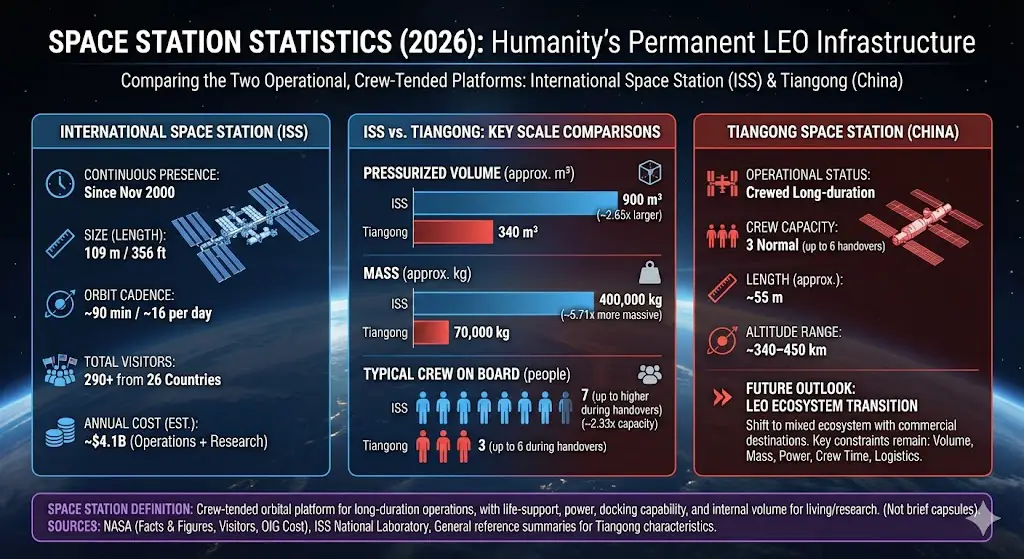
Space Station Statistics (Top Highlights)
- Operational long-duration space stations in orbit: 2 (the International Space Station and China’s Tiangong).
- Continuous human presence on the ISS: since November 2000.
- ISS size: 109 m end-to-end (356 ft).
- ISS pressurized volume: approximately 900 m³.
- ISS mass (approx.): 400,000 kg (varies with visiting vehicles).
- ISS orbit cadence: about 90 minutes per orbit, roughly 16 orbits per day.
- ISS visitors: 290+ individuals from 26 countries.
- ISS annual cost (operations + related research): about $4.1B per year (widely cited estimate).
- Tiangong crew capacity: 3 normally, up to 6 during crew handovers.
- Tiangong pressurized volume (approx.): 340 m³.
- Tiangong mass (approx.): 70,000 kg.
What Counts as a Space Station?
A space station is typically defined as a crew-tended orbital platform designed for long-duration operations, with life-support systems, power generation, docking/berthing capability for visiting spacecraft, and internal volume for living and research. The statistics below focus on stations intended for repeated crew rotations and ongoing utilization (not brief crewed capsules or short-lived laboratory missions).
How Many Space Stations Are Currently in Orbit?
As of 2026, there are two operational long-duration space stations in orbit: the International Space Station (ISS) and China’s Tiangong. Both support recurring crew rotations, visiting spacecraft, and a steady research cadence in microgravity.
International Space Station Statistics
ISS By the Numbers
| Metric | Value |
|---|---|
| Continuous occupancy | Since November 2000 |
| Length (end-to-end) | 109 m (356 ft) |
| Pressurized volume | ~900 m³ |
| Mass (approx.) | ~400,000 kg (varies with visiting vehicles) |
| Typical crew on board | 7 people (often higher during handovers) |
| Orbits | ~90 minutes per orbit; ~16 orbits per day |
| Visitors | 290+ individuals from 26 countries |
What Those ISS Numbers Mean in Practice
The ISS is best thought of as a permanently crewed laboratory with a logistics pipeline. The headline physical numbers (mass and volume) translate into usable lab racks, crew quarters, exercise space, storage, and docking ports that enable a continuous flow of research hardware, supplies, and experiments.
Operationally, “continuous occupancy” matters because it reflects the station’s ability to maintain life support, power, thermal control, communications, and maintenance cycles without interruption. The steady cadence of crew rotations, visiting vehicles, and ongoing research is the core purpose of a long-duration station.
ISS Economics and Oversight (Context)
Large, crewed orbital infrastructure is expensive to operate. A commonly cited estimate places ISS operations and related research spending at about $4.1B per year. This figure is often used as a shorthand indicator of the scale of resources required to keep a permanently crewed outpost functioning safely and productively.
Tiangong Space Station Statistics
Tiangong By the Numbers (Commonly Reported)
| Metric | Value |
|---|---|
| Operational status | Crewed long-duration station (major assembly completed in the early 2020s) |
| Orbit altitude range (approx.) | ~340–450 km |
| Crew capacity | 3 normally; up to 6 during crew replacement |
| Length (approx.) | ~55 m |
| Mass (approx.) | ~70,000 kg |
| Pressurized volume (approx.) | ~340 m³ |
Note: Publicly stated figures for Tiangong can vary by source and by whether docked vehicles are included; the values above are widely cited approximations intended for high-level comparison.
ISS vs Tiangong: Key Comparisons
Using the commonly reported comparison figures above, the ISS is larger on the two most intuitive “capacity” metrics: pressurized volume and mass. On these inputs, the ISS provides more internal room for crew and equipment, and more integrated hardware overall.
| Metric | ISS | Tiangong | Simple takeaway |
|---|---|---|---|
| Pressurized volume | ~900 m³ | ~340 m³ | ISS is about 2.65× the pressurized volume |
| Mass (approx.) | ~400,000 kg | ~70,000 kg | ISS is about 5.71× the mass |
| Typical crew | 7 | 3 | ISS typically supports about 2.33× as many people |
| Typical operating concept | Multi-partner station with long-running international utilization | National station with recurring crew and research missions | Different governance, similar “always-on” station role |
Space Station Comparison Charts
Pressurized Volume: ISS vs Tiangong (m³)
| Label | Bar | Value | ||
|---|---|---|---|---|
| ISS |
| 900 | ||
| Tiangong |
| 340 |
Max = 900. Widths: ISS 100.00%, Tiangong 37.78%.
Mass: ISS vs Tiangong (kg)
| Label | Bar | Value | ||
|---|---|---|---|---|
| ISS |
| 400000 | ||
| Tiangong |
| 70000 |
Max = 400000. Widths: ISS 100.00%, Tiangong 17.50%.
Typical Crew On Board: ISS vs Tiangong (people)
| Label | Bar | Value | ||
|---|---|---|---|---|
| ISS |
| 7 | ||
| Tiangong |
| 3 |
Max = 7. Widths: ISS 100.00%, Tiangong 42.86%.
What Happens Next in Low Earth Orbit?
Space station strategy in LEO is shifting from a single government-led outpost to a more mixed ecosystem. The ISS has been central to long-duration human spaceflight for decades, while Tiangong provides a separate, continuously utilized platform. Looking ahead, policy and industry efforts have emphasized transitioning research and crew operations toward commercial LEO destinations over time, while maintaining safe, uninterrupted access to microgravity for science, technology demonstrations, and crewed operations.
In practical terms, the next phase is driven by the same core constraints reflected in the numbers above: pressurized volume, mass and power capability, crew time, and logistics. Any replacement station must deliver enough internal capacity and visiting-vehicle throughput to sustain continuous operations at a manageable cost.
Sources
- NASA — International Space Station: Facts and Figures
- NASA — Space Station visitors by country
- NASA Office of Inspector General — ISS cost and oversight reporting (annual cost figure commonly cited)
- ISS National Laboratory — utilization and program background materials
- General reference summaries for Tiangong technical characteristics (crew capacity, approximate mass and volume)