
The RIX Titan-T3 Thermal Monocular LRF is built for buyers who want a serious thermal spotting tool with rangefinding and ballistic support in one unit.
This review focuses on what the listing actually promises, where that matters, and who is likely to get the most value from it.
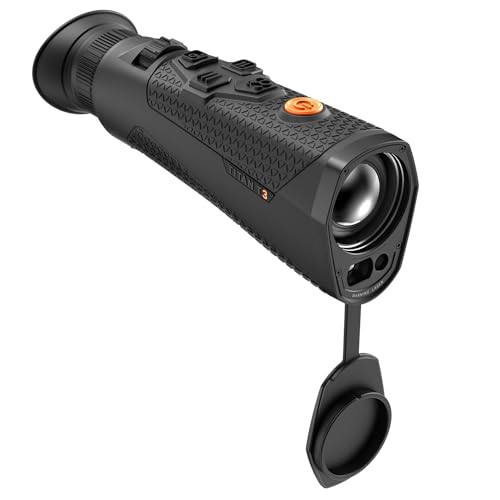
Titan T3 Review Summary
The RIX Titan-T3 makes sense for users who want more than basic thermal viewing.
Its combination of a 25mm lens, 384×288 thermal sensor, integrated laser rangefinder, ballistic calculator, and 1920×1080 OLED display points to a device aimed at hunting, field observation, and safety work where identification and distance judgment matter.
Best for buyers who need a feature-rich thermal monocular, not a stripped-down one. The listing suggests a device that prioritizes clarity, stability, and utility in the field.
If you care about seeing detail in darkness and want distance tools built in, the Titan-T3 has a coherent feature set.
If you only need occasional thermal scanning, some of these capabilities may be more than you need.
Review Scorecard
| Category | Score | Rationale |
|---|---|---|
| Thermal image quality | 8/10 | 384×288 resolution, 12μm detector, and a 1920×1080 OLED display point to strong clarity for a handheld monocular. |
| Distance tools | 9/10 | The integrated laser rangefinder and free ballistic calculator are major advantages for hunting and long-range spotting. |
| Low-light performance | 8/10 | The 25mm F0.9 lens is designed to gather more light and support clear viewing in difficult conditions. |
| Ease of use | 8/10 | One-hand operation and ergonomic button placement suggest practical field handling. |
| Image stability | 8/10 | Electronic image stabilization is a meaningful benefit when moving or dealing with vehicle vibration. |
| Versatility | 9/10 | Thermal viewing, rangefinding, ballistic calculation, zoom enhancement, and stabilization make it broadly useful. |
| Value for feature set | 8/10 | The listing packs in advanced functions that usually matter to committed users more than casual ones. |
Key Features and Specifications of Titan T3
The Titan T3 centers on a 25mm objective lens paired with a 384×288 thermal sensor and 12μm pixel pitch detector.
The listing also states a NETD below 20mK, which is the kind of figure buyers usually look for when they want better sensitivity to small temperature differences.
The display is a 1920×1080 0.49-inch OLED panel.
That is an important part of the story because thermal devices are only as useful as the display quality that turns sensor data into something you can actually read in the field.
RIX positions this screen as a major upgrade over standard 1024×768 OLED panels.
The lens is described as F0.9, which the listing says gathers more light than a traditional F1.0 lens.
For a thermal monocular, that claim is really about helping the optic preserve usable image detail in dim or difficult conditions rather than about visible-light brightness in the usual sense.
Other listed capabilities matter just as much:
- Integrated laser rangefinder
- Free built-in ballistic calculator
- Detection up to 1421 yards
- Measurement capability up to 1312 yards
- One-hand operation
- Ergonomic button layout
- Focus wheel near the eyepiece
- Electronic image stabilization
- RET technology for digital zoom detail enhancement
Taken together, these specs place the Titan T3 in a more advanced category than entry-level handheld thermal units.
It is not just about scanning heat signatures.
It is about making the information more useful once you have found something.
Pros and Cons of Titan T3
Pros
- Integrated rangefinding and ballistic calculation reduce the need to juggle separate tools.
- High-resolution OLED output should make the viewing experience more usable than a basic display.
- Electronic image stabilization is a practical field advantage, especially when the user is moving.
- One-hand operation makes it easier to manage in real-world hunting or patrol scenarios.
- RET zoom enhancement is a smart addition for preserving detail when digitally magnifying the image.
Cons
- The feature set is specialized, so casual buyers may pay for tools they rarely use.
- The listing is heavy on performance claims and light on real-world context, so expectations should stay grounded in the published specs.
- The compact 25mm lens can be a tradeoff if your priority is maximum reach rather than handheld portability.
- There are no hands-on notes here, so judgment should stay tied to the database evidence instead of assumed field experience.
Who Should Buy Titan T3?
The Titan T3 is a good fit for buyers who want a thermal monocular for hunting, safety inspection, rural property scanning, or general nighttime observation.
It is especially compelling if you value built-in rangefinding and want a device that can help turn a detection into a more actionable read on distance and positioning.
This is most attractive to serious users, not casual experimenters. The ballistic calculator and rangefinder suggest a workflow where the user already has a purpose in mind.
If that describes you, the Titan T3 is easier to justify because the added tools can genuinely streamline field decisions.
You should probably skip it if you only want a simple thermal monocular for occasional checking around a yard or campsite.
The listing points to a more advanced instrument, and the extra capability only pays off if you will actually use it.
It also makes less sense if your main priority is the broadest possible detection range in the smallest possible package.
The Titan T3 is still a handheld device with a 25mm lens, so its strengths are more about balanced utility than extreme specialization in a single direction.
Thermal Viewing and Field Use of Titan T3
Display and Detail
The 1920×1080 OLED display is one of the clearest indicators that RIX is trying to improve the user experience, not just the sensor count on a spec sheet.
A sharper display can make target edges, contrast changes, and screen reading easier to interpret in the moment.
Rangefinding and Decision-Making
The integrated laser rangefinder is not a gimmick in a product like this.
In thermal use, knowing that something is present is only part of the job; knowing how far away it is often determines what to do next.
The built-in ballistic calculator reinforces that the Titan T3 is meant to support action, not just observation.
Stabilization and Movement
Electronic image stabilization is valuable because handheld thermal viewing often happens in less-than-ideal conditions.
Movement, vehicle vibration, and quick scanning can all make a thermal image harder to parse, so a stabilization system can have real practical value if it works as advertised.
Zoom and Retained Clarity
RIX says its RET technology uses AI to enhance pixel detail during digital zoom.
That matters because zoomed thermal images can become noisy or blocky fast.
The point here is not that digital zoom becomes magical, but that the Titan T3 is designed to manage the normal penalty better than a bare-bones device.
Alternatives to Titan T3
If you want to compare options before buying, look at other established thermal monocular and thermal imaging lines that often appear on Amazon, including ATN OTS monoculars, AGM thermal monoculars, FLIR thermal monoculars, and Pulsar thermal monoculars.
Those alternatives make sense if you want a different balance of ecosystem, handling, or model lineup.
Some buyers will prefer a brand with a longer track record in thermal optics, while others will care more about finding the right mix of sensor quality, display type, and field features for their specific use case.
Is Titan T3 Worth It?
Yes, if you want a thermal monocular that combines viewing, rangefinding, and ballistic support in a single package.
The Titan T3 looks like a thoughtful tool for hunters and serious field users who will benefit from its display, stabilization, and detail-preserving zoom approach.
If you only need basic thermal scanning, it is probably more device than you need.
But if the extra functionality fits your workflow, the Titan T3 is the kind of feature-dense monocular that can justify itself through practical use rather than just spec-sheet appeal.