
Ecowitt GW1200 Wi-Fi Gateway review: this is a focused hub for people building a broader Ecowitt weather or home-sensor setup.
It makes the most sense if you want a compact gateway that can also act as an indoor readout.
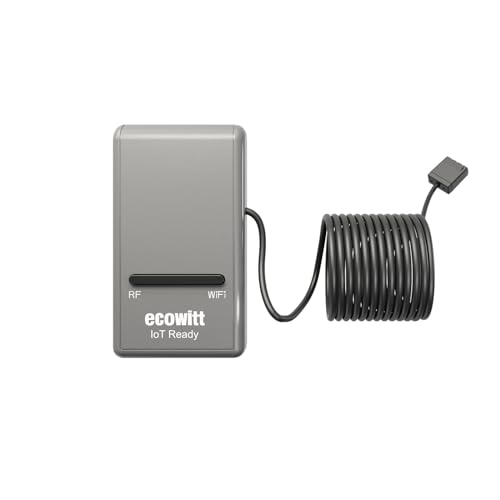
GW1200 Review Summary
The Ecowitt GW1200 is best for buyers who want a simple bridge between Ecowitt sensors, local environmental readings, and online weather services.
It is not a flashy standalone weather station; it is a practical gateway first, with enough built-in sensing to stay useful even before you add more devices.
That makes it a strong fit for home weather hobbyists, data-minded users, and anyone already planning to expand into Ecowitt’s ecosystem.
If your goal is to collect sensor data, upload it to internet services, and manage compatible devices from one hub, the GW1200 is clearly positioned for that job.
Review Scorecard
| Category | Score | Why it earns that score |
|---|---|---|
| Gateway usefulness | 9/10 | Built to connect Ecowitt-developed sensors and upload data after Wi-Fi setup. |
| Built-in sensing | 8/10 | Includes temperature, humidity, and barometric pressure sensing in the unit itself. |
| Expansion potential | 9/10 | Supports a wide range of Ecowitt sensors and several IoT devices. |
| Setup flexibility | 8/10 | Offers app-based or web-based Wi-Fi configuration and USB power. |
| Everyday convenience | 8/10 | USB extension cable and cable clip help with placement in the home. |
| Cloud/service compatibility | 8/10 | Can publish to ecowitt.net and multiple external weather services. |
Key Features and Specifications of GW1200
The GW1200 combines a built-in 3-in-1 sensor with gateway functions.
According to the listing, it measures indoor temperature, humidity, and barometric pressure, while also serving as a Wi-Fi bridge for Ecowitt-developed sensors and subdevices.
It is powered by USB 2.0 or later, and the package includes a 1.5 m USB extension cable plus a cable clip.
That is useful because the best placement for a sensor hub is often not the same as the nearest outlet.
The supported ecosystem is the real selling point.
The listing says it can work with a broad range of Ecowitt sensors, including:
- WN32 outdoor temperature and humidity sensor
- WH40 rain gauge sensor
- WS68 wireless anemometer
- WS90 outdoor sensor array
- Up to 8 WN31 thermo-hygrometer sensors
- Up to 8 WH51/WH51L soil moisture sensors
- Up to 8 WN34L/WN34D pool thermometers
- Up to 4 WH41/WH43 PM2.5 air quality sensors
- WH45/WH46 air quality sensor
- WH55 water leak sensors
- WH57 lightning sensor
- Up to 16 IoT devices such as WFC01 and AC1100
The gateway also supports IoT-ready control for compatible devices.
The listing specifically mentions pairing with smart control devices such as WFC01 watering timer and AC1100, then controlling them in the Ecowitt app after Wi-Fi configuration.
For connectivity, the listing notes 915 MHz RF frequency.
It also says you can configure Wi-Fi through the Ecowitt app or the website, and that the device can upload data to ecowitt.net by default as well as to wunderground.com, weathercloud.net, wow.metoffice.gov.uk, and custom servers.
The firmware update option is also worth noting.
The listing says firmware can be updated automatically if you choose, while retaining original data.
Pros and Cons of GW1200
Pros
- Built-in temperature, humidity, and barometric sensing give it immediate value.
- Works as a gateway for a wide range of Ecowitt-developed sensors.
- Supports both sensor monitoring and compatible IoT control devices.
- USB power and the included extension cable make placement easier.
- App and web setup options reduce friction during installation.
- Can upload data to multiple weather services and custom servers.
Cons
- The best experience depends on buying into the Ecowitt ecosystem.
- It is not a universal gateway for every third-party weather sensor.
- Some of its value is tied to additional sensors or IoT devices you may need to buy separately.
- Buyers wanting a complete outdoor station in one box may find this too modular.
Who Should Buy GW1200?
The GW1200 is a good fit for buyers who want a central hub for Ecowitt sensors rather than a one-piece weather display.
If you already use Ecowitt hardware or plan to build a multi-sensor setup over time, this device makes that expansion cleaner.
It is also a sensible choice if you care about live data access and cloud upload.
The listing explicitly highlights viewing live data in the Ecowitt app, managing sensor calibration, and uploading to several weather services.
Buyers who should skip it are those who want a simple plug-and-play outdoor weather station with no ecosystem planning.
If you do not intend to add compatible sensors, the GW1200’s gateway strengths may be more than you need.
How GW1200 Fits a Modular Weather Setup
Built-In Readout First
The built-in temperature, humidity, and pressure sensing means the GW1200 still does something useful on its own.
That matters if you want a compact indoor monitor while you decide which external sensors to add next.
Sensor Hub Expansion
The strongest argument for the GW1200 is expansion.
The listing shows support for many Ecowitt sensors across weather, soil, rain, pool, air quality, leak, and lightning monitoring, which makes it attractive for users who like a layered setup.
App and Web Control
Setup through the app or website is a practical touch, especially for a gateway that may end up tucked into a utility room or office.
The ability to view live data and manage calibration inside the app adds convenience for ongoing use.
Cloud and IoT Integration
This is not just a local display.
The GW1200 is designed to upload data to internet weather services and to work with compatible smart control devices.
That broader role is what separates it from a basic sensor screen.
Alternatives to GW1200
If you want a simpler path, look at an Ecowitt weather station with a more self-contained display and fewer ecosystem decisions.
If your priority is garden or lawn monitoring, an Ecowitt soil moisture sensor may be a better add-on than a gateway-first device.
For users comparing whole-home weather ecosystems, a WeatherFlow station is a credible alternative line to evaluate.
If you mainly want rain and wind coverage, consider a Ambient Weather station, which is often shortlisted by buyers building a more complete station.
Is GW1200 Worth It?
Yes, if you want a modular Ecowitt hub and you expect to expand into multiple sensors. The GW1200 earns its place by combining built-in indoor sensing, broad Ecowitt device support, Wi-Fi upload, and IoT control in one compact gateway.
It is less compelling if you want an all-in-one weather station with no ecosystem commitment.
But for buyers who value flexibility, live data access, and a growing sensor network, the GW1200 is a sensible purchase.