
The E130 Light Meter review case is straightforward: if you need a handheld tool for checking lux, CCT, and light spread, this model is built for that job.
It is especially relevant for people comparing LEDs, fluorescent sources, sunlight, or mixed lighting setups.
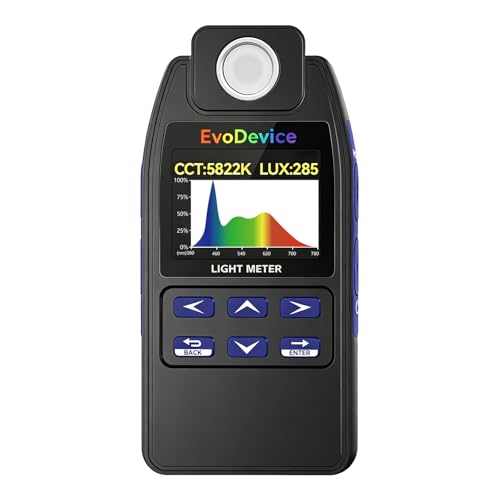
E130 Light Meter Review Summary
The E130 Light Meter makes sense for buyers who care about practical lighting measurements more than flashy extras.
Its biggest appeal is the combination of lux and color temperature measurement, 99-point light mapping, and a spectrum mode that the listing says is accurate for phosphor-converted white LEDs excited by 420nm or 450nm chips.
That mix is useful for anyone trying to understand not just how bright a space is, but how evenly that brightness is distributed and what kind of light source is actually present.
If you want a compact meter for room lighting checks, shelf or bench setup, aquarium lighting evaluation, or general light comparison work, the E130 is a sensible fit.
It is less compelling if you want a general-purpose scientific instrument for deep spectral analysis.
The listing is clear that the spectrum curve is not intended for analysis on sunlight, sodium, metal halide, or CFL sources, so buyers should treat the spectrum feature as a practical aid rather than a lab-grade research tool.
This is a utility-first device, not a specialty analyzer.
Review Scorecard
| Category | Score | Rationale |
|---|---|---|
| Lux measurement usefulness | 9/10 | The listing emphasizes accurate illuminance checks across LED, fluorescent, HID, sunlight, and more. |
| CCT usefulness | 8/10 | Color temperature measurement is one of the core functions and fits common lighting work. |
| Light mapping | 9/10 | 99-point mapping is a strong differentiator for uneven spaces and setup comparisons. |
| Spectrum feature clarity | 6/10 | Useful for certain white LEDs, but the listing itself limits how far to trust it. |
| Ease of everyday use | 8/10 | Handheld design and simple controls suggest low friction for routine checks. |
| Buyer specificity | 8/10 | Strong for lighting-focused users, narrower for anyone outside that use case. |
Key Features and Specifications of E130 Light Meter
The E130 is built around three core functions: lux measurement, color temperature measurement, and a spectrum mode.
The listing positions it as a meter for real-world lighting checks across LED, fluorescent, HID, sunlight, and other sources, which makes it useful for common buy-or-compare decisions around fixtures and installations.
The standout feature is the 99-point light mapping.
That matters because many spaces are not lit evenly.
A single reading can hide hot spots, falloff, and dead zones, but a grid of up to 99 points gives a better picture of what a room, shelf, bench, tank, or workspace is actually doing.
The form factor is described as handheld with simple controls, which is an advantage if you want something you can pull out quickly for repeat checks.
For most buyers, that matters more than deep menu complexity.
A meter that is easy to use tends to get used more often.
The spectrum feature needs the most careful interpretation.
The listing says it is accurate for phosphor-converted white LEDs excited by 420nm or 450nm chips.
For sunlight, sodium, metal halide, and CFL, the listing says the E130 is useful for accurate lux and CCT, while the spectrum curve itself is not intended for analysis.
That is an important limitation and also a sign of honest product positioning.
In short, the E130 is not trying to be everything at once.
It focuses on everyday lighting diagnostics, and that is where it appears strongest.
| Feature | What it suggests for buyers |
|---|---|
| Lux measurement | Good for brightness checks and comparing light levels in real spaces. |
| CCT measurement | Useful for matching warm, neutral, or cool lighting conditions. |
| 99-point mapping | Better for uneven lighting than a one-spot reading. |
| Handheld design | Easier to carry and use repeatedly. |
| Simple controls | Lower learning curve for routine checks. |
| Spectrum mode | Best viewed as a limited practical aid, not broad lab analysis. |
Pros and Cons of E130 Light Meter
Pros
- Accurate-looking utility focus for lux and CCT checks across common light sources.
- 99-point mapping is a real advantage if you care about consistency across a space.
- Handheld, simple-control design should be easier to live with than a more complicated meter.
- Spectrum mode has a clearly stated use case, which helps set expectations.
- Broad lighting-source compatibility makes it useful in mixed-environment testing.
Cons
- Spectrum mode is limited and should not be treated like full analytical spectroscopy.
- Not a general-purpose instrument if you only need one simple brightness reading now and then.
- Feature set is specialized, so casual buyers may not use the mapping or spectrum functions often.
- Listing clarity is strongest on function, not on advanced instrumentation detail, so technical buyers may want more depth.
Who Should Buy E130 Light Meter?
The E130 Light Meter is a good match for people who make decisions based on lighting quality, not just brightness.
That includes hobbyists, installers, makers, and anyone comparing fixtures or checking whether a workspace is evenly lit.
It also makes sense for users who want to evaluate lighting in places where one-point measurements are not enough.
The 99-point mapping feature is the clearest reason to choose this model over a basic handheld meter.
If you are checking a room, display area, shelf, bench, or tank, evenness matters as much as the headline lux number.
Buy this if you need a practical meter for repeated lighting checks, especially when color temperature and distribution both matter.
Skip it if you only need occasional brightness checks and have no interest in mapping or CCT.
It is also not the right pick if your main goal is deep spectral analysis across many source types.
The listing itself narrows the spectrum function, so buyers expecting a universal analyzer may be disappointed.
Lighting Measurement Use Cases for E130 Light Meter
Room and Workspace Checks
For rooms and work areas, the E130’s value is in showing whether lighting is both bright enough and evenly distributed.
A single reading can tell you the level at one point, but the mapping function is what helps reveal whether the space is actually usable across the full area.
Fixture Comparison
If you are comparing LED fixtures, the meter’s lux and CCT functions let you look at the practical differences between options.
That is useful when you want a warmer or cooler look, or when you need to confirm whether a fixture really delivers the coverage it promises.
Shelf, Bench, and Tank Lighting
The listing specifically calls out shelves, benches, tanks, and workspaces as good candidates for 99-point mapping.
That makes sense because these are the kinds of spaces where small lighting gaps are easy to miss until they affect the final result.
Spectrum Mode Limits
The spectrum feature is best treated as a targeted aid.
The listing says it is accurate for certain white LEDs, but not intended for analysis on several other source types.
That means the E130 is more useful for everyday lighting evaluation than for advanced light-source science.
Alternatives to E130 Light Meter
If you want a similar handheld meter from a more established test-instrument brand, look at Extech light meter options.
If you want a straightforward lighting measurement tool with broad availability, UNI-T light meter models are another common comparison point.
For buyers who care more about more serious measurement workflows, Sekonic light meter products are worth a look.
If you want a simple brightness checker rather than a specialized tool, lux meter search results will surface plenty of basic alternatives.
The E130 stands apart mainly because of the 99-point mapping and its mix of lux, CCT, and spectrum features.
That combination is more specialized than a bare-bones meter, but less specialized than professional imaging or scientific measurement gear.
Is E130 Light Meter Worth It?
Yes, if your buying decision depends on more than a single brightness number.
The E130 Light Meter looks worth considering for anyone who regularly checks lighting quality, compares fixtures, or wants to understand distribution across a space.
It is not the best choice for buyers who only need the simplest possible meter, and it is not positioned as a deep spectral analysis instrument.
But for practical lighting work, the feature mix is well chosen.
If you want a handheld meter with lux, CCT, and 99-point mapping in one package, the E130 is worth a close look.