
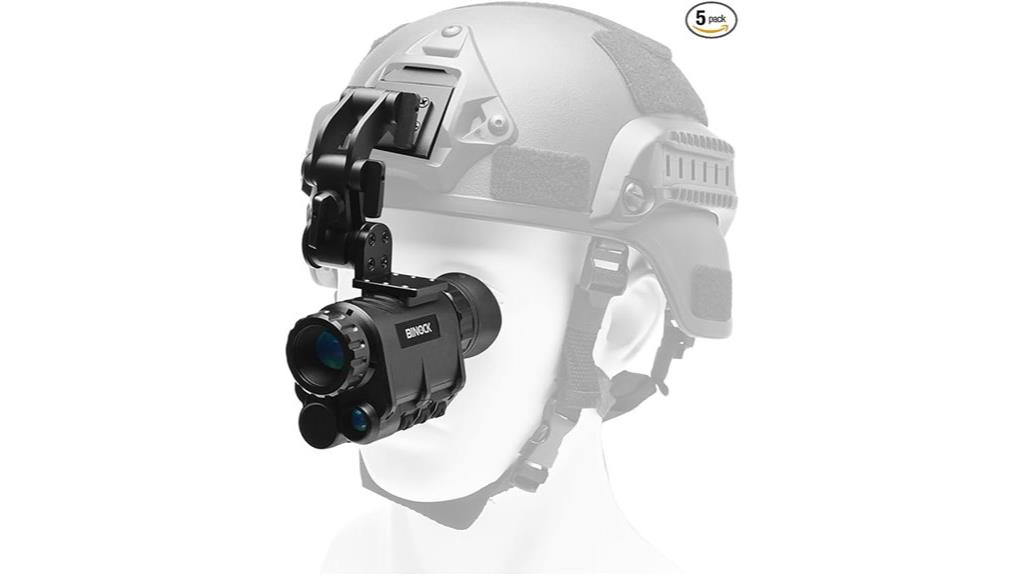
When I first got my hands on the BINOCK NVG30 Helmet Night Vision Monoculars, I was curious about their performance and features. At a budget-friendly price, they promised a lot for outdoor enthusiasts like me. However, I quickly realized there’s more to this device than meets the eye. Let’s explore what makes these monoculars stand out, along with some of their quirks that might make you think twice.
Product Features and Specifications
When I first examined the BINOCK NVG30 Helmet Night Vision Monoculars, I was impressed by its blend of advanced technology and practical features.
With a 2K resolution and a field of view of 40 degrees, it offers impressive visuals. The optical magnification is 1X, while digital magnification reaches 4X, giving versatility in viewing distances.
I appreciated the automatic brightness adjustment and various color modes, which enhance usability.
Weighing just under 2 pounds, it’s lightweight and easy to carry.
The inclusion of a WIFI module for real-time image transmission adds another layer of functionality that I found particularly appealing.

Performance in Various Conditions
Although the BINOCK NVG30 Helmet Night Vision Monoculars are designed for a variety of environments, I’ve found their performance varies considerably depending on the conditions.
In low-light settings, they excel, providing clear visibility without much grain. However, in complete darkness, I noticed the need for infrared light to enhance the image quality.
During bright moonlit nights, the clarity is impressive, but any ambient light can wash out the details.
I’ve also tested them in wooded areas, where the image sometimes struggled with clarity due to shadows.
User Experience and Control Interface
After testing the BINOCK NVG30 in various lighting conditions, I was keen to explore the user experience and control interface.
The three-button setup is straightforward, with one for power, another for filter/IR control, and a zoom adjustment. However, I found maneuvering the menu a bit tricky, especially since the power button doubles as a menu selector.
The compact design makes it easy to handle, but I noticed the focus could be touchy, requiring some adjustments to get it just right.
Customer Feedback and Common Issues
While many users appreciate the BINOCK NVG30’s price-to-performance ratio and features, I’ve noticed some common issues that deserve attention.
Some folks report that image quality can be inconsistent, particularly in very low light, where graininess tends to creep in. Additionally, battery life seems to be a concern; a few users wish it came with an included battery.
Mounting compatibility isn’t always straightforward either, with some adapters causing frustration. Finally, the focus adjustment is described as touchy, requiring patience to achieve the right clarity.
These points are essential to bear in mind before making a decision on this monocular.
Final Thoughts on Value and Recommendations
Given the mixed feedback on the BINOCK NVG30’s performance, it’s important to evaluate its overall value and suitability for potential buyers.
I believe this monocular offers a decent entry point into night vision technology, especially for outdoor enthusiasts and beginners. Its features like multiple color modes and real-time image transmission are impressive at this price.
However, be mindful of potential image quality issues and the need for an IR light in complete darkness. If you’re looking for a budget-friendly option without high expectations, I’d recommend giving the NVG30 a try—but manage your expectations regarding performance.