
2-in-1 Kids Microscope and Telescope review: this is a compact STEM gadget for kids who want one tool for close-up discovery and distant spotting.
It makes most sense for families who value portability, screen viewing, and simple outdoor science play.
Kids Microscope Telescope Review Summary
The 2-in-1 Kids Microscope and Telescope is a straightforward choice for parents who want a science toy that can travel outdoors and keep attention on real objects instead of a phone screen.
It is best for younger children who like bugs, leaves, bird watching, or casual backyard exploration, and it suits families that want one compact device rather than separate instruments.
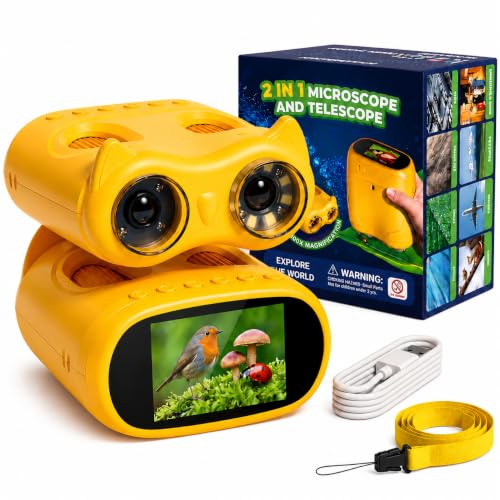
Its appeal is the mix of a 1000X handheld digital microscope, a 10X telescope lens, and a built-in 2.0-inch color screen.
That combination gives kids an easy way to inspect tiny details up close and then switch to simple distance viewing without carrying bulky gear.
The tradeoff is that this is still a kid-oriented hybrid, so it is more about curiosity and hands-on discovery than serious optical performance.
Review Scorecard
| Category | Score | Why it scores this way |
|---|---|---|
| Portability | 9/10 | At 9.9 oz and roughly 5.12 x 5.04 x 3.31 inches, it is easy for kids to carry. |
| STEM Appeal | 8/10 | The microscope-and-telescope combination supports exploration in two directions. |
| Ease of Use | 8/10 | The screen-based design lowers the barrier for children compared with eyepiece-only tools. |
| Outdoor Versatility | 8/10 | It is aimed at field trips, parks, camping, and backyard use. |
| Imaging Features | 7/10 | 1080P camera and built-in storage are useful, but memory card use is still needed for video. |
| Battery Convenience | 7/10 | USB-C charging is practical, though runtime is limited. |
| Gift Potential | 8/10 | The educational positioning fits birthdays and holiday gifting well. |
Bottom line: this is a sensible buy if you want a kid-friendly STEM device that encourages observation and can move easily from indoors to outdoors.
Key Features and Specifications of Kids Microscope Telescope
The listing centers on a dual-purpose design.
One side is a digital microscope with up to 1000X magnification, and the other is a 10X telescope lens meant for objects from roughly 3M to 1000M away.
That makes the product feel more versatile than a simple pocket microscope, especially for children who are just starting to compare near and far observation.
The built-in 2.0-inch color screen is one of the most important practical details.
It lets children look at the image directly instead of peering through a tiny eyepiece, which is often easier for small hands and shorter attention spans.
The listing also says there are 8 LED lights, which should help when examining darker subjects such as leaves, insects, or tabletop samples.
Other useful specifics include:
- 1080P camera for still photos
- Built-in storage for about 200 photos
- Video capture at 1080P 30fps with an external memory card
- Support for cards up to 128GB, not included
- Type-C charging
- Around 2 hours of continuous video recording in microscope mode with LEDs on
- Around 3 hours in telescope mode
- Lightweight design at 9.9 oz
The product is clearly aimed at portability and low-friction use.
The listing also says it can be charged in about 2 hours, which is convenient for families who do not want a device sitting idle for long before a trip.
The overall package includes the microscope/telescope unit, a Type-C cable, and a user manual.
Pros and Cons of Kids Microscope Telescope
Pros
- Combines two observation tools in one compact unit
- Screen-based viewing is easier for kids than a classic eyepiece
- 8 LEDs improve visibility for close-up inspection
- Lightweight enough for backpacks and field trips
- Built-in storage lets children capture some photos immediately
- USB-C charging is practical for modern households
Cons
- The telescope side is only 10X, so it is for casual spotting rather than serious magnification
- Video recording needs a separate memory card
- Battery life is limited compared with larger devices
- The 2.0-inch screen is functional but still small
- It is designed for kid-friendly exploration, not advanced microscopy
The strongest point is the convenience of having one device for two kinds of curiosity.
The biggest limitation is also clear: the product is broad and playful rather than specialized, so buyers expecting one tool to compete with dedicated microscopes or binoculars may be disappointed.
Who Should Buy Kids Microscope Telescope?
This is a good fit for children ages 4 to 12 who are naturally curious about nature and enjoy exploring bugs, plants, rocks, clouds, and distant objects.
It is especially appealing for parents who want a screen-based educational toy that can support outdoor learning without creating a complicated setup.
It also makes sense as a gift if the goal is to encourage field trips, camping activities, or backyard discovery.
The listing positions it as a birthday, holiday, Easter, Christmas, or back-to-school present, and that matches the kind of product it is: compact, approachable, and easy to understand at a glance.
It is less suitable for buyers who want a more serious optical instrument.
If the main goal is high-end image quality, longer battery endurance, or a larger viewing display, a dedicated microscope or a better telescope will be the better choice.
This product is for exploration first and precision second.
How the Kids Microscope Telescope Works in Practice
Close-Up Exploration
The microscope side is the main attraction because it is designed for inspecting tiny subjects like insects, plant textures, and small outdoor finds.
The 8 LEDs and screen viewing help make the experience feel immediate, and that matters for kids who want quick feedback rather than a more technical setup.
Distance Viewing
The telescope lens adds flexibility for spotting birds or looking across a yard or campsite.
At 10X, it is not a powerful telescope, but it does give the product a second use case that makes sense for casual family outings.
Portability and Storage
At under 10 ounces, the device seems built for real movement rather than desk-only use.
The built-in storage for around 200 photos is a nice convenience for children who want to capture discoveries right away, while the memory card requirement for video keeps expectations realistic.
Battery and Charging
The Type-C charging port is the right call for a kids’ gadget in 2026.
The claimed two-hour charge and modest runtime suggest a product that should be used in short sessions, which fits the way most children will actually interact with it.
Alternatives to Kids Microscope Telescope
If you want a similar but more specialized route, consider a dedicated kids microscope from brands like Celestron or National Geographic.
These are better if your child mostly wants close-up science rather than a hybrid device.
For families who care more about outdoor viewing, a starter monocular or child-friendly telescope line from brands like Gskyer or Educational Insights may be a better fit.
Those options are more focused on distance observation and less on microscope-style inspection.
If the real goal is beginner science play, a kid microscope kit with slides and specimens can be a stronger learning tool than a hybrid gadget.
That route is better when you want structured STEM activities instead of a handheld all-in-one.
Is Kids Microscope Telescope Worth It?
Yes, if you want a portable STEM toy that encourages kids to look closely at the world and also gives them a simple way to spot things at a distance. The 2-in-1 design, screen-based viewing, LEDs, built-in storage, and USB-C charging all support easy everyday use.
It is not the right choice for buyers who want strong optical performance or a serious research tool.
But for young children, family outings, and gift buying, the balance of convenience and curiosity is the main reason this product makes sense.