
Wireless video receivers can simplify live production by sending a camera feed to a computer, monitor, switcher, or multiple viewing points without long HDMI or SDI runs. The right system depends on more than advertised range: resolution, latency, output options, reliability, and compatibility all affect the on-air experience.
This roundup compares 10 wireless video transmission systems for creators, event teams, educators, and production professionals. Use the guide below to narrow the choices by workflow, budget, and required video quality.
Best 10 Wireless Video Receivers for Live Streaming Picks for 2026
Best Professional Streaming Pick

- Dual-band range up to 1,200 feet
- UVC output for computer streaming
- Supports up to four monitoring devices
Best For: Professional shoots, live events, and multi-person monitoring
Best Multi-Screen Value

- Streams to up to four receivers
- 1080p at 60Hz over 5GHz
- TuTuPlay phone and tablet preview
Best For: Presentations, classrooms, home theaters, and multi-display setups
Best 4K Production System

- 4K30 and 1080p60 transmission
- Up to 1,300 feet with 60ms latency
- UVC streaming and HDMI loop-out
Best For: Film production, live broadcasting, and 4K monitoring
Best Plug-and-Play Home Setup

- No app, Bluetooth, or Wi-Fi required
- 4K30 receiver support
- Includes mini and micro HDMI adapters
Best For: Home theaters, classrooms, meetings, and casual camera connections
Best Pocket 3 Streaming Kit
Osmo Pocket 3 Wireless Video System

- Built-in Type-C transmitter for Osmo Pocket 3
- UVC output enables up to 1080p60 PC streaming
- 20 channels, HDMI loop-out, and up to five receivers
Best For: Osmo Pocket 3 creators streaming through a computer
Best Professional Long-Range Pick
Hollyland Pyro Ultra 4K60 Wireless System

- 4K60 transmission with HDMI and SDI connectivity
- UVC capture and RTMP streaming built in
- Broadcast Mode supports up to 20 receivers
Best For: Professional film and broadcast-style live productions
Best Plug-and-Play HDMI Extender

- 1080p60 transmission with claimed 0.05-second delay
- HDMI loop-out and dual receiver HDMI outputs
- IR control plus support for up to five receivers
Best For: Simple 1080p streaming, presentations, and multi-screen monitoring
Long-Range 4K Pick

- 4K30Hz video with approximately 0.1-second latency
- UVC output for OBS streaming without a capture card
- 1-to-5 receiver support with 20 adjustable channels
Best For: 4K streaming and multi-camera monitoring
Low-Latency Production Pick

- 1080p/60fps transmission with claimed 40ms latency
- Up to 300 meters with HDMI input, output, and loop-out
- 2W low-power design plus monitoring and review app
Best For: Responsive 1080p production monitoring
Built-In Monitor Pick
7-Inch 1-to-5 Wireless HDMI System
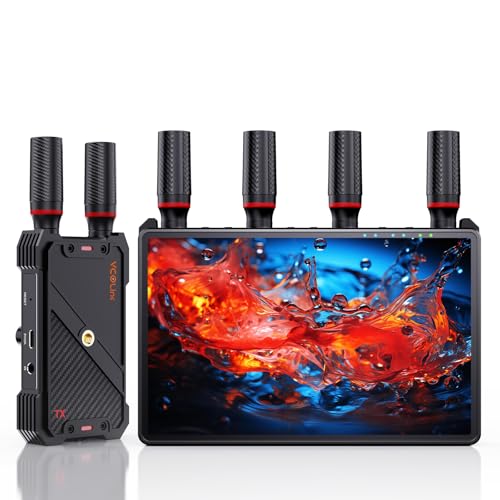
- Built-in 7-inch receiver monitor for immediate viewing
- 1080p/60Hz with claimed latency below 0.05 seconds
- 1-to-5 receiver support, loop-out, and flexible power
Best For: On-set monitoring without a separate screen
Best Professional Streaming Pick – Accsoon CineView HE
For demanding wireless video receivers for live streaming, the Accsoon CineView HE stands out with dual-band transmission, low latency, and a receiver with UVC output. It is designed to send HDMI camera footage to a computer without requiring a separate capture device.
Best For: Professional shoots, live events, and crews needing long-range monitoring and direct computer streaming.
Pros:
- 2.4GHz and 5GHz dual-band transmission supports stable signals up to 1,200 feet.
- UVC output enables plug-and-play streaming to platforms such as OBS and YouTube.
- One transmitter can connect with up to four receivers or mobile devices.
- HDMI loop-out provides zero-latency lossless output.
Cons:
- Battery and charging cables are not included.
- Its professional feature set may be more than casual users need.
The CineView HE is a strong choice when dependable range, multi-person monitoring, and streamlined UVC streaming matter more than a basic wireless HDMI link.
Best Multi-Screen Value – Lemorele Wireless HDMI Kit
The Lemorele kit is a practical option among wireless video receivers for live streaming when you want to share one HDMI source across several screens. Its 5GHz connection supports 1080p at 60Hz, while the TuTuPlay app adds phone and tablet monitoring.
Best For: Presentations, classrooms, home theaters, and basic camera or stream previews across multiple displays.
Pros:
- One transmitter can send to up to four receivers simultaneously.
- Supports 1080p 60Hz transmission with a stated line-of-sight range of up to 656 feet.
- Plug-and-play aluminum design requires no drivers or software.
- TuTuPlay app turns compatible iOS and Android devices into preview screens.
Cons:
- Phones are supported for TuTuPlay real-time preview, not as signal transmitter sources.
- The listed range depends on line-of-sight conditions.
Choose this model if multi-screen distribution and simple setup are priorities. It is less specialized for production workflows than dedicated camera transmission systems, but its receiver count is useful for group viewing.
Best 4K Production System – Hollyland Pyro H
The Hollyland Pyro H is a capable choice for wireless video receivers for live streaming, combining 4K30 transmission, HDMI loop-out, UVC streaming, and dual-band operation. Smart Channel Scan helps the system select an appropriate frequency in changing shooting environments.
Best For: Film production, live broadcasting, ENG/EFP work, and teams that need higher-resolution monitoring.
Pros:
- Supports up to 4K at 30fps through HDMI.
- Offers up to 1,300 feet of transmission range with 60ms latency.
- UVC support enables direct computer live streaming.
- Smart Channel Scan helps manage 2.4GHz and 5GHz interference.
Cons:
- The listed kit includes only one transmitter and one receiver.
- 4K support is limited to 30fps.
With its combination of 4K capability, long range, loop-out, and UVC support, the Pyro H is well suited to more demanding productions that need both crew monitoring and a direct streaming path.
Best Plug-and-Play Home Setup – AIMIBO Wireless HDMI Kit
For shoppers seeking straightforward wireless video receivers for live streaming and general HDMI sharing, the AIMIBO kit emphasizes quick setup and broad device compatibility. It supports 4K at 30Hz on the receiver, includes mini and micro HDMI adapters, and works without Bluetooth, Wi-Fi, or apps.
Best For: Home theaters, classrooms, meetings, gaming setups, and casual camera-to-display connections.
Pros:
- Plug-and-play setup requires no app, Bluetooth, or Wi-Fi connection.
- Receiver supports 4K at 30Hz, while transmitter and receiver support 1080p at 60Hz.
- Up to eight transmitters can pair with one receiver for source switching.
- Includes mini and micro HDMI adapters for additional camera and device compatibility.
Cons:
- Stated range is up to 165 feet without barriers and may fall to 32 feet through walls or floors.
- Its 0.1-second latency is higher than the dedicated professional systems listed here.
The AIMIBO is a sensible pick for users who value easy installation and flexible HDMI connections. Its shorter barrier-free range makes it better suited to rooms and small venues than large production spaces.
Best Pocket 3 Streaming Kit – Osmo Pocket 3 Wireless Video System
If you need wireless video receivers for live streaming with a DJI Osmo Pocket 3, this kit stands out for its built-in Type-C transmitter and UVC receiver output. It sends video at up to 1080p60 and can connect directly to a computer for OBS streaming without a separate capture device.
Best For: DJI Osmo Pocket 3 users, basic multi-camera streams, and wireless monitoring setups that need direct PC webcam functionality.
Pros:
- Built specifically for the Osmo Pocket 3 with a plug-and-play Type-C transmitter.
- UVC output supports up to 1080p60 streaming to a computer through software such as OBS.
- Offers 20 adjustable channels, an LCD status display, HDMI loop-out, and support for up to five receivers.
- Supports a claimed 1,640-foot line-of-sight range in open, interference-free conditions.
Cons:
- Walls, glass, brick, and metal can significantly reduce range or interrupt the signal.
- NP-F batteries are supported but must be purchased separately.
- Its feature set is especially tailored to the Osmo Pocket 3 rather than general 4K workflows.
Choose this system if direct Osmo Pocket 3 connectivity and simple computer streaming matter more than 4K resolution. The UVC output and built-in monitoring features make it practical for creators who want a straightforward live-production setup.
Best Professional Long-Range Pick – Hollyland Pyro Ultra 4K60 Wireless System
For professional productions comparing wireless video receivers for live streaming, the Hollyland Pyro Ultra offers a broader feature set than basic HDMI extenders. It combines 4K60 transmission with HDMI and SDI connectivity, UVC capture, RTMP streaming, and support for multiple receivers.
Best For: Film crews, broadcast-style live productions, focus-pulling teams, and multi-monitor setups requiring 4K and SDI support.
Pros:
- Supports 4K60 video transmission at 12 Mbps through HDMI.
- Includes HDMI and SDI inputs and outputs, plus 4K60 HDMI loop-out.
- UVC capture supports up to 4K60, while RTMP streaming supports up to 1080p60.
- Broadcast Mode can distribute video to up to 20 receivers, with a claimed 4,900-foot line-of-sight range in standard mode.
Cons:
- The professional feature set may be excessive for simple home or single-camera streaming.
- The listed product dimensions and 7.35-pound item weight suggest a less compact setup than basic wireless kits.
- Its lowest stated Focus Mode latency depends on the selected resolution and frame rate.
The Pyro Ultra is the strongest choice here for demanding productions that need 4K60, SDI, multi-receiver distribution, and direct streaming options. Its advanced workflow features are best justified when reliability and production flexibility matter more than simplicity.
Best Plug-and-Play HDMI Extender – 1080p Wireless System with IR
This wireless HDMI kit is a practical option for live streaming and monitoring when 1080p resolution is sufficient. It provides plug-and-play transmission from cameras, laptops, or set-top boxes, with IR control, HDMI loop-out, and dual HDMI output on the receiver.
Best For: Home studios, presentations, sports or gaming displays, and users who want simple 1080p wireless video distribution.
Pros:
- Supports up to 1080p60 with a stated 0.05-second delay and no software installation.
- Provides a claimed 1,300-foot line-of-sight range in open, interference-free conditions.
- HDMI loop-out and dual HDMI receiver outputs support local and auxiliary monitoring.
- IR expansion lets users control the HDMI source from a remote location.
Cons:
- Walls, metal, brick, and glass can reduce coverage or cause substantial signal loss.
- It is limited to Full HD rather than 4K transmission.
- NP-F batteries are supported but are not included.
This model makes sense when easy installation, remote control, and multiple display outputs are more important than advanced broadcast features. It is a capable 1080p choice for straightforward wireless video distribution and monitoring.
Long-Range 4K Pick – VRRIIS WL096 PRO
For shoppers comparing wireless video receivers for live streaming, the VRRIIS WL096 PRO stands out with 4K30Hz transmission, UVC output, and a claimed range of up to 1,500 feet. Its pre-paired setup and adjustable 5GHz channels make it practical for production monitoring, though its approximately 0.1-second latency is not intended for highly responsive applications.
Best For: 4K live streaming, multi-camera monitoring, outdoor filming, and setups that need direct UVC output to a computer.
Pros:
- Supports 4K30Hz video with approximately 0.1-second latency.
- UVC output enables streaming through OBS or other platforms without a separate capture card.
- One transmitter can send to up to five receivers and includes HDMI loop-out.
- Offers 20 adjustable channels, LCD status displays, and multiple power options.
Cons:
- Approximately 0.1-second latency is not suitable for gaming or other high-response uses.
- UVC output is limited to up to 1080p at 60Hz.
- Batteries are not included.
This is a feature-rich choice when resolution, long-range coverage, and flexible monitoring matter most. Buyers focused on the lowest possible latency should consider a different option.
Low-Latency Production Pick – SYNCO XVision
The SYNCO XVision is a practical option among wireless video receivers for live streaming when responsive monitoring is important. It transmits 1080p at 60fps over distances up to 300 meters with claimed 40ms latency, while HDMI input, output, and loop-out connections support production and event workflows.
Best For: Professional filming, live events, drones, cranes, and crews that want low-power operation with app-assisted monitoring.
Pros:
- Provides 1080p/60fps transmission with claimed 40ms latency.
- Supports HDMI dual input/output and loop-out for flexible production connections.
- Uses a low-power design rated at 2W without fan cooling.
- The SYNCO Link app offers monitoring, image adjustments, screenshots, saving, and playback.
Cons:
- Resolution is limited to 1080p/60fps rather than 4K.
- The supplied notes do not specify included accessories or power options.
- Its 300-meter range depends on stable transmission conditions and the stated use environment.
Choose the XVision if smooth, responsive 1080p monitoring and a quiet, low-power design are more valuable than maximum resolution. The app and status display also make it appealing for production teams that need quick setup and review.
Built-In Monitor Pick – 7-Inch 1-to-5 Wireless HDMI System
For wireless video receivers for live streaming that need immediate on-set viewing, this system combines a receiver with a built-in 7-inch monitor. It supports 1080p at 60Hz, claims less than 0.05-second latency and a 1,312-foot line-of-sight range, and can send one transmitter’s feed to as many as five receivers.
Best For: Film crews, studios, live events, and solo operators who want built-in monitoring without carrying a separate screen.
Pros:
- Built-in 7-inch screen provides real-time monitoring without an extra display.
- Supports 1080p/60Hz with claimed latency below 0.05 seconds.
- One transmitter can connect with up to five receivers, each offering HDMI output.
- Includes HDMI loop-out, IR remote control, headphone monitoring, and flexible power options.
Cons:
- It does not offer 4K transmission.
- The stated 1,312-foot range is specified for line-of-sight use.
- Smartphone or tablet compatibility requires a Type-C-to-HDMI cable.
This is the most convenient choice for crews that value an integrated monitor and fast feedback. Its 1080p limit is a reasonable tradeoff for the built-in screen, multi-viewer support, and low claimed latency.
How We Picked These Wireless Video Receivers for Live Streaming
We selected systems that support practical live-production workflows, including direct camera-to-computer streaming, remote monitoring, event presentation, and multi-receiver setups. We compared stated resolution, frame-rate support, transmission distance, latency, connection bands, receiver capacity, and output features such as HDMI loop-out, SDI, and UVC connectivity.
Specifications vary by environment. Range claims are typically measured with clear line of sight, while walls, crowded 2.4GHz networks, metal structures, and competing wireless equipment can reduce performance. Treat advertised distance as a best-case reference rather than a guaranteed indoor result.
Quick Comparison
- Best for direct computer streaming: Choose a model with UVC output so your computer can recognize the receiver as a camera source without a separate capture device.
- Best for professional production: Look for 4K support, SDI, low latency, stable dual-band operation, and multiple receiver capability.
- Best for simple HDMI distribution: A 1080p kit with loop-out can send video to a display while preserving a local connection for another device.
- Best for multi-viewer setups: Systems supporting several receivers are useful for directors, presenters, confidence monitors, and remote displays.
Key Buying Factors for Wireless Video Receivers for Live Streaming
Resolution and Frame Rate
1080p60 is sufficient for many livestreams and usually requires less bandwidth than 4K. Choose 4K support when you need high-resolution recording, cropping, detailed presentation content, or a future-ready production chain. Confirm that both the transmitter and receiver support the resolution and frame rate your camera actually outputs.
Latency and Reliability
Low latency matters when talent must react to a monitor, when audio and video need to stay aligned, or when a remote operator is controlling a camera. A lower published delay is helpful, but signal stability is equally important. Favor systems with clear channel selection, dual-band operation, and sensible line-of-sight placement.
Outputs and Compatibility
UVC output can make computer-based streaming easier, while HDMI is common for monitors and switchers. SDI is valuable in longer professional cable runs and broadcast-oriented environments. Check connector types, supported operating systems, camera compatibility, power requirements, and whether an HDMI loop-out is included.
Range and Receiver Count
Choose range based on the real venue, not only the product listing. A compact studio may need only a few dozen feet, while events and outdoor shoots benefit from more headroom. If several people need the feed, verify the maximum number of receivers and whether additional receivers are sold separately.
Who Should Buy Which Wireless Video Receivers for Live Streaming?
Solo creators and livestreamers should prioritize UVC output, straightforward setup, 1080p60 support, and low latency. Small studios and educators may prefer HDMI loop-out and dependable dual-band transmission for cameras, projectors, or classroom displays. Event and production teams should focus on receiver scalability, SDI or 4K support, strong range, and operational controls. Traveling creators will benefit from compact hardware, flexible power options, and a receiver that works with common cameras or compact video devices.
Before buying, confirm the complete signal path: camera output, transmitter input, receiver output, capture hardware, streaming software, and display resolution. Matching every component prevents avoidable black screens, unsupported frame rates, and audio-sync problems.