
The right eyepiece can make a noticeable difference in how much sky you see, how comfortably you observe, and how easily you find and track targets. Wide-angle designs are especially useful for sweeping star fields, large deep-sky objects, and relaxed viewing.
This roundup compares 10 options across several focal lengths, apparent fields of view, barrel sizes, and configurations. Use the guide below to match an eyepiece to your telescope, observing style, and budget.
Best 10 Wide Angle Telescope Eyepieces Picks for 2026
Panoramic Deep-Sky Views
SVBONY SV154 26mm 70° SWA Eyepiece
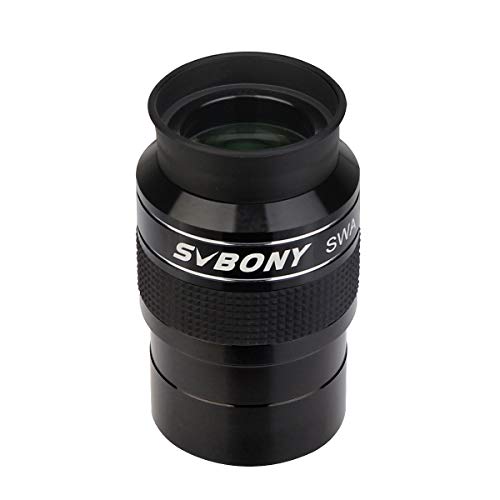
- 70° field of view for sweeping star fields
- 26mm focal length for moderate magnification
- 2-inch barrel with filter compatibility
Best For: Panoramic deep-sky viewing with compatible 2-inch telescopes
Flexible Magnification Set
SVBONY Gold Line 6/9/15/20mm Eyepieces
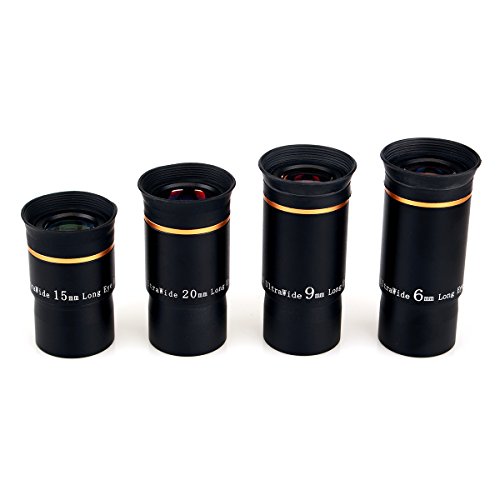
- Four focal lengths from 6mm to 20mm
- 66° wide field for lunar and deep-sky targets
- 1.25-inch set with foldable eye cups
Best For: Observers wanting multiple magnifications in one kit
Compact Planetary Detail
SVBONY 4mm 62° Aspheric Eyepiece

- 4mm focal length for high magnification
- 62° field of view with aspheric optics
- Lightweight 1.25-inch design
Best For: Detailed lunar and planetary viewing
Low-Power Wide Field
SVBONY Redline 20mm 68° Eyepiece
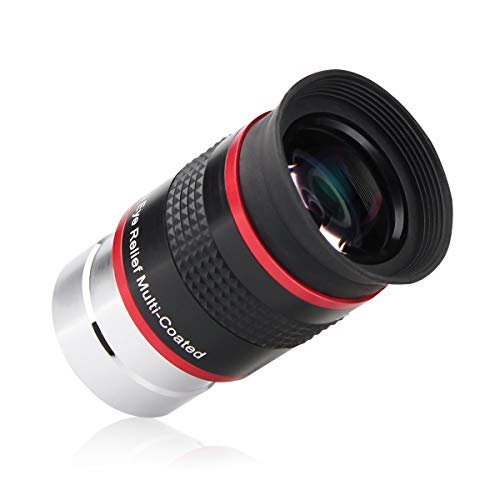
- 68° field for object locating and star fields
- 20mm focal length for low magnification
- 1.25-inch barrel with filter thread
Best For: Low-power deep-sky viewing and broad star fields
Wide-Field Clarity

- 70° apparent field of view
- 13mm eye relief with twist-up eyecup
- Fully multi-coated five-element optics
Best For: A single comfortable wide-field 1.25-inch eyepiece
Versatile Viewing Kit
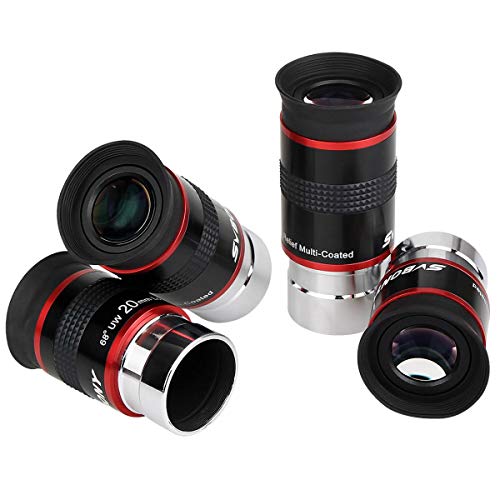
- Four focal lengths from 6mm to 20mm
- 68° apparent field of view
- Fully multi-coated optics with soft eye guards
Best For: Beginners wanting a flexible 1.25-inch eyepiece collection
Adjustable Magnification
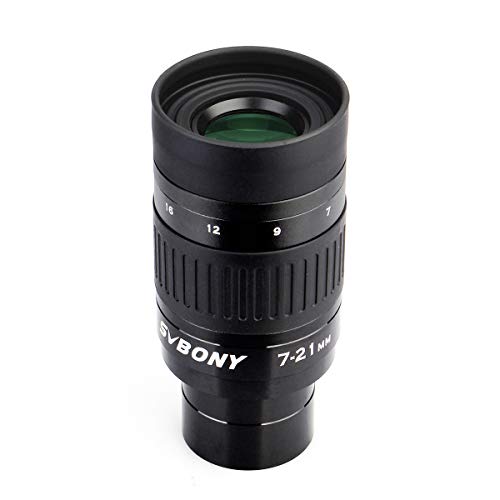
- 7–21mm adjustable focal length
- 40°–57° apparent field of view
- 18mm–16.3mm eye relief
Best For: Convenient variable-magnification viewing with one eyepiece
Versatile Wide-Angle Set
SVBONY 4mm/10mm/23mm Eyepieces

- Three focal lengths for flexible observing
- 62° wide field of view
- 1.25-inch compatibility with filter thread
Best For: Observers wanting one versatile eyepiece set
High-Power Wide View
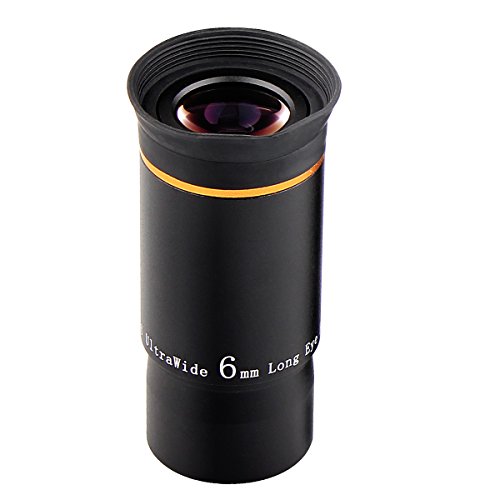
- 6mm focal length for planetary detail
- 66° field of view
- 16mm eye relief and fully multi-coated optics
Best For: Moon and planetary observation
Balanced UWA Performance

- 68° ultra-wide field of view
- 15mm focal length for versatile observing
- FMC optics and fold-down eye guard
Best For: General and planetary observation with a single eyepiece
Panoramic Deep-Sky Views – SVBONY SV154 26mm 70° SWA Eyepiece
The SVBONY SV154 is a practical choice for observers seeking wide angle telescope eyepieces with a spacious 70° apparent field of view. Its 26mm focal length provides moderate magnification for sweeping star fields, nebulae, clusters, and general lunar or planetary viewing.
Best For: Panoramic deep-sky viewing and locating celestial objects with a compatible 2-inch telescope.
Pros:
- Wide 70° field of view suits star fields, nebulae, and clusters.
- 26mm focal length offers versatile, moderate magnification.
- Five-element, three-group design with fully multi-coated optics supports bright, high-contrast images.
- Includes a foldable rubber eye cup and accepts standard 2-inch filters.
Cons:
- Requires a telescope and accessories with a 2-inch fit.
- Its relatively large format may be less convenient for compact setups.
- The supplied notes do not recommend it for reflector telescopes.
Choose the SV154 when field width and comfortable deep-sky scanning matter more than high magnification. Confirm your telescope’s mount size and calculate magnification before ordering.
Flexible Magnification Set – SVBONY Gold Line 6/9/15/20mm Eyepieces
This four-piece SVBONY set gives wide angle telescope eyepiece coverage across 6mm, 9mm, 15mm, and 20mm focal lengths. The 66° field of view works well for lunar observations, planets, double stars, clusters, nebulae, and other deep-sky targets through a 1.25-inch telescope.
Best For: Beginners and observers who want several magnification options in one 1.25-inch kit.
Pros:
- Four focal lengths provide high- and medium-magnification flexibility.
- 66° field of view supports broad lunar and deep-sky observations.
- Fully multi-coated optics and edge-blackened interiors help improve contrast.
- Foldable eye cups, dust covers, and an extra rubber eye cup add practicality.
Cons:
- Only fits telescopes and accessories with a 1.25-inch mount.
- The shortest 6mm focal length may require suitable telescope conditions for comfortable use.
- A set can be more than needed if you already own several focal lengths.
This is the most versatile option in the group for building a basic eyepiece collection. Its multiple focal lengths make it easier to switch between detailed planetary views and broader deep-sky targets.
Compact Planetary Detail – SVBONY 4mm 62° Aspheric Eyepiece
The SVBONY 4mm aspheric eyepiece is a lightweight choice among wide angle telescope eyepieces, pairing a 62° field of view with high magnification. It is designed primarily for closer views of the Moon and planets while remaining compatible with standard 1.25-inch telescope focusers.
Best For: High-magnification lunar and planetary observation with a 1.25-inch telescope.
Pros:
- 4mm focal length provides detailed, high-power views.
- 62° field of view is wider than a narrow planetary eyepiece.
- Fully multi-coated optics support light transmission and contrast.
- Lightweight aspheric design weighs about 0.09 pounds.
Cons:
- Its high magnification is less suited to broad, low-power scanning.
- It is a single 4mm eyepiece rather than a multi-focal-length set.
- Requires a compatible 1.25-inch focuser.
Consider this model when your priority is a closer look at lunar terrain and planetary detail in a compact package. For broad star-field views, a longer focal length will be more appropriate.
Low-Power Wide Field – SVBONY Redline 20mm 68° Eyepiece
The SVBONY Redline 20mm is one of the more straightforward wide angle telescope eyepieces for low-power observing. Its 68° field of view helps with locating objects and enjoying larger nebulae, clusters, and expansive star fields through a 1.25-inch telescope.
Best For: Low-power deep-sky viewing and object locating with a 1.25-inch setup.
Pros:
- 68° field of view creates a broad observing window.
- 20mm focal length is suited to low-magnification deep-sky views.
- Fully multi-coated and internally blackened optics are designed to support contrast.
- Fold-down eye guard and standard filter thread improve usability.
Cons:
- Offers only one 20mm focal length.
- Its low magnification is not intended for close planetary detail.
- Compatible with 1.25-inch eyepiece mounts only.
The Redline is a sensible pick for broad views without moving to a 2-inch format. It works best as a low-power complement to shorter focal-length eyepieces used for planets and lunar details.
Wide-Field Clarity – SV154 15mm 70° Eyepiece
For anyone comparing wide angle telescope eyepieces, the SVBONY SV154 emphasizes a broad 70-degree view with a 15mm focal length. Its five-element, four-group design, fully multi-coated optics, and 13mm eye relief make it a practical choice for comfortable lunar, planetary, and general deep-sky viewing.
Best For: Observers who want a single wide-field 1.25-inch eyepiece with comfortable eye relief.
Pros:
- Broad 70-degree apparent field of view for expansive vistas.
- Five-element, four-group optics with fully multi-coated lenses support sharp, high-contrast images.
- 13mm eye relief and metallic twist-up eyecups improve viewing comfort.
- Safety undercut, blackened lens edges, and anti-reflection threads help with handling and contrast.
Cons:
- Its fixed 15mm focal length does not provide zoom flexibility.
- The 1.25-inch mount limits compatibility to telescopes or diagonals accepting that size.
The SV154 is a focused upgrade for viewers who prioritize a spacious field and comfortable operation over a multi-eyepiece kit or adjustable magnification.
Versatile Viewing Kit – 68° Wide-Angle Eyepiece Set
This four-piece set is a useful starting point for shoppers seeking wide angle telescope eyepieces at multiple magnifications. With 6mm, 9mm, 15mm, and 20mm focal lengths, each using a 68-degree apparent field of view, it supports a range of astronomical observing without buying separate eyepieces one at a time.
Best For: Beginners and observers who want several 1.25-inch focal lengths in one set.
Pros:
- Includes four focal lengths—6mm, 9mm, 15mm, and 20mm—for flexible magnification choices.
- 68-degree apparent field of view provides broad viewing across the set.
- Fully multi-coated lenses and a multi-element design are intended to support sharp images, contrast, and color correction.
- Fold-down soft rubber eye guards can block stray light and accommodate eyeglass wearers.
Cons:
- The set uses a fixed 1.25-inch mount and is not suitable for larger eyepiece formats.
- Individual focal lengths are fixed rather than continuously adjustable.
Choose this kit when coverage and convenience matter more than selecting one specialized eyepiece; its four focal lengths make it easier to adapt to different observing situations.
Adjustable Magnification – SV135 7–21mm Zoom Eyepiece
The SVBONY SV135 takes a different approach to wide angle telescope eyepieces by combining 7mm to 21mm focal lengths in one adjustable unit. Its field of view ranges from 40 to 57 degrees, while fully multi-coated six-element, four-group optics and extended eye relief support lunar, planetary, landscape, and general astronomical observation.
Best For: Observers who value adjustable magnification and fewer accessories in their telescope case.
Pros:
- 7–21mm zoom range can replace several fixed focal-length eyepieces.
- 18mm to 16.3mm eye relief is designed for comfortable viewing, including for eyeglass wearers.
- Fully multi-coated six-element, four-group optics support center and edge sharpness.
- Standard 1.25-inch barrel fits telescopes accepting 1.25-inch eyepieces.
Cons:
- The apparent field narrows to 40 degrees at one end of the zoom range.
- It offers a smaller maximum field than the fixed 68-degree and 70-degree options listed here.
- At 230g, it is heavier than the SV154 listed above.
The SV135 is the practical pick for convenience: adjust magnification without swapping eyepieces, while accepting a narrower field at the lower end of its 7–21mm range.
Versatile Wide-Angle Set – SVBONY 4mm/10mm/23mm Eyepieces
For shoppers comparing wide angle telescope eyepieces, this three-piece SVBONY set offers 4mm, 10mm, and 23mm focal lengths in a 62° field of view. It is designed to cover detailed views of bright objects as well as broader views of clusters and nebulae.
Best For: Beginners and observers who want a flexible eyepiece set for multiple viewing situations.
Pros:
- Includes 4mm, 10mm, and 23mm eyepieces for varied magnification needs.
- 62° field of view helps with object location and immersive viewing.
- Aspherical, fully multi-coated optics are designed to improve clarity, light transmission, and contrast.
- Compatible with telescopes using a standard 1.25-inch focuser and includes a filter thread.
Cons:
- Compatibility depends on having a 1.25-inch focuser.
- Users must calculate magnification and avoid exceeding the recommended limit for their telescope.
This is the most adaptable option of the three, particularly if you need several focal lengths in one purchase. Confirm your telescope’s mount size and specifications before ordering.
High-Power Wide View – SVBONY 6mm Gold Line Eyepiece
This 6mm SVBONY is a focused choice among wide angle telescope eyepieces, combining a 66° field of view with high magnification. It is suited to detailed lunar and planetary observing while still making it easier to locate objects.
Best For: Planetary observers who want detailed views with a relatively wide viewing window.
Pros:
- 6mm focal length supports high-magnification views of the Moon, Jupiter, and Saturn.
- 66° field of view is useful for locating objects and viewing larger deep-sky targets.
- Fully multi-coated optics and blackened interior help reduce glare, scatter, and internal reflections.
- 16mm eye relief can be more comfortable for eyeglass wearers.
Cons:
- A 6mm eyepiece may provide too much magnification for some telescope and viewing conditions.
- It is a single focal length rather than a multi-eyepiece set.
Choose this model when detailed planetary viewing is the priority and your telescope can use a 1.25-inch eyepiece. Its eye relief and wide field add practical comfort during extended sessions.
Balanced UWA Performance – SVBONY 15mm 68° Eyepiece
If you want wide angle telescope eyepieces for a balanced mix of framing and magnification, this 15mm SVBONY uses a 68° ultra-wide field. Its fully multi-coated design and blackened housing are intended to support contrast during planetary and general observations.
Best For: Telescope users seeking a single mid-range eyepiece with a generous field of view.
Pros:
- 68° ultra-wide field expands the scope’s viewing area.
- 15mm focal length provides a versatile mid-range option.
- Fully multi-coated optics are designed for contrast and resolution.
- Blackened interior helps reduce light scatter, while the fold-down rubber eye guard accommodates eyeglass wearers.
Cons:
- Only one 15mm focal length is included.
- Designed for telescopes with a 1.25-inch mount.
This model is a practical middle ground for users who want a wider view without committing to a multi-piece set. Its eye guard and protected lens caps add convenience for regular use.
How We Picked the Best Wide Angle Telescope Eyepieces
We selected this group to cover the main choices telescope owners face: single eyepieces and sets, standard 1.25-inch and 2-inch barrels, fixed and zoom focal lengths, and apparent fields ranging from about 40° to 70°. We also considered focal-length variety, advertised lens coatings, practical versatility, and suitability for common visual targets.
Because eyepiece performance depends heavily on the telescope, we do not treat a larger field number as an automatic guarantee of better views. Compatibility, edge sharpness, eye relief, optical quality, and magnification are equally important.
Quick Comparison
| Best For | Look For | Why It Matters |
|---|---|---|
| Wide deep-sky views | 20mm focal length; 68°–70° field | Provides a broad, bright view for clusters and nebulae |
| Planetary detail | 4mm–6mm focal length | Produces higher magnification when seeing conditions allow |
| General-purpose observing | 9mm–15mm focal length | Balances magnification, brightness, and field size |
| Flexible setup | 7–21mm zoom | Lets you adjust magnification without changing eyepieces |
| Maximum field potential | 2-inch barrel | Can support wider true fields at longer focal lengths |
Key Buying Factors for Wide-Angle Telescope Eyepieces
Focal Length and Magnification
Magnification equals your telescope’s focal length divided by the eyepiece focal length. Shorter eyepieces magnify more but typically show a dimmer, narrower usable view and demand steadier atmospheric conditions. Longer focal lengths are generally easier for locating objects and observing extended targets.
Apparent and True Field of View
Apparent field describes how wide the view feels through the eyepiece; true field describes the actual portion of sky visible. A wide apparent field can make tracking more comfortable, particularly with a manual mount. Check the telescope’s focal length and the eyepiece’s specifications before assuming two models will show the same amount of sky.
Barrel Size and Compatibility
Most options here use a 1.25-inch barrel, which fits many beginner and intermediate telescopes. A 2-inch model may provide a wider true field with compatible equipment, but your focuser, diagonal, and mount must all support it. Confirm clearance and avoid forcing an incompatible barrel into the system.
Eye Relief, Coatings, and Optical Quality
Longer eye relief is more comfortable, especially for glasses wearers. Fully multi-coated optics can improve light transmission and contrast, but real-world edge performance also depends on telescope design and focal ratio. Very fast telescopes can reveal more edge distortion in budget wide-field eyepieces.
Who Should Buy Which Wide Angle Telescope Eyepieces?
Choose a longer 20mm wide-angle eyepiece if you want sweeping views of star fields, open clusters, or large nebulae. Choose a 15mm or 9mm model for a versatile middle range that suits many galaxies, clusters, and lunar observations. Choose a 4mm or 6mm option for close lunar and planetary work, but only if your telescope and local seeing support the resulting magnification.
Choose a set if you are building a first collection and want several magnification steps at once. Choose a zoom for convenience, outreach, or quick adjustments at the eyepiece; fixed wide-angle designs may offer a more consistent field and viewing experience. Finally, verify barrel size, telescope focal ratio, mount style, and eye-relief needs before ordering.