
A dependable home weather station can make local conditions more useful than a general forecast. The right model tracks details such as temperature, humidity, wind, rainfall, and pressure from your own property.
We selected 10 weather stations under $100 with different strengths, including color displays, atomic timekeeping, customizable alerts, rain gauges, and optional Wi-Fi connectivity. Use the guide below to match features with your space, habits, and budget.
Best 10 Weather Stations Under 100 Picks for 2026
Best Custom Alerts
La Crosse C85845-INT Weather Station

- Indoor/outdoor temperature and humidity readings
- Custom high/low alerts and comfort charts
- Large display with atomic time and adjustable brightness
Best For: Home users who prioritize alerts and readability
Best Data Coverage
AcuRite Iris 01512 Wireless Weather Station
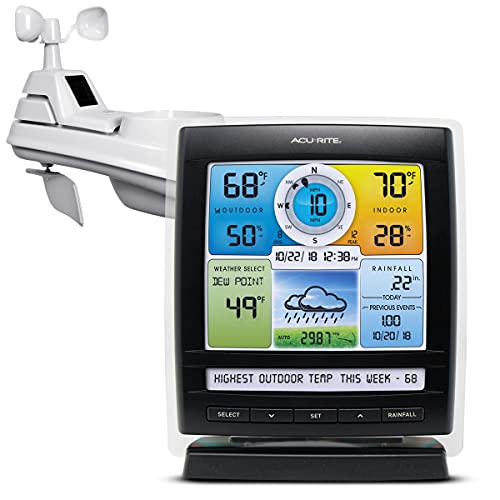
- Displays more than 55 weather data points
- Adds wind, rainfall, pressure, and historical readings
- Color screen with adjustable dimmer and forecast
Best For: Users who want broad backyard weather data
Best Atomic Time Display
La Crosse 308-1414B Weather Station

- Color forecast with indoor/outdoor temperature and humidity
- Atomic clock with calendar and daylight-saving adjustment
- Adjustable backlight, alerts, and wireless sensor range
Best For: Homes wanting basic weather data and precise time
Best Wi-Fi Weather Sharing
AcuRite Iris 5-in-1 Weather Station
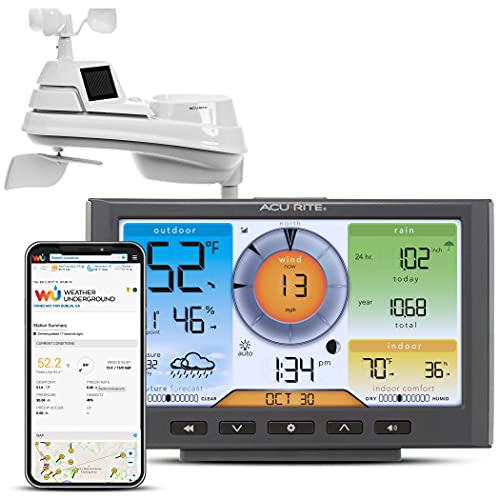
- Connects to Weather Underground
- Tracks five core outdoor weather measurements
- Offers 25-plus data points and historical information
Best For: Remote monitoring and online weather-data sharing
Best Large-Display Atomic Clock
Wireless Weather Station with Atomic Clock

- Uses a high-contrast 7.6-inch VA display
- Synchronizes time through WWVB atomic-clock signals
- Supports up to three remote sensors
Best For: Readable whole-home monitoring and precise timekeeping
Best Color Display Pick
AcuRite 02077M Wireless Weather Station
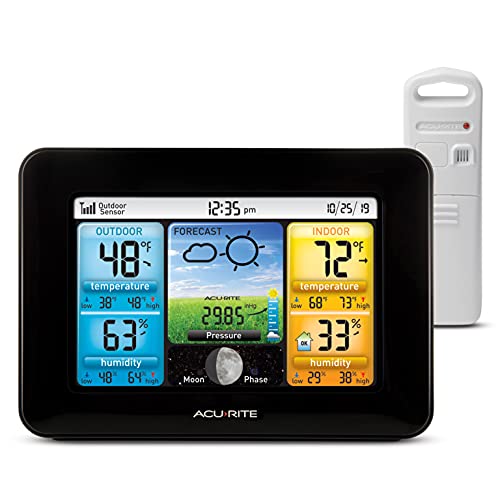
- Color LCD with adjustable dimmer
- Tracks 15+ home-weather data points
- Includes wireless outdoor sensor
Best For: Simple at-a-glance home weather monitoring
Best Clock Combo
Newentor Wireless Weather Station

- Large color LCD with adjustable brightness
- Atomic clock with dual alarms
- Supports up to three remote sensors
Best For: Bedrooms and living spaces needing weather data plus clock functions
Best for Rain and Wind Data
Sainlogic 12-in-1 Weather Station

- Measures rain, wind, dew point, and heat index
- Large high-contrast eight-inch display
- Wireless system designed for larger outdoor spaces
Best For: Gardens, farms, and detailed outdoor weather tracking
Best Custom Alerts – La Crosse C85845-INT Weather Station
If you want weather stations under 100 with straightforward indoor and outdoor monitoring, the La Crosse C85845-INT is a practical choice. It displays temperature, humidity, dew point, heat index, forecast icons, and daily high/low records on a large adjustable-brightness screen.
Best For: Home users who want customizable temperature and humidity alerts plus an easy-to-read display.
Pros:
- Tracks indoor and wireless outdoor temperature and humidity.
- Includes customizable high/low alerts for temperature and humidity.
- Shows dew point, heat index, comfort charts, and daily high/low records.
- Atomic clock, calendar, adjustable brightness, and multiple time-zone settings add convenience.
Cons:
- Forecast calibration may take 7–10 days.
- Requires a power cord for continuous backlighting.
- Backup and outdoor sensor batteries are not included.
This La Crosse model emphasizes everyday readability and alerts rather than advanced wind or rainfall tracking. It is a well-rounded option for basic household weather awareness.
Best Data Coverage – AcuRite Iris 01512 Wireless Weather Station
Among weather stations under 100, the AcuRite Iris 01512 stands out for the breadth of information it provides. Its color display receives indoor and outdoor readings for temperature, humidity, wind, barometric pressure, and rainfall, along with historical and forecast information.
Best For: Gardeners and homeowners who want wind and rainfall data alongside temperature and humidity readings.
Pros:
- Provides more than 55 weather data points, including historical information.
- Measures outdoor temperature, humidity, wind speed and direction, pressure, and rainfall.
- Color LCD includes time, date, adjustable dimmer, and personalized 12-hour forecasts.
- Wireless sensor includes a mounting bracket and is designed for straightforward setup.
Cons:
- The system requires many batteries overall.
- The listed lower temperature rating is 32°F.
- Its larger, heavier display may require more placement space.
The Iris is the most information-focused option in this group. Choose it if rainfall and wind readings matter as much as basic indoor and outdoor temperature monitoring.
Best Rainfall Tracking – Sainlogic Wireless Weather Station
The Sainlogic wireless weather station is a strong candidate among weather stations under 100 for users who specifically need rainfall and wind information. It combines a large-font color LCD with a wireless outdoor sensor that tracks rain, wind direction and speed, pressure, temperature, humidity, and related readings.
Best For: Gardeners, farms, and outdoor users who want detailed rainfall records without Wi-Fi.
Pros:
- Includes a rain gauge with hourly, daily, weekly, monthly, and total rainfall records.
- Displays wind speed and direction, pressure, temperature, humidity, dew point, and feels-like readings.
- 6.5-inch HD color screen uses oversized fonts and adjustable backlighting.
- Wireless sensor is designed for mounting on fences, roofs, or similar outdoor locations.
Cons:
- This model does not include Wi-Fi connectivity.
- The outdoor sensor requires installation and alignment.
- The display console is battery powered according to the listed specifications, with a power adapter included among the components.
With its dedicated rain gauge and broad outdoor measurements, the Sainlogic is better suited to garden and property monitoring than simple indoor comfort tracking. It is a compelling pick when precipitation records are a priority.
Best Atomic Time Display – La Crosse 308-1414B Weather Station
For shoppers comparing weather stations under 100, the La Crosse 308-1414B offers a simple combination of color forecasting, indoor/outdoor temperature, humidity, and accurate timekeeping. Its full-color LCD and adjustable backlight make it convenient for routine household monitoring.
Best For: Home users who want a readable forecast display with atomic time and basic temperature alerts.
Pros:
- Shows indoor and outdoor temperature and humidity with minimum/maximum records.
- Includes customizable alerts and a weather-resistant wireless sensor with up to 330 feet of range without obstructions.
- Atomic time, calendar, daylight-saving adjustment, and 12/24-hour modes improve convenience.
- Backlight offers high, low, and off settings, plus a time alarm with snooze.
Cons:
- The product is primarily focused on temperature and humidity rather than wind or rainfall.
- Full-feature display operation uses the included power adapter.
- Backup batteries are required separately.
This model is a sensible everyday station for a living room, bedroom, or office. Its strengths are readable basics, customizable alerts, and reliable clock features rather than comprehensive outdoor measurements.
Best for Easy Setup – Sainlogic 12-in-1 Wireless Weather Station
For shoppers comparing weather stations under 100, the Sainlogic 12-in-1 stands out for its broad data coverage and rainfall-focused monitoring. It tracks indoor and outdoor conditions, wind, pressure, and precipitation without requiring Wi-Fi.
Best For: Homeowners, gardeners, and users who want detailed rainfall records and a large, adjustable display.
Pros:
- Records rainfall hourly, daily, weekly, monthly, and cumulatively.
- Displays 12 measurements, including temperature, humidity, wind, pressure, dew point, and moon phase.
- Large 6.5-inch color display with three backlight levels.
- Wireless range reaches up to 443 feet in open conditions.
Cons:
- No Wi-Fi connectivity for remote monitoring.
- Requires three AA batteries.
Its combination of rainfall history, wide wireless range, and extensive local readings makes this a particularly capable pick for backyard or garden monitoring when online access is not a priority.
Best Wi-Fi Weather Sharing – AcuRite Iris 5-in-1 Weather Station
Among weather stations under 100, the AcuRite Iris is a practical choice for shoppers who want local readings plus Wi-Fi access. Its 5-in-1 sensor measures core outdoor conditions and can connect with Weather Underground for remote monitoring.
Best For: Users who want a color home display, historical weather information, and the ability to share or view readings online.
Pros:
- Measures temperature, humidity, wind speed and direction, pressure, and rainfall.
- Connects to Weather Underground for remote monitoring and data sharing.
- Provides more than 25 data points, including heat index, dew point, and wind chill.
- Color LCD includes time, date, adjustable brightness, alarms, and historical tracking.
Cons:
- Temperature accuracy is listed at plus or minus 2 degrees Fahrenheit.
- Its outdoor temperature rating begins at 32 degrees Fahrenheit.
- Wi-Fi setup adds another connection step compared with offline stations.
The Iris offers a strong balance between straightforward home monitoring and online connectivity, making it appealing if remote access and Weather Underground integration matter more than having the widest range of measurements.
Best Large-Display Atomic Clock – Wireless Weather Station with Atomic Clock
For shoppers seeking weather stations under 100 with easy-to-read information, this wireless model combines a 7.6-inch VA display with an atomic clock and multi-zone time support. It also provides pressure trends and supports up to three remote sensors.
Best For: Families and older users who prioritize readability, accurate timekeeping, and whole-home sensor expansion.
Pros:
- Large VA display is designed for strong color contrast and readability.
- Atomic clock automatically synchronizes daily with WWVB signals.
- Supports seven time zones and up to three remote sensors.
- Tracks hourly barometric pressure trends with absolute and relative modes.
Cons:
- Wireless pairing range is limited to a stated maximum of 328 feet.
- Atomic-clock setup requires correct time-zone and daylight-saving settings.
- Supplied notes do not specify Wi-Fi or remote online monitoring.
This station is a sensible fit for households that value a prominent display and dependable time synchronization. Its expandable sensor support adds flexibility for monitoring multiple areas around the home.
Best Color Display Pick – AcuRite 02077M Wireless Weather Station
For shoppers comparing weather stations under 100, the AcuRite 02077M is a practical choice for straightforward home monitoring. Its color LCD shows indoor and outdoor temperature, humidity, barometric pressure trends, forecast icons, moon phase, and additional records in an easy-to-view format.
Best For: Homeowners who want a simple wireless station with a colorful display and hyperlocal forecast information.
Pros:
- Displays more than 15 data points, including temperature, humidity, pressure trends, records, and signal strength.
- Wireless outdoor sensor provides indoor and outdoor readings without a wired connection.
- Adjustable display dimmer supports placement in a home, office, or RV.
- Forecast icons, trend arrows, and moon-phase information add useful at-a-glance context.
Cons:
- The required two AA batteries for the outdoor sensor are not included.
- The forecast is a short-term, approximately 12-hour prediction rather than a long-range forecast.
- The supplied details do not list a warranty.
The AcuRite stands out when clear presentation and uncomplicated setup matter most. It is less suited to buyers seeking wind or rainfall measurements, but it offers a useful set of everyday home-weather readings.
Best Clock Combo – Newentor Wireless Weather Station
Among weather stations under 100, the Newentor Q3-BLACK is a versatile indoor-outdoor thermometer and clock for rooms where you want weather data always visible. It combines a large color LCD with temperature and humidity readings, forecasts, barometric pressure, alarms, moon phase, and atomic time.
Best For: Bedrooms, living rooms, or offices where a weather monitor and atomic alarm clock need to share one display.
Pros:
- Large color screen shows indoor and outdoor temperature and humidity, highs and lows, alerts, time, date, and more.
- Included power adapter supports an always-on display, while battery backup provides an eco mode.
- Supports up to three wireless remote sensors for monitoring multiple locations.
- Includes atomic time, dual alarms, snooze, weather forecast, and barometric pressure information.
Cons:
- Only one remote sensor is included; additional sensors are needed for other locations.
- Batteries are not included.
- Battery-only operation dims the screen after a 15-second quick glance.
The Newentor is a strong fit for buyers who value a full-time clock display and household convenience features. Its forecast calibrates over seven to 10 days, so initial readings may be less personalized while that process is underway.
Best for Rain and Wind Data – Sainlogic 12-in-1 Weather Station
For shoppers seeking weather stations under 100 with broader outdoor coverage, the Sainlogic 12-in-1 provides substantially more environmental data than a basic thermometer. Its wireless sensor system measures temperature, humidity, wind, rainfall, dew point, heat index, barometric pressure, and moon phase, with no Wi-Fi required.
Best For: Gardeners, hobbyists, farms, and households that want rainfall and wind readings alongside standard temperature and humidity data.
Pros:
- Tracks temperature, humidity, wind speed and direction, rainfall, dew point, heat index, pressure, and moon phase.
- Eight-inch display uses large bold fonts, high contrast, and three backlight levels for easier viewing.
- Wireless transmission is designed for larger outdoor spaces such as orchards and farms.
- Rain gauge supports manual calibration and provides stated accuracy ranges for light and heavy rain.
Cons:
- It does not provide Wi-Fi connectivity.
- Backup batteries are sold separately.
- The outdoor sensor requires mounting and setup according to the included instructions.
The Sainlogic is the most capable option here for outdoor activity tracking, especially when precipitation and wind matter. Choose it over a simpler station if you are prepared to mount the sensor and do not need app-based or Wi-Fi monitoring.
How We Picked the Best Weather Stations Under 100
We focused on the features that matter most at this price: measurement range, sensor coverage, display readability, setup requirements, alert options, and useful weather data. The lineup includes simple indoor/outdoor thermometers as well as more complete systems with wind, rain, pressure, dew point, and forecast functions.
We also considered practical ownership details. A station is more useful when its outdoor sensor is easy to position, its screen is readable from across a room, and its power or connectivity requirements suit your home. Models with Wi-Fi or Weather Underground support can provide remote access, while non-connected systems are often simpler and more private.
Quick Comparison
- Best for broad weather tracking: Choose a model with wind, rain, humidity, pressure, and forecast readings.
- Best for simple monitoring: A temperature-and-humidity station is easier to install and typically more affordable.
- Best for visibility: Look for a large color LCD with clear indoor and outdoor readings.
- Best for remote access: Select a Wi-Fi-enabled station that supports an online weather service.
- Best for accurate timekeeping: Atomic-clock models automatically synchronize where reception is available.
Key Buying Factors for Weather Stations Under $100
Measurements and Accuracy
Decide which readings you will actually use. Temperature and humidity suit everyday comfort checks, while wind speed, direction, rainfall, dew point, and barometric pressure are more valuable for gardening, outdoor work, storm awareness, or hobby forecasting.
Sensor Placement and Range
Outdoor sensors need a suitable location away from walls, vents, direct heat, and obstructions. Check the stated wireless range and whether the rain or wind sensors require more open exposure. A technically capable station can perform poorly if installation is restricted.
Display and Alerts
A large, high-contrast screen helps when the station sits across the room. Customizable high- and low-temperature alerts are useful for nurseries, workshops, garages, and protecting sensitive plants. Consider whether the display must remain plugged in or offers battery operation.
Connectivity and Maintenance
Wi-Fi adds remote viewing and online data sharing but may involve a more involved setup. Basic wireless stations avoid network dependence. Replace batteries as needed, keep sensors clean, and periodically verify readings against a trusted reference.
Who Should Buy Which Weather Stations Under 100?
Choose a basic wireless model if you mainly want indoor and outdoor temperature, humidity, and time without apps or complicated installation. Choose a full-featured Sainlogic or similar system if wind, rain, pressure, and dew point are central to your plans. Choose an AcuRite Iris with Wi-Fi if checking local conditions remotely or sharing data through Weather Underground matters. Choose a La Crosse model with alerts if notifications and an easy-to-read home display are priorities. Finally, choose an atomic-time model when accurate clock synchronization is as important as weather information.