
Choosing the right USB oscilloscope can make hobby electronics faster to debug and easier to learn. The best models balance bandwidth, sample rate, software quality, and the extra tools you actually need.
This roundup of usb oscilloscopes for hobbyists focuses on practical value, from simple budget scopes to advanced PC-connected lab instruments with logic analysis and generator functions.
Best 10 USB Oscilloscopes for Hobbyists Picks for 2026
All-in-One Bench Companion
EspoTek Labrador USB Oscilloscope

- 2-channel scope plus generator, power supply, logic analyzer, and multimeter
- Open-source and compatible with Windows, Mac, Linux, Android, and Raspberry Pi
- Compact 20 g design for a small bench or portable kit
Best For: Makers who want a multi-function USB test tool in one compact unit
Portable Pocket Pick
FNIRSI DSO152 Handheld Oscilloscope

- Handheld oscilloscope with 2.8-inch display and built-in battery
- 2.5 MS/s real-time sampling with 200 kHz bandwidth
- Auto, Normal, and Single trigger modes for quick checks
Best For: Hobbyists who want a portable handheld scope for simple measurements
Isolation Upgrade
Owon VDS1022I USB PC Oscilloscope

- USB isolation helps reduce interference and protect the PC
- Up to 100 MHz bandwidth with 1 GS/s real-time sampling
- FFT, X-Y, and multi-trigger tools for deeper analysis
Best For: Hobbyists who want a PC scope with isolation and advanced features
Budget PC Starter
Hantek 6022BE USB Oscilloscope

- 2-channel PC-based oscilloscope with standard USB interface
- 23 measurement functions plus PASS/FAIL check
- Waveform math, persistence, and X-Y plotting included
Best For: Beginners who want an affordable laptop-based oscilloscope
Premium Multi-Tool Lab Scope

- 125 MS/s per channel, 14-bit two-channel scope
- Adds waveform generator, logic analyzer, and power supplies
- Software tools include FFT, spectrogram, and protocol analysis
Best For: Hobbyists who want one compact USB instrument for mixed-signal work
Budget Portable PC Scope

- Two-channel scope with 20MHz bandwidth
- 48MSa/s real-time sampling and 20+ measurement functions
- USB-powered and portable for Windows PCs
Best For: Budget-minded hobbyists doing basic PC-based signal checks
Automotive Diagnostic USB Scope

- 8-channel scope with 12-bit resolution
- 80+ automotive diagnostic functions and signal generation
- Windows-only USB tool for vehicle troubleshooting
Best For: Hobbyists and technicians focused on automotive diagnostics
Portable PC Scope
6022BL PC Digital Oscilloscope
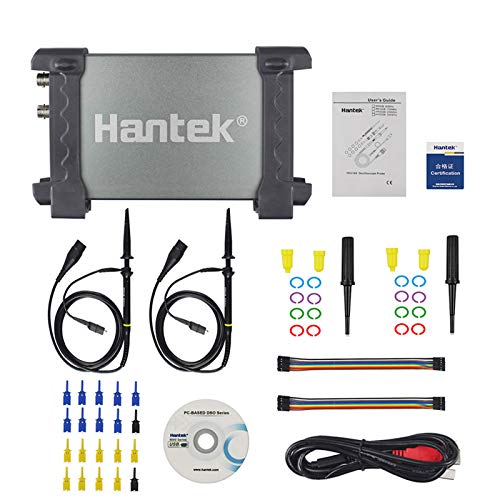
- USB2.0-powered with no extra supply needed
- 2 channels and 20MHz bandwidth
- 20+ automatic measurements plus pass/fail check
Best For: PC-based hobbyists needing a compact, portable oscilloscope
Handheld Easy-Use Scope
2.8-Inch Portable USB Oscilloscope

- Battery-powered handheld scope with 400mAh battery
- 2.5MS/s sample rate and 250kHz bandwidth
- AUTO, Normal, and Single trigger modes
Best For: Beginners and hobbyists wanting a simple portable handheld scope
Advanced PC Scope
PicoScope 2204A-D2 USB Oscilloscope

- 2 channels, 10MHz bandwidth, up to 100MS/s
- PS7 software for Windows, Linux, and Mac
- Includes generator, analyzer, and protocol decoding tools
Best For: Serious hobbyists who want advanced software and cross-platform support
All-in-One Bench Companion – EspoTek Labrador USB Oscilloscope
If you want one of the more versatile usb oscilloscopes for hobbyists, the EspoTek Labrador stands out by combining several tools in a single open-source device. It works with Windows, Mac, Linux, Android, and Raspberry Pi, making it easy to slot into a small bench or portable setup.
Best For: Makers who want an all-in-one USB test tool with scope, generator, power supply, and basic logic analysis.
Pros:
- Combines a 2-channel oscilloscope, 2-channel waveform generator, logic analyzer, and multimeter
- Works across Windows, Mac, Linux, Android, and Raspberry Pi
- Open-source design with compact 20 g form factor
- Includes closed-loop power supply output from 4.5 to 15 V
Cons:
- Oscilloscope sample rate is limited to 750 ksps
- Power supply output is capped at 0.75 W max
- Logic analyzer is only 2 channels
For hobbyists who value flexibility over raw scope performance, this is a practical multi-tool that can cover a lot of bench tasks without taking up much space.
Portable Pocket Pick – FNIRSI DSO152 Handheld Oscilloscope
The FNIRSI DSO152 is a straightforward choice if you want usb oscilloscopes for hobbyists in a handheld format rather than a PC-tethered setup. It offers a 2.8-inch display, 2.5 MS/s sampling, and easy one-key AUTO operation for quick waveform checks.
Best For: Hobbyists who want a portable handheld oscilloscope for quick field or bench measurements.
Pros:
- Portable assembled handheld design with built-in 1000 mAh battery
- 2.5 MS/s real-time sampling and 200 kHz bandwidth
- Full trigger modes: Auto, Normal, and Single
- Type-C charging and data transfer with firmware upgrade support
Cons:
- 200 kHz bandwidth is modest for higher-frequency work
- Only a 2.8-inch 320 x 240 display
- Not a USB PC oscilloscope style device
This is best viewed as a grab-and-go scope for basic troubleshooting, education, and portable testing rather than a high-bandwidth lab instrument.
Isolation Upgrade – Owon VDS1022I USB PC Oscilloscope
If you are comparing usb oscilloscopes for hobbyists and want more confidence at the PC, the Owon VDS1022I adds USB isolation to help reduce interference and protect the computer. Its thin body, USB bus power, and remote-control option make it a convenient bench companion.
Best For: Hobbyists who want a PC oscilloscope with isolation and more advanced viewing features.
Pros:
- USB isolation helps reduce signal interference and protect the PC
- Up to 100 MHz bandwidth and 1 GS/s real-time sample rate
- 10M record length plus FFT and X-Y display modes
- Multi-trigger options including edge, video, slope, pulse, and alternate
Cons:
- At 1.45 pounds, it is heavier than compact pocket scopes
- Designed as a USB PC unit, so it depends on a computer
- Optional LAN remote control may be more than casual users need
For users who want a more capable PC-based scope with useful protection and analysis features, this model offers a strong middle ground.
Budget PC Starter – Hantek 6022BE USB Oscilloscope
The Hantek 6022BE is a classic entry-level option in usb oscilloscopes for hobbyists who want a PC-based tool with a practical set of measurement features. It uses a standard USB interface and is aimed at notebook use, maintenance work, and general technical applications.
Best For: Beginners and budget-minded hobbyists needing a simple 2-channel USB oscilloscope for PC use.
Pros:
- 2-channel USB oscilloscope with a standard USB interface
- Includes 23 measurement functions and PASS/FAIL check
- Offers waveform average, persistence, intensity, and math functions
- X-Y plotting and arithmetic tools broaden analysis options
Cons:
- PC-based design means it is not a standalone handheld scope
- 20 MHz class product is less suited to higher-frequency work
- Bulkier than ultra-compact USB dongle-style options
This model makes sense if you want a straightforward scope interface on a laptop and value utility features more than portability or top-end bandwidth.
Premium Multi-Tool Lab Scope – Analog Discovery 3
If you want one of the most versatile usb oscilloscopes for hobbyists, the Analog Discovery 3 stands out because it combines a scope, waveform generator, logic analyzer, and variable power supplies in a single USB-C device. Its 14-bit acquisition, up to 125 MS/s per channel, and software tools like FFT, spectrogram, eye diagram, and protocol analysis make it a strong fit for hands-on electronics work.
Best For: Hobbyists who want one compact USB instrument to cover analog, digital, and power-supply tasks.
Pros:
- Two differential oscilloscope channels with 14-bit resolution and up to 125 MS/s per channel.
- Built-in waveform generator, 16-channel logic analyzer, and programmable variable power supplies.
- Extra software instruments include spectrum, network, and impedance analysis, plus data logging and scripting support.
- Includes support for LabVIEW and MATLAB for more advanced workflows.
Cons:
- Requires a computer-based workflow rather than a standalone scope.
- Power supply output is limited and needs an auxiliary power source for up to 800 mA per channel.
- Higher capability may be more than casual users need.
This is a premium all-in-one choice for makers who want to test, generate, and analyze signals without buying separate bench tools. If your projects span mixed-signal circuits, the feature set is unusually broad for a portable USB device.
Budget Portable PC Scope – Hantek 6022BE
For hobbyists looking for a straightforward entry point into usb oscilloscopes for hobbyists, the Hantek 6022BE focuses on the essentials: two channels, 20MHz bandwidth, and 48MSa/s real-time sampling. It is USB-powered and built in an anodized aluminum case, so it suits portable troubleshooting and basic signal checks on a Windows PC.
Best For: Hobbyists who need an affordable, portable two-channel USB oscilloscope for basic PC-based measurements.
Pros:
- Two channels with 20MHz bandwidth and 48MSa/s real-time sampling.
- USB-powered design means no separate power supply is needed.
- Includes more than 20 automatic measurement functions and PASS/FAIL check.
- Durable anodized aluminum case and support for multiple Windows versions.
Cons:
- Works with Windows only.
- Bandwidth and sampling are modest compared with higher-end USB scopes.
- Driver setup may require extra help on some Windows 10 systems.
This model makes sense if you want a compact, PC-connected scope for general electronics checks without paying for advanced lab features. It is best viewed as a practical utility tool for everyday signal viewing and measurement.
Automotive Diagnostic USB Scope – Hantek 1008C
If your projects lean toward vehicle repair, the Hantek 1008C is one of the more specialized usb oscilloscopes for hobbyists because it combines an 8-channel oscilloscope, diagnostic functions, and a programmable signal generator. With automotive-focused tests for ignition, sensors, bus detection, actuator systems, and charging circuits, it is aimed at practical troubleshooting rather than general lab use.
Best For: Hobbyists and technicians who want a Windows-based USB oscilloscope for automotive diagnostics.
Pros:
- Eight analogue channels with 12-bit resolution and 4K memory depth.
- Includes more than 80 automotive diagnostic functions for common vehicle systems.
- Programmable signal generator can simulate crankshaft and camshaft signals.
- Also supports general oscilloscope use with 20 automatic measurement modes.
Cons:
- Windows-only software support.
- Real-time sampling rate is limited to 2.4MSa/s.
- Automotive focus makes it less versatile for general electronics than mixed-purpose scopes.
This is the right pick when vehicle diagnostics matter more than bench-style flexibility. For users who want to inspect, simulate, and troubleshoot automotive signals from a laptop, the 1008C offers a lot of targeted functionality in one unit.
Portable PC Scope – 6022BL PC Digital Oscilloscope
If you’re comparing usb oscilloscopes for hobbyists, this 6022BL is a practical PC-connected option that keeps the setup simple. It runs from USB power, offers 2 channels and 20MHz bandwidth, and adds more than 20 automatic measurement functions plus pass/fail checking for hands-on troubleshooting and learning.
Best For: Hobbyists who want a compact, USB-powered PC oscilloscope for general electronics work and basic logic analysis.
Pros:
- USB2.0-powered design means no extra power supply is needed.
- 2 channels with 20MHz bandwidth suit common hobby electronics tasks.
- Includes more than 20 automatic measurement functions and pass/fail check.
- Compact aluminum housing makes it easy to carry for notebook-based use.
Cons:
- Requires a Windows PC, with support listed for older and current versions.
- Not a standalone handheld scope; it depends on a computer connection.
For hobbyists who want a small USB oscilloscope for bench or field use, this model focuses on convenience and core measurement features rather than advanced standalone hardware. The included logic-analyzer-style capability and portable build make it a flexible starter or backup tool.
Handheld Easy-Use Scope – 2.8-Inch Portable USB Oscilloscope
Among usb oscilloscopes for hobbyists, this handheld model stands out for simplicity: it is battery powered, portable, and built around quick waveform capture. The 2.5MS/s sample rate, 250kHz bandwidth, and three trigger modes make it a straightforward choice for basic repair work, teaching, and signal checking.
Best For: Hobbyists who want a small handheld oscilloscope with simple controls and a rechargeable battery.
Pros:
- Portable handheld design with a 400mAh rechargeable battery.
- 3 trigger modes help capture different signal types more reliably.
- AUTO mode simplifies setup by identifying waveform type and adjusting settings.
- 2.8-inch HD display shows key measurement status clearly.
Cons:
- 250kHz bandwidth is modest compared with more capable bench or PC scopes.
- AUTO mode is noted as ineffective for frequencies below 45Hz.
This is a good fit if you value grab-and-go convenience over deep analysis features. Its focus on easy operation and a clear screen makes it approachable for beginners, though its performance envelope is aimed at lighter-duty testing.
Advanced PC Scope – PicoScope 2204A-D2 USB Oscilloscope
If you’re shopping usb oscilloscopes for hobbyists and want a more polished PC tool, the PicoScope 2204A-D2 offers a strong software-driven package. It combines 2 channels, 10MHz bandwidth, up to 100MS/s sampling, and PS7 software support across Windows, Linux, and Mac, making it well suited to small labs and serious learning projects.
Best For: Hobbyists who want a compact USB oscilloscope with advanced software features and cross-platform support.
Pros:
- 2-channel scope with up to 100MS/s sampling and 10MHz bandwidth.
- Includes spectrum analyzer, function generator, and arbitrary waveform generator features.
- PS7 software supports Windows, Linux, and Mac.
- Advanced tools include serial protocol decoding, math/filtering, and mask limit testing.
Cons:
- 8 kS capture memory is relatively small for some use cases.
- It is a PC-connected scope, so it is not a standalone handheld unit.
For hobbyists who care about software depth and analysis tools, this PicoScope is the most feature-rich option here. The tradeoff is that it leans heavily on your computer and software workflow, but that also gives it a more capable overall measurement experience.
How We Picked the Best USB Oscilloscopes for Hobbyists
We prioritized USB Oscilloscopes for Hobbyists that offer a useful mix of performance, usability, and value. That means real-world bandwidth for common projects, enough sample rate for clean captures, and software that is stable enough for regular use. We also considered portability, channel count, and whether the device includes extras like a signal generator, logic analyzer, or isolation.
Quick Comparison
For simple troubleshooting and learning, entry-level handheld or PC-based 2-channel models are usually the easiest starting point. If you work on mixed-signal projects, multi-channel devices and scopes with bundled logic analysis are more practical. For heavier bench use, higher-performance units and isolated PC scopes are better suited to cleaner measurements and safer connections.
Key Buying Factors for USB Oscilloscopes for Hobbyists
Bandwidth and Sample Rate
Bandwidth determines how fast a signal the scope can measure accurately, while sample rate affects detail and timing resolution. For microcontrollers, audio, and general maker work, moderate bandwidth is often enough. For faster digital signals or switching circuits, choose more headroom.
Channel Count and Extras
Two channels cover many hobby tasks, but more channels help when comparing signals or debugging buses. Built-in generators, logic analyzer support, and multimeter functions can reduce how many separate tools you need on the bench.
Software and Compatibility
Since these are PC-connected instruments, software matters as much as hardware. Look for reliable driver support, clear controls, and compatibility with your operating system. A well-designed interface can save more time than a small spec bump.
Isolation and Safety
Isolated USB scopes can be worth paying for if you work with uncertain grounding, laptops, or bench systems where noise and safety are concerns. Basic non-isolated models are fine for low-voltage hobby circuits, but they require more care.
Who Should Buy Which USB Oscilloscopes for Hobbyists?
If you want a simple, low-cost learning tool, choose a basic 2-channel model with good software and enough bandwidth for your projects. If you build embedded systems or mixed-signal circuits, look for multi-channel support and logic features. If you need more precision, isolation, or a more complete lab setup, step up to higher-end USB Oscilloscopes for Hobbyists with stronger software and expanded functionality.