
When you’re tackling a science project, having the right tools can make all the difference. USB data loggers offer a straightforward solution for monitoring environmental conditions. They come in various models, each designed for specific needs. Whether you’re focused on temperature, humidity, or even industrial applications, there’s a logger suited for your project. Wondering which options stand out? Let’s explore the top choices available to enhance your data collection process.
Elitech RC-5 USB Temperature Data Logger Recorder

The Elitech RC-5 USB Temperature Data Logger Recorder stands out as an ideal choice for anyone needing precise temperature monitoring, especially in critical applications like vaccine storage. With a recording capacity of 32,000 points and a measuring range of -30℃ to 70℃, you can trust it for accuracy. The built-in USB connector allows for easy data downloads without extra cables, and it generates detailed PDF reports using free software. Thanks to its LCD display, you can quickly view logged data and alarms. Plus, with IP65 protection, it’s tough enough for dry ice and vaccine transport. You’ve got reliable support too!
Best For: The Elitech RC-5 USB Temperature Data Logger Recorder is best for professionals and organizations requiring reliable temperature monitoring for sensitive products like vaccines and pharmaceuticals.
Pros:
- High recording capacity: Can store up to 32,000 data points for extended monitoring.
- User-friendly: Built-in USB connector allows for easy data downloads without additional equipment.
- Durable design: IP65 protection makes it suitable for challenging environments, including dry ice and vaccine transport.
Cons:
- Limited battery life: The battery lasts only up to 6 months before needing replacement.
- No wireless connectivity: Requires physical connection for data transfer, which may not be convenient for all users.
- Software dependency: Generating reports requires specific free software, which may not be ideal for everyone.
Lascar Electronics EL-USB-1 USB Temperature Data Logger

Looking for a reliable solution to monitor temperature fluctuations in your science project? The Lascar Electronics EL-USB-1 USB Temperature Data Logger is perfect for you. Compact at 5 x 1 x 1 inches, it records over 16,000 ambient temperature readings, with a range from -35 to +80°C (-31 to +176°F). You can choose sampling rates from 10 seconds to 12 hours, ensuring flexibility for your needs. Powered by a 1/2 AA 3.6 Volt lithium battery, it boasts a battery life of one year. Plus, it’s compatible with Windows 7, XP, and Vista, featuring LED indicators for easy monitoring.
Best For: Individuals or researchers looking for a compact and efficient solution to monitor temperature variations in scientific projects or experiments.
Pros:
- Records and stores over 16,000 ambient temperature readings for extensive data collection.
- Offers flexible sampling rates from 10 seconds to 12 hours to suit different monitoring needs.
- Long battery life of one year ensures reliable performance without frequent replacements.
Cons:
- Limited compatibility with only Windows 7, XP, and Vista, restricting use for Mac or other operating systems.
- Requires a specific battery type (1/2 AA 3.6 Volt Lithium), which may not be easily found.
- Temperature measurement range, while broad, may not meet the requirements for extreme temperature applications outside specified limits.
USB Temperature Data Logger Recorder for Temperature and Humidity

For researchers and students who need accurate readings in various environments, the USB Temperature Data Logger Recorder for Temperature and Humidity stands out with its high precision and real-time measurement capabilities. With a temperature range of -30 to 70°C, humidity from 0.1 to 99.9%, and barometric pressure monitoring, it’s versatile for any project. You can store up to 16,000 data groups, supporting real-time recording and statistical analysis. Its USB plug-and-play feature makes data management easy on Windows. Plus, you can customize settings and generate detailed reports in PDF or Excel, making it an excellent choice for your science projects.
Best For: Researchers, students, and professionals who require precise temperature and humidity measurements in various environments.
Pros:
- High accuracy with real-time measurement capabilities.
- Large storage capacity for up to 16,000 data groups.
- USB plug-and-play feature simplifies data management and reporting.
Cons:
- Limited to Windows OS compatibility.
- Requires computer for customization and report generation.
- IP65 waterproof design may not be suitable for all outdoor conditions.
Serial Data Logger for Arduino and Raspberry Pi
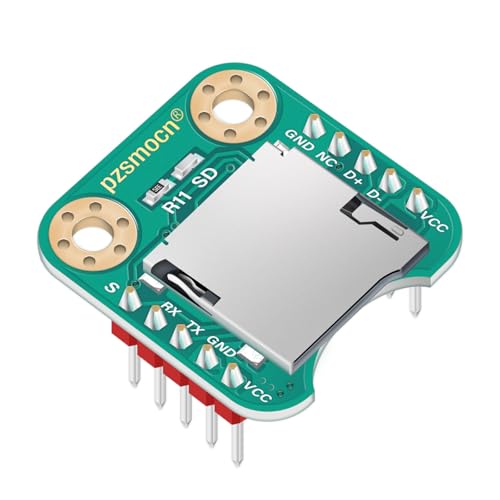
If you’re working on projects involving Arduino or Raspberry Pi, the Serial Data Logger is an excellent choice for your data acquisition needs. It’s compatible with both boards and supports various baud rates, ensuring good connectivity. With a 32GB TF card and a FAT32 file system, you’ll have ample storage for your data. This logger excels in offline data collection and can capture essential debug logs, making it perfect for robot and UAV debugging. Plus, the USB feature eliminates the need for a card reader, and an LED indicator keeps you informed about data writing status.
Best For: This product is best for hobbyists and professionals working on Arduino and Raspberry Pi projects that require efficient data logging and debugging.
Pros:
- Supports multiple baud rates for versatile connectivity.
- USB function allows for easy data transfer without a card reader.
- LED indicator provides real-time status of data writing.
Cons:
- Limited to a maximum storage of 32GB, which may not be sufficient for large projects.
- Requires a TF card, which is an additional cost if not already owned.
- May have compatibility issues with some less common Arduino or Raspberry Pi models.
Elitech RC-51 Digital Temperature Data Logger USB Reusable 32000 Points

The Elitech RC-51 Digital Temperature Data Logger stands out as an ideal choice for researchers and students who need precise temperature monitoring for their science projects. With a wide measuring range of -22℉ to 158℉, this reusable logger records up to 32,000 temperature points. You’ll love its plug-and-play USB functionality, generating PDF reports automatically upon connection—no software needed. The LCD display shows real-time temperature, max/min values, and logging points. Plus, you can set up to five alarms to protect sensitive items. With 24/7 US technician support, you’re never alone in your data logging journey.
Best For: The Elitech RC-51 Digital Temperature Data Logger is best for researchers and students needing precise temperature monitoring for science projects.
Pros:
- Plug-and-play USB functionality allows for easy report generation without additional software.
- Wide temperature measuring range of -22℉ to 158℉ makes it suitable for various applications.
- LCD display provides real-time data and allows for easy monitoring of max/min values and logging points.
Cons:
- Requires a USB connection to access data, which may limit portability.
- Calibration certificate is only available upon request, which may be inconvenient for some users.
- The default log interval of 2 minutes may not be suitable for applications needing more frequent data recording.
Elitech USB Digital Temperature Data Logger with External Probe

Ideal for those needing reliable temperature monitoring, the Elitech USB Digital Temperature Data Logger with External Probe stands out with its Shadow Data function, ensuring your data remains intact even if the logger is accidentally stopped or started. With a capacity of 32,000 points, this reusable device generates Auto PDF/CSV reports without needing extra software. It displays current temperature, maximum/minimum values, and Mean Kinetic Temperature (MKT) clearly on-screen. You can easily switch between Fahrenheit and Celsius, set alarms, and adjust logging intervals. This versatile logger is perfect for life science, food cold chain, and industrial applications, offering high accuracy across a wide temperature range.
Best For: Individuals and businesses needing dependable temperature monitoring for life science, food cold chain, and industrial applications.
Pros:
- Shadow Data function prevents data loss during accidental stops or starts.
- Auto PDF/CSV reports generated without the need for additional software, simplifying data access.
- Wide temperature range and high accuracy make it suitable for various applications.
Cons:
- External probe may require careful handling to avoid damage.
- Limited to temperature monitoring; does not log other environmental factors.
- Some users may find the initial setup and parameter settings complex.
Frigga Temperature Data Logger (10 Pack)

For researchers and students needing reliable temperature monitoring during cold chain transportation, the Frigga Temperature Data Logger (10 Pack) stands out with its impressive ability to record up to 28,800 data points over 200 days. It covers a measuring range from -30°C to 70°C, with an accuracy of ±0.5℃ in key areas. You’ll appreciate the straightforward operation—just press a button to start or stop recording. Plus, it generates instant CSV and PDF reports when plugged into any computer. With LED alarms and 24/7 tech support, this pack guarantees you stay informed and supported throughout your project.
Best For: Researchers and students requiring reliable and accurate temperature monitoring during cold chain transportation.
Pros:
- Easy to use with a simple button for starting and stopping recordings.
- Generates instant reports in both CSV and PDF formats without needing software installation.
- Includes LED alarms for temperature thresholds and offers 24/7 technician support.
Cons:
- Limited to Celsius measurement; no support for Fahrenheit.
- Single-use loggers may not be cost-effective for long-term monitoring needs.
- Accuracy varies outside the -20°C to +40°C range, potentially affecting certain applications.
Tzone Temperature Data Logger USB Single Use Temp Recorder (10 Packs)

Designed for temperature-sensitive goods, the Tzone Temperature Data Logger USB is perfect for anyone needing reliable monitoring during transportation or storage. Each single-use recorder comes in packs of 10, allowing for easy management. With a measurement range of -30°C to 60°C and an accuracy of ±0.5°C, it guarantees precise tracking. You’ll appreciate the simple button to activate it and a 30-minute delayed start for better accuracy. Plus, the LED alarm indicator keeps you informed of temperature changes. Its compact, waterproof design makes it a versatile choice for medical refrigerators, vaccines, and cold chain logistics.
Best For: Those needing reliable temperature monitoring for temperature-sensitive goods during transportation or storage.
Pros:
- Easy-to-use with a simple button activation and 30-minute delayed start for improved accuracy.
- Compact and waterproof design, making it suitable for various environments.
- Generates PDF reports without the need for additional software, simplifying data analysis.
Cons:
- Single-use only, limiting long-term monitoring capabilities.
- Battery life of up to 1 year may not be sufficient for extended storage needs.
- Requires careful placement to ensure accurate readings, as it relies on adhesive placement.
Elitech RC-5 USB Temperature Data Logger Recorder (10 Pack)

The Elitech RC-5 USB Temperature Data Logger Recorder (10 Pack) stands out as an excellent choice for scientists and researchers who need reliable temperature monitoring. With a measuring range of -30℃ to 70℃, it captures up to 32,000 recording points. You’ll appreciate its long battery life of up to six months and the convenience of a built-in USB connector for easy data downloads—no extra cables required. The clear LCD display shows logged points and alarms, while IP65 protection guarantees durability, making it suitable for dry ice and vaccine storage. Plus, you can count on 24/7 US support whenever needed.
Best For: Scientists and researchers needing reliable and durable temperature monitoring solutions.
Pros:
- Built-in USB connector allows for easy data downloads without extra cables.
- Long battery life of up to six months with a replaceable battery enhances convenience.
- IP65 protection grade ensures durability and suitability for sensitive storage, like vaccines and dry ice.
Cons:
- Limited to a measuring range of -30℃ to 70℃, which may not cover all extreme conditions.
- Requires free software for Fahrenheit/Celsius switching, adding an extra step for users.
- The LCD display may be less visible in direct sunlight or very bright environments.
Temperature Data Logger USB for Lab and Cold Chain Fresh Tag

If you’re in charge of transporting temperature-sensitive materials, the Temperature Data Logger USB is your go-to solution. With a capacity for 129,600 data points, it tracks temperatures from -22℉ to +158℉. Its compact design fits easily into various containers, ensuring accuracy during transport. Simply press the START/STOP button to activate it, and enjoy a 10-minute start delay. The LED indicators let you know if you’re within safe temperature ranges. Plus, you can plug it into any USB slot for instant PDF reports—no software needed. Its waterproof design makes it perfect for pharmaceuticals, vaccines, and biopharmaceuticals.
Best For: Those responsible for transporting temperature-sensitive materials such as pharmaceuticals, vaccines, and biopharmaceuticals.
Pros:
- High capacity of 129,600 data points for comprehensive temperature tracking.
- Waterproof design (IP67 standards) ensures reliability in various environments.
- Easy data access with instant PDF report generation via any USB port, no software needed.
Cons:
- Single-use design may not be cost-effective for frequent monitoring needs.
- Limited to a default 10-minute start delay, which may not suit all applications.
- Requires manual activation, which could lead to errors if not monitored carefully.
Factors to Consider When Choosing USB Data Loggers for Science Projects
When choosing a USB data logger for your science project, you’ll want to take into account several key factors. Think about the measurement range, data storage capacity, and battery life to guarantee it fits your needs. Additionally, look for reporting features and environmental protection ratings that align with your project’s requirements.
Measurement Range Flexibility
How can you guarantee that your USB data logger meets the specific needs of your science project? Start by considering the measurement range. For typical laboratory applications, look for a logger that operates between -30°C to 70°C. If your experiments involve extreme temperatures, choose one with a broader range, like -40°C to 85°C. This flexibility allows you to accommodate various materials and environmental conditions, ensuring accurate data collection. Pay attention to accuracy; a logger with ±0.1°C precision is ideal for sensitive experiments. Finally, check if it can switch between Fahrenheit and Celsius, enhancing usability based on your preference. Selecting the right measurement range is essential for obtaining reliable results in your scientific endeavors.
Data Storage Capacity
Data storage capacity plays an essential role in selecting the right USB data logger for your science project. You’ll find that capacities range widely, from models storing as few as 10,000 points to those accommodating up to 129,600 data points. If you plan on extended experiments or field studies, a higher storage capacity allows you to monitor for longer without interruptions. Consider the frequency of data sampling, too; a logger sampling every 10 seconds will fill up quickly compared to one that samples hourly. Additionally, if your project involves parameters like humidity or pressure alongside temperature, this can impact storage needs. Choosing a logger with adequate capacity guarantees you won’t lose critical data during long-term monitoring.
Battery Life Considerations
Choosing a USB data logger with adequate battery life is essential for guaranteeing your project runs smoothly. Battery life determines how long your logger can function without needing a replacement or recharge. Some models last up to a year, while others might only last six months. If your project is long-term, consider getting devices with replaceable batteries, as this can extend usability. Additionally, pay attention to power consumption; low power models are better for prolonged use. Some loggers even indicate battery status, allowing you to monitor remaining power and plan for replacements. Ultimately, select a data logger that fits the expected duration of your science project to guarantee continuous data recording without interruptions.
Reporting Features Availability
When selecting a USB data logger for your science project, it is crucial to take into account the availability of reporting features. Many loggers offer auto-generated reports in formats like PDF and CSV, allowing you to access data easily without extra software. Some models include detailed reporting with graphical representations, which help you analyze trends effectively. Customizing report parameters, such as date ranges and measurement units, can make your reports more relevant to your specific needs. Additionally, certain loggers support multi-language reporting, catering to diverse user bases. With the convenience of accessing reports by simply plugging the logger into your computer’s USB port, you’ll find immediate review and analysis of your recorded data simple and efficient.
Environmental Protection Rating
One essential factor to evaluate in your selection of USB data loggers for science projects is the environmental protection rating, often defined by an IP (Ingress Protection) code. This rating assesses a device’s resistance to dust and moisture, which is critical for various scientific environments. For instance, an IP65 rating means the device is dust-tight and can handle water jets, making it suitable for outdoor or wet lab conditions. If your experiments involve liquids or humid environments, consider loggers with an IP67 rating, allowing submersion in water up to 1 meter for 30 minutes. Choosing data loggers with appropriate environmental ratings guarantees durability and reliability, reducing the risk of equipment failure and enhancing your project’s success.
Compatibility With Software
After ensuring your USB data logger can withstand environmental challenges, the next vital aspect to evaluate is its compatibility with software. This factor greatly affects how easily you can retrieve data and generate reports in formats like PDF or CSV. Look for plug-and-play functionality, which allows you to access data directly from a USB port without needing extra software installation. Some loggers come with built-in software that supports multiple languages and lets you customize parameters like sampling intervals and alarm settings. Also, check that the software is compatible with your operating system, whether it’s Windows or Mac. A data logger that generates detailed reports automatically will enhance usability, making it simpler to analyze and present your findings.