
The best telescope eyepieces with long eye relief make observing more comfortable, especially for eyeglass wearers and extended viewing sessions. This lineup includes low-power wide-view designs, high-power planetary eyepieces, zooms, and versatile sets.
Use the guide below to compare focal lengths, fields of view, optical features, and practical fit before choosing the right eyepiece for your telescope.
Best 10 Telescope Eyepieces with Long Eye Relief Picks for 2026
Best Low-Power Plossl

- 19mm eye relief for comfortable viewing
- 32mm focal length with a 48° field of view
- Fully multi-coated and filter-threaded
Best For: Wide views of nebulae, clusters, and comets
Best Wide-View Comfort

- Wide 60° field of view
- Six-element fully multi-coated optics
- Pop-up eyeguard and filter-ready barrel
Best For: Comfortable wide, low-power telescope views
Best Versatile Zoom
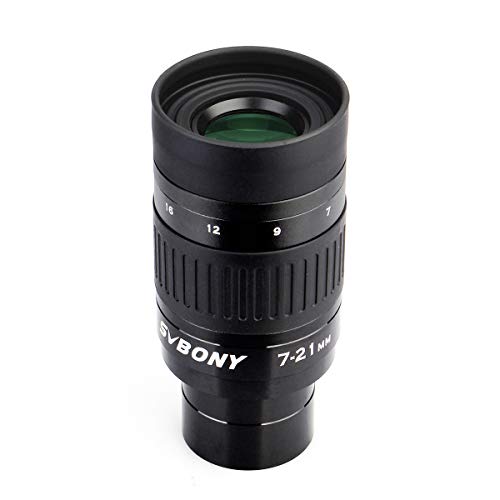
- Adjustable 7mm-21mm focal length
- 16.3mm-18mm eye relief for eyeglass wearers
- 40°-57° field of view with fully multi-coated optics
Best For: Flexible lunar, planetary, and deep-sky observing
Best Planetary Detail

- 7mm focal length for Moon and planet detail
- 60° field of view with six-element optics
- Adjustable eyeguard and filter-ready barrel
Best For: Higher-magnification lunar and planetary observing
Best Wide-Field Comfort
SVBONY SV154 15mm 70° Eyepiece

- 13mm eye relief with twist-up eyecup
- 70° apparent field of view
- Fully multi-coated five-element optics
Best For: Comfortable wide-field observing with a 1.25-inch focuser
Best for Everyday Use
Celestron X-Cel LX 5mm Eyepiece
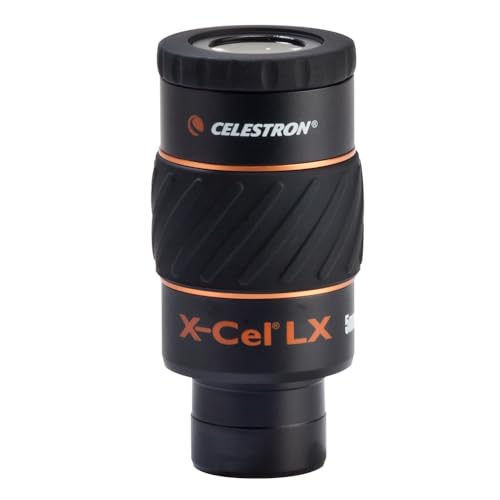
- High-power 5mm focal length
- 60° field with six-element optics
- Pop-up rubber eyeguard and filter threads
Best For: High-magnification planetary viewing
Best Value Eyepiece Set
SVBONY 4mm, 10mm & 23mm Set

- Three focal lengths for varied targets
- 62° wide-angle viewing
- Fully coated aspherical optics
Best For: Beginners building a versatile 1.25-inch eyepiece collection
Best with Extra Features
Celestron 8-24mm Zoom Eyepiece

- Smooth 8-24mm focal-length adjustment
- Fully multi-coated optics and 55° field of view
- Fits standard 1.25-inch holders and filters
Best For: Flexible observing with one eyepiece
Comfort-Focused Zoom
NEEWER 7-21mm Telescope Eyepiece

- 15mm eye relief for comfortable viewing
- 7-21mm zoom with 40°-57° field of view
- Five-element design with multiple coatings
Best For: Glasses wearers and flexible skywatching
Best Simple Pick

- 60° field of view for planetary viewing
- Six-element fully multi-coated optical system
- Pop-up rubber eyeguard and filter-threaded barrel
Best For: Dedicated lunar and planetary observation
Best Low-Power Plossl – SVBONY SV131 32mm
For shoppers comparing telescope eyepieces with long eye relief, the SVBONY SV131 stands out with a 32mm focal length and 19mm of eye relief. Its 48° field of view and 1.25-inch barrel make it a practical choice for broad, comfortable views of dim deep-sky targets.
Best For: Low-power viewing of nebulae, star clusters, comets, and other faint celestial objects.
Pros:
- 19mm eye relief supports longer, more comfortable observing sessions.
- 32mm focal length and 48° field of view suit wide, bright views.
- Fully multi-coated optics and blackened lens edges help produce clear images with reduced stray light.
- Threaded 1.25-inch barrel accepts standard filters.
Cons:
- Its 32mm focal length is intended for low power rather than high-magnification planetary detail.
- It uses a 1.25-inch mount, so compatibility depends on the telescope’s focuser.
The SV131 is a straightforward, comfort-focused eyepiece for scanning larger targets. Its long eye relief, filter compatibility, and low-power optical design make it a sensible addition to a beginner or general-purpose eyepiece set.
Best Wide-View Comfort – Celestron X-Cel LX 25mm
The Celestron X-Cel LX 25mm is a useful option for anyone seeking telescope eyepieces with long eye relief and a spacious viewing experience. Its 60° field of view, six-element fully multi-coated optical system, and adjustable rubber eyeguard are designed for comfortable low-power observing.
Best For: Wide low-power views with added eye-position comfort and grip.
Pros:
- Wide 60° field of view provides expansive views through the telescope.
- Six-element fully multi-coated lens system supports the supplied planetary-viewing design.
- Pop-up rubber eyeguard can improve comfort and contrast.
- Threaded 1.25-inch barrel accepts filters, while the rubber grip helps prevent slipping.
Cons:
- The supplied notes do not specify an exact eye-relief measurement.
- Its 25mm focal length is more suited to wide, lower-power views than maximum magnification.
Choose the X-Cel LX 25mm if a broad field and physical viewing comfort matter more than a compact basic Plossl design. Celestron also includes a 2-year US warranty and unlimited support from its US-based team.
Best Versatile Zoom – SVBONY SV135 7-21mm
The SVBONY SV135 is a flexible pick among telescope eyepieces with long eye relief because one eyepiece covers a 7mm-to-21mm focal-length range. Its stated 18mm-to-16.3mm eye relief, 40°-57° field of view, and 1.25-inch fit make it useful when you want to adjust magnification without changing eyepieces.
Best For: Observers who want adjustable magnification for the Moon, planets, nebulae, clusters, and landscapes.
Pros:
- 7mm-to-21mm zoom range provides the versatility of multiple focal lengths.
- 18mm-to-16.3mm eye relief is especially suitable for eyeglass wearers.
- Six-element, four-group fully multi-coated design is intended to improve edge and center sharpness.
- Rubber eyeguard helps with viewing comfort and stray-light control.
Cons:
- The field of view changes from 40° to 57° across the zoom range.
- As a zoom eyepiece, it may be less straightforward than a fixed-focal-length model for users who prefer a simple optical setup.
The SV135 is the most adaptable option in this group. It is a practical choice for observers who value eye comfort and quick magnification changes more than carrying several fixed eyepieces.
Best Planetary Detail – Celestron X-Cel LX 7mm
For higher-magnification observing, the Celestron X-Cel LX 7mm brings the comfort features of the X-Cel LX line to Moon and planetary viewing. Its 60° field of view, fully multi-coated six-element system, and pop-up rubber eyeguard make it worth considering among telescope eyepieces with long eye relief, although the supplied notes do not provide an exact eye-relief measurement.
Best For: Moon and planetary detail when the telescope and observing conditions support higher magnification.
Pros:
- 7mm focal length is designed for detailed Moon and planetary viewing.
- Six-element fully multi-coated optical system and a 60° field of view support the supplied viewing design.
- Pop-up rubber eyeguard helps provide a more comfortable viewing position and increase contrast.
- Threaded 1.25-inch barrel accepts filters, and the textured grip is useful with gloves.
Cons:
- The supplied notes do not specify an exact eye-relief measurement.
- A 7mm eyepiece produces higher magnification, so results depend more on the telescope and viewing conditions.
The X-Cel LX 7mm is a focused choice for observers building a planetary-detail setup. Its wide apparent field and adjustable eyeguard add usability, while the included 2-year US warranty and unlimited support provide extra purchase reassurance.
Best Wide-Field Comfort – SVBONY SV154 15mm 70° Eyepiece
If you want telescope eyepieces with long eye relief for comfortable wide-field observing, the SVBONY SV154 is a practical 1.25-inch option. Its 15mm focal length, 70° apparent field of view, and stated 13mm eye relief suit relaxed views of the Moon, planets, and wider star fields.
Best For: Observers who prioritize a broad view and comfortable sessions with a standard 1.25-inch focuser.
Pros:
- 13mm eye relief with metallic twist-up eyecups for added viewing comfort.
- 70° apparent field of view provides an expansive, immersive view.
- Five-element, four-group optics and fully multi-coated lenses are designed for sharp, high-contrast images.
- Safety undercut helps reduce the chance of slipping from the focuser or diagonal.
Cons:
- Its 13mm eye relief may be less accommodating than longer-relief designs for some eyeglass wearers.
- The 15mm focal length is a general-purpose choice rather than a dedicated high-power planetary eyepiece.
The SV154 balances a wide field, useful midrange focal length, and comfort-focused design. Choose it when easy framing and relaxed observing matter more than maximum magnification.
Best for Everyday Use – Celestron X-Cel LX 5mm Eyepiece
The Celestron X-Cel LX 5mm is a high-power option for shoppers comparing telescope eyepieces with long eye relief for planetary viewing. It combines a six-element fully multi-coated lens system with a 60° field of view and a pop-up rubber eyeguard.
Best For: Observers seeking high magnification for planetary views with a comfort-oriented eyeguard and grippy housing.
Pros:
- Designed and optimized for planetary viewing.
- Six-element fully multi-coated optics and a 60° field of view.
- Pop-up rubber eyeguard can improve comfort and increase contrast.
- Threaded 1.25-inch barrel accepts filters, while the rubber grip is suitable for use with gloves.
Cons:
- The 5mm focal length produces high power and may be demanding under less-than-ideal viewing conditions.
- The supplied notes do not specify an eye-relief measurement, so eyeglass compatibility is not confirmed.
With its short focal length and planetary emphasis, the X-Cel LX is aimed at detailed, high-power sessions. Its adjustable eyeguard and filter threads add practical flexibility, but verify your telescope can support 5mm magnification effectively.
Best Value Eyepiece Set – SVBONY 4mm, 10mm & 23mm Set
For beginners who want multiple focal lengths, this SVBONY set is a flexible entry point among telescope eyepieces with long eye relief. The 4mm, 10mm, and 23mm lenses cover higher-power detail through wider views, while their 62° field and fully coated optics support easier object finding.
Best For: Beginners who need a range of magnifications for the Moon, planets, star clusters, nebulae, and general sky scanning.
Pros:
- Three focal lengths provide more observing flexibility than a single eyepiece.
- 62° apparent field of view makes objects easier to locate and frames extended targets well.
- Aspherical, fully multi-coated optics are designed to reduce aberrations and improve light transmission.
- Standard 1.25-inch barrels fit astronomical telescopes with a 1.25-inch focuser and accept filters.
Cons:
- The supplied notes do not provide a specific eye-relief measurement for the set.
- The 4mm eyepiece can produce demanding magnification depending on the telescope.
- Compatibility should be checked by confirming the focuser size, telescope focal length, and appropriate magnification.
This set is most useful when versatility matters more than specialized performance. It gives new observers three practical starting points, but calculate magnification first and confirm your telescope uses a 1.25-inch focuser.
Best with Extra Features – Celestron 8-24mm Zoom Eyepiece
For shoppers comparing telescope eyepieces with long eye relief, this Celestron zoom model offers a practical way to explore different magnifications without carrying several fixed eyepieces. Its 8-24mm range, 55-degree field of view, and removable rubber eyecup support flexible observing with compatible 1.25-inch telescopes.
Best For: Beginners and observers who want one eyepiece for experimenting with multiple magnifications.
Pros:
- Smoothly zooms from 8mm to 24mm for low- to high-power viewing.
- Fully multi-coated optics are designed to improve brightness, contrast, and color.
- Works with standard 1.25-inch telescope or spotting-scope holders and accepts 1.25-inch filters.
- Includes T-threads for astrophotography and a two-year US warranty.
Cons:
- Variable zoom design may not suit shoppers seeking a dedicated fixed focal length.
- The supplied notes do not specify an eye-relief measurement.
This is a convenient, space-saving choice when flexibility matters more than a specialized single-focal-length setup. The removable eyecup adds comfort, but buyers specifically requiring measured long eye relief should confirm that specification before purchasing.
Comfort-Focused Zoom – NEEWER 7-21mm Telescope Eyepiece
This NEEWER model is a strong option among telescope eyepieces with long eye relief because it specifies 15mm of eye relief and includes a rubber eye guard. The 7-21mm zoom range covers detailed high-magnification viewing as well as wider, lower-power observation through a standard 1.25-inch barrel.
Best For: Glasses wearers and observers who want adjustable magnification with a stated 15mm eye-relief distance.
Pros:
- Provides a smooth 7-21mm focal-length range without changing eyepieces.
- Specified 15mm eye relief and a rubber eye guard support comfortable viewing.
- Offers a 40°-57° field of view for different observing magnifications.
- Uses five elements in three groups with multiple coatings to support sharp, higher-contrast images.
Cons:
- The field of view becomes narrower at the high-magnification end.
- Its 1.25-inch barrel limits compatibility to telescopes that accept that size.
With its clearly stated eye-relief specification and comfortable eye guard, this is the most directly targeted choice here for users prioritizing relaxed viewing. Its zoom format also makes it useful for moving between lunar, planetary, and broader observations.
Best Simple Pick – Celestron X-Cel LX 12mm
For observers choosing telescope eyepieces with long eye relief for focused lunar and planetary work, the Celestron X-Cel LX 12mm emphasizes a wide 60-degree field of view and a six-element fully multi-coated optical system. Its pop-up rubber eyeguard is designed to improve comfort and contrast during viewing.
Best For: Planetary and lunar observers who prefer a dedicated 12mm eyepiece with a wide field of view.
Pros:
- Six-element fully multi-coated lens system is optimized for planetary viewing.
- Provides a 60-degree field of view for a broad viewing experience.
- Twist-up rubber eyeguard supports comfort and helps increase contrast.
- Textured rubber grip and filter-threaded 1.25-inch barrel add practical usability.
Cons:
- Fixed 12mm focal length does not provide the flexibility of a zoom eyepiece.
- The supplied notes do not state a numerical eye-relief measurement.
This model is best suited to buyers who want a dedicated planetary-viewing eyepiece rather than an all-purpose zoom. The adjustable eyeguard is useful for comfort, but shoppers needing specifically quantified long eye relief should verify that detail before purchase.
How We Picked the Best Telescope Eyepieces with Long Eye Relief
We selected this group to cover the most useful observing ranges and budgets, from 32mm low-power eyepieces for locating large targets to 5mm and 7mm options for lunar and planetary detail. The roundup also includes zoom models for flexible magnification, wide-angle designs for more immersive views, and multipiece sets for beginners building a collection.
Our comparisons focus on stated eye relief, focal length, apparent field of view, barrel size, optical coatings, and compatibility with common 1.25-inch focusers. Actual performance also depends on your telescope’s aperture, focal length, optical quality, atmospheric conditions, and collimation.
Quick Comparison
| Type | Best Use | Typical Strength | Potential Trade-Off |
|---|---|---|---|
| Long focal length | Open clusters, galaxies, and large nebulae | Bright, wide views | Lower magnification |
| Short focal length | Moon and planets | More detail and magnification | More sensitive to seeing and tracking |
| Zoom | Changing magnification quickly | Flexible and convenient | Narrower field at some settings |
| Wide-angle | Immersive observing and easier target tracking | Larger apparent field | May cost more or weigh more |
Key Buying Factors for Telescope Eyepieces with Long Eye Relief
Eye Relief and Eyeglasses
Eye relief is the distance your eye can sit from the eyepiece while still seeing the full field. If you observe with glasses, look for roughly 15mm or more, while 20mm can be more comfortable. Adjustable eyecups can help position your eye and reduce stray light.
Focal Length and Magnification
Magnification equals your telescope’s focal length divided by the eyepiece focal length. Longer focal lengths produce lower magnification and generally brighter, easier-to-use views. Shorter focal lengths reveal more lunar and planetary detail but require steadier air and a stable mount.
Field of View and Optics
A wider apparent field makes objects easier to keep in view, particularly with a manual mount. Fully multi-coated optics can improve light transmission and contrast, but clean glass, accurate alignment, and a well-matched telescope matter just as much.
Fit, Weight, and Practical Compatibility
Confirm that the eyepiece barrel matches your focuser; the models here are primarily 1.25-inch designs. Also check clearance, balance, and storage space if you are considering a zoom or a heavier wide-angle eyepiece.
Who Should Buy Which Telescope Eyepieces with Long Eye Relief?
Beginners who want flexibility should consider a zoom or a set covering several focal lengths. Observers who wear glasses should prioritize the models with the longest stated eye relief and a comfortable eyecup. For broad, low-power views, choose a 25mm or 32mm design. For planets and the Moon, a 5mm, 7mm, or 12mm eyepiece is more suitable, provided your telescope and local seeing support the magnification. A wide-angle SWA or similar design is a good choice for manual mounts and immersive deep-sky viewing.